Neckle:Network-based Communicative
Kanji Learning Environment
focusing on the Difference between
Japanese and Chinese Kanji Meaning
Yuqin Liu, Hiroaki Ogata, Youji Ochi, and Yoneo Yano
Department of Information Science and Intelligent Systems, Tokushima University 2-1 Minami-Josanjima-Cho, Tokushima-shi, 770-8506, Japan
E-mail: [yu, ogata, ochi, yano]@ is.tokushima-u.ac.jp
This study focuses on the problem of language transfer in foreign language learning. We analyze the meaning relationship between a learner's mother language and target language, and propose a CGM (Communicative Gap Model) due to language difference. We develop an educational system called Neckle (Network-based Communicative Kanji Learning Environment) to support foreign language learning through communication with native speakers. In Neckle, Pakal (Peer agent for kanji learning)observes the conversation between the learner and the native speaker, checks up the communicative gap according to CGM, and notices the gap for the support of language learning congenial to each learnr. Learners can also acquire knowledge and its backgrounds from the native speaker. The knowledge database can also be enlarged.
Keywords:computer assisted language learning, communicative approach, cross-cultural education, issue of language transfer, Japanese Kanji learning
1. Introduction
With the fast development of computer networking, people around the world have more chances to communicate directly. It is now possible for learners to communicate with native speakers in foreign languages , by applying computer networking to language learning. In fact, many approaches, which are intended to improve exchange among different cultures and language learning by e-mail, ha ve been proposed [1], [2], [3]. In [1] Hanson et al. have introduced the Internet for improving international cooperation and understanding among university students around the world. Through the exchange of e-mail, the ability of learner’s to comprehend and express themselves in foreign languages has been highly improved. In [3] Saita et al. ha ve examined the variation of learners' la nguage misuse and correct usage while learners communicate with native speakers by e-mail. Saita et al. pointed out that through the exchange of e-mail, the percentage of language misuse has gradually declined, learners have come to use sentences with more complicated structure, and the ability of the learner to use the language has been improved. This approach, which emphasizes communication, is called the communicative approach [4]. Recently, it has attracted much interest. In this study, there was a focused on supporting foreign language learning through communication with native speakers in language -learning cyberspace constructed with existing communication tools.
Language transfer means that one’s knowledge or mother language tends to influence foreign language learning. It is an important issue in foreign language learning and usually happens especially in the meaning of vocabulary and causes a communicative learning gap [5]. If a transfer takes place with no difference between the languages resulted it is called
“positive transfer”. If a transfer happens with difference resulted it is called a “negative transfer”. Therefore, language learning support, which focuses on the language difference, is necessary. Bull [6], [7] has proposed a foreign language learning support system focusing on
language transfer, considering the grammatical difference between Portuguese and English.
In this paper, by introducing a software agent into the Internet communication environment, an agent based language learning environment called Neckle (Network-based communicative kanji learning Environment) was proposed while considering the difference between a learner’s mother language and target language [8]. In Ne ckle , the software agent that supports Chinese people’s Japanese learning was named Pakal (Peer agent for kanji learning). The rest of this paper is organized as follows. In section 2, an analysis of the relationship between languages and describe a communicative gap model based on language difference. In section 3, present the system framework and agent model and explain the foreign language learning supporting. In section 4, show the development of Neckle system, which is Network-based communicative kanji learning environment focusing on the difference between Japanese and Chinese kanji meaning. Finally, conclusions are drawn in section 5.
2. Languages difference and communication
Language transfer is related to the difference between languages. In this section consider the meaning difference and analyze the relationship between the learner’s mother language and the target language.
2.1 Relationship between languages
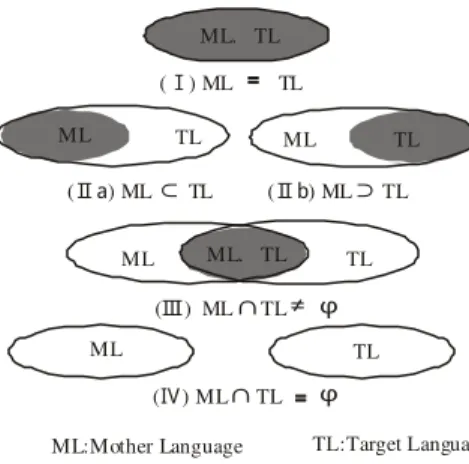
In contrastive linguistics, research has been carried out on the relationship between vocabulary meaning of different languages’ vocabulary. Andou [9] classified the relationship into (1) “Same”, (2) “Overlap”, (3) “Nothing”. In this study, considering the meaning scope of learner ’s ML (Mother Language) and a TL (Target Language) from the foreign language learning’s viewpoint, subdivided (2) “Overlap” into “Inclusion” and
“Overlap-difference”.
(I) Same: both of learner’s ML and TL signify the same or common meaning.
(II) Inclusion: (IIa) the meaning scope of ML is a subset of TL; (IIb) The meaning scope of ML is wider than that of TL.
(III) Overlap-difference: while ML and TL have common meaning, the difference exists.
(IV) Nothing: vocabulary that has common meaning doesn’t exist due to difference in culture.
Fig.1 shows meaning relationship between learner’s ML and TL. Table.1 shows the example of Japanese and another language. For example,“単位” belongs to (III). In Chinese,
“単位” has no meaning of “credit” like Japanese, it means “place of employment” instead. However, a common meaning of “a unit” exists.
2.2 CGM (Communication Gap Model)
The factor of communication gap between learner’s ML and TL are analyzed as follows.
(1) Meaning difference of learner’s ML and TL: Tanaka [5] pointed out that meaning difference is a factor of language transfer. Therefore, when the relationship is (II)
( Ⅰ) ML TL
(Ⅱa) ML ⊂ TL (Ⅱb) ML⊃ TL
(Ⅲ) ML∩TL ≠ φ
(Ⅳ) ML∩TL φ ML TL
ML:Mother Language TL:Target Language ML. TL
=
=
Relation Example (Japanese: another language) (I) 春 :Spring (English)
(Ⅱa) 着 る:Put (English) 兄弟 :Brother (English) (Ⅲ)
(Ⅱb)
単位 :単 位( Chinese)
Table 1. Example of meaning relation between Japanese and another language
Fig.1 Meaning relationship between mother and target l anguages
ML TL ML TL
ML ML. TL TL
(IV ) 鳥居 :Nothing
“Inclusion” or (III) “have common meaning and different meaning between each other”, a communication gap occurs.
(2) The same letters: this research focuses on text-based communication. Therefore, it is possible that language transfer might occur even with the same letters. For example, as shown in table 2. (IV). If letters were different, there would be no gap. But, if the letters are the same, gap will occur. Such as “走”. In Chinese, “走” means “walking” instead of “running” as in Japanese.
(3) Learner’s position in the communication: Two positions exist, one is sender and the other is receiver, however communication gap doses not occur because of their positions.
After consider the three above factors, CGM (Communicative Gap Model) that represents gap model of language difference communication was proposed (see Table 2).
• In (I), because the meaning is same, there will be no gap.
• In (IIa), when the student’s position is receiver, the student will take the TL’s meaning ith a narrower view than the TL, so a gap will occur. When the student’s position is sender, a gap will not occur because the native speaker is able to understand the meaning by the context.
• In (IIb), when the student receives information from a native speaker, native speaker ’s intentions can be got easily When the student is the sender, a gap can occur if the native speaker takes the student’s meaning into a narrower scope than the student intended.
• In (III), depending on a common meaning, a gap can occur at both positions of student and the native speaker.
• In (Ⅳ), if the letters is different, a caused by language transfer will not occur. However, if the letter is the same, a gap can occur between the sender and the receiver.
3. Network based framework of foreign language learning environment
An agent base collaborative learning environment called GRACILE [10] has been proposed to support Japanese language learning among learners in a networked environment, but systems that focus on language distinction have not been challenged yet. In this paper, under a networked environment, we proposed a learning-support framework where a Software Agent, which focuses on language distinction, provides support to learners communicating with native speakers. In this section, present an agent-oriented framework, which focuses on the meaning difference between learner’s ML and TL, to support foreign language learning through network communication.
3.1 Design strategies of learning environment The design strategies of the framework are as follows:
(1) Communicative approach: learners st udy TL through communication with native speakers. And moreover, the achievement of different culture communication is also provided.
(2) Language learning focusing on the language difference: mainly supporting the knowledge where there is a difference between learner’s ML and TL.
(3) Learner-centered environment: knowledge of TL is based on learners’ needs and depends on the contents of the conversation. And agent supports the learning according to the communication contents and the status of knowledge understanding.
Meaning relation
Same letter
(I) (IIa) (IIb) (III) (IV)
Receiver Sender Receiver Sender
× ×
○ ×
× ○
○ ○
× ×
○ ×
○ ○
× ×
× ○
Different letter
○ ○
Table 2 Communication gap model.
3.2 Diagram of the agent’s support
Figure 2. A framework of support language learning focusing on meaning difference
The framework shown in fig 2 uses the above design strategies. The agent works as the following diagram.
Step 1 Observing the communication between learners and native speakers.
Step 2 Analyzing the conversation in real time using the “dictionary " and judging the relationship between ML and TL.
Step 3 Judging whether a communication gaps exist according to the CGM.
Step 4 Constructing “intervening tactics" according to the student model and existence of a conversation gap, thus reducing the influence of intervening.
Step 5 Intervening in the communication by asking whether the student has already understood, then reflecting the responds to student’s model..
Step 6 Deciding the “teaching strategy” based on the response from learners. If a student ’s answer was wrong, the agent would notice the difference of knowledge according to certain teaching strategies.
Step 7 Obtaining knowledge from native speaker and registering those that weren’t registered into a temporary dictionary. After if a Japanese teacher confirmed the knowledge, it would be registered into the dictionary.
3.3 Student model and intervention, teaching strategies
In this study, it is important to learn a foreign language through communication with a native speaker based on the communicative approach. The support principles were decided as follows. The student model, agent intervention, and teaching strategy according these principles were suggested.
(1) The agent doesn’t frequently intervene in the conversation between student and native speaker, so that the communication is not disturbed.
(2) The agent teaches knowledge gradually while interrupting the communication as little as possible.
3.3.1 Student model
Figur 3. Relationship between student model, intervention and teaching strategy.
In this system, we grasp the state of student’s knowledge by questioning. The state of
Languages difference dict ionary
Communication gap model
Interventi on timi ng Teaching strategy Pakal
Native speaker Learner
(1) (2)
(3)
(4) (5)
(6) (7) Internet
Temporary Languages difference dictionary
Student model
Intervention Student model Teaching strategy
Always (ii) Temporary misunderstanding Simple teaching Always (iii) Misunderstanding Detail teaching
Always (i) Initial state
Not always (iv) Temporary understanding Never (v) Understanding
Correct a nswer Wr ong answer With time No teaching No teaching
knowledge is classified into “understanding” and “not-understa nding.” We then divide it further into “temporary understanding” and “temporary not-understanding ” according above principles. The status of knowledge understanding evolves as Fig. 3.
(i) The system has not checked any Kanji words with meaning difference in the dialogue.
(ii) Temporary not-understanding state: Answer to a question was wrong but only once.
(iii) Temporary understanding state: Answer to a question was correct but the meaning was not fully grasped.
(iv) Not-understanding state: Despite the notice at the temporary not-understanding state,
Figure 3. Relationship between student model, intervention and teaching strategies. The answer to the same question was wrong again.
(v) Understanding state: Answer to a question was correct again, the meaning was fully grasped.
3.3.2 Intervention and teaching strategies
If there is any gap, the Agent will intervene into the conversation as following according to the student’s model.
(1) Always: always intervene if student’s knowledge state was “initial”, “temporary not-understanding”, and “not-understanding”.
(2) Not always: agent intervenes when state of “temporary understanding” appears several times
(3) Never: agent does not intervene if the state is “understanding”. 3.3.3 Teaching strategies
In order not to interrupt communication, we fixed teaching strategies into “simple” and
“detail”(See Table 3).
(1) Simple teaching: show ing the relationship between learner’s ML and TL intended for
“temporary not-understanding ”.
(2) Detail teaching: teaching knowledge of meaning, spell, grammar, and usage, etc. about TL intended for “not-understanding”.
4. Neckle
Figure 4. System configuration
A system called Neckle was developed, it is a network-based KanJi learning environment focusing on the difference between Japanese and Chinese. In this environment, learners whose ML is Chinese learn Japanese Kanji through conversations with Japanese native
Simple teaching Detail Teaching
Relation among the ML & T L Meaning of the TL
Relation among the ML & TL Meaning of the TL
Meaning of the ML Relevant Knowledge of TL Tabole 3. Teaching strategy.
Agent interface Monitoring
Intervention timing Teaching strategy Communication
gap model
Student model Pakal
Languages difference dictionary Mapheme analysis dictionary
Communication tool Communication tool
Learner Native speaker
Mapheme analysis
Dictionary management
Server
IPC
speakers. In this section explain the development and user interface of Neckle
4.1 System structure
Fig 4 shows the system structure. Neckle is composed of three part s, i.e. communication tool, Pakal and server. Communication tool uses text-based chat.
4.1.1 Pakal
Pakal always stays in learner’s environment, supporting Kanji learning. It is composed of modules as following.
(1) Monitor: it is used for recording a dialogue between the learner and the native speakers.
(2) Agent interface: it is used for supporting a dialogue teaching knowledge.
(3) Student model: it is used for recording the learners’ status of knowledge understanding, last attending date and attending times (see Table 4)
(4) Intervention strategy mechanism: agent checks the gap existence according to CGM, notices a gap based on the learner model, and then determines intervention timing.
(5) Teaching strategies mechanism: it determines the teaching strategies by referring to the student model.
4.1.2 Server
Server is composed of the following modules.
(1) Morpheme analyzer: a Japanese morpheme analyzer system. It analyzes the morphemes in a conversation and replays the result to Pakal.
(2) Dictionary server: The Kanji knowledge of Chinese and Japanese is recorded in this base. It is used for Pakal to judge any difference and teach this Kanji knowledge.
If the Kanji used in conversation not recorded in the knowledge base, Pakal will record it as temporary knowledge in this base. The knowledge base will also be enlarged.
4.2 Data representation
Figure 5. Data representation
The database of language ’s dictionary is shown in Fig 5. Japanese knowledge including meaning, grammar, and an example are explained by Chinese. Japanese table is linked to Chinese table and Japanese example table by field of “Kanji” and “Japanese”. Refer to [11], [12],and recorded 403 Kanji which are different between Japanese and Chinese.
4.3 User interface
User interface is shown in Fig 6. It is divided into windows of “chat”, “Pakal ”, “question”,
“teaching” and “dictionary”.
A) Chat window: learner can engage in a dialogue with a native speaker through the Chart in real time.
B) Agent window: agent Pakal has an inter face of Personification, which starts with the Chat window. It monitors the dialogue and intervenes when a difference in knowledge is involved in the dialogue. Pakal provides the learner with the message and transmits the intention to the learner using prepared dialogue template
親切 熱情 養 養家 口 養 養狗
親切 親 切(だ ) 熱情 親切 親 切(が ) 好意 養 養 う 養 家口
親切 (だ) 形容詞 親 切な 人です . 熱情 的人 し んせ つ 親切 (が) 名詞 ご親 切あ りが とう謝々 爾的好 意 し んせ つ 養う 動詞 家 族を 養う . 養家 糊口 やし なう
Kanji Mean Kanji Japanese Mean
Japanese Part Example Chinese Read Chinese m eaning Japanese meaning
Japanese example
Kanji State of knowledge Attending da te Atending time s 祖 父 Temporary understanding 1998/11/02/15:27:32 2
単 位 Understanding 1998/12/5/14:09:53 3 Table 4. Example of student model.
Figure 6. User interface
C) Question window: Pakal provides learner with the question checks the answer and informs the leaner about the correctness of it with sound. Then, it enters or amends the student model.
D) Teaching window: to prevent too long communication, the system supports leaning in two ways:
D-1) Simply teaching window: for “temporary misunderstanding”, the system gives with a diagram of the relationship of the Japanese-Chinese Kanji meanings. When the learner clicks a Japanese area, the meaning window will be popped up.
D-2) Detailed teaching window: for “misunderstanding”, the system compares the learner’s Chinese with Japanese meaning to support the understanding of Japanese meaning. If the stude nt requests to know other knowledge, a dictionary window will be showed.
D-3) Dictionary window: in addition to the Kanji meaning, Grammar, spelling and so on are also provided.
4.4 Experimentation
We evaluated the learning environment of Neckle with nine Japanese students and nine Chinese students in which four beginners, three intermediates , and two advances. We arrayed nine groups that consisted of one Japanese student and one foreign student. They talked about three topics that are “my family”, “the circumstances of China”, and “staying in Japan” in Neckle. At least, they had talked 30 minutes about each topic. After three days, they talked about same topics on Neckle. The results of experimentation are:
(1) The entering timing of Pakal is proper.
(2) It is reasonable that our teaching strategies are divided into two parts, the simple one and the detailed one.
(3) The Neckle is more useful for beginners than for advanced learners. (4) The efficiency of learning by Neckle is very highly.
Moreover, we obtained many comments from learners. The following are a few examples of the comments.
• Talking of learning foreign language, grammar or vocabularies come into our mind. However, Neckle changed traditional study manner, It provides a new learning method through conversation with native speaker.
• Neckle supported to learn not only language itself but also Japanese culture and customs (such as Japanese Oshyougatu, Japanese family. etc).
• It very good that Pakal entering when learner dose not know whether Kanji could be understood Chinese meaning.
• It is easy for learner to learn by conversation with native speaker.
Under viewing the results of experimentation, Neckle highly facilitate language learning
5. Conclusions and future work
This paper aimed at the problem of language transfer in foreign language learning, and analyzed the meaning relationship between learner ’s ML and TL. We also proposed a communication gap model caused to meaning difference and suggested a framework of foreign language learning environment – Neckle (a network-based communicative environment focusing on the difference between learner ’s ML and TL meaning) and described agent support. Finally, we described the development of the Neckle by agent Pakal andexperimentation about Neckle.
In the future work, first ly, we will make Pakal to consider more learners’ knowledge state, especially for advanced learners, and let agent take part in conversation between learner and native speaker in a natural way. Secondly, we will collect and add more learning data. Thirdly, we will keep on evaluating for a long time. Firally, we will try to apply Neckle to another language learning. Neckle was developed on the Windows NT using Visual Basic 6.0. Access 97 was used for the Database. Morpheme analyzer of Japanese is Chasen [13], and Microsoft Agent [14] was used as agent interface.
Acknowledgments
This research was supported in part by the Grant-in-aid for scientific research (B) (2) No. 09558017 from the Ministry of Education, Science, Sports and Culture in Japan.
References
[1] Hanson, J., Ribold, M. and Weber, P., “Cross Cultural Awareness,” Proc. ED-Media 98, pp.1900-1901 (1998).
[2] St. Olaf College, “Intercultural E-Mail Classroom Connections,” http://www.stolaf.edu/network/iecc/. [3] Saita, I., arruson, R., Itoman, D., Otubo, K., Mtuzaki, H., Kawazoe, Y.and Iguti, N. “Designing Japanese
Language Learning using Email,” Journal of Japanese Language Teaching Society, pp.49-54 (1996). [4] Okazaki, T., Okazaki, H. Communicative approach in Japanese education , Bonjinsya (1990).
[5] Tanaka, S., Abe, H. “The Language transfer in the foreign language learning -historical background and present-”, English education, No, 1, pp.78-81, Taisyukan (1989).
[6] Bull, S. “Promoting Effective Learning Strategy Use in CALL,” Computer Assisted Language Learning, Vol.10, No.1,pp.3-39(1997)
[7] Bull, S., Pain, H.and Brna, P. “Student Modeling in an Intelligent Computer Assisted Language Learning System: The Issues of Language Transfer and Learning Strategy,” Proc. ICCE 93, pp.121-126 (1993).
[8] Liu, Y., Ogata, H., Ochi, Y., and Yano, Y., “Agent based Computer Supported Language Learning Environment focusing on Languages Distinction,” Proc. ICCPOL 99, 261-264 (1999)
[9] Andou, S. The logic behind English and Japanese, daisyukan, pp.28-37 (1986).
[10] Ayala, G.and Yano, Y. “GRACILE: A Framework for Collaborative Intelligent Learning Environments," Journal of Japanese Society for Artificial Intelligence, Vo1.10, No.6, pp.988-1002 (1995).
[11] Bunkacho. The Kango equivalent for Chinese , research material of Japanese education, pp.85-143 (1978).
[12] Tobita, Y., Ro, Y. Dictionary of Japanese and Chinese meaning, Nanundou (1987). [13] http://cactus.aist-nare.ac.jp/lab/nlt/chasen.html.
[14] http://www.microsoft.com/workshop/imedia/ agent/agentdevdl.asp.