Pensoft Data Publishing Policies
and Guidelines for Biodiversity Data
Lyubomir Penev1,7, Daniel Mietchen2, Vishwas Chavan3, Gregor Hagedorn4, David Remsen3, Vincent Smith5, David Shotton6
1 Institute of Biodiversity and Ecosystem Research, Soia, Bulgaria 2 Science 3.0 3 Global Biodiversity Infor- mation Facility, Copenhagen, Denmark 4 Julius Kühn-Institute, Königin-Luise-Straße 19, 14195 Berlin, Ger- many 5 he Natural History Museum, Cromwell Road, London, UK 6 Image Bioinformatics Research Group, Department of Zoology, University of Oxford, UK 7 Pensoft Publishers, Soia, Bulgaria
Citation: Penev L, Mietchen D, Chavan V, Hagedorn G, Remsen D, Smith V, Shotton D (2011). Pensoft Data Publishing Policies and Guidelines for Biodiversity Data. Pensoft Publishers, http://www.pensoft.net/J_FILES/Pensoft_Data_ Publishing_Policies_and_Guidelines.pdf
First published: 26th of May 2011. Implemented by Pensoft Publishers.
his document is published under Creative Commons Attribution License CC-BY.
Tableof ConTenT
Data Publishing Policies ... 2
Data Publishing in a Nutshell ... 2
What is a Dataset? ... 3
Why Publish Data ... 4
Data Publishing Licenses ... 5
How to Publish Data ... 7
Open Data Repositories ... 8
Publishing Data with GBIF through the Integrated Publishers Tookit (IPT) and Darwin Core Archive (DwC-A) Format ... 8
Depositing Data in the Dryad Data Repository ... 10
Depositing Data on Phylogenies with TreeBASE ... 11
Depositing Genome Data with GenBank and Barcode of Life ... 12
Other Repositories ... 12
How to Cite Data in Pensoft Journal Articles ... 14
Guidelines for Authors ... 17
Data Published within Supplementary Information Files ... 17
Data Published in Association with a Stand-Alone Scholarly Publication (a Data Paper) ... 19
What is a “Data Paper” ... 19
How to Write and Submit a Data Paper ... 20
Data Papers Describing Primary Biodiversity Data ... 21
Structure of Data Papers Describing Primary Biodiversity Data ... 23
Generation of Data Paper manuscripts using the GBIF Integrated Publishing Toolkit (IPT) ... 25
Data Papers Describing Ecological and Environmental Data ... 27
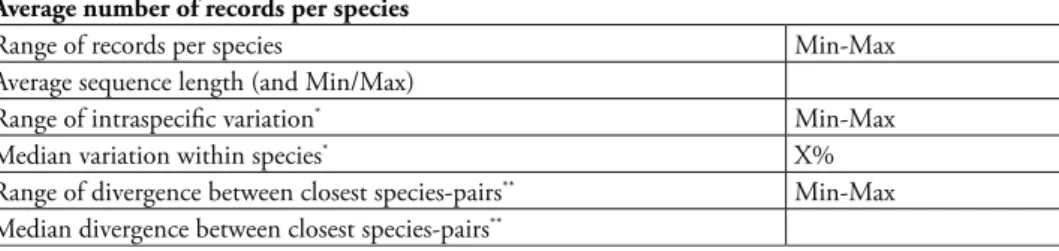
Data Papers Describing Genome Data ... 28
Barcode Data Release Papers ... 28
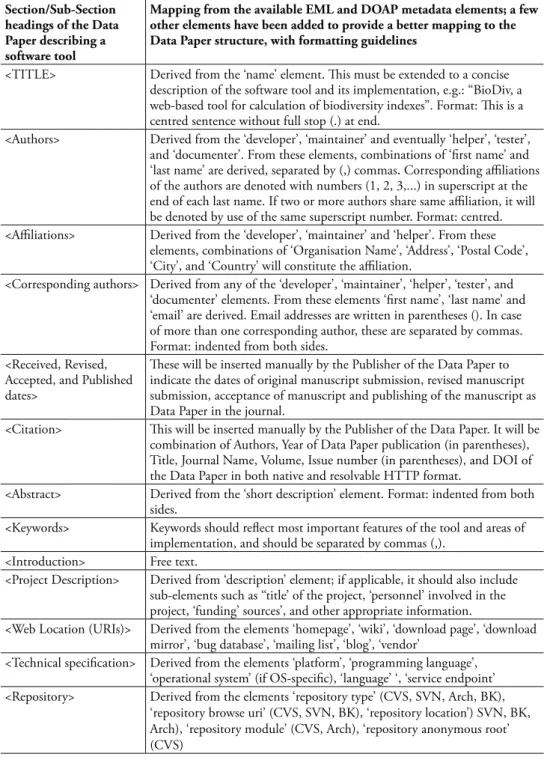
Data Papers Describing Software Tools ... 30
Guidelines for Reviewers of Data Papers ... 32
Quality of the Manuscript ... 33
Quality of the Data ... 33
Consistency between Manuscript and Data ... 33
Acknowledgements ... 34
References ... 34
DaTa Publishing PoliCies
Data Publishing in a Nutshell
he current document describes the data publishing policies of Pensoft Publishers, with an emphasis on biodiversity and biodiversity-related ecological data. Publishing the data associated with research articles is strongly encouraged in all Pensoft’s journals.
Data publishing in this digital age is the act of making data available on the Internet, so that they can be downloaded, analysed, re-used and cited by people and organisations other than the creators of the data. his can be achieved in various ways. In the broadest sense, any upload of a dataset onto a freely accessible website could be regarded as “data publishing”. here are, however, several issues to be considered during the process of data publication, including:
• Data hosting, long-term preservation and archiving
• Documentation and metadata
• Citation and credit to the data authors
• Licenses for publishing and re-use
• Data interoperability standards
• Format of published data
• Software used for creation and retrieval
• Dissemination of published data
his Data Publishing Policies document describes some general concepts, including a deinition for datasets, incentives to publish data, and methods and licenses for data publishing. Further, it deines and compares the two main routes for data publishing, namely as supplementary information iles to research articles, which may be made
available directly by the publisher, or published in a specialized data repository with a link to the research article or a Data Paper, i.e. a speciic, stand-alone publication describing a particular dataset or a collection of datasets.
More detailed instructions on how to prepare data for publication are listed be- low under the Guidelines for Authors. he Guidelines for Reviewers section describes the main criteria for evaluation of data during the peer-review and editorial process. Special attention is given to existing standards, protocols and tools to facilitate data publishing, such as the GBIF Integrated Publishing Toolkit (IPT) and the Darwin Core Archive (DwC-A).
A separate section describes some of the leading data hosting/indexing infrastruc- tures and repositories for biodiversity and ecological data.
What is a Dataset?
A dataset is understood here as a digital collection of logically connected facts (observations, descriptions or measurements), typically structured in tabular form as a set of records, with each record comprising a set of ields, and recorded in one or more computer data iles that together comprise a data package. Certain types of research datasets, e.g. a video recording of animal behaviour, will not be in tabular form, although analyses of such recordings may be. Within the domain of biodiversity, a dataset can be any discrete collection of data underlying a paper – e.g., a list of all species occurrence data published in the paper, data tables from which a graph or map is produced, digital images or videos that are the basis for conclusions, an appendix with morphological measurements, or ecological observations.
More generally, with the development of XML-based publishing technologies, the research and publishing communities are coming to a much wider deinition of data, proposed in the BMC position statement (2010): “the raw, non-copyrightable facts provided in an article or its associated additional iles, which are potentially available for harvesting and re-use”.
As these examples illustrate, while the term „dataset“ is convenient and widely used, its deinition is vague. Data repositories such as Dryad, wishing for precision, do not use the term „dataset“. Instead, they describe data packages to which metadata and unique identiiers are asigned. Each data package comprises one or more related data iles, these being data-containing computer iles in deined formats, to which unique identiiers and metadata are also assigned. Nevertheless, the term “dataset” is used below except where a more speciic distinction is required
For practical reasons, we propose a clear distinction between static data that represent speciic completed compilations of data upon which the analyses and conclusions of a given scientiic paper may be based, and curated data that belong to a large data collection (usually called a ‘database’) with ongoing goals and curation, for example the various bioinformatics databases that curate nucleotide sequences. Both forms are of strong potential scientiic interest and application. Where a static dataset
is inextricably linked to a scientiic paper, the data publisher must assure consistent and secure access to it on the same time-scale as the text content of the digital article. As a consequence, it is not permissible to upload a new version of such data in ways that would replace the original, unless strict versioning is undertaken and the reader of the published article has easy access to the original version of the data resource as well as to updated versions.
Curated data, on the other hand, are usually hosted on external servers or in data hosting centres. A primary goal of the data publishing process in this case is to guarantee that these data are properly described, up to date, available to others under appropriate licensing schemes, peer-reviewed, and where appropriate linked from a research article or a Data Paper at the time of publication. Especially in cases where the long-term viability of the curated project may be insecure (e.g. in the case of grant- funded projects), the publisher may in addition support the publication of a dated and versioned copy of such data (with the option to update these with another version later one, keeping access to all versions).
Why Publish Data
Data publishing becomes increasingly important and already afects the policies of the world’s leading science funding frameworks and organizations (see for example the NSF Data Management Plan Requirements, or Riding the Wave (How Europe Can Gain From the Rising Tide of Scientiic Data) report submitted to the European Commission in October 2010. More generally, the concept of “open data” is described in the Protocol for Implementing Open Access Data, the Open Knowledge/Data Deinition, the Pan- ton Principles for Open Data in Science, and the Open Data Manual.
here are several incentives for authors and institutions to publish data:
• here is a widespread conviction that data produced using public funds should be regarded as a common good, and should be openly published and made available for inspection, interpretation and re-use by third parties.
• Open data increases transparency and the overall quality of science; published datasets can be re-analyzed and veriied by others;
• Published data can be cited and re-used in the future, either alone or in association with other data;
• Open data can be integrated with other datasets across both space and time;
• Data integration increases recognition and opportunities for collaboration;
• Open data increases the potential for interdisciplinary research, and for re-use in new contexts not envisaged by the data creator;
• Duplication of data-collecting eforts and associated costs will be reduced;
• Published data can be indexed and made discoverable, browsable and searchable through internet services (e.g. Web search engines) or more speciic infrastructures (e.g., GBIF for biodiversity data);
• Collection managers can trace usage and citations of digitized data from their collections;
• Data creators, and their institutions and funding agencies, can be credited for their work of data creation and publication through the conventional channels of scholarly citation; priority and authorship is achieved in the same way as with a publication of a research paper;
• Datasets and their metadata, and any related Data Papers, may be inter-linked into Research Objects, to expedite and mutually extend their dissemination, to the beneit of the authors, other scientists in their ields, and society at large;
• Published data may be structured as ‚Linked Data‘, by which term is meant data accessible using RDF, the Resource Description Framework, one of the fundamentals of the semantic web. Since RDF descriptions are based on pub- licly available ontology terms, ideally derived from a limited number of comple- mentary non-overlapping ontologies, this permits automated data integration, since data elements from diferent sources have built-in syntactic and semantic alignment. Additionally, since the underlying ontologies have a logical structure, unlike simple controlled vocabularies, which for example includes subsumption („is_a“) hierarchies (so that tigers and cheetahs are deined as members of the family Felidae, and tigers and elephants are known to be mammals), this has the potential to facilitate reasoning across diverse and distributed datasets.
Data Publishing Licenses
One of the basic postulates of the Panton Principles is that data publishers should deine clearly the license or waiver under which the data are published, so re-use rights are clear to potential users. hey recommend use of the most liberal licenses, or of public domain waivers, to prevent legal and operational barriers for data sharing and integration. For clarity, we list here the short version of the Panton Principles:
1. When publishing data, make an explicit and robust statement of your wishes. 2. Use a recognized waiver or open publication license that is appropriate for
data.
3. If you want your data to be efectively used and added to by others, it should be fully „open“ as deined by the Open Knowledge/Data Deinition – in particular, non-commercial and other restrictive clauses should not be used. 4. Explicit dedication of data underlying published science into the public domain
via PDDL or CC-Zero is strongly recommended and ensures compliance with both the Science Commons Protocol for Implementing Open Access Data and the Open Knowledge/Data Deinition.
A variety of waivers and licenses, that are speciically designed for and appropriate for the treatment of data, are described in Table 1.
Table 1. Data publishing licences recommended by Pensoft.
Data publishing license URL
Open Data Commons Attribution License http://www.opendatacommons.org/licenses/by/1.0/ Creative Commons CC-Zero Waiver http://creativecommons.org/publicdomain/zero/1.0/ Open Data Commons Public Domain
Dedication and Licence
http://www.opendatacommons.org/licenses/pddl/1-0/
he default data publishing license used by Pensoft is the Open Data Commons Attribution License (ODC-By), which is a license agreement intended to allow users to freely share, modify, and use the published data(base), provided that the data creators are attributed (cited or acknowledged). his ensures that those who publish their data receive the academic credit that is their due.
As an alternative, the other licenses, namely the Creative Commons CC0 (also cited as “CC-Zero” or “CC-zero”) and the Open Data Commons Public Domain Dedication and Licence (PDDL), are also STRONGLY encouraged for use in Pensoft journals. According to the CC0 license, “the person who associated a work with this deed has dedicated the work to the public domain by waiving all of his or her rights to the work worldwide under copyright law, including all related and neighboring rights, to the extent allowed by law. You can copy, modify, distribute and perform the work, even for commercial purposes, all without asking permission.”
Publication of data under a non-attribution waiver such as CC0 avoids potential problems of „attribution stacking“ when data from several sources are aggregated for re-use, particularly if this re-use is undertaken automatically. In such cases, while there is no legal requirement to provide attribution to the data creators, the norms of academic citation best practice for fair use still apply, and those who re-use the data should reference the data source, as they would reference others‘ research articles.
he Attribution-ShareAlike Open Data Commons Open Open Database License (OdbL) is NOT recommended for use in Pensoft’s journals, although it may be used as an exception in particular cases.
Many widely recognized open access licenses are intended for text-based publications on which copyright pertains, and are not intended for, and are not appropriate for, data or collections of data which do not carry copyright. Creative Commons licenses apart from CC-Zero (e.g., CC-BY, CC-BY-NC, CC-BY-NC-SA, CC-BY-SA, etc.) as well as GFDL, GPL, BSD and similar licenses widely used for open source software, are NOT appropriate for data, and their use for data associated with Pensoft journal articles is strongly discouraged.
Authors should explicitly inform the publisher if they want to publish data associ- ated with a Pensoft journal article under a license that is diferent from the Open Data Commons Attribution License (ODC-By).
Any set of data published by Pensoft, or associated with a journal article published by Pensoft, must always clearly state its licensing terms in both a human-readable and a machine-readable manner.
Where data are published by a public data repository under a particular license, and subsequently associated with a Pensoft research article or Data Paper, Pensoft journals will accept that repository license as the default for the published datasets.
Images, videos and similar ‘artistic works’ are automatically covered by copyright, unless speciically placed in the public domain by use of a public domain waiver such as CC0. Where copyright is retained by the creator, such multimedia entities can still be published under an open data attribution license, while their metadata can be published under a CC0 waiver.
Databases can contain a wide variety of types of content (images, audiovisual material, and sounds, for example, as well as tabular data, which might all be in the same database), and each may have a diferent license, which must be separately speciied in the content metadata. Databases may also automatically acrue their own rights, such as the European Union Database Right, although no equivalent database right exists in the USA. In addition, the contents of a database, or the database itself, can be covered by other rights not addressed here (such as private contracts, trademark over the name, or privacy rights / data protection rights over information in the contents). hus authors are advised to be aware of potential problems for data reuse from databases, and to clear other rights before engaging in activities not covered by the respective license.
How to Publish Data
At Pensoft, data can be published either (a) as supplementary iles related to a research paper or (b) in association with a stand-alone description of the data resource (a Data Paper). Within these two main routes, Pensoft supports the following methods for data publishing:
• Supplementary data iles (max. 20 MB each) related to and published with a research article, and stored on the publisher’s website. Guidelines on the for- mat are available here.
• Primary biodiversity data (species-by-occurrence records) published through the GBIF Integrated Publishing Toolkit (IPT). A format that is strongly encour- aged for the publication of biodiversity and species occurrence data, checklists and their associated metadata is the Darwin Core Archive (DwC-A) format.
• Datasets other than primary biodiversity data (e.g., ecological observations, environmental data, genome data and other data types) preserved in certiied institutional or international data repositories and linked permanently to a research article or a Data Paper.
Best practice recommendations:
• Deposition of data in an established international repository is always to be preferred to supplementary iles published on a journal‘s website.
• Occurrence-by-species records should be deposited through GBIF IPT.
• Genomic data should be deposited at GenBank, either directly or via an ailiated repository, e.g. Barcode of Life Data Systems (BOLD).
• Phylogenetic data should be deposited at TreeBASE, either directly or through the Dryad Data Repository.
• All other biological data, including heterogeneous datasets, should be deposited in the Dryad Data Repository.
• Repositories not mentioned above, including institutional repositories, may be used at the discretion of the author.
• Digital Object Identiiers (DOIs) or other persistent links (URLs) to the data deposited in repositories, as well as the name of the repository, should always be published in the paper describing that data resource.
Open Data Repositories
Open data repositories (public databases, data warehouses, data hosting centres) are subject- or institution-oriented infrastructures, usually based at large national or international institutions. hese provide data storage and preservation according to widely accepted standards, and provide free access to their data holdings for anyone to use and re-use under the minimum requirement of attribution, or under an open data waiver such as the CC-Zero waiver.
here are several directories of data repositories relevant to biodiversity and ecological data, such as those listed in the Open Access Directory (http://oad.simmons. edu/oadwiki/Data_repositories#Biology) and in Table 1 of Tessen and Patterson’s (2011) Data Issues in Life Sciences White Paper (932 kB PDF document).
Such repositories could be used to host data associated with a published Data Pa- per, as explained below. For their own data, authors are advised to use an internation- ally recognised, trusted (normally ISO-certiied), specialized repository (see Krump 2011). he following repositories and databases fall into that category.
Publishing Data with GBIF through the Integrated Publishers Tookit (IPT) and Darwin Core Archive (DwC-A) format
he Global Biodiversity Information Facility (GBIF) was established in 2001, and is now the world’s largest multilateral initiative for enabling free and open access to biodiversity data via the Internet. It comprises a network of 55 countries and 47 international organisations that contribute to its vision of ‘a world in which biodiversity information is freely and universally available for science, society, and a sustainable future’. GBIFs’ mission is ‘to be the foremost global resource for biodiversity information, and engender smart solutions for environmental and
human well-being. he GBIF network facilitates access to over 276 million primary biodiversity data records contributed by 316 data publishers across the globe (as on May 2011).
GBIF is not a repository in the strict sense, but a distributed network of data publishers and local data hosting centers which discover and publish data employing tools based on community-agreed standards for exchange/sharing of primary biodiversity data. At global scale, discovery and access to data is facilitated through the GBIF data portal (http://data.gbif.org/). Pensoft facilitates discovery and publishing of data and metadata to the GBIF network through Pensoft’s IPT Data Hosting Center (http://ipt.pensoft.net/ipt/), that is based on the GBIF Integrated Publishing Toolkit (IPT) (http://code.google.com/p/gbif-providertoolkit/). A list of IPT installations used by other data publishers can be accessed at: http://tools.gbif.org/data-paper-authoring/.
he Darwin Core Archive (DwC-A) is an international biodiversity informatics data standard and the preferred format for publishing data through the (GBIF) net- work. Each Darwin Core Archive consists of at least three iles:
1. One or more data iles keeping all records of the particular dataset in a tabular format such as a comma-separated or tab-separated list;
2. he archive descriptor (meta.xml) ile describing the individual data ile columns used, as well as their mapping to DwC terms; and
3. A metadata ile describing the entire dataset which GBIF recommends to be based on EML (Ecological Metadata Language 2.1.1).
he format is deined in the Darwin Core Text Guidelines. Darwin Core is no longer restricted to occurrence data, and together with the more generic Dublin Core metadata standard (on which its ideas are based), it is used by GBIF and others to encode metadata about organism names, taxonomies and species information.
GBIF has produced a series of documents and supporting tools that focus primarily on Darwin Core publishing. hey are divided into three proiles, each of which repre- sents a series of documents based on the diferent content types on which GBIF focuses:
• Primary biodiversity data: http://www.gbif.org/informatics/primary-data/pub- lishing/
• Checklists: http://www.gbif.org/informatics/name-services/publishing/
• Resource metadata: http://www.gbif.org/informatics/discoverymetadata/pub- lishing/
In addition to the GBIF Integrated Publishing Toolkit, there are two additional tools developed for producing Darwin Core Archives:
1. A suite of MS Excel Templates (http://tools.gbif.org/spreadsheet-processor/), which are coupled with a web service that processes completed iles and re- turns a validated Darwin Core Archive. Templates exist for primary biodi-
versity data, simple checklists, and EML metadata. See http://tools.gbif.org/ spreadsheet-processor/ for further details.
2. Darwin Core Archive Assistant (http://tools.gbif.org/dwca-assistant/) is a tool that composes an XML metaile, the only XML component of a Darwin Core Archive. It displays a drop-down list of Darwin Core and extension terms, accessed dynamically from the GBIF registry, and displays these to the user who describes the data iles. his allows Darwin Core Archives to be created for sharing without the need to install any software. See http://tools.gbif.org/ dwca-assistant/ for details.
he Darwin Core Archive (DwC-A) iles can be used to publish data underlying any taxonomic revision or checklist through IPT or as supplementary iles (see a sam- ple paper by Talamas et al. (2011). It also can be used to publish species occurrence data. he publication of large datasets in the form of Data Papers is also supported.
Darwin Core Archive iles can also be generated from data uploaded on IPT and then published as a zipped supplementary ile, associated with a research article.
Depositing Data in the Dryad Data Repository
Pensoft encourages authors to deposit data underlying biological research articles in the Dryad data repository which is being used for this purpose by many other journals and societies, in cases where no suitable more specialized public data repository (e.g. GBIF for species-by-occurrence data and taxon checklists, or GenBank for genome data) exists.
Data can be deposited with Dryad either before or at the time of submission of the manuscript to the journal, or after the manuscript acceptance but before submission of the inally revised, ready-for-layout version for publication. One or more individual data iles are aggregated into a data package for submission.
Once you deposit your data package, it receives a unique and stable identiier, namely a DataCite DOI. Individual data iles within this package are given their own DOIs, based on the package DOI, as do subsequent versions of these data iles, as explained at https://www.nescent.org/wg_dryad/DOI_Usage. You should include appropriate Dryad DOIs in the inal text of the manuscript, both in the in-text citation statement and in the formal data reference in your paper‘s reference list, as explained and exempliied above. his is very important, since if the data DOI does not appear in the inal published article, that greatly weakens its connection to the underlying data.
More information about depositing data in Dryad can be found at http://www. datadryad.org/repo/depositing, and in a 2-minute video on SciVee (http://www.scivee. tv/node/26563; doi: 10.4016/26563.01).
Advantages of depositing data in Dryad include:
• Visibility: Making your data available online (and linking it to the publication) provides a independent way for others to discover your work.
• Citability: all data you deposit will receive a persistent, resolvable identiier that can be used in a citation, as well as listed on your CV.
• Workload reduction: if you receive individual requests for data, you can simply direct them to the iles in Dryad.
• Preservation: your data iles will be permanently and safely archived in perpetuity.
• Impact: other researchers have more opportunities to use and cite your work. Pensoft supports Dryad and its goal of enabling authors to publicly archive suicient data to support the indings described in their journal article. Dryad is a safe, sustainable location for data storage and there are no restrictions on data format. Note that data deposited to Dryad is made available for reuse using the Creative Commons CC0 waiver, detailed above.
You may wish to take a look at some example data packages in Dryad to see how data packages related to published articles are displayed, such as doi:10.5061/dry- ad/13.10, doi:10.5061/dryad.7994 and doi:10.5061/dryad.8682.
If some of the data iles in a data package are more suitable for other more specialized repositories, for example TreeBase for phylogenetic trees (see below), they can be submitted to Dryad, which will then forward them to TreeBase for hosting, while retaining within Dryad a copy of the metadata and a link to the original data ile.
Data deposited to Dryad in association with Pensoft journal articles will be made public immediately on publication of the article, but can be made available to publica- tion editors and reviewers in advance of publication using a special access code.
Depositing Data on Phylogenies with TreeBASE
TreeBASE is a repository of phylogenetic information, speciically user-submitted phylogenetic trees and the data used to generate them. TreeBASE accepts all types of phylogenetic data (e.g., trees of species, trees of populations, trees of genes) representing all biotic taxa. Data in TreeBASE are exposed to the public if they are used in a publication that is in press or published in a peer-reviewed scientiic journal, book, conference proceedings, or thesis. Data used in publications that are in preparation or in review can be submitted to TreeBASE but are embargoed until after publication, and only available before publication to the publication editors or reviewers using a special access code.
Depositing Genome Data with GenBank and Barcode of Life
he NCBI GenBank is the National Institutes of Health (NIH) genetic sequence data- base, an annotated collection of all publicly available DNA sequences. GenBank is part of the Internatioinal Nucleotide Sequence Database Collaboration, which comprises the DNA DataBank of Japan (DDBJ), the European Bioinformatics Institute (EBI) which is part of the European Molecular Biology Laboratory (EMBL), and GenBank at NCBI. hese three organizations exchange data on a daily basis. An example of a GenBank record for a Saccharomyces cerevisiae gene may be viewed here. here are sev- eral options for submitting data to GenBank.
he Barcode Submission Tool is a web-based tool for the submission of GenBank sequences for Barcode of Life projects; currently, only mitochondrial cytochrome coxi- dase subunit I (COI) genes are being accepted with this tool.
he Consortium for the Barcode of Life (CBOL) urges participants in major DNA barcoding initiatives to consider submitting “BARCODE data release papers” for possible publication in academic journals. A BARCODE data release paper is a short manuscript that announces and documents the public deposit to a member of the International Nucleotide Sequence Data Collaboration (INSDC, which includes Gen- Bank, EMBL, and DDBJ) of a signiicant body of data records that meet the BAR- CODE data standards.
Other Repositories
• PANGAEA. he information system PANGAEA is operated as an Open Ac- cess library aimed at archiving, publishing and distributing georeferenced data from earth system research. he description of each dataset is always visible and includes the name of the principle investigator (PI), who may be contacted to request data access. Each dataset can be identiied and cited by using a DOI. Data are archived as supplements to publications or as citable data collections. Citations are available through the portal of the German National Library of Science and Technology (GetInfo). Archiving follows the Recommendations of the Commission on Professional Self Regulation in Science (200 kB PDF doc- ument) for safeguarding good scientiic practice. he policy of data manage- ment and archiving follows the Principles and Responsibilities of ICSU World Data Centers and the OECD Principles and Guidelines for Access to Research Data from Public Funding. PANGAEA is open to any project or individual scientist to archive and publish data. Data submission can be started here.
• he Knowledge Network for Biocomplexity (KNB) is a national network in- tended to facilitate ecological and environmental research on biocomplexity. For scientists, the KNB is an eicient way to discover, access, interpret, inte- grate and analyze complex ecological data from a highly-distributed set of ield stations, laboratories, research sites, and individual researchers.
• he National Biological Information Infrastructure is a broad, collaborative program to provide increased access to data and information on United States biological resources. he NBII links diverse, high-quality biological databases, information products, and analytical tools maintained by NBII partners and other contributors in government agencies, academic institutions, non-gov- ernment organizations, and private industry.
• DataBasin is a free system that connects you with spatial datasets, non-tech- nical tools, and a network of scientists and practitioners. One can explore and download a vast library of datasets, connect to external data sources, upload and publish your own datasets, connect to experts, create working groups, and produce customized maps that can be easily shared.
• DataONE is currently an NSF-funded project that aims at providing the dis- tributed framework, sound management, and robust technologies that enable long-term preservation of diverse multi-scale, multi-discipline, and multi-na- tional observational data. DataONE initially emphasizes observational data collected by biological (genome to ecosystem) and environmental (atmospher- ic, ecological, hydrological, and oceanographic) scientists, research networks, and environmental observatories.
• he PaleoBiology Database is a public resource for the global scientiic com- munity whose purpose is to provide global, collection-based occurrence and taxonomic data for marine and terrestrial animals and plants of any geologi- cal age, as well as web-based software for statistical analysis of the data. he project‘s wider, long-term goal is to encourage collaborative eforts to answer large-scale paleobiological questions by developing a useful database infra- structure and bringing together large data sets. here is an option to protect data for private use only.
• he Research Collaboratory for Structural Bioinformatics (RCSB)‘s Protein Data Bank (PDB) contains information about experimentally-determined structures of proteins, nucleic acids, and complex assemblies. As a member of the Worldwide Protein Data Bank (wwPDB), the RCSB PDB curates and annotates PDB data according to agreed standards. See its data deposition policies and services.
• he Universal Protein Resource (UniProt) is a comprehensive resource for pro- tein sequence and annotation data. he UniProt databases are the UniProt Knowledgebase (UniProtKB), the UniProt Reference Clusters (UniRef ), and the UniProt Archive (UniParc). he UniProt Metagenomic and Environmen- tal Sequences (UniMES) database is a repository speciically developed for metagenomic and environmental data.
• INSPIRE. Although currently at a prototype stage, the INSPIRE Geoportal is an important spatial data infrastructure that will enable the sharing of en- vironmental spatial information among public sector organisations and better facilitate public access to spatial information across Europe. INSPIRE is not yet open for hosting of data.
howTo CiTe DaTain PensofT Journal arTiCles
his section of the Pensoft Data Publishing Policies and Guidelines is based on a draft set of Data Citation Best Practice Guidelines currently being developed for publication by David Shotton, with assistance from colleagues at Dryad and elsewhere (http://bit. ly/lE2E21), and on earlier papers concerning data citation mechanisms in biodiversity science published in ZooKeys (Penev et al. 2009a, 2009b).
he well-established norm for citing genetic data is that one simply cited the Genbank identiier (accession number) in the text. Similar usage is also common- place for items in other bioinformatics databases. Pensoft is not recommending a change in that practice. he following guidelines apply to more heterogeneous re- search data published in other institutional or subject-speciic data repositories, fre- quently described in related journal articles or Data Papers (see below). hey are intended to permit data citations to be treated as ‚irst class‘ citation objects, on a par with bibliographic citations, and to enable them to be more easily harvested from reference lists, so that those who have made the efort to publish their research data might more easily be ascribed academic credit for their work through the normal mechanisms of citation recognition.
For such data in data repositories, each published data package and each pub- lished data ile should always be associated with a persistent unique identiier. A Digital Object Identiier (DOI) issued by DataCite should be used wherever possible. If this is not possible, the identiier should be one issued by the data repository or database, and should be in the form of a persistent and resolvable URL. As an example, the use of DOIs in the Dryad Data Repository is explained at https://www.nescent.org/ wg_dryad/DOI_Usage.
Data citations may relate either to the author‘s own data, or to data created and published by others (“third-party data”). In the former case, the dataset may have been previously published, or may be published for the irst time in association with the article that is now citing it. All these types of data should, for consistency, be cited in the same manner.
Generic recommendations
As is the norm when citing another research article, any citation of a data publication, including a citation of one’s own data, should always have two components:
• An in-text citation statement containing an in-text reference pointer that directs the reader to a formal data reference in the paper’s reference list.
• A formal data reference within the article‘s reference list.
We recommend that the in-text citation statement also contains a separate citation of the research article in which the data were irstly described, if such an article exists, with its own in-text reference pointer to a formal article reference in the paper’s refer- ence list, unless the paper being authored is the one providing that irst description of
the data. If the in-text citation statement includes the DOI for the data (a desirable practice), this DOI should always be presented as a dereferenceable URI, as shown below.
he data reference in the article‘s reference list should contain the minimal compo- nents recommended in the DataCite Metadata Kernel v2.0 speciication. In DataCite terms: Creator PublicationYear Title Publisher Identiier; alternatively (but meaning the same thing): Author PublicationYear Title DataRepositoryName DOI. hese com- ponents should be presented in whatever format and punctuation style the journal speciies for its references.
he following example demonstrates in general terms what is required. In-text citation:
“his paper uses data from the [name] data repository at http://dx.doi.org/***** (Jones et al. 2008a), irst described in Jones et al. 2008b. “
Data reference and article reference in reference list:
“Jones A, Bloggs B, Smith C (2008a). Title of data package. Repository name. doi:*****.
Jones A, Saul D, Smith C (2008b). Title of journal article. Journal Volume: Pages. doi:#####.”
Note that the authorship and the title of the data package may, for valid academic reasons, difer from those of the author‘s paper describing the data – indeed, to avoid confusion of what is being referenced, it is highly desirable that the titles of the data package and of the associated journal article are clearly diferent.
Pensoft journals require the following formats for data citation:
1. When referring to the author’s own newly published data, cited from within the paper in which these data are irst described, the citation statement and the data reference should take the following form.
• he citation statement of data deposition should be included in the body of the paper, in a separare section named Data Resources, situated after the Material and Methods section.
• In addition, the formal data reference should be included in the paper’s reference list, using the recommended journal’s reference format
he following dummy example demonstrates what is required. In-text citation:
“he data underpinning the analysis reported in this paper were deposited on [date] in the Dryad Data Repository at http://dx.doi.org/10.5061/dryad.#### (Miller et al. 2009) and at GBIF, the Global Biodiversity Information Facility, http://ipt.pen- soft.net/ipt/resource.do?r=xxxxxx.
Data reference in reference list:
“Miller JA, Griswold CE, Yin CM (2009) Locality data for all specimens of the spider families heridiosomatidae, Mysmenidae, Anapidae and Symphytognathidae collected during an inventory of the Gaoligongshan, Yunnan, China, 1998-2007. Data ile 1: Microsoft Excel (1997-2003); Data ile 2: KML (Keyhole Markup Language) version 2.1 for GoogleEarth. Dryad Data Repository. doi:10.5061/dryad.####; and GBIF, the Global Biodiversity Information Facility, http://ipt.pensoft.net/ipt/resource.do?r=xxxxxx.
Note: If at the time of authoring the article, the DOI for the data package is not known, the author should enter a dummy place-holder for the missing value (as shown), to be replaced with the real value later in the article production process.
2. When acknowledging re-use in the paper of previously published data (including the author‘s own data) that is associated with another published peer-reviewed journal article, the citation and reference should take the same form, except that the full correct DOI should be employed, and that the jour- nal article irst describing the data should also be cited.
• A statement of usage of the previously published data, with citation of the data source(s) and of the related journal article(s), should be placed in a separate section named Data Resources, situated after the Material and Methods section.
• In addition, the formal data reference and a formal reference to the related journal article should be included in the paper’s reference list, using the recommended journal’s reference format.
he following real example demonstrates what is required. In-text citation:
“he data underpinning this analysis were obtained from the Dryad Data Repository at http://dx.doi.org/10.5061/dryad.829 (Miller 2003a), and were irst de- scribed by Miller (2003b).”
Data reference and article reference in reference list:
“Miller JA (2003a) Data from: Assessing progress in systematics with continuous jackknife function analysis. Dryad Data Repository. doi:10.5061/dryad.829.
Miller JA (2003b) Assessing Progress in Systematics with Continuous Jackknife Function Analysis. Systematic Biology, 52 (1), 55-65. doi:10.1080/10635150390132731 3. When acknowledging re-use of previously published data (including the author‘s own data) that has NO association with a published research article, the same general format should be adopted, although a reference to a related journal article clearly cannot be included.
• A statement of usage of previously published data, with citation of the data source(s), should be placed in a separate section named Data Resources, situated after the Material and Methods section.
• In addition, the formal data reference should be included in the paper’s ref- erence list, using the recommended journal’s reference format.
he following real example demonstrates what is required. In-text citation:
“he global seismic monitor data underpinning this analysis were obtained from the GeoForschungsZentrum Potsdam (GFZ). http://dx.doi.org/10.1594/GFG. GEOFON.gfz2009kciu. (Geofon operator 2009).”
Data reference in reference list:
“Geofon operator (2009): GEFON event gfz2009kciu (NW Balkan Region). Geo- ForschungsZentrum Potsdam (GFZ). doi:10.1594/GFG.GEOFON.gfz2009kciu.“
guiDelinesfor auThors
Data Published within Supplementary Information Files
Online publishing allows an author to provide data sets, tables, video iles, or other information as supplementary information iles associated with papers, or to deposit such iles in one of the repositories described above, greatly increasing the impact of the submission. For larger biodiversity datasets, authors should consider the alternative of submitting a separate Data Paper (see description below).
Submission of data to a recognised data repository is encouraged as a superior and more sustainable method of data publication than submission as a supplementary information ile with an article. Nevertheless, Pensoft will accept supplementary information iles if authors wish to submit them with their articles. Details for uploading such iles is given in Step 4 of the Pensoft submission process (available through the “Submit a Manuscript” button after registration on any of the Pensoft journal websites).
By default, the maximum ile size for each supplementary information ile that can be uploaded onto the Pensoft web site is 20 MB. If you need more than that, or wish to submit a ile type not listed below, please contact us before uploading.
he supplementary information iles will not be displayed in the printed version of the article, but will exist as linkable downloadable iles in the online version.
When submitting a supplementary information ile, the following information should be completed:
• File format (including name and a URL of an appropriate viewer if the format is unusual)
• Title of the supplementary information ile. (he authorship will be assumed to be the same as for the paper itself.)
• Description of the data, software listings, protocols or other information contained within the supplementary information ile.
All supplementary information iles should be referenced explicitly by ile name within the body of the article, e.g. “See Supplementary File 1: Movie 1 recording the original data used to perform this analysis”.
Ideally, the supplementary information ile formats should not be platform- speciic, and should be viewable using free or widely available tools. Suitable ile formats are:
For supplementary documentation:
• PDF (Adobe Acrobat; ISO 32000-1)
• HTML (Hypertext Markup Language)
• XML (Extensible Markup Language) For animations:
• SWF (Shockwave Flash)
• DHTML (Dynamic HTML) For images:
• GIF (Graphics Interchange Format)
• JPEG/JFIF (JPEG File Interchange Format)
• PNG (Portable Network Graphics)
• SVG (Scalable Vector Graphics)
• TIFF (Tagged Image File Format) For movies:
• MOV (QuickTime)
• MPG (MPEG)
• OGG (an open and free multimedia container format) For datasets:
• XLS (Excel spreadsheet)
• CSV (Comma separated values)
• ODS (OpenOice spreadsheets)
he ile names should use the standard ile extensions (as in “Supplementary-Fig- ure-1.png”). Please also make sure that each supplementary information ile is of a single table, igure, image or movie.
Data Published in Association with a Stand-Alone Scholarly Publication (a Data Paper)
What is a “Data Paper”
A Data Paper is a scholarly journal publication whose primary purpose is to describe a dataset or a group of datasets, rather than to report a research investigation (Chavan and Ingwersen 2009, Chavan and Penev, 2011). As such, it contains facts about data, not hypotheses and arguments in support of those hypotheses based upon data, as found in a conventional research article. Its purposes are three-fold:
• to provide a citable journal publication that brings scholarly credit to data publishers;
• to describe the data in a structured human-readable form, and
• to bring the existence of the data to the attention of the scholarly community. he description should include several important elements (usually called metada- ta, or “description of data”) that document, for example, how the dataset was collected, which taxa it covers, the spatial and temporal ranges and regional coverage of the data re- cords, provenance information concerning who collected and who owns the data, details of which software was used to create the data, or could be used to view the data, and so on.
Most Pensoft journals have data sections in which Data Papers are published. By 2012, Pensoft will also open a new Biodiversity Data Journal based on an innovative edi- torial and peer-review platform. Pensoft thus welcomes the submission of Data Papers, that can be indexed and cited like any other research article, thus bringing registration of priority, a permanent publication record, recognition and academic credit to the data creators. In other words, the Data Paper is a mechanism to acknowledge eforts in authoring ‘it-for-use’ and enriched metadata describing a data resource. he general objective of Data Papers in biodiversity science is to describe all types of biodiversity data resources, including environmental data resources.
An important feature of Data Papers is that they should always be linked to the published datasets they describe, and that link (a URL, ideally resolving a DOI) should be published within the paper itself. Conversely, the metadata describing the dataset held within data archives should include the bibliographic details of the Data Paper once that is published, including a resolvable DOI.
How to Write and Submit a Data Paper
In principle, any valuable dataset hosted in a trusted data repository could be described in a Data Paper, and published following these Guidelines. Each Data Paper consists of a set of elements (sections), some of which are mandatory and some not. An example
for such a list of elements needed to describe primary biodiversity data is available in the section Data Papers Describing Primary Biodiversity Data below.
A sample Data Paper which can be used as illustration of the concept can be down- loaded here.
All claims in a Data Paper should be substantiated by the associated data. If the methodology is standard, please explain in what respects your data are unique and merit a publication in the form of Data Paper.
(Alternatively, if the methodology used to acquire the data difers signiicantly from established approaches, please consider submitting your data as supplementary ile(s) associated with a standard paper (see above) in which these methodologies can be more fully explained.)
At the time of submission of the Data Paper manuscript, the data described should be freely available online in a public repository under a suitable data license, so that they can be retrieved anonymously for reuse, resampling and redistribution by anyone for any purpose, subject to one condition at most - that of proper attribution using scholarly norms (see the Data Publishing Licenses and How to Cite Data sections, above). he repository, or at least one public mirror thereof, should not be under the control of the submitting authors. he relevant data package DOIs or accession num- bers, as well as any special instructions for acquiring and re-publishing the data, should be included in the submitted Data Paper manuscript.
he procedures for data retrieval should be described, along with the mechanisms for updating and correcting information. his can be achieved by referencing an exist- ing description if that is up to date, citable in its exact version, and publicly accessible on the web.
All methodological details necessary to replicate the original acquisition of the raw data have to be included in the Data Paper, along with a description of all data processing steps undertaken to transform the raw data into the form in which the data have been deposited in the repository and presented in the paper. Authors should discuss any relevant sources of error and how these have been addressed.
In addition to Data Papers describing new data resources, Data Papers describing existing resources are welcome, as long as these are up to date and their current version is publicly accessible and can be cited. If possible, authors should outline possible re-use cases, taking into account that future uses of the data might involve researchers from diferent backgrounds, or be undertaken automatically. We encourage the provision of tools to facilitate visualization and reuse of the data.
For primary biodiversity (species-by-occurrence) data, authors are strongly encouraged to use the data publishing worklow of the Integrated Publishing Toolkit (IPT) developed by the GBIF, described above. From IPT, data manuscripts can be generated in RTF format directly from the metadata through the “Manage Resources” menu, provided that the respective dataset has already been indexed and properly described by metadata in IPT. he process of data indexing through IPT is described in the IPT Manual. he editorial worklow for Data Papers generated through IPT is described in the next section, Data Papers Describing Primary Biodiversity Data.
For datasets that are not indexed through the IPT - e.g., genome, ecological or biodiversity-related environmental data - the authors should submit a manuscript writ- ten in any text editor, e.g., MS Word or Open Oice. he structures of such Data Papers are described below.
Data Papers Describing Primary Biodiversity Data
Primary biodiversity data are the digital text or multimedia data records that detail the instance of an organism – the ‘what, where, when, how and by whom’ of the organism’s occurrence and recording (see http://www.gbif.org/informatics/primary-data/).
Currently, the majority of primary biodiversity data consists of species-by-occur- rence data records available from published sources and/or natural history collections. Other types of primary biodiversity data that merit publication are observational data and multimedia resources in biodiversity.
Authoring Metadata through the Integrated Publishing Toolkit (IPT)
he GBIF Integrated Publishing Toolkit (IPT) facilitate authoring of metadata. For this purpose, the GBIF Metadata Proile (GMP) was developed to standardise how biodiversity data resources are indexed and described through the GBIF network. he deinitions of the metadata elements are taken from:
(a) ISO 19139: ISO 19139: North American Proile of ISO19115:2003 – Geo- graphic information – Metadata,
(b) EML: Ecological Metadata Language (EML) Speciication, and
(c) NCD: Natural Collections Descriptions (NCD): A data standard for exchang- ing data describing natural history collections.
he GMP elements, together with their descriptions, are listed in the Structure of Data Papers Describing Primary Biodiversity Data section, below.
he GBIF Integrated Publishing Toolkit (IPT) makes it easy to share three types of biodiversity-related information: primary taxon occurrence data (also known as pri- mary biodiversity data), taxon checklists, and general metadata about data sources. An IPT instance, as well as the data and metadata registered through the IPT, is con- nected to the Global Biodiversity Resource Discovery System (GBRDS - also known as the GBIF Registry), indexed for consultation via the GBIF network and portal, and made accessible for public use. More information about the GBIF IPT can be found at http://www.gbif.org/informatics/infrastructure/publishing/.
he IPT is a server-side software tool that allows users to author metadata, map data- bases or upload text iles that conform to the Darwin Core standard, to install extensions and vocabularies to allow for richer content and, ultimately, to register datasets for publi- cation and sharing through GBIF. IPT operators undertake the responsibility of running an Internet server which should be maintained, namely that is it should remain online
and be addressable. Any set of metadata can be downloaded from any IPT (version 2.0.2+) into RTF format in the form of a Data Paper manuscript, and can then be sub- mitted for publication through the normal journal submission and peer review process.
herefore data authors have the following options:
• Install and run an IPT instance, registering it with GBIF.
• Use an account on the Pensoft IPT Data Hosting Centre at http://ipt.pensoft. net/ipt/; please ask the Journal’s Editorial Oice to open an account for you.
• Approach any other existing IPT operator and seek to host data through them. A list of existing IPT installations supporting the authoring of Data Papers is available at http://tools.gbif.org/data-paper-authoring/, and the IPT user manual is available at: http://code.google.com/p/gbif-providertoolkit/wiki/IPT2ManualNotes.
Once you have decided to publish your data and generate a Data Paper manuscript through the GBIF IPT, please consider the following simple rules:
1. he metadata within one IPT resource must describe only one core set of biodiversity data (e.g., either occurrence data or a taxon checklist), that is uploaded through the IPT, indexed in the GBIF Data Portal, and published in Darwin Core Archive Format. he IPT will generate for you an RTF manuscript that will describe the core dataset. he link to the core dataset will appear in your manuscript under the heading “Data published through GBIF”. 2. Additional datasets that relate to the core one, e.g., ecological or environmental
data, can also be briely described within the same resource and linked through the “External links” ield of the IPT. hose datasets will appear in the section
“External datasets” of your manuscript.
3. It is possible to open a resource and enter the respective metadata for it without upload of a core dataset. his option should be used to describe a dataset that has been already uploaded on a repository (e.g., data previously indexed through GBIF for which you have a GBIF link). In this case, you will need to insert the link(s) to the dataset(s) in the “External links”ield of the IPT. 4. he option explained in point 3 above could also be used to describe non-
digitized natural history collections.
5. We strongly recommend uploading a core set of biodiversity data through the IPT Darwin Core Archive format, which facilitates not only publication of your data but also its easy sharing and integration with other data, hence its re-use and dissemination.
Structure of Data Papers Describing Primary Biodiversity Data
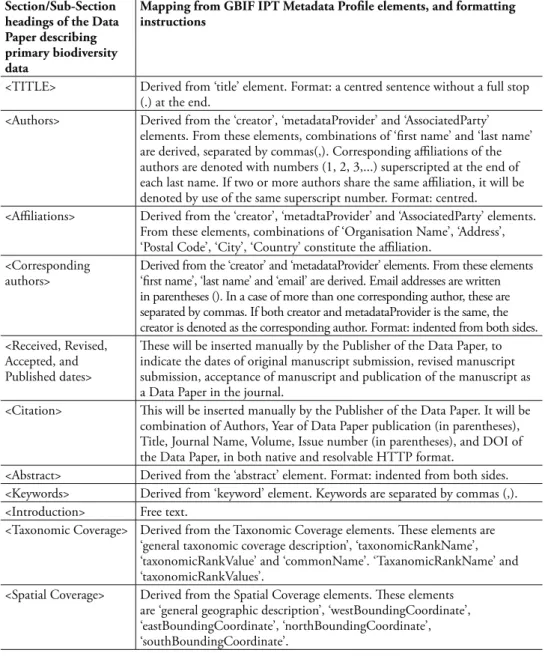
he structure of a Data Paper largely resembles that of a standard research paper. However, it must contain several speciic elements. hese elements are listed in Ta-
ble 2 below, which describes the general structure of the Data Paper (left column) mapped to the metadata elements (right column), and is intended to serve as a human- readable model for any Data Paper manuscript, whether generated through the IPT or written independently in a text editor. A sample Data Paper which can be used as an illustration of the concept can be downloaded from http://www.pensoft.net/J_FILES/ temp/Pensoft_Data_Publishing_Policies_and_Guidelines.pdf
Table 2. Structure of Data Paper and its mapping from GBIF IPT Metadata Proile elements. Section/Sub-Section
headings of the Data Paper describing primary biodiversity data
Mapping from GBIF IPT Metadata Proile elements, and formatting instructions
<TITLE> Derived from ‘title’ element. Format: a centred sentence without a full stop (.) at the end.
<Authors> Derived from the ‘creator’, ‘metadataProvider’ and ‘AssociatedParty’ elements. From these elements, combinations of ‘irst name’ and ‘last name’ are derived, separated by commas(,). Corresponding ailiations of the authors are denoted with numbers (1, 2, 3,...) superscripted at the end of each last name. If two or more authors share the same ailiation, it will be denoted by use of the same superscript number. Format: centred.
<Ailiations> Derived from the ‘creator’, ‘metadtaProvider’ and ‘AssociatedParty’ elements. From these elements, combinations of ‘Organisation Name’, ‘Address’,
‘Postal Code’, ‘City’, ‘Country’ constitute the ailiation.
<Corresponding authors>
Derived from the ‘creator’ and ‘metadataProvider’ elements. From these elements
‘irst name’, ‘last name’ and ‘email’ are derived. Email addresses are written in parentheses (). In a case of more than one corresponding author, these are separated by commas. If both creator and metadataProvider is the same, the creator is denoted as the corresponding author. Format: indented from both sides.
<Received, Revised, Accepted, and Published dates>
hese will be inserted manually by the Publisher of the Data Paper, to indicate the dates of original manuscript submission, revised manuscript submission, acceptance of manuscript and publication of the manuscript as a Data Paper in the journal.
<Citation> his will be inserted manually by the Publisher of the Data Paper. It will be combination of Authors, Year of Data Paper publication (in parentheses), Title, Journal Name, Volume, Issue number (in parentheses), and DOI of the Data Paper, in both native and resolvable HTTP format.
<Abstract> Derived from the ‘abstract’ element. Format: indented from both sides.
<Keywords> Derived from ‘keyword’ element. Keywords are separated by commas (,).
<Introduction> Free text.
<Taxonomic Coverage> Derived from the Taxonomic Coverage elements. hese elements are
‘general taxonomic coverage description’, ‘taxonomicRankName’,
‘taxonomicRankValue’ and ‘commonName’. ‘TaxanomicRankName’ and
‘taxonomicRankValues’.
<Spatial Coverage> Derived from the Spatial Coverage elements. hese elements are ‘general geographic description’, ‘westBoundingCoordinate’,
‘eastBoundingCoordinate’, ‘northBoundingCoordinate’,
‘southBoundingCoordinate’.
Section/Sub-Section headings of the Data Paper describing primary biodiversity data
Mapping from GBIF IPT Metadata Proile elements, and formatting instructions
<Temporal Coverage> Derived from the Temporal Coverage elements namely, ‘beginDate’ and
‘endDate’.
<Project Description> Derived from project elements as described in the GBIF Metadata Proile. hese elements are ‘title’ of the project, ‘personnel’ involved in the project, ‘funding’ sources’, ‘StudyAreaDescription/descriptor’, and
‘designDescription’.
<Natural Collections Description>
Derived from project NCD elements as described in the GBIF Metadata proile. hese elements are ‘parentCollectionIdentiier’, ‘collectionName’,
‘collectionIdentiier’, formationPeriod’, ‘livingTimePeriod’,
‘specimenPreservationMethod’, and ‘curatorialUnit’.
<Methods> Derivedfrom methods elements as described in the GBIF Metadata Proile. hese elements are ‘methodStep/description’, Sampling/StudyExtent/ description’, ‘sampling/samplingDescription’, and qualityControl/ description.
<Dataset descriptions> Derived from physical and other elements as described in the GBIF Metadata Proile. hese elements are ‘objectName’, ‘characterEncoding
’,‘formatName’, ‘formatVersion’, ‘distribution/online/URL’ ,‘pubDate’,
‘language’, and ‘intellectualRights’.
<Additional Information>
Derived from ‘additionalInfo’ element.
<References> Derived from ‘citation’ element. his element assumes a reference to a research article or a web link, cited in the metadata description.
For information on the meaning and use of each metadata element implemented in the IPT to describe primary (species-by-occurrence) biodiversity data, please see De- tailed descriptions of the GBIF Metadata Proile (GMP) elements. Descriptions of the elements are also available in the form of pop-up help in the metadata editor of IPT.
Generation of Data Paper Manuscripts using the GBIF Integrated Publishing Toolkit (IPT)
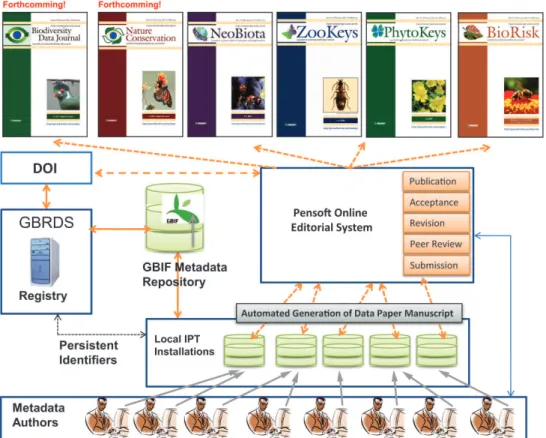
As described in the previous section, data creators will be able to author Data Paper manuscripts in various ways. However, to lower the technical barrier and make the process easy-to-adapt, a conversion tool to automatically export metadata to a manu- script available in IPT 2.0.2+ at the click of a button. he step-by-step process in gen- eration of a Data Paper manuscript from the metadata is depicted in Figure 1, and is described below.
1. he Data Creator completes the metadata for a biodiversity resource dataset using the metadata editor in IPT 2.0.2+. IPT assigns the Persistent Identiier to the authored metadata.
Figure 1. he GBIF/Pensoft worklow of data publishing and automated generation of Data Paper manuscripts
• A list of IPT installations supporting authoring of the Data Paper is accessible at http://tools. gbif.org/data-paper-authoring/.
• Pensoft‘s IPT-based Data Hosting Center (http://ipt.pensoft.net/ipt/) can also be used for authoring metadata. Please ask the Journal’s Editorial Oice to open an account for you.
2. Once the metadata are complete to the best of the author‘s ability, a Data Pa- per manuscript may be generated automatically from these metadata using the automated tool available within IPT 2.0.2+ (menu: Manage Resources - RTF download).
3. he author checks the created manuscript, completing the textual Introduc- tion, and then submits it for publication in the Data Paper section of an ap- propriate Pensoft journal through the online submission system.
4. he manuscript undergoes peer review according to the journal’s policies and the Guidelines for Reviewers of Data Papers (below). After review, and in case of ac- ceptance, the manuscript is returned to the author by the editor alongside the re- viewers’ and editorial comments, for any required pre-publication modiications.
5. he corresponding author inserts all accepted corrections or additions recommended by the reviewers and the editor in the metadata (not the man- uscript of the paper), thereby improving the metadata for the data resource itself. Once the metadata have been improved, these can be made available on the IPT by pressing Publish button in the Manage Resources menu).
6. he inal revised version of the Data Paper manuscript can then be created using the same automated metadata-to-manuscript conversion tool within IPT 2.0.2+ (menu: Manage Resources - RTF download) as was used to create the initally submitted draft. It is really important to remember that all changes in the metadata will be exported in the revised manuscript only after they have been recorded as metadata by pressing the button “Publish” in the “Manage Resources” menu. 7. After manual re-insertion of the text of the Introduction, the revised Data
Paper manuscript can then be submitted to the journal for inal review and subsequent acceptance decision.
8. Once the manuscript is accepted, it goes to a prooing stage, at which point submission, revision, acceptance and publication dates are added by the pub- lisher, and a Digital Object Indentiier (DOI) is assigned to the Data Paper. his facilitates persistent accessibility of the online scholarly publication. 9. Once the inal proofs are approved by the author, the Data Paper is published
in four diferent formats: (a) print format, (b) PDF format, identical to print version, (c) semantically enhanced HTML to provide interactive readings and links to external resources, and (d) inal published XML to be archived in PubMedCentral and other archives to facilitate future data mining.
10. After publication, the DOI of the Data Paper is linked with the Persistent Identiier of the metadata document registered in the GBIF Registry which is given in the Data Paper. his provides multiple cross-linking between the data resource, its corresponding metadata and the corresponding Data Paper. 11. Depending on the journal’s policies and scope, the published Data Paper will
be actively disseminated through the world’s leading indexers and archives, including Web of Knowledge (ISI), PubMedCentral, Scopus, Zoological Record, Google Scholar, CAB Abstracts, Directory of Open Access Journal (DOAJ) and EBSCO.
Data Papers Describing Ecological and Environmental Data
Metadata descriptions of primary biodiversity data used in the GBIF Metadata Proiile (GMP) and the Integrated Publishing Toolkit (IPT) are based on standards created by ecologists and geographers, in particular ISO 19139: North American Proile of ISO19115:2003 – Geographic information – Metadata and the Ecological Metadata Language (EML) Speciication. herefore, the same basic elements and the overall