Binary-decomposed DCNN for accelerating computation and compressing model
without retraining
Ryuji Kamiya
Chubu University
Takayoshi Yamashita
Chubu University
Mitsuru Ambai
Denso IT Laboratory
Ikuro Sato
Denso IT Laboratory
Yuji Yamauchi
Chubu University
Hironobu Fujiyoshi
Chubu University
Abstract
Recent trends show recognition accuracy increasing even more profoundly. Inference process of Deep Convo-lutional Neural Networks (DCNN) has a large number of parameters, requires a large amount of computation, and can be very slow. The large number of parameters also require large amounts of memory. This is resulting in in-creasingly long computation times and large model sizes. To implement mobile and other low performance devices incorporating DCNN, model sizes must be compressed and computation must be accelerated. To that end, this paper proposes Binary-decomposed DCNN, which resolves these issues without the need for retraining. Our method replaces real-valued product computations with binary inner-product computations in existing network models to accel-erate computation of inference and decrease model size without the need for retraining. Binary computations can be done at high speed using logical operators such as XOR and AND, together with bit counting. In tests using AlexNet with the ImageNet classification task, speed increased by a factor of 1.79, models were compressed by approximately 80%, and increase in error rate was limited to 1.20%. With VGG-16, speed increased by a factor of 2.07, model sizes decreased by 81%, and error increased by only 2.16%.
1. Introduction
Deep Convolutional Neural Networks (DCNN) real-ize extremely high recognition accuracy for various tasks such as general object recognition[17], detection[6][13] and
semantic segmentation[10][18]. Since AlexNet[11] won
the ImageNet Large Scale Visual Recognition Challenge (ILSVRC) 2012, which involved computation of 1,000 cat-egories, network models with large numbers of layers began to appear, including VGG-16[16] and Residual Network (ResNet)[8], producing remarkable increases in speed and dropping error rates. Recently, there is a continuing trend
Table 1. Comparison of DCNN and Binarized-DCNN
Model Computations [million] Model size [MB] Convolutional Fully connected Convolutional Fully connected
ImageNet classification task
AlexNet 10.77 0.55 14.29 237.91 VGG-16 153.47 1.26 56.12 471.63 ResNet 113.96 0.021 223.90 7.81 Proposed AND 6.06 AND 0.31
(AlexNet) bitcount 6.06 bitcount 0.31 2.71 42.14 multiply 0.24 multiply 0.003
Proposed AND 86.33 AND 0.70
(VGG-16) bitcount 86.33 bitcount 0.70 10.62 88.64 multiply 4.88 multiply 0.0033
Proposed AND 63.67 AND 0.012
(ResNet) bitcount 63.67 bitcount 0.012 43.22 1.49 multiply 7.93 multiply 0.00006
Places205 scene recognition task
AlexNet 10.77 0.55 14.29 211.20 VGG-16 153.47 1.20 56.12 459.20 Proposed AND 6.06 AND 3.12
(AlexNet) bitcount 6.06 bitcount 3.12 2.71 39.79 multiply 0.24 multiply 0.003
Proposed AND 6.06 AND 3.12
(VGG-16) bitcount 6.06 bitcount 3.12 10.62 71.91 multiply 0.24 multiply 0.003
speed of recognition processing and to decrease model size in order to use these methods in environments with limited resources, such as embedded and mobile devices. To re-solve this issue, research on accelerating computation and compressing model sizes has been proposed.
BinaryNet[4], Binarized Neural Networks[9] and
XNOR-Net[12] are proposed methods to simultaneously accelerate processing and reduce memory use by binarizing DCNN. Both networks express activation values and weights as binary values and express parameters as single bits to reduce memory size and perform high-speed inner products. These methods are able to increase speed and effectively decrease memory use, as is needed, but they require retraining, so they cannot be applied to existing network models. As such, our research proposes Binary-decomposed DCNN, which is able to accelerate inference computation and compress model size for existing network models, without requiring retraining. Binary-decomposed DCNN accelerates recognition processing and compresses models for existing network models by converting feature maps and weightings, which are used in recognition computations in each layer, to binary values and using ap-proximate inner-product computations. The contributions of this method are as follows:
1. Simultaneously accelerates recognition computation and compresses models without the need for re-training by using many binary values and a small num-ber of real values to approximate real-valued parame-ters.
2. Converts real-valued feature maps to binary feature maps in real time by introducing a quantization sub-layer.
3. Can be applied to large-scale network models without great loss of accuracy, unlike BinaryNet and XNOR-Net.
2. Related work
VGG-16 and ResNet achieved high recognition perfor-mance in ILSVRC, but models with many layers are com-plex, so long computation times and large model sizes were issues. To use such models in environments with limited re-sources, such as embedded devices and smartphones, it will be essential to accelerate recognition processing and com-press model sizes. Various research has proposed ways to accelerate processing and compress models, solving these issues.
2.1. Compressing model size by eliminating
param-eters
Deep Compression[7] and SqueezeNet[2] are research on compressing model size. Deep Compression combines
branch pruning, quantization and Huffman encoding to compress model size by approximately 1/50, while increas-ing performance. It first eliminates connections in a trained model by setting all weight below a certain threshold to zero. This enables the dense weight matrix to be handled as a sparse matrix. The model can then be effectively com-pressed further using storage methods such as Comcom-pressed Sparse Row (CSR) or Compressed Sparse Column (CSC). Similar weights can also be shared by applying clustering to the sparse weight matrix. Finally, the model is compressed using Huffman encoding. The distribution of shared weight indices is uneven so this also improves efficiency of mem-ory use. SqueezeNet introduces Fire modules, compress-ing models by approximately 1/50 while achievcompress-ing perfor-mance comparable to AlexNet. A Fire module is composed
of a Squeeze layer, which replaces3×3weight filters with
1×1weight filters, and an Expand layer, which uses
multi-ple1×1and3×3weight filters. Using the Squeeze layer
at the first stage reduces the dimensionality of the weight filters, and reduces the number of channels needed in the Expand layer. SqueezeNet uses schemes such as introduc-ing the Expand layer and down-samplintroduc-ing in the lower layers preserve inference performance.
2.2. Acceleration and model compression using
bi-nary parameters
BinaryNet[4], Binarized Neural Networks[9] and
XNOR-Net[12] are methods that simultaneously accelerate computation and compress memory use by Binarizing
DCNN feature maps and weights. BinaryNet expresses
activation and weight values as binary values, expressing parameters as single bits to reduce memory size, and en-abling fast inner product computations. BinaryConnect[5] is used to binarize activation values and weights. When updating parameters, real-valued parameters rather than the binarized parameters are updated. Although binarizing activation and weight values achieves both faster computa-tion and model compression, parameters cannot be updated
through back-propagation of error. As such, BinaryNet
computes updated weights by replacing some parameters only when performing parameter clipping and gradient
computation. XNOR-Net improves on the accuracy of
BinaryNet by introducing scaling coefficients. To do so, both binary filters and scale factors are approximated to minimize the approximation error due to each weights in the BinaryConnect binarization method. To compute the parameter updates, a method similar to BinaryNet is used. There are also regions during convolution computations
where inner product computations are duplicated. This
3. Proposed method
Our proposed method simultaneously accelerates infer-ence computation and compresses models for DCNN by transforming feature maps and weights to binary values. The proposed method consists of two parts: (1) decompos-ing real-valued vector of weights to binary basis vectors, (2) quantization sub-layer.
3.1. Decomposing real-valued vector to binary basis
vectors
To use binary inner product operations, real-valued
parameters must be converted to binary values. One
method for converting parameters to binary is vector
decomposition[15][19][1]. Vector decomposition breaks
down a weight vector,w∈RD, into a binary basis matrix,
M∈ {−1,1}D×k, and a scaling coefficient vector,c∈Rk.
Here,kis the number of basis vectors, or basis rank, andD
is the input dimensionality. By applying vector decomposi-tion to the weight vectors, inner products between two real values can be replaced with inner products between binary
values when an input vector,x, is binarized. Inner products
between binary values can be done quickly using logical operations and bit counting. Two algorithms for optimiz-ing vector decomposition are the greedy algorithm[15] and the exhaustive algorithm[19]. In this section, we describe decomposition using an exhaustive optimization algorithm which is better than the greedy algorithm.
3.1.1 Exhaustive algorithm [19]
Decomposition by the exhaustive algorithm computes a
bi-nary basis matrix,M, and scaling vector,c, that minimize
the cost function in Eqn. 1 on the weight vector, w. The
decomposition is very slow, optimizingMthrough
exhaus-tive search, but it can provide a decomposition with better approximation performance than the greedy algorithm. The decomposition algorithm is shown in Algorithm 1. First,
M is initialized to random values from{−1,1}, and cis
initialized to random real values. Then,Mandcare
opti-mized. It is difficult to optimize bothMandc
simultane-ously, so they are each optimized alternately. Mis fixed,
andcis optimized by minimizing Eqn. 1 using the least
squares method. Then, cis fixed andMis optimized by
exhaustive search. This process is repeated until the value of the cost function, Eqn. 1, converges. Note that the accu-racy of approximation of the vector decomposition depends
on the initial values, so we take the values ofMandcthat
minimize Eqn. 1 after changing the initial valuesLtimes as
the basis decomposition result.
E=||w−Mc||2
2 (1)
Algorithm 1Decomposition algorithm
Require: w,k,L
foritoLdo
InitializeMiby random values on{−1,1}
repeat
ci= (MT
iMi)−1(MTi w)
Mi = arg min
Mi∈{−1,1}D×k
||w−Mici||2 2
until||w−Mc||2
2converges
ˆ
M,ˆc= arg min
M,c
||w−Mc||2 2
end for return Mˆ,ˆc
3.1.2 Applying vector decomposition to the convolu-tion layers
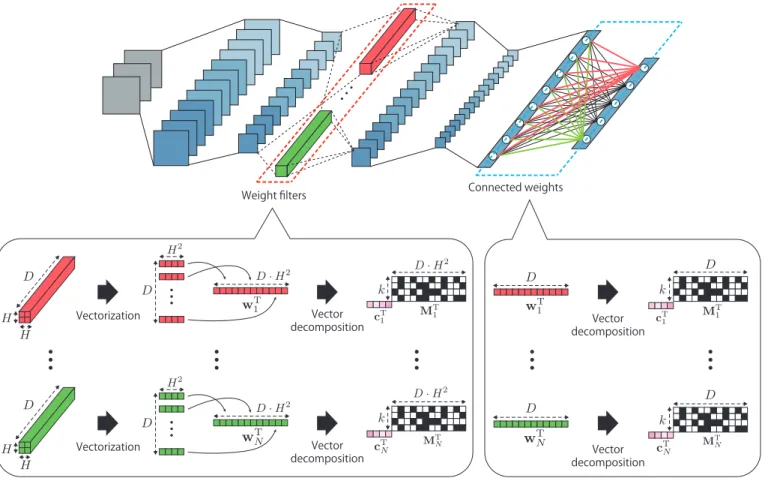
First, consider application of vector decomposition to the
mth weight filter associated with thenth feature map in the
lth layer,wln,m∈RH×H. Vector decomposition applies to
vectors, so it cannot be applied directly to the weight filter, which is a matrix. As such, we apply vector decomposi-tion by expressing the weight filter as a vector. Expressing the weight filter as a vector results in a vector of dimension
H·H. With network models as in VGG-16 and ResNet, the
weight filter for each layer is usually very small, so this does not reduce the amount of computation using approximate inner-product computations has little effect. Thus, rather than decomposing a single weight filter, filters in the
chan-nel direction are expressed as a vector. WithMas the
num-ber of input feature maps, the decomposed weight vectors
can be defined as . Then, the dimension ofWnisM·H2, so
approximate inner-product computations have more effect.
In convolutional layers,Wonly hasN output maps.
Vec-tor decomposition using Algorithm 1 is applied to eachW,
decomposing them into and . In convolutional layer infer-ence processing, these and are used for approximate inner product calculations.
3.1.3 Applying vector decomposition to the fully-connected layers
Next, consider application of vector decomposition to
con-nection weights in the nth unit of thelth fully-connected
layer, wln ∈ RM. The weights used to get the output
from the nth unit of a fully connected layer are an M
-dimensional weight vector. Also a fully connected layer
has values equaling the number of output units,N. Vector
decomposition using Algorithm 1 is applied to each weight
vector,wl
n, to decompose into the binary basis matrix,Mˆ,
Weight filters Connected weights
Figure 1. Weights decomposition in DCNN layers
3.2. Quantization sub-layer
Quantization can convert to binary rapidly, but it applies to a fixed range, so real and negative values cannot be quan-tized. Thus, we introduce a quantization sub-layer able to binarize real values, including negative values, rapidly. The quantization sub-layer is able to quantize real values includ-ing negative values by changinclud-ing the quantization range.
Before quantizing a feature map, the quantization
bit-depth,Q, is decided. The approximation accuracy of
quan-tization increases with larger Q, but the amount of
com-putation required for approximate inner products also
in-creases, making computation slower. Conversely, asQ
be-comes smaller, the amount of computation decreases, so in-ference computations become faster, but approximation ac-curacy decreases due to quantization. First, Eqn. (2) is used
to find the quantization range,∆d,between the maximum
and minimum values in feature map. ∆ddepends on the
maximum and minimum values in the feature map, so the value is different for each feature map.
∆d= max (x)−min (x)
2Q−1 (2)
Next, Eqn. (3) is used to shift the minimum value of the
feature map to0. Here,1represents the unit vector.
Shift-ing the feature map enables quantization of even negative values, which normally could not be quantized.
x′ =x−1min(x)
1Q (3)
Finally,x′is quantized. Quantizingx′generates a binary
code,B∈ {0,1}D×Q. The binary code from the
quantiza-tion sub-layer can be recovered using Eqn. 4.
x≈Br+1min(x) (4)
3.3. Inference processing
Binary-decomposed DCNN accelerates forward compu-tation of network using approximate binary inner product computations. To perform operations on two binary values, the quantization sub-layer is introduced to binarize feature
mapsB. Feature map values and feature vectors in each
3.3.1 Computation in convolution layers
For ordinary convolution computations, the n-th feature
map un,i,j is obtained as the sum of products of the
lo-cal area of feature mappingxi,j, and weight filterwT
n. In
our method the output is computed by replacing the sum of products of real values with binary operations. Input feature maps are first quantized by the quantization sub-layer. This
generates binary feature maps, B ∈ {0,1}M H2×Q. Then
the convolution is computed using the binary feature maps
and binary weight filters, MTn and cTn, obtained through
vector decomposition. The outputui,j,nis given by Eqn.
5.
un,i,j = wTnxi,j
≈ ˆcT
nMˆTn(Bi,jri,j+1min(x))
= ˆcTnMˆTnBi,jri,j+ ˆcTnMˆTn1min(x) (5)
Here, wT
n ∈ RDH 2
is the weighting used when
generat-ing then-th feature map, and xi,j ∈ RDH2
is the feature
map used when generating the unit at coordinatesi, jin the
output feature map.
3.3.2 Computation in fully-connected layers
The i-th output ui, from fully-connected layers are
com-puted by inner products between real-valued feature
vec-tors, x, and connection weights, wi. To accelerate
inner-product calculations in fully-connected layers, real values are replaced with binary values, as in the convolutional
lay-ers. This generates binary feature matrixB ∈ {0,1}D×Q
from the input feature vectorx∈RD. Then, the outputiis
approximated by Eqn. 6 from the binary feature matrix and the binary weight vectors decomposed beforehand.
ui = wTix
≈ ˆcT
iMˆTi (Br+1min(x))
= ˆcT
iMˆTi Br+ ˆciTMˆTi1min(x) (6)
where, MˆT ∈ {−1,1}k×D
andB ∈ {0,1}D×Q are
bi-nary, so it can be computed using logical operators and bit counting, as in Eqn. 7. The computation can be done at high speed, counting bits using the POPCNT function im-plemented in the Streaming SIMD Extension (SSE) 4.2.
ˆ
mTi bj = 2×POPCNT(AND( ˆmiT,bj))− ∥bj∥2
1 (7)
4. Experiments
In testing, we evaluated recognition performance, pro-cessing time and model size when applying the proposed method to several network models. Quantization bit depth,
Q, of 4, 6 and 8 were used for approximations, and
simi-larly, basis rank of 4, 6, and 8 were used. Quantization bit
depths and basis rank less than 4 were not used because er-ror rates increased to a great degree. Similarly, with quan-tization bit rate and basis rank greater than 8, the drop in error rate had peaked, so they were not included. To evalu-ate model size in testing, the total memory occupied by the
network model, including weights,W, binarized basis
ma-trix, M, and scaling coefficient vector, c, were compared.
Published trained models were used as parameters for each network model, with no fine tuning. Top-5 accuracy was used to evaluate recognition performance. Top-5 accuracy is a method that counts cases where the training signal is included among the five most probable inferred classes, as success. We used an Intel Core i7-4770 3.40-GHz proces-sor.
4.1. ImageNet classification task
Testing was done using the AlexNet, VGG-16, and ResNet-152 network models. The ImageNet data set used in the ILSVRC 2012 [14] classification task was used. Im-ageNet is a very large object recognition dataset, contain-ing 1,200,000 traincontain-ing samples, 100,000 test samples, and 50,000 validation samples. Each sample is classified into one of 1000 categories. In testing, evaluation was done us-ing the 50,000 validation samples.
4.1.1 Model 1: AlexNet
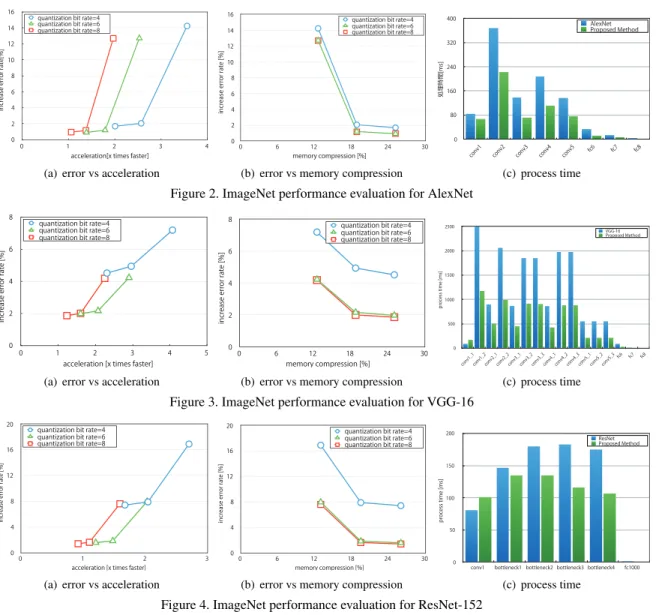
AlexNet is composed of 5 convolutional layers and 3 fully-connected layers. A comparison of recognition accuracy, processing time, and error-rate increases when using ap-proximate inner-product calculations is shown in Figure 2.
Here,kindicates the basis rank used for weight
decompo-sition. Comparing the same basis rank for quantization bit-depths of 6 and 8, almost no increase in the error rate is shown. In this case, the lower quantization bit-depth of 6 is better, requiring less computation. Figure 2(b) shows that memory compression does not change between quantiza-tion bit depths of 4 and 6 using the same basis rank, so we can say quantization bit-depth does not affect reduction of memory use. The error rate also does not change greatly when comparing basis ranks of 6 and 8. This is similar to the trend in Figure 2(a). For both quantization bit-depth and basis rank of 6, speed increased by a factor of 1.79, and model size decreased from 237.91 MB to 44.85 MB. Here, error rates increased by 1.20%.
4.1.2 Model 2: VGG-16
(a) error vs acceleration (b) error vs memory compression (c) process time
Figure 2. ImageNet performance evaluation for AlexNet
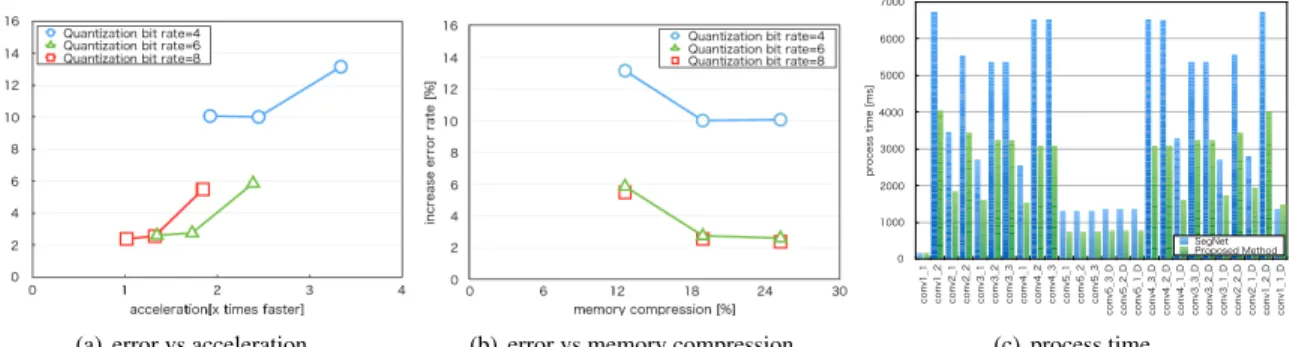
(a) error vs acceleration (b) error vs memory compression (c) process time
Figure 3. ImageNet performance evaluation for VGG-16
(a) error vs acceleration (b) error vs memory compression (c) process time
Figure 4. ImageNet performance evaluation for ResNet-152
layer for testing. Recognition accuracy, processing time, and model size with approximate inner-product computa-tions are shown in Figure 3. With a quantization bit-depth of 6 and basis rank of 6, speed increased by a factor of 2.07 and the model size reduced from 527.74 MB to 99.26 MB. In this case, the error rate increased by 2.16%.
4.1.3 Model 3: ResNet-152
ResNet-152 is composed of 151 convolutional layers and 1 fully connected layer. Recognition accuracy, processing speed and model size using the approximate inner product calculations are shown in Figure 4. ResNet has 152 con-volutional layers, which account for approximately 96% of the model size. Clearly, reduction in model size can also be gained for models like ResNet, which have very many convolutional layers. With a quantization bit-depth of 6 and basis rank of 6, speed increased by a factor of 1.77 and the
model size reduced from 229.08 MB to 44.71 MB. In this case, the error rate increased by 1.86%.
Table 2. Comparison of performance with methods based on AlexNet
Model Top1 Top5 acceleration compression AlexNet 56.8 80.0 - -Deep Compression 56.8 79.9 1.00 35
XNOR-Net 44.2 69.2 58.0 32 proposed 55.1 78.8 1.79 5
4.1.4 Comparison with other methods
(a) error vs acceleration (b) error vs memory compression
QSPDFTTUJNF<NT>
DPOW@ DPOW@ DPOW@ DPOW@ DPOW@ DPOW@ DPOW@ DPOW@ DPOW@ DPOW@ DPOW@ DPOW@ DPOW@
DPOW@@% DPOW@@% DPOW@@% DPOW@@% DPOW@@% DPOW@@% DPOW@@% DPOW@@% DPOW@@% DPOW@@% DPOW@@% DPOW@@% DPOW@@% 4FH/FU 1SPQPTFE.FUIPE
(c) process time
Figure 5. Cityscapes dataset performance evaluation for SegNet
input image label image SegNet Proposed quantization bit rate=4
basis=8
Proposed quantization bit rate=6
basis=6
Proposed quantization bit rate=8
basis=4
Figure 6. Semantic segmentation results in Cityscapes
a quantization bit depth of 6. The comparison results are shown in Table 2. Although Deep Compression had excel-lent compression performance, its recognition computation was no faster. XNOR-Net had superior acceleration scaling performance and compression performance, but its recogni-tion accuracy was much lower. The proposed method had worse acceleration scaling and compression performance than the other methods, but maintained its recognition ac-curacy while simultaneously achieving a high acceleration scale factor and model compression.
4.2. Cityscapes semantic segmentation task
We performed an evaluation of semantic segmentation using the Cityscapes Dataset[3]. The Cityscapes Dataset is a very large segmentation dataset. In this experiment, we performed the evaluation using the 500 verification sam-ples. For the network model, we used SegNet[18]. For the model parameters, we used published learned param-eters, and fine tuning was not performed. Figures 5 and 6 show the recognition performance when using Cityscapes. With a quantization bit depth of 6 and a basis rank of 6, we achieved an acceleration scale factor of approximately 1.73 and compressed the model size from approximately 112.25 MB to approximately 21.23 MB. In this case, the rate of error increase was approximately 2.75%.
5. Conclusion
We have proposed a method able to accelerate inference computation while compressing model sizes, using exist-ing network models without the need for retrainexist-ing. The method compresses memory use by converting weightings from each layer from real-valued parameters to binary pa-rameters, and accelerates inference computation by replac-ing real-valued inner product calculations with binary val-ued inner product calculations using logical operations and bit counting. Using a quantization bit-depth of 6 and basis rank of 6, AlexNet model sizes were reduced by approxi-mately 80%, and speed increased by a factor of 1.79. In this case, error rates increased by 1.20%. With VGG-16, model sizes reduced by 81%, and speed increased by a fac-tor of 2.07. In this case, error rates increased by 2.16%. In the future, we plan to increase approximation accuracy and reduce the increases in error rates.
References
[1] M. Ambai and I. Sato. SPADE: Scalar Product Accelerator by Integer Decomposition for Object Detection. InECCV, 2014.
with 50x fewer parameters and<1MB model size. arXiv preprint arXiv:1602.02830, 2016.
[3] M. Cordts, M. Omran, S. Ramos, T. Rehfeld, M. Enzweiler, R. Benenson, U. Franke, S. Roth, and B. Schiele. The cityscapes dataset for semantic urban scene understanding. InProceedings of the IEEE Conference on Computer Vision and Pattern Recognition (CVPR), 2016.
[4] M. Courbariaux and Y. Bengio. BinaryNet: Training Deep Neural Networks with Weights and Activations Constrained to +1 or -1.arXiv preprint arXiv:1602.02830, 2016. [5] M. Courbariaux, Y. Bengio, and J. David. BinaryConnect:
Training Deep Neural Networks with binary weights during propagations.arXiv preprint arXiv:1511.00363, 2015. [6] R. Girshick. Fast R-CNN. InProceedings of the
Interna-tional Conference on Computer Vision (ICCV), 2015. [7] S. Han, H. Mao, and W. J. Dally. Deep Compression:
Compressing Deep Neural Networks with Pruning, Trained Quantization and Huffman Coding. InProceedings of the In-ternational Conference on Learning Representations (ICLR), 2016.
[8] K. He, X. Zhang, S. Ren, and J. Sun. Deep Residual Learning for Image Recognition. InThe IEEE Conference on Com-puter Vision and Pattern Recognition (CVPR), 2016. [9] I. Hubara, D. Soudry, and R. E. Yaniv. Binarized Neural
Networks.arXiv preprint aiXiv:1602.02505, 2016. [10] L. Jonathan, S. Evan, and D. Trevor. Fully Convolutional
Networks for Semantic Segmentation. InThe IEEE Confer-ence on Computer Vision and Pattern Recognition (CVPR), 2015.
[11] A. Krizhevsky, I. Sutskever, and G. E. Hinton. ImageNet Classification with Deep Convolutional Neural Networks. In
Advances in Neural Information Processing Systems (NIPS), pages 1097–1105. Curran Associates, Inc., 2012.
[12] R. Mohammad, O. Vicente, R. Joseph, and F. Ali. XNOR-Net: ImageNet Classification Using Binary Convolutional Neural Networks.European Conference on Computer Vision (ECCV), 2016.
[13] S. Ren, K. He, R. Girshick, and J. Sun. Faster R-CNN: Towards Real-Time Object Detection with Region Pro-posal Networks. InNeural Information Processing Systems (NIPS), 2015.
[14] O. Russakovsky, J. Deng, H. Su, J. Krause, S. Satheesh, S. Ma, Z. Huang, A. Karpathy, A. Khosla, M. Bernstein, A. C. Berg, and L. Fei-Fei. ImageNet Large Scale Visual Recognition Challenge. International Journal of Computer Vision (IJCV), 115(3):211–252, 2015.
[15] P. H. T. Sam Hare, Amir Saffari. Efficient Online Structured Output Learning for Keypoint-Based Object Tracking. In
the Proceedings IEEE Conference of Computer Vision and Pattern Recognition (CVPR), 2012.
[16] K. Simonyan and A. Zisserman. Very Deep Convolutional Networks for Large-Scale Image Recognition. In Proceed-ings of the International Conference on Learning Represen-tations (ICLR), 2015.
[17] C. Szegedy, W. Liu, Y. Jia, P. Sermanet, S. Reed, D. Anguelov, D. Erhan, V. Vanhoucke, and A. Rabinovich. Going deeper with convolutions. InThe IEEE Conference on Computer Vision and Pattern Recognition (CVPR), 2015.
[18] B. Vijay, K. Alex, and C. Roberto. SegNet: A Deep Convo-lutional Encoder-Decoder Architecture for Image Segmenta-tion.arXiv preprint arXiv:1511.00561, 2015.