Global Solver and Its Efficient Approximation for
Variational Bayesian Low-rank Subspace Clustering
Shinichi Nakajima Nikon Corporation Tokyo, 140-8601 Japan [email protected]
Akiko Takeda The University of Tokyo
Tokyo, 113-8685 Japan
[email protected] S. Derin Babacan
Google Inc.
Mountain View, CA 94043 USA [email protected]
Masashi Sugiyama Tokyo Institute of Technology
Tokyo 152-8552, Japan [email protected] Ichiro Takeuchi
Nagoya Institute of Technology Aichi, 466-8555, Japan
Abstract
When a probabilistic model and its prior are given, Bayesian learning offers infer- ence with automatic parameter tuning. However, Bayesian learning is often ob- structed by computational difficulty: the rigorous Bayesian learning is intractable in many models, and its variational Bayesian (VB) approximation is prone to suf- fer from local minima. In this paper, we overcome this difficulty for low-rank subspace clustering (LRSC) by providing an exact global solver and its efficient approximation. LRSC extracts a low-dimensional structure of data by embedding samples into the union of low-dimensional subspaces, and its variational Bayesian variant has shown good performance. We first prove a key property that the VB- LRSC model is highly redundant. Thanks to this property, the optimization prob- lem of VB-LRSC can be separated into small subproblems, each of which has only a small number of unknown variables. Our exact global solver relies on an- other key property that the stationary condition of each subproblem consists of a set of polynomial equations, which is solvable with the homotopy method. For further computational efficiency, we also propose an efficient approximate variant, of which the stationary condition can be written as a polynomial equation with a single variable. Experimental results show the usefulness of our approach.
1 Introduction
Principal component analysis (PCA) is a widely-used classical technique for dimensionality reduc- tion. This amounts to globally embedding the data points into a low-dimensional subspace. As more flexible models, the sparse subspace clustering (SSC) [7, 20] and the low-rank subspace clustering (LRSC) [8, 13, 15, 14] were proposed. By inducing sparsity and low-rankness, respectively, SSC and LRSC locally embed the data into the union of subspaces. This paper discusses a probabilistic model for LRSC.
As the classical PCA requires users to pre-determine the dimensionality of the subspace, LRSC re- quires manual parameter tuning for adjusting the low-rankness of the solution. On the other hand,
Bayesian formulations enable us to estimate all unknown parameters without manual parameter tuning [5, 4, 17]. However, in many problems, the rigorous application of Bayesian inference is computationally intractable. To overcome this difficulty, the variational Bayesian (VB) approxima- tion was proposed [1]. A Bayesian formulation and its variational inference have been proposed for LRSC [2]. There, to avoid computing the inverse of a prohibitively large matrix, the posterior is approximated with the matrix-variate Gaussian (MVG) [11].
Typically, the VB solution is computed by the iterated conditional modes (ICM) algorithm [3, 5], which is derived through the standard procedure for the VB approximation. Since the objective function for the VB approximation is generally non-convex, the ICM algorithm is prone to suffer from local minima. So far, the global solution for the VB approximation is not attainable except PCA (or the fully-observed matrix factorization), for which the global VB solution has been analytically obtained [17]. This paper makes LRSC another exception with proposed global VB solvers. Two common factors make the global VB solution attainable in PCA and LRSC: first, a large portion of the degrees of freedom that the VB approximation learns are irrelevant, and the optimization problem can be decomposed into subproblems, each of which has only a small number of unknown variables; second, the stationary condition of each subproblem is written as a polynomial system (a set of polynomial equations).
Based on these facts, we propose an exact global VB solver (EGVBS) and an approximate global VB solver (AGVBS). EGVBS finds all stationary points by solving the polynomial system with the homotopy method[12, 10], and outputs the one giving the lowest free energy. Although EGVBS solves subproblems with much less complexity than the original VB problem, it is still not efficient enough for handling large-scale data. For further computational efficiency, we propose AGVBS, of which the stationary condition is written as a polynomial equation with a single variable. Our ex- periments on artificial and benchmark datasets show that AGVBS provides a more accurate solution than the MVG approximation [2] with much less computation time.
2 Background
In this section, we introduce the low-rank subspace clustering and its variational Bayesian formula- tion.
2.1 Subspace Clustering Methods
LetY ∈ RL×M = (y1, . . . , yM) be L-dimensional observed samples of size M . We generally denote a column vector of a matrix by a bold-faced small letter. We assume that each ymis ap- proximately expressed as a linear combination ofM′ wordsin a dictionary, D = (d1, . . . , dM′), i.e.,
Y = DX +E,
whereX ∈ RM′×M is unknown coefficients, and E ∈ RL×M is noise. In subspace clustering, the observed matrixY itself is often used as a dictionary D. The convex formulation of the sparse subspace clustering (SSC) [7, 20] is given by
minX ∥Y − Y X∥ 2
Fro+ λ∥X∥1, s.t. diag(X) = 0, (1) whereX ∈ RM×M is a parameter to be estimated, λ > 0 is a regularization coefficient to be manually tuned. ∥ · ∥Froand∥ · ∥1 are the Frobenius norm and the (element-wise)ℓ1-norm of a matrix, respectively. The first term in Eq.(1) requires that each data point ymcan be expressed as a linear combination of a small set of other data points{dm′} for m′ ̸= m. This smallness of the set is enforced by the second (ℓ1-regularization) term, and leads to the low-dimensionality of each obtained subspace. After the minimizer bX is obtained, abs( bX) + abs( bX⊤), where abs(·) takes the absolute value element-wise, is regarded as an affinity matrix, and a spectral clustering algorithm, such as normalized cuts [19], is applied to obtain clusters.
In the low-rank subspace clustering (LRSC) or low-rank representation [8, 13, 15, 14], low- dimensional subspaces are sought by enforcing the low-rankness ofX:
minX ∥Y − Y X∥ 2
Fro+ λ∥X∥tr. (2)
Thanks to the simplicity, the global solution of Eq.(2) has been analytically obtained [8]. 2.2 Variational Bayesian Low-rank Subspace Clustering
We formulate the probabilistic model of LRSC, so that the maximum a posteriori (MAP) estimator coincides with the solution of the problem (2) under a certain hyperparameter setting:
p(Y|A′, B′)∝ exp(−2σ12∥Y − DB′A′⊤∥2Fro), (3) p(A′)∝ exp(−12tr(A′CA−1A′⊤)), p(B′)∝ exp(−12tr(B′CB−1B′⊤)). (4) Here, we factorizedX as X = B′A′⊤, as in [2], to induce low-rankness through the model-induced regularization mechanism [17]. In this formulation, A′ ∈ RM×H and B′ ∈ RM×H for H ≤ min(L, M ) are the parameters to be estimated. We assume that hyperparameters
CA= diag(c2a1, . . . , c2aH), CB = diag(c2b1, . . . , c2bH).
are diagonal and positive definite. The dictionaryD is treated as a constant, and set to D = Y , once Y is observed.1
The Bayes posterior is written as
p(A′, B′|Y ) =p(Y |A′,Bp(Y )′)p(A′)p(B′), (5) wherep(Y ) =⟨p(Y |A′, B′)⟩p(A′)p(B′)is the marginal likelihood. Here,⟨·⟩pdenotes the expecta- tion over the distributionp. Since the Bayes posterior (5) is computationally intractable, we adopt the variational Bayesian (VB) approximation [1, 5].
Letr(A′, B′), or r for short, be a trial distribution. The following functional with respect to r is called the free energy:
F (r) =⟨logp(Y |A′r(A,B′),p(A′,B′)′)p(B′)
⟩
r(A′,B′)=
⟨
logp(Ar(A′,B′,B′|Y )′)
⟩
r(A′,B′)− log p(Y ). (6) In the last equation of Eq.(6), the first term is the Kullback-Leibler (KL) distance from the trial distribution to the Bayes posterior, and the second term is a constant. Therefore, minimizing the free energy (6) amounts to finding a distribution closest to the Bayes posterior in the sense of the KL distance. In the VB approximation, the free energy (6) is minimized over some restricted function space.
2.2.1 Standard VB (SVB) Iteration
The standard procedure for the VB approximation imposes the following constraint on the posterior: r(A′, B′) = r(A′)r(B′).
By using the variational method, we can show that the VB posterior is Gaussian, and has the follow- ing form:
r(A′)∝ exp (
−tr((A′− bA′)ΣA′−12 (A′− bA′)⊤)
)
, r(B′)∝ exp (
−(˘b
′−b˘b′)⊤Σ˘B′−1(˘b′−b˘b′) 2
) , (7)
where ˘b′= vec(B′)∈ RM H. The means and the covariances satisfy the following equations: Ab′= σ12Y⊤Y bB′ΣA′, ΣA′ = σ2(⟨B′⊤Y⊤Y B′⟩r(B′)+ σ2CA−1)−1, (8)
b˘b′= Σ˘σB′2 vec(Y⊤Y bA′), Σ˘B′ = σ2(( bA′⊤Ab′+ M ΣA′)⊗ Y⊤Y + σ2(CB−1⊗ IM))−1, (9) where⊗ denotes the Kronecker product of matrices, and IM is theM -dimensional identity matrix.
1Our formulation is slightly different from the one proposed in [2], where a clean version of Y is introduced as an additional parameter to cope with outliers. Since we focus on the LRSC model without outliers in this paper, we simplified the model. In our formulation, the clean dictionary corresponds to Y BA⊤(BA⊤)†, where
† denotes the pseudo-inverse of a matrix.
For empirical VB learning, where the hyperparameters are also estimated from observation, the following are obtained from the derivatives of the free energy (6):
c2ah =∥ba′h∥2/M + σ2a′
h, c
2 bh =
(∥bb′h∥2+∑Mm=1σB2m,h′
)
/M, (10)
σ2=tr
(
Y⊤Y(IM−2 bB′Ab′⊤+⟨B′( bA′⊤Ab′+M ΣA′)B′⊤⟩r(B′ )
))
LM , (11)
where(σ2a′
1, . . . , σ2a′
H) and ((σ
2
B′1,1, . . . , σB2′
M,1), . . . , (σ2B′
1,H, . . . , σB2′
M,H)) are the diagonal entries ofΣA′and ˘ΣB′, respectively. Eqs.(8)–(11) form an ICM algorithm, which we call the standard VB (SVB) iteration.
2.2.2 Matrix-Variate Gaussian Approximate (MVGA) Iteration
Actually, the SVB iteration cannot be applied to a large-scale problem, because Eq.(9) requires the inversion of a hugeM H× MH matrix. This difficulty can be avoided by restricting r(B′) to be the matrix-variate Gaussian (MVG) [11], i.e.,
r(B′)∝ exp(−12tr (
Θ−1B′(B′− bB′)ΣB−1′(B′− bB′)⊤)). (12) Under this additional constraint, a gradient-based computationally tractable algorithm can be derived [2], which we call the MVG approximate (MVGA) iteration.
3 Global Variational Bayesian Solvers
In this section, we first show that a large portion of the degrees of freedom in the expression (7) are irrelevant, which significantly reduces the complexity of the optimization problem without the MVG approximation. Then, we propose an exact global VB solver and its approximation.
3.1 Irrelevant Degrees of Freedom of VB-LRSC Consider the following transforms:
A = ΩYright⊤A′, B = ΩYright⊤B′, where Y = ΩYleftΓYΩYright⊤ (13) is the singular value decomposition (SVD) ofY . Then, we obtain the following theorem:
Theorem 1 The global minimum of the VB free energy (6) is achieved with a solution such that A, bb B, ΣA, ˘ΣBare diagonal.
(Sketch of proof) After the transform (13), we can regard the observed matrix as a diagonal matrix, i.e.,Y → ΓY. Since we assume Gaussian priors with no correlation, the solution bB bA⊤is naturally expected to be diagonal. To prove this intuition, we apply a similar approach to [17], where the diagonalities of the VB posterior covariances were proved in fully-observed matrix factorization by investigating perturbations around any solution. We first show that bA′⊤Ab′+M ΣA′is diagonal, with which Eq.(9) implies the diagonality of ˘ΣB. Other diagonalities can be shown similarly. ✷ Theorem 1 does not only reduce the complexity of the optimization problem greatly, but also makes the problem separable, as shown in the following.
3.2 Exact Global VB Solver (EGVBS)
Thanks to Theorem 1, the free energy minimization problem can be decomposed as follows: Lemma 1 LetJ(≤ min(L, M)) be the rank of Y , γmbe them-th largest singular value of Y , and
(ba1, . . . , baH), (σa21, . . . , σa2H), (bb1, . . . , bbH), ((σB21,1, . . . , σ2BM,1), . . . , (σB21,H, . . . , σ2BM,H)) be the diagonal entries of bA, ΣA, bB, ˘ΣB, respectively. Then, the free energy(6) is written as
F = 21(LM log(2πσ2) +∑Jh=1σ2γh2 +∑Hh=12Fh
), where (14)
Algorithm 1 Exact Global VB Solver (EGVBS) for LRSC. 1: Calculate the SVD ofY = ΩYleftΓYΩYright⊤.
2: forh = 1 to H do
3: Find all the solutions of the polynomial system (16)–(18) by the homotopy method. 4: Discard prohibitive solutions with complex numbers or with negative variances. 5: Select the stationary point giving the smallestFh(defined by Eq.(15)).
6: The global solution forh is the selected stationary point if it satisfies Fh < 0, otherwise the null solution (19).
7: end for
8: Calculate bX = ΩrightY B bbA⊤ΩYright⊤
9: Apply spectral clustering with the affinity matrix equal to abs( bX) + abs( bX⊤).
2Fh= M log c
2 ah
σah2 +
∑J m=1log
c2bh
σ2Bm,h − (M + J) +ba
2 h+M σ
2 ah
c2ah +
bb2h+∑Jm=1σ2Bm,h c2bh
+σ12
{
γh2(−2bahbbh+ bbh2(ba2h+ M σa2h))+∑Jm=1γm2σ2Bm,h(ba2h+ M σa2h)}, (15) and its stationary condition is given as follows: for eachh = 1, . . . , H,
bah= γσh22bbhσa2h, σ2ah = σ2(γh2bb2h+∑Jm=1γm2σB2m,h+cσ22 ah
)−1
, (16)
bbh= γ
2 h
σ2bahσ
2
Bh,h, σ
2 Bm,h =
σ2
(
γ2m(ba2h+ M σ2ah)+cσ22 bh
)−1
(m≤ J),
c2bh (m > J),
(17)
c2ah = ba2h/M + σa2h, c2bh =(bb2h+∑Jm=1σ2Bm,h)/J. (18) If no stationary point givesFh< 0, the global solution is given by
bah= bbh= 0, σ2ah, σB2m,h, c2ah, c2bh → 0 for m = 1, . . . , M. (19) Taking account of the trivial relationsc2bh= σ2Bm,hform > J, Eqs.(16)–(18) for each h can be seen as a polynomial system with5 + J unknown variables, i.e.,(bah, σa2h, c2ah, bbh,{σB2m,h}Jm=1, c2bh). Thus, Lemma 1 has decomposed the original problem (8)–(10) withO(M2H2) unknown variables intoH subproblems with O(J) variables each.
Given the noise varianceσ2, our exact global VB solver (EGVBS) finds all stationary points that sat- isfy the polynomial system (16)–(18) by using the homotopy method [12, 10],2After that, it discards the prohibitive solutions with complex numbers or with negative variances, and then selects the one giving the smallestFh, defined by Eq.(15). The global solution is the selected stationary point if it satisfiesFh < 0, or the null solution (19) otherwise. Algorithm 1 summarizes the procedure of EGVBS. Ifσ2is unknown, we conduct a naive 1-D search by iteratively applying EGVBS, as for VB matrix factorization [17].
3.3 Approximate Global VB Solver (AGVBS)
Although Lemma 1 significantly reduced the complexity of the optimization problem, EGVBS is not applicable to large-scale data, since the homotopy method is not guaranteed to find all the solu- tions in polynomial time inJ, when the polynomial system involves O(J) unknown variables. For large-scale data, we propose a scalable approximation by introducing an additional constraint that γm2σ2Bm,hare constant overm = 1, . . . , J, i.e.,
γm2σ2Bm,h= σ2bh for all m≤ J. (20)
2The homotopy method is a reliable and efficient numerical method to solve a polynomial system [6, 9]. It provides all the isolated solutions to a system of n polynomials f(x) ≡ (f1(x), . . . , fn(x)) = 0 by defining a smooth set of homotopy systems with a parameter t ∈[0, 1]: g(x, t) ≡ (g1(x, t), g2(x, t), . . . , gn(x, t)) = 0, such that one can continuously trace the solution path from the easiest (t= 0) to the target (t = 1). We use HOM4PS-2.0 [12], which is one of the most successful polynomial system solvers.
Under this constraint, we obtain the following theorem (the proof is omitted):
Theorem 2 Under the constraint (20), any stationary point of the free energy (15) for eachh satis- fies the following polynomial equation with a single variable bbγh:
ξ6bbγ6h+ ξ5bbγ5h+ ξ4bbγ4h+ ξ3bbγ3h+ ξ2bbγ2h+ ξ1bbγh+ ξ0= 0, (21)
where ξ6= φγ2h2
h
, ξ5=−2φ2hγM σ3 2 h
+2φγh
h , ξ4=
φ2hM2σ4 γh4 −
2φh(2M −J)σ2 γh2 + 1 +
φ2h(M σ2−γh2)
γh2 , (22)
ξ3= 2φhM(M −J)σγ3 4
h −
2(M −J)σ2 γh +
φh((M +J)σ2−γh2)
γh −
φ2hM σ2(M σ2−γh2)
γ3h +
φh(M σ2−γ2h) γh , (23)
ξ2= (M −J)γ22σ4
h −
φhM σ2((M +J)σ2−γh2)
γ2h + ((M + J)σ2− γh2)−φh(M −J)σγ22(M σ2−γ2h)
h , (24)
ξ1=−(M −J)σ2((M +J)σγh 2−γh2)+φhM J σγh 4, ξ0= M Jσ4. (25) Here,γ = (∑Jm=1γm−2/J)−1andϕh=(1−γγ2h2
)
. For each real solution bbγhsuch that bγh= bbγ + γh−M σ
2
γh , bκ = γ
2
h− (M + J)σ2−(M σ2− γh2
)ϕh bb γ
γh, (26)
b τ = 2M J1
( bκ +
√
bκ2− 4MJσ4(1 + ϕhγbbγh
)), bδh= √σ2 b τ
(γh−M σ
2
γh − bγh
)−1
, (27)
are real and positive, the corresponding stationary point candidate is given by (
bah, σ2ah, c2ah, bbh, σ2bh, c2bh)= (√
bγbδ,σγ2hbδh,√bτ ,
√
bγ/bδ/γh, σ2
γhbδh−φh√σ2 bτ
,√τ /γb 2h )
. (28)
Given the noise varianceσ2, obtaining the coefficients (22)–(25) is straightforward. Our approx- imate global VB solver (AGVBS) solves the sixth-order polynomial equation (21), e.g., by the
‘roots’ function in MATLAB⃝R, and obtain all candidate stationary points by using Eqs.(26)–(28). Then, it selects the one giving the smallestFh, and the global solution is the selected stationary point if it satisfiesFh< 0, otherwise the null solution (19). Note that, although a solution of Eq.(21) is not necessarily a stationary point, selection based on the free energy discards all non-stationary points and local maxima. As in EGVBS, a naive 1-D search is conducted for estimatingσ2.
In Section 4, we show that AGVBS is practically a good alternative to the MVGA iteration in terms of accuracy and computation time.
4 Experiments
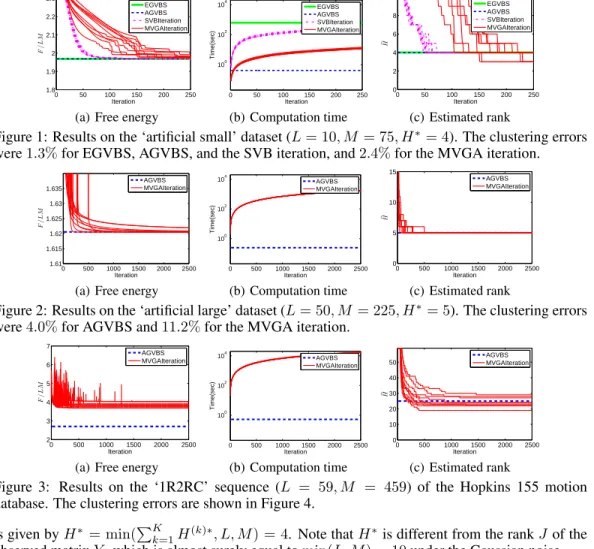
In this section, we experimentally evaluate the proposed EGVBS and AGVBS. We assume that the hyperparameters(CA, CB) and the noise variance σ2are unknown and estimated from observations. We use the full-rank model (i.e.,H = min(L, M )), and expect VB-LRSC to automatically find the true rank without any parameter tuning.
We first conducted an experiment with a small artificial dataset (‘artificial small’), on which the exact algorithms, i.e., the SVB iteration (Section 2.2.1) and EGVBS (Section 3.2), are computation- ally tractable. Through this experiment, we can measure the accuracy of the efficient approximate variants, i.e., the MVGA iteration (Section 2.2.2) and AGVBS (Section 3.3). We randomly cre- atedM = 75 samples in L = 10 dimensional space. We assumed K = 2 clusters: M(1)∗ = 50 samples lie in a H(1)∗ = 3 dimensional subspace, and the other M(2)∗ = 25 samples lie in a H(2)∗ = 1 dimensional subspace. For each cluster k, we independently drew M(k)∗samples from NH(k)∗(0, 10IH(k)∗), whereNd(µ, Σ) denotes the d-dimensional Gaussian, and projected them into the observedL-dimensional space by R(k)∈ RL×H(k)∗, each entry of which followsN1(0, 1). Thus, we obtained a noiseless matrixY(k)∗ ∈ RL×M(k)∗ for the k-th cluster. Concatenating all clusters,Y∗= (Y(1)∗, . . . , Y(K)∗), and adding random noise subject toN1(0, 1) to each entry gave an artificial observed matrixY ∈ RL×M, whereM = ∑Kk=1M(k)∗ = 75. The true rank of Y∗
0 50 100 150 200 250 1.8
1.9 2 2.1 2.2 2.3
Iteration
F/LM
EGVBS AGVBS SVBIteration MVGAIteration
(a) Free energy
0 50 100 150 200 250
100 102 104
Iteration
Time(sec)
EGVBS AGVBS SVBIteration MVGAIteration
(b) Computation time
0 50 100 150 200 250
0 2 4 6 8 10
Iteration b H
EGVBS AGVBS SVBIteration MVGAIteration
(c) Estimated rank
Figure 1: Results on the ‘artificial small’ dataset (L = 10, M = 75, H∗= 4). The clustering errors were1.3% for EGVBS, AGVBS, and the SVB iteration, and 2.4% for the MVGA iteration.
0 500 1000 1500 2000 2500
1.61 1.615 1.62 1.625 1.63 1.635
Iteration
F/LM
AGVBS MVGAIteration
(a) Free energy
0 500 1000 1500 2000 2500
100 102 104
Iteration
Time(sec)
AGVBS MVGAIteration
(b) Computation time
0 500 1000 1500 2000 2500
0 5 10 15
Iteration b H
AGVBS MVGAIteration
(c) Estimated rank
Figure 2: Results on the ‘artificial large’ dataset (L = 50, M = 225, H∗= 5). The clustering errors were4.0% for AGVBS and 11.2% for the MVGA iteration.
0 500 1000 1500 2000 2500
2 3 4 5 6 7
Iteration
F/LM
AGVBS MVGAIteration
(a) Free energy
0 500 1000 1500 2000 2500
100 102 104
Iteration
Time(sec)
AGVBS MVGAIteration
(b) Computation time
0 500 1000 1500 2000 2500
0 10 20 30 40 50
Iteration b H
AGVBS MVGAIteration
(c) Estimated rank
Figure 3: Results on the ‘1R2RC’ sequence (L = 59, M = 459) of the Hopkins 155 motion database. The clustering errors are shown in Figure 4.
is given byH∗ = min(∑Kk=1H(k)∗, L, M ) = 4. Note that H∗is different from the rankJ of the observed matrixY , which is almost surely equal to min(L, M ) = 10 under the Gaussian noise. Figure 1 shows the free energy, the computation time, and the estimated rank of bX = bB′Ab′⊤ over iterations. For the iterative methods, we show the results of 10 trials starting from different random initializations. We can see that AGVBS gives almost the same free energy as the exact methods (EGVBS and the SVB iteration). The exact method requires a large computation cost: EGVBS took 621 sec to obtain the global solution, and the SVB iteration took∼ 100 sec to achieve almost the same free energy. The approximate methods are much faster: AGVBS took less than 1 sec, and the MVGA iteration took∼ 10 sec. Since the MVGA iteration had not converged after 250 iterations, we continued the MVGA iteration until 2500 iterations, and found that the MVGA iteration sometimes converges to a local solution with significantly higher free energy than the other methods. EGVBS, AGVBS, and the SVB iteration successfully found the true rankH∗ = 4, while the MVGA iteration sometimes failed. This difference is actually reflected to the clustering error, i.e., the misclassification rate with all possible cluster correspondences taken into account, after spectral clustering [19] is performed:1.3% for EGVBS, AGVBS, and the SVB iteration, and 2.4% for the MVGA iteration.
Next we conducted the same experiment with a larger artificial dataset (‘artificial large’) (L = 50, K = 4, (M(1)∗, . . . , M(K)∗) = (100, 50, 50, 25), (H(1)∗, . . . , H(K)∗) = (2, 1, 1, 1)), on which EGVBS and the SVB iteration are computationally intractable. Figure 2 shows results with AGVBS and the MVGA iteration. An advantage in computation time is clear: AGVBS took∼ 0.1 sec, while the MVGA iteration took more than100 sec. The clustering errors were 4.0% for AGVBS and 11.2% for the MVGA iteration.
Finally, we applied AGVBS and the MVGA iteration to the Hopkins 155 motion database [21]. In this dataset, each sample corresponds to a trajectory of a point in a video, and clusteirng the trajectories amounts to finding a set of rigid bodies. Figure 3 shows the results on the ‘1R2RC’
0 0.2 0.4 0.6
ClusteringError 1R2RC 1R2RCR 1R2RCR_g12 1R2RCR_g13 1R2RCR_g23 1R2RCT_A 1R2RCT_A_g12 1R2RCT_A_g13 1R2RCT_A_g23 1R2RCT_B 1R2RCT_B_g12 1R2RCT_B_g13 1R2RCT_B_g23 1R2RC_g12 1R2RC_g13 1R2RC_g23 1R2TCR 1R2TCRT 1R2TCRT_g12 1R2TCRT_g13
MAP (with optimized lambda) AGVBS
MVGAIteration
Figure 4: Clustering errors on the first 20 sequences of Hopkins 155 dataset.
(L = 59, M = 459) sequence.3 We see that AGVBS gave a lower free energy with much less computation time than the MVGA iteration. Figure 4 shows the clustering errors over the first 20 sequences. We find that AGVBS generally outperforms the MVGA iteration. Figure 4 also shows the results with MAP estimation (2) with the tuning parameterλ optimized over the 20 sequences (we performed MAP with different values for λ, and selected the one giving the lowest average clustering error). We see that AGVBS performs comparably to MAP with optimized λ, which implies that VB estimates the hyperparameters and the noise variance reasonably well.
5 Conclusion
In this paper, we proposed a global variational Bayesian (VB) solver for low-rank subspace clus- tering (LRSC), and its approximate variant. The key property that enabled us to obtain a global solver is that we can significantly reduce the degrees of freedom of the VB-LRSC model, and the optimization problem is separable.
Our exact global VB solver (EGVBS) provides the global solution of a non-convex minimization problem by using the homotopy method, which solves the stationary condition written as a poly- nomial system. On the other hand, our approximate global VB solver (AGVBS) finds the roots of a polynomial equation with a single unknown variable, and provides the global solution of an ap- proximate problem. We experimentally showed advantages of AGVBS over the previous scalable method, called the matrix-variate Gaussian approximate (MVGA) iteration, in terms of accuracy and computational efficiency. In AGVBS, SVD dominates the computation time. Accordingly, applying additional tricks, e.g., parallel computation and approximation based on random projection, to the SVD calculation would be a vital option for further computational efficiency.
LRSC can be equipped with an outlier term, which enhances robustness [7, 8, 2]. With the outlier term, much better clustering error on Hopkins 155 dataset was reported [2]. Our future work is to extend our approach to such robust variants. Theorem 2 enables us to construct the mean update (MU) algorithm [16], which finds the global solution with respect to a large number of unknown variables in each step. We expect that the MU algorithm tends to converge to a better solution than the standard VB iteration, as in robust PCA and its extensions. EGVBS and AGVBS cannot be applied to the applications whereY has missing entries. Also in such cases, Theorem 2 might be used to derive a better algorithm, as the VB global solution of fully-observed matrix factorization (MF) was used as a subroutine for partially-observed MF [18].
In many probabilistic models, the Bayesian learning is often intractable, and its VB approximation has to rely on a local search algorithm. Exceptions are the fully-observed MF, for which an analytic- form of the global solution has been derived [17], and LRSC, for which this paper provided global VB solvers. As in EGVBS, the homotopy method can solve a stationary condition if it can be written as a polynomial system. We expect that such a tool would extend the attainability of global solutions of non-convex problems, with which machine learners often face.
Acknowledgments
The authors thank the reviewers for helpful comments. SN, MS, and IT thank the support from MEXT Kakenhi 23120004, the FIRST program, and MEXT KAKENHI 23700165, respectively.
3Peaks in free energy curves are due to pruning, which is necessary for the gradient-based MVGA iteration. The free energy can jump just after pruning, but immediately get lower than the value before pruning.
References
[1] H. Attias. Inferring parameters and structure of latent variable models by variational Bayes. In Proc. of UAI, pages 21–30, 1999.
[2] S. D. Babacan, S. Nakajima, and M. N. Do. Probabilistic low-rank subspace clustering. In Advances in Neural Information Processing Systems 25, pages 2753–2761, 2012.
[3] J. Besag. On the statistical analysis of dirty pictures. Journal of the Royal Statistical Society B, 48:259– 302, 1986.
[4] C. M. Bishop. Variational principal components. In Proc. of International Conference on Artificial Neural Networks, volume 1, pages 514–509, 1999.
[5] C. M. Bishop. Pattern Recognition and Machine Learning. Springer, New York, NY, USA, 2006. [6] F. J. Drexler. A homotopy method for the calculation of all zeros of zero-dimensional polynomial ideals.
In H. J. Wacker, editor, Continuation methods, pages 69–93, New York, 1978. Academic Press. [7] E. Elhamifar and R. Vidal. Sparse subspace clustering. In Proc. of CVPR, pages 2790–2797, 2009. [8] P. Favaro, R. Vidal, and A. Ravichandran. A closed form solution to robust subspace estimation and
clustering. In Proceedings of CVPR, pages 1801–1807, 2011.
[9] C. B. Garcia and W. I. Zangwill. Determining all solutions to certain systems of nonlinear equations. Mathematics of Operations Research, 4:1–14, 1979.
[10] T. Gunji, S. Kim, M. Kojima, A. Takeda, K. Fujisawa, and T. Mizutani. Phom—a polyhedral homotopy continuation method. Computing, 73:57–77, 2004.
[11] A. K. Gupta and D. K. Nagar. Matrix Variate Distributions. Chapman and Hall/CRC, 1999.
[12] T. L. Lee, T. Y. Li, and C. H. Tsai. Hom4ps-2.0: a software package for solving polynomial systems by the polyhedral homotopy continuation method. Computing, 83:109–133, 2008.
[13] G. Liu, Z. Lin, and Y. Yu. Robust subspace segmentation by low-rank representation. In Proc. of ICML, pages 663–670, 2010.
[14] G. Liu, H. Xu, and S. Yan. Exact subspace segmentation and outlier detection by low-rank representation. In Proc. of AISTATS, 2012.
[15] G. Liu and S. Yan. Latent low-rank representation for subspace segmentation and feature extraction. In Proc. of ICCV, 2011.
[16] S. Nakajima, M. Sugiyama, and S. D. Babacan. Variational Bayesian sparse additive matrix factorization. Machine Learning, 92:319–1347, 2013.
[17] S. Nakajima, M. Sugiyama, S. D. Babacan, and R. Tomioka. Global analytic solution of fully-observed variational Bayesian matrix factorization. Journal of Machine Learning Research, 14:1–37, 2013. [18] M. Seeger and G. Bouchard. Fast variational Bayesian inference for non-conjugate matrix factorization
models. In Proceedings of International Conference on Artificial Intelligence and Statistics, La Palma, Spain, 2012.
[19] J. Shi and J. Malik. Normalized cuts and image segmentation. IEEE Trans. Pattern Anal. Machine Intell., 22(8):888–905, 2000.
[20] M. Soltanolkotabi and E. J. Cand`es. A geometric analysis of subspace clustering with outliers. CoRR, 2011.
[21] R. Tron and R. Vidal. A benchmark for the comparison of 3-D motion segmentation algorithms. In Proc. of CVPR, 2007.