Playing Games with Algorithms:
Algorithmic Combinatorial Game Theory
∗Erik D. Demaine† Robert A. Hearn‡
Abstract
Combinatorial games lead to several interesting, clean problems in algorithms and complexity theory, many of which remain open. The purpose of this paper is to provide an overview of the area to encourage further research. In particular, we begin with general background in Combinatorial Game Theory, which analyzes ideal play in perfect-information games, and Constraint Logic, which provides a framework for showing hardness. Then we survey results about the complexity of determining ideal play in these games, and the related problems of solving puzzles, in terms of both polynomial-time algorithms and computational intractability results. Our review of background and survey of algorithmic results are by no means complete, but should serve as a useful primer.
1
Introduction
Many classic games are known to be computationally intractable (assuming P 6= NP): one-player puzzles are often NP-complete (as in Minesweeper) or PSPACE-complete (as in Rush Hour), and two-player games are often PSPACE-complete (as in Othello) or EXPTIME-complete (as in Check-ers, Chess, and Go). Surprisingly, many seemingly simple puzzles and games are also hard. Other results are positive, proving that some games can be played optimally in polynomial time. In some cases, particularly with one-player puzzles, the computationally tractable games are still interesting for humans to play.
We begin by reviewing some basics of Combinatorial Game Theory in Section 2, which gives tools for designing algorithms, followed by reviewing the relatively new theory of Constraint Logic in Section 3, which gives tools for proving hardness. In the bulk of this paper, Sections 4–6 survey many of the algorithmic and hardness results for combinatorial games and puzzles. Section 7 concludes with a small sample of difficult open problems in algorithmic Combinatorial Game Theory.
Combinatorial Game Theory is to be distinguished from other forms of game theory arising in the context of economics. Economic game theory has many applications in computer science as well, for example, in the context of auctions [dVV03] and analyzing behavior on the Internet [Pap01].
∗A preliminary version of this paper appears in theProceedings of the 26th International Symposium on
Mathe-matical Foundations of Computer Science, Lecture Notes in Computer Science 2136, Czech Republic, August 2001, pages 18–32. The latest version can be found at http://arXiv.org/abs/cs.CC/0106019.
†MIT Computer Science and Artificial Intelligence Laboratory, 32 Vassar St., Cambridge, MA 02139, USA,
‡Neukom Institute for Computational Sciece, Dartmouth College, Sudikoff Hall, HB 6255, Hanover, NH 03755,
2
Combinatorial Game Theory
A combinatorial game typically involves two players, often calledLeft and Right, alternating play in well-defined moves. However, in the interesting case of a combinatorial puzzle, there is only one player, and for cellular automata such as Conway’s Game of Life, there are no players. In all cases, no randomness or hidden information is permitted: all players know all information about gameplay (perfect information). The problem is thus purely strategic: how to best play the game against an ideal opponent.
It is useful to distinguish several types of two-player perfect-information games [BCG04, pp. 14– 15]. A common assumption is that the game terminates after a finite number of moves (the game is finite orshort), and the result is a unique winner. Of course, there are exceptions: some games (such as Life and Chess) can bedrawn out forever, and some games (such as tic-tac-toe and Chess) define ties in certain cases. However, in the combinatorial-game setting, it is useful to define the
winner as the last player who is able to move; this is callednormal play. If, on the other hand, the winner is the first player who cannot move, this is called mis`ere play. (We will normally assume normal play.) A game isloopy if it is possible to return to previously seen positions (as in Chess, for example). Finally, a game is called impartial if the two players (Left and Right) are treated identically, that is, each player has the same moves available from the same game position; otherwise the game is called partizan.
A particular two-player perfect-information game without ties or draws can have one of four
outcomes as the result of ideal play: player Left wins, player Right wins, the first player to move wins (whether it is Left or Right), or the second player to move wins. One goal in analyzing two-player games is to determine the outcome as one of these four categories, and to find a strategy for the winning player to win. Another goal is to compute a deeper structure to games described in the remainder of this section, called the value of the game.
A beautiful mathematical theory has been developed for analyzing two-player combinatorial games. A new introductory book on the topic is Lessons in Play by Albert, Nowakowski, and Wolfe [ANW07]; the most comprehensive reference is the book Winning Ways by Berlekamp, Conway, and Guy [BCG04]; and a more mathematical presentation is the book On Numbers and Games by Conway [Con01]. See also [Con77, Fra96] for overviews and [Fra07] for a bibliography. The basic idea behind the theory is simple: a two-player game can be described by a rooted tree, where each node has zero or moreleft branches corresponding to options for player Left to move and zero or more right branches corresponding to options for player Right to move; leaves correspond to finished games, with the winner determined by either normal or mis`ere play. The interesting parts of Combinatorial Game Theory are the several methods for manipulating and analyzing such games/trees. We give a brief summary of some of these methods in this section.
2.1 Conway’s Surreal Numbers
A richly structured special class of two-player games are John H. Conway’ssurreal numbers1
[Con01, Knu74, Gon86, All87], a vast generalization of the real and ordinal number systems. Basically, a surreal number {L | R} is the “simplest” number larger than all Left options (in L) and smaller than all Right options (in R); for this to constitute a number, all Left and Right options must be numbers, defining a total order, and each Left option must be less than each Right option. See [Con01] for more formal definitions.
For example, the simplest number without any larger-than or smaller-than constraints, denoted
1
{|}, is 0; the simplest number larger than 0 and without smaller-than constraints, denoted {0 |}, is 1; and the simplest number larger than 0 and 1 (or just 1), denoted{0,1|}, is 2. This method can be used to generate all natural numbers and indeed all ordinals. On the other hand, the simplest number less than 0, denoted{|0}, is−1; similarly, all negative integers can be generated. Another example is the simplest number larger than 0 and smaller than 1, denoted{0|1}, which is 1
2; similarly, all dyadic rationals can be generated. After a countably infinite number of such
construction steps, all real numbers can be generated; after many more steps, the surreals are all numbers that can be generated in this way.
Surreal numbers form a field, so in particular they are totally ordered, and support the opera-tions of addition, subtraction, multiplication, division, roots, powers, and even integration in many situations. (For those familiar with ordinals, contrast with surreals which define ω−1, 1/ω, √ω, etc.) As such, surreal numbers are useful in their own right for cleaner forms of analysis; see, e.g., [All87].
What is interesting about the surreals from the perspective of combinatorial game theory is that they are a subclass of all two-player perfect-information games, and some of the surreal structure, such as addition and subtraction, carries over to general games. Furthermore, while games are not totally ordered, they can still be compared to some surreal numbers and, amazingly, how a game compares to the surreal number 0 determines exactly the outcome of the game. This connection is detailed in the next few paragraphs.
First we define some algebraic structure of games that carries over from surreal numbers; see Table 1 for formal definitions. Two-player combinatorial games, or trees, can simply be represented as {L | R} where, in contrast to surreal numbers, no constraints are placed on L and R. The
negation of a game is the result of reversing the roles of the players Left and Right throughout the game. The (disjunctive) sum of two (sub)games is the game in which, at each player’s turn, the player has a binary choice of which subgame to play, and makes a move in precisely that subgame. A partial order is defined on games recursively: a game xisless than or equal to a gamey if every Left option ofx is less than y and every Right option ofy is more than x. (Numeric) equality is defined by being both less than or equal to and more than or equal to. Strictly inequalities, as used in the definition of less than or equal to, are defined in the obvious manner.
Note that while {−1 | 1} = 0 = {|} in terms of numbers, {−1 | 1} and {|} denote different games (lasting 1 move and 0 moves, respectively), and in this sense are equal in value but not
identical symbolically or game-theoretically. Nonetheless, the games {−1 | 1} and {|} have the same outcome: the second player to move wins.
Amazingly, this holds in general: two equal numbers represent games with equal outcome (under ideal play). In particular, all games equal to 0 have the outcome that the second player to move wins. Furthermore, all games equal to a positive number have the outcome that the Left player wins; more generally, all positive games (games larger than 0) have this outcome. Symmetrically, all negative games have the outcome that the Right player wins (this follows automatically by the negation operation). Examples of zero, positive, and negative games are the surreal numbers themselves; an additional example is described below.
There is one outcome not captured by the characterization into zero, positive, and negative games: the first player to move wins. To find such a game we must obviously look beyond the surreal numbers. Furthermore, we must look for games G that are incomparable with zero (none of G= 0, G <0, orG >0 hold); such games are called fuzzy with 0, denotedGk0.
Letx={xL
|xR
}be a game.
• x≤y precisely if everyxL
< y and everyyR
> x.
• x=y precisely if x≤y and x≥y; otherwise x6=y.
• x < y precisely if x≤y and x6=y, or equivalently,x≤y and x6≥y.
• −x={−xR
| −xL
}.
• x+y={xL
+y, x+yL
|xR
+y, x+yR
}.
• x is impartial precisely if xL
and xR
are identical sets and recursively every position (∈xL
=xR
) is impartial.
• A one-pile Nim game is defined by ∗n={∗0, . . . ,∗(n−1)| ∗0, . . . ,∗(n−1)}, together with ∗0 = 0.
Table 1: Formal definitions of some algebra on two-player perfect-information games. In particular, all of these notions apply to surreal numbers.
Left cannot move. Thus, in either case, the first player to move wins. The claim above implies that
{1 | 0} k0. Indeed, {1 | 0} kx for all surreal numbers x, 0 ≤x ≤1. In contrast, x < {1 | 0} for all x <0 and {1|0}< xfor all 1 < x. In general it holds that a game is fuzzy with some surreal numbers in an interval [−n, n] but comparable with all surreals outside that interval. Another example of a game that is not a number is {2|1}, which is positive (>0), and hence Right wins, but fuzzy with numbers in the range [1,2].
For brevity we omit many other useful notions in Combinatorial Game Theory, such as ad-ditional definitions of summation, super-infinitesimal games∗ and ↑, mass, temperature, thermo-graphs, the simplest form of a game, remoteness, and suspense; see [BCG04, Con01].
2.2 Sprague-Grundy Theory
A celebrated result in Combinatorial Game Theory is the characterization of impartial two-player perfect-information games, discovered independently in the 1930’s by Sprague [Spr36] and Grundy [Gru39]. Recall that a game is impartial if it does not distinguish between the players Left and Right (see Table 1 for a more formal definition). The Sprague-Grundy theory [Spr36, Gru39, Con01, BCG04] states that every finite impartial game is equivalent to an instance of the game of Nim, characterized by a single natural numbern. This theory has since been generalized to all impartial games by generalizing Nim to all ordinals n; see [Con01, Smi66].
Nim [Bou02] is a game played with severalheaps, each with a certain number of tokens. A Nim game with a single heap of size n is denoted by ∗n and is called a nimber. During each move a player can pick any pile and reduce it to any smaller nonnegative integer size. The game ends when all piles have size 0. Thus, a single pile ∗ncan be reduced to any of the smaller piles ∗0, ∗1, . . . ,
Even more surprising is thatevery impartial two-player perfect-information game has the same value as a single-pile Nim game, ∗n for some n. The number n is called the G-value, Grundy-value, or Sprague-Grundy function of the game. It is easy to define: suppose that game x has k
optionsy1, . . . , ykfor the first move (independent of which player goes first). By induction, we can computey1 =∗n1, . . . , yk=∗nk. The theorem is thatx equals∗nwherenis the smallest natural number not in the set {n1, . . . , nk}. This number n is called the minimum excluded value or mex of the set. This description has also assumed that the game is finite, but this is easy to generalize [Con01, Smi66].
The Sprague-Grundy function can increase by at most 1 at each level of the game tree, and hence the resulting nimber is linear in the maximum number of moves that can be made in the game; the encoding size of the nimber is only logarithmic in this count. Unfortunately, computing the Sprague-Grundy function for a general game by the obvious method uses time linear in the number of possible states, which can be exponential in the nimber itself.
Nonetheless, the Sprague-Grundy theory is extremely helpful for analyzing impartial two-player games, and for many games there is an efficient algorithm to determine the nimber. Examples in-clude Nim itself, Kayles, and various generalizations [GS56b]; and Cutcake and Maundy Cake [BCG04, pp. 24–27]. In all of these examples, the Sprague-Grundy function has a succinct charac-terization (if somewhat difficult to prove); it can also be easily computed using dynamic program-ming.
The Sprague-Grundy theory seems difficult to generalize to the superficially similar case of mis`ere play, where the goal is to be the first player unable to move. Certain games have been solved in this context over the years, including Nim [Bou02]; see, e.g., [Fer74, GS56a]. Recently a general theory has emerged for tackling mis`ere combinatorial games, based on commutative monoids called “mis`ere quotients” that localize the problem to certain restricted game scenarios. This theory was introduced by Plambeck [Pla05] and further developed by Plambeck and Siegel [PS07]. For good descriptions of the theory, see Plambeck’s survey [Plaa], Siegel’s lecture notes [Sie06], and a webpage devoted to the topic [Plab].
2.3 Strategy Stealing
Another useful technique in Combinatorial Game Theory for proving that a particular player must win is strategy stealing. The basic idea is to assume that one player has a winning strategy, and prove that in fact the other player has a winning strategy based on that strategy. This contradiction proves that the second player must in fact have a winning strategy. An example of such an argument is given in Section 4.1. Unfortunately, such a proof by contradiction gives no indication of what the winning strategy actually is, only that it exists. In many situations, such as the one in Section 4.1, the winner is known but no polynomial-time winning strategy is known.
2.4 Puzzles
A consequence of the above view is that a puzzle is basically an impartial two-player game except that we are not interested in the outcome from two players alternating in moves. Rather, questions of interest in the context of puzzles are (a) whether a given puzzle is solvable, and (b) finding the solution with the fewest moves. An important open direction of research is to develop a general theory for resolving such questions, similar to the two-player theory.
3
Constraint Logic
Combinatorial Game Theory provides a theoretical framework for giving positive algorithmic results for games, but does not naturally accommodate puzzles. In contrast, negative algorithmic results— hardness and completeness within computational complexity classes—are more uniform: puzzles and games have analogous prototypical proof structures. Furthermore, a relatively new theory called Constraint Logic attempts to tie together a wide range of hardness proofs for both puzzles and games.
Proving that a problem is hard within a particular complexity class (like NP, PSPACE, or EX-PTIME) almost always involves a reduction to the problem from a known hard problem within the class. For example, the canonical problem to reduce from for NP-hardness is Boolean Satisfiability (SAT) [Coo71]. Reducing SAT to a puzzle of interest proves that that puzzle is NP-hard. Similarly, the canonical problem to reduce from for PSPACE-hardness is Quantified Boolean Formulas (QBF) [SM73].
Constraint Logic [DH08] is a useful tool for showing hardness of games and puzzles in a variety of settings that has emerged in recent years. Indeed, many of the hardness results mentioned in this survey are based on reductions from Constraint Logic. Constraint Logic is a family of games where players reverse edges on a planar directed graph while satisfying vertex in-flow constraints. Each edge has a weight of 1 or 2. Each vertex has degree 3 and requires that the sum of the weights of inward-directed edges is at least 2. Vertices may be restricted to two types: Andvertices have
incident edge weights of 1, 1, and 2; andOr vertices have incident edge weights of 2, 2, and 2. A
player’s goal is to eventually reverse a given edge.
This game family can be interpreted in many game-theoretic settings, ranging from zero-player automata to multiplayer games with hidden information. In particular, there are natural versions of Constraint Logic corresponding to one-player games (puzzles) and two-player games, both of bounded and unbounded length. (Here we refer to whether the length of the game is bounded by a polynomial function of the board size. Typically, bounded games are nonloopy while unbounded games are loopy.) These games have the expected complexities: one-player bounded games are NP-complete; one-player unbounded games and two-player bounded games are PSPACE-complete; and two-player unbounded games are EXPTIME-complete.
What makes Constraint Logic specially suited for game and puzzle reductions is that the prob-lems are already in form similar to many games. In particular, the fact that the games are played on planar graphs means that the reduction does not usually need a crossover gadget, whereas historically crossover gadgets have often been the complex crux of a game hardness proof.
4
Algorithms for Two-Player Games
Many bounded-length two-player games are PSPACE-complete. This is fairly natural because games are closely related to Boolean expressions with alternating quantifiers (for which deciding satisfiability is PSPACE-complete): there exists a move for Left such that, for all moves for Right, there exists another move for Left, etc. A PSPACE-completeness result has two consequences. First, being in PSPACE means that the game can be played optimally, and typically all positions can be enumerated, using possibly exponential time but only polynomial space. Thus such games lend themselves to a somewhat reasonable exhaustive search for small enough sizes. Second, the games cannot be solved in polynomial time unless P = PSPACE, which is even “less likely” than P equaling NP.
On the other hand, unbounded-length two-players games are often EXPTIME-complete. Such a result is one of the few types of true lower bounds in complexity theory, implying that all algorithms require exponential time in the worst case.
In this section we briefly survey many of these complexity results and related positive results. See also [Epp] for a related survey and [Fra07] for a bibliography.
4.1 Hex
Figure 1: A 5×5 Hex board. Hex [BCG04, pp. 743–744] is a game designed by Piet Hein and
played on a diamond-shaped hexagonal board; see Figure 1. Play-ers take turns filling in empty hexagons with their color. The goal of a player is to connect the opposite sides of their color with hexagons of their color. (In the figure, one player is solid and the other player is dotted.) A game of Hex can never tie, because if all hexagons are colored arbitrarily, there is precisely one connecting path of an appropriate color between opposite sides of the board.
John Nash [BCG04, p. 744] proved that the first player to move can win by using a strategy-stealing argument (see Section 2.3). Suppose that the second player has a winning strategy, and assume by symmetry that Left goes first. Left selects the first hexagon arbitrarily. Now Right is to move first and Left is effectively the second player. Thus, Left can follow the winning strategy for the second player, except that Left has one additional hexagon. But this additional hexagon can only help Left: it only restricts Right’s moves, and if Left’s strategy suggests filling the additional hexagon, Left can instead move anywhere else. Thus, Left has a winning strategy, contradicting that Right did, and hence the first player has a winning strategy. However, it remains open to give a polynomial characterization of a winning strategy for the first player.
In perhaps the first PSPACE-hardness result for “interesting” games, Even and Tarjan [ET76] proved that a generalization of Hex to graphs is PSPACE-complete, even for maximum-degree-5 graphs. Specifically, in this graph game, two vertices are initially colored Left, and players take turns coloring uncolored vertices in their own color. Left’s goal is to connect the two initially Left vertices by a path, and Right’s goal is to prevent such a path. Surprisingly, the closely related problem in which players color edges instead of vertices can be solved in polynomial time; this game is known as the Shannon switching game [BW70]. A special case of this game is Bridgit or
different from the general graph reduction of Even and Tarjan [ET76], but the main milestone is to prove that Hex is PSPACE-complete for planar graphs.
4.2 More Games on Graphs: Kayles, Snort, Geography, Peek, and Interactive Hamiltonicity
The second paper to prove PSPACE-hardness of “interesting” games is by Schaefer [Sch78]. This work proposes over a dozen games and proves them PSPACE-complete. Some of the games involve propositional formulas, others involve collections of sets, but perhaps the most interesting are those involving graphs. Two of these games are generalizations of “Kayles”, and another is a graph-traversal game called Edge Geography.
Kayles [BCG04, pp. 81–82] is an impartial game, designed independently by Dudeney and Sam Loyd, in which bowling pins are lined up on a line. Players take turns bowling with the property that exactly one or exactly two adjacent pins are knocked down (removed) in each move. Thus, most moves split the game into a sum of two subgames. Under normal play, Kayles can be solved in polynomial time using the Sprague-Grundy theory; see [BCG04, pp. 90–91], [GS56b].
Node Kayles is a generalization of Kayles to graphs in which each bowl “knocks down” (removes) a desired vertex and all its neighboring vertices. (Alternatively, this game can be viewed as two players finding an independent set.) Schaefer [Sch78] proved that deciding the outcome of this game is PSPACE-complete. The same result holds for a partizan version of node Kayles, in which every node is colored either Left or Right and only the corresponding player can choose a particular node as the primary target.
Geography is another graph game, or rather game family, that is special from a techniques point of view: it has been used as the basis of many other PSPACE-hardness reductions for games described in this section. The motivating example of the game is players taking turns naming distinct geographic locations, each starting with the same letter with which the previous name ended. More generally, Geography consists of a directed graph with one node initially containing a token. Players take turns moving the token along a directed edge. InEdge Geography, that edge is then erased; in Vertex Geography, the vertex moved from is then erased. (Confusingly, in the literature, each of these variants is frequently referred to as simply “Geography” or “Generalized Geography”.)
Schaefer [Sch78] established that Edge Geography (a game suggested by R. M. Karp) is PSPACE-complete; Lichtenstein and Sipser [LS80] showed that Vertex Geography (which more closely matches the motivating example above) is also PSPACE-complete. Nowakowski and Poole [NP96] have solved special cases of Vertex Geography when the graph is a product of two cycles.
One may also consider playing either Geography game on an undirected graph. Fraenkel, Scheinerman, and Ullman [FSU93] show that Undirected Vertex Geography can be solved in poly-nomial time, whereas Undirected Edge Geography is PSPACE-complete, even for planar graphs with maximum degree 3. If the graph is bipartite then Undirected Edge Geography is also solvable in polynomial time.
One consequence of partizan node Kayles being PSPACE-hard is that deciding the outcome in Snort is PSPACE-complete on general graphs [Sch78]. Snort [BCG04, pp. 145–147] is a game designed by S. Norton and normally played on planar graphs (or planar maps). In any case, players take turns coloring vertices (or faces) in their own color such that only equal colors are adjacent.
is AW[∗]-complete [DF97, ch. 14].
Stockmeyer and Chandra [SC79] were the first to prove combinatorial games to be EXPTIME-hard. They established EXPTIME-completeness for a class of logic games and two graph games. Here we describe an example of a logic game in the class, and one of the graph games; the other graph game is described in the next section. One logic game, called Peek, involves a box containing several parallel rectangular plates. Each plate (1) is colored either Left or Right except for one ownerless plate, (2) has circular holes carved in particular (known) positions, and (3) can be slid to one of two positions (fully in the box or partially outside the box). Players take turns either passing or changing the position of one of their plates. The winner is the first player to cause a hole in every plate to be aligned along a common vertical line. A second game involves a graph in which some edges are colored Left and some edges are colored Right, and initially some edges are “in” while the others are “out”. Players take turns either passing or changing one edge from “out” to “in” or vice versa. The winner is the first player to cause the graph of “in” edges to have a Hamiltonian cycle. (Both of these games can be rephrased under normal play by defining there to be no valid moves from positions having aligned holes or Hamiltonian cycles.)
4.3 Games of Pursuit: Annihilation, Remove, Capture, Contrajunctive, Block-ing, Target, and Cops and Robbers
The next suite of graph games essentially began study in 1976 when Fraenkel and Yesha [FY76] announced that a certain impartial annihilation game could be played optimally in polynomial time. Details appeared later in [FY82]; see also [Fra74]. The game was proposed by John Conway and is played on an arbitrary directed graph in which some of the vertices contain a token. Players take turns selecting a token and moving it along an edge; if this causes the token to occupy a vertex already containing a token, both tokens are annihilated (removed). The winner is determined by normal play if all tokens are annihilated, except that play may be drawn out indefinitely. Fraenkel and Yesha’s result [FY82] is that the outcome of the game can be determined and (in the case of a winner) a winning strategy ofO(n5
) moves can be computed inO(n6
) time, wherenis the number of vertices in the graph.
A generalization of this impartial game, called Annihilation, is when two (or more) types of tokens are distinguished, and each type of token can travel along only a certain subset of the edges. As before, if a token is moved to a vertex containing a token (of any type), both tokens are annihilated. Determining the outcome of this game was proved NP-hard [FY79] and later PSPACE-hard [FG87]. For acyclic graphs, the problem is PSPACE-complete [FG87]. The precise complexity for cyclic graphs remains open. Annihilation has also been studied under mis`ere play [Fer84].
A related impartial game, calledRemove, has the same rules as Annihilation except that when a token is moved to a vertex containing another token, only the moved token is removed. This game was also proved NP-hard using a reduction similar to that for Annihilation [FY79], but otherwise its complexity seems open. The analogous impartial game in which just the unmoved token is removed, called Hit, is PSPACE-complete for acyclic graphs [FG87], but its precise complexity remains open for cyclic graphs.
the game is PSPACE-complete [GR95].
A different partizan version of Annihilation is Contrajunctive, in which players can move both types of tokens, but each player can use only a certain subset of the edges. This game is NP-hard even for acyclic graphs [FY79] but otherwise its complexity seems open.
The Blocking variations of Annihilation disallow a token to be moved to a vertex containing another token. Both variations are partizan and played with tokens on directed graph. In Node Blocking, each token is assigned to one of the two players, and all tokens can travel along all edges. Determining the outcome of this game was proved NP-hard [FY79], then PSPACE-hard [FG87], and finally EXPTIME-complete [GR95]. Its status for acyclic graphs remains open. In
Edge Blocking, there is only one type of token, but each player can use only a subset of the edges. Determining the outcome of this game is PSPACE-complete for acyclic graphs [FG87]. Its precise complexity for general graphs remains open.
A generalization of Node Blocking isTarget, in which some nodes are marked astargets for each player, and players can additionally win by moving one of their tokens to a vertex that is one of their targets. When no nodes are marked as targets, the game is the same as Blocking and hence EXPTIME-complete by [GR95]. In fact, general Target was proved EXPTIME-complete earlier by Stockmeyer and Chandra [SC79]. Surprisingly, even the special case in which the graph is acyclic and bipartite and only one player has targets is PSPACE-complete [GR95]. (NP-hardness of this case was established earlier [FY79].)
A variation on Target is Semi-Partizan Target, in which both players can move all tokens, yet Left wins if a Left token reaches a Left target, independent of who moved the token there. In addition, if a token is moved to a nontarget vertex containing another token, the two tokens are annihilated. This game is EXPTIME-complete [GR95]. While this game may seem less natural than the others, it was intended as a step towards the resolution of Annihilation.
Many of the results described above from [GR95] are based on analysis of a more complex game called Pursuit or Cops and Robbers. One player, the robber, has a single token; and the other player, the cops, have k tokens. Players take turns moving all of their tokens along edges in a directed graph. The cops win if at the end of any move the robber occupies the same vertex as a cop, and the robber wins if play can be forced to draw out forever. In the case of a single cop (k = 1), there is a simple polynomial-time algorithm, and in general, many versions of the game are EXPTIME-complete; see [GR95] for a summary. For example, EXPTIME-completeness holds even for undirected graphs, and for directed graphs in which cops and robbers can choose their initial positions. For acyclic graphs, Pursuit is PSPACE-complete [GR95].
4.4 Checkers (Draughts)
Figure 2: A natural start-ing configuration for 10×10 Checkers, from [FGJ+78].
The standard 8×8 game of Checkers (Draughts), like many classic games, is finite and hence can be played optimally in constant time (in theory). Indeed, Schaeffer et al. [SBB+
07] recently computed that optimal play leads to a draw from the initial configuration (other con-figurations remain unanalyzed). The outcome of playing in a general
n×nboard from a natural starting position, such as the one in Fig-ure 2, remains open. On the other hand, deciding the outcome of an arbitrary configuration is PSPACE-hard [FGJ+
hence is PSPACE-complete. Without such a restriction, however, Checkers is EXPTIME-complete [Rob84b].
On the other hand, certain simple questions about Checkers can be answered in polynomial time [FGJ+
78, DDE02]. Can one player remove all the other player’s pieces in one move (by several jumps)? Can one player king a piece in one move? Because of the notion of parity onn×nboards, these questions reduce to checking the existence of an Eulerian path or general path, respectively, in a particular directed graph; see [FGJ+
78, DDE02]. However, for boards defined by general graphs, at least the first question becomes NP-complete [FGJ+78].
4.5 Go
Presented at the same conference as the Checkers result in the previous section (FOCS’78), Licht-enstein and Sipser [LS80] proved that the classic Asian game of Go is also PSPACE-hard for an arbitrary configuration on ann×nboard. Go has few rules: (1) players take turns either passing or placing stones of their color on positions on the board; (2) if a new black stone (say) causes a collection of white stones to be completely surrounded by black stones, the white stones are removed; and (3) a ko rule preventing repeated configurations. Depending on the country, there are several variations of the ko rule; see [BW94]. Go does not follow normal play: the winner in Go is the player with the highest score at the end of the game. A player’s score is counted as either the number of stones of his color on the board plus empty spaces surrounded by his stones (area counting), or as empty spaces surrounded by his stones plus captured stones (territory counting), again varying by country.
Figure 3: A simple form of ko in Go. The PSPACE-hardness proof of Lichtenstein and Sipser
[LS80] does not involve any situations called kos, where the ko rule must be invoked to avoid infinite play. In contrast, Robson [Rob83] proved that Go is EXPTIME-complete un-der Japanese rules when kos are involved, and indeed used judiciously. The type of ko used in this reduction is shown in Figure 3. When one of the players makes a move shown in the figure, the ko rule prevents (in particular) the other move shown in the figure to be made immediately after-wards.
Robson’s proof relies on properties of the Japanese rules for both the upper and lower bounds. For other rulesets, all that is known is that Go is PSPACE-hard and in EXPSPACE. In particular, the “superko” variant of the ko rule (as used in, e.g., the U.S.A. and New Zealand), which prohibits recreation of any former board position, suggests EXPSPACE-hardness, by a result of Robson for no-repeat games [Rob84a]. However, if all dynamical state in the game occurs in kos, as it does in the EXPTIME-hardness construction, then the game is still in EXPTIME, because then it is an instance of Undirected Vertex Geography (Section 4.2), which can be solved in time polynomial in the graph size. (In this case the graph is all the possible game positions, of which there are exponentially many.)
shows that it is NP-complete to determine the status of certain restricted forms of life-and-death problems in Go.
4.6 Five-in-a-Row (Gobang)
Five-in-a-Row orGobang [BCG04, pp. 738–740] is another game on a Go board in which players take turns placing a stone of their color. Now the goal of the players is to place at least 5 stones of their color in a row either horizontally, vertically, or diagonally. This game is similar to Go-Moku [BCG04, p. 740], which does not count 6 or more stones in a row, and imposes additional constraints on moves.
Reisch [Rei80] proved that deciding the outcome of a Gobang position is PSPACE-complete. He also observed that the reduction can be adapted to the rules ofk-in-a-Row for fixedk. Although he did not specify exactly which values ofk are allowed, the reduction would appear to generalize to any k≥5.
4.7 Chess
Fraenkel and Lichtenstein [FL81] proved that a generalization of the classic game Chess to n×n
boards is EXPTIME-complete. Specifically, their generalization has a unique king of each color, and for each color the numbers of pawns, bishops, rooks, and queens increase as some fractional power ofn. (Knights are not needed.) The initial configuration is unspecified; what is EXPTIME-hard is to determine the winner (who can checkmate) from an arbitrary specified configuration.
4.8 Shogi
Shogi is a Japanese game along lines similar to Chess, but with rules too complex to state here. Adachi, Kamekawa, and Iwata [AKI87] proved that deciding the outcome of a Shogi position is EXPTIME-complete. Recently, Yokota et al. [YTK+
01] proved that a more restricted form of Shogi,Tsume-Shogi, in which the first player must continually make oh-te (the equivalent of check in Chess), is also EXPTIME-complete.
4.9 Othello (Reversi)
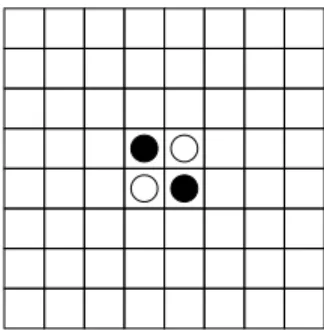
Figure 4: Initial config-uration in Othello.
Othello (Reversi) is a classic game on an 8×8 board, starting from the initial configuration shown in Figure 4, in which players alternately place pieces of their color in unoccupied squares. Moves are restricted to cause, in at least one row, column, or diagonal, a consecutive sequence of pieces of the opposite color to be enclosed by two pieces of the current player’s color. As a result of the move, the enclosed pieces “flip” color into the current player’s color. The winner is the player with the most pieces of their color when the board is filled.
Generalized to an n×n board with an arbitrary initial configuration, the game is clearly in PSPACE because only n2
4.10 Hackenbush
Hackenbush is one of the standard examples of a combinatorial game inWinning Ways; see, e.g., [BCG04, pp. 1–6]. A position is given by a graph with each edge colored either red (Left), blue (Right), or green (neutral), and with certain vertices marked asrooted. Players take turns removing an edge of an appropriate color (either neutral or their own color), which also causes all edges not connected to a rooted vertex to be removed. The winner is determined by normal play.
Chapter 7 of Winning Ways [BCG04, pp. 189–227] proves that determining the value of a red-blue Hackenbush position is NP-hard. The reduction is from minimum Steiner tree in graphs. It applies to a restricted form of hackenbush positions, called redwood beds, consisting of a red bipartite graph, with each vertex on one side attached to a red edge, whose other end is attached to a blue edge, whose other end is rooted.
4.11 Domineering (Crosscram) and Cram
Domineering or crosscram [BCG04, pp. 119–126] is a partizan game involving placement of hor-izontal and vertical dominoes in a grid; a typical starting position is an m×n rectangle. Left can play only vertical dominoes and Right can play only horizontal dominoes, and dominoes must remain disjoint. The winner is determined by normal play.
The complexity of Domineering, computing either the outcome or the value of a position, remains open. Lachmann, Moore, and Rapaport [LMR00] have shown that the winner and a winning strategy can be computed in polynomial time for m ∈ {1,2,3,4,5,7,9,11} and all n. These algorithms do not compute the value of the game, nor the optimal strategy, only a winning strategy.
Cram [Gar86], [BCG04, pp. 502–506] is the impartial version of Domineering in which both players can place horizontal and vertical dominoes. The outcome of Cram is easy to determine for rectangles having an even number of squares [Gar86]: if both sides are even, the second player can win by a symmetry strategy (reflecting the first player’s move through both axes); and if precisely one side is even, the first player can win by playing the middle two squares and then applying the symmetry strategy. It seems open to determine the outcome for a rectangle having two odd sides. The complexity of Cram for general boards also remains open.
Linear Cram is Cram in a 1×nrectangle, where the game quickly splits into a sum of games. This game can be solved easily by applying the Sprague-Grundy theory and dynamic programming; in fact, there is a simpler solution based on proving that its behavior is periodic inn[GS56b]. The variation on Linear Cram in which 1×k rectangles are placed instead of dominoes can also be solved via dynamic programming, but whether the behavior is periodic remains open even for
k= 3 [GS56b]. Mis`ere Linear Cram also remains unsolved [Gar86].
4.12 Dots-and-Boxes, Strings-and-Coins, and Nimstring
Dots-and-Boxes is a well-known children’s game in which players take turns drawing horizontal and vertical edges connecting pairs of dots in anm×nsubset of the lattice. Whenever a player makes a move that encloses a unit square with drawn edges, the player is awarded a point and must then draw another edge in the same move. The winner is the player with the most points when the entire grid has been drawn. Most of this section is based on Chapter 16 ofWinning Ways [BCG04, pp. 541–584]; another good reference is a recent book by Berlekamp [Ber00].
Figure 5: A Dots-and-Boxes endgame.
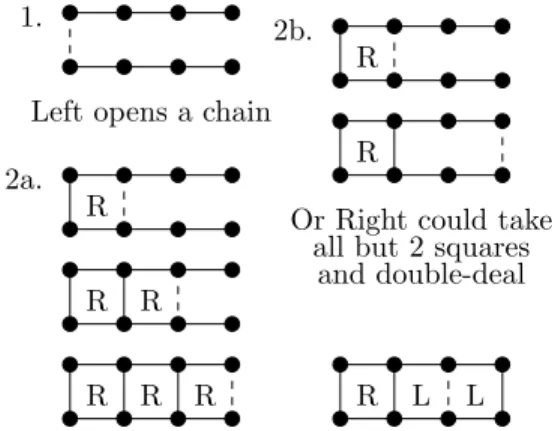
L
Right could claim 3 squares, but then
must move again
R
Or Right could take all but 2 squares
and double-deal
Left wins 2 squares but is forced to open
the next chain R L Left opens a chain
R
R
R R R
R
R
1. 2b.
2a.
Figure 6: Chains and double-dealing in Dots-and-Boxes.
Figure 5. In the endgame, the “free move” awarded by enclosing a square often leads to several squares enclosed in a single move, following achain; see Figure 6. Most children apply the greedy algorithm of taking the most squares possible, and thus play entire chains of squares. However, this strategy forces the player to open another chain (in the endgame). A simple improved strategy is called double dealing, which forfeits the last two squares of the chain, but forces the opponent to open the next chain. The double-dealer is said to remain in control; if there are long-enough chains, this player will win (see [BCG04, p. 543] for a formalization of this statement).
A generalization arising from the dual of Dots-and-Boxes isStrings-and-Coins[BCG04, pp. 550– 551]. This game involves a sort of graph whose vertices arecoins and whose edges arestrings. The coins may be tied to each other and to the “ground” by strings; the latter connection can be modeled as a loop in the graph. Players alternate cutting strings (removing edges), and if a coin is thereby freed, that player collects the coin and cuts another string in the same move. The player to collect the most coins wins.
Another game closely related to Dots-and-Boxes is Nimstring [BCG04, pp. 552–554], which has the same rules as Strings-and-Coins, except that the winner is determined by normal play. Nimstring is in fact a special case of Strings-and-Coins [BCG04, p. 552]: if we add a chain of more thann+ 1 coins to an instance of Nimstring having ncoins, then ideal play of the resulting string-and-coins instance will avoid opening the long chain for as long as possible, and thus the player to move last in the Nimstring instance wins string and coins.
graphs. Embeddability of such graphs in the square grid follows because long chains and cycles (longer than two edges for chains and three edges for cycles) can be replaced by even longer chains or cycles [BCG04, p. 561].
It remains open whether Dots-and-Boxes or Strings-and-Coins are in NP or PSPACE-complete from an arbitrary configuration. Even the case of a 1×ngrid of boxes is not fully understood from a Combinatorial Game Theory perspective [GN02].
4.13 Amazons
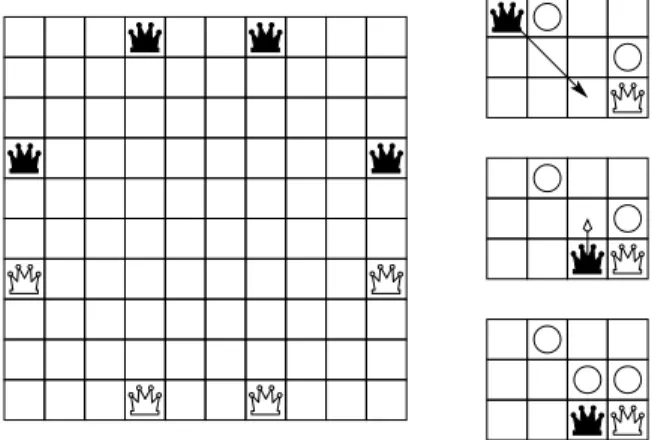
Figure 7: The initial position in Amazons (left) and an example of black trapping a white amazon (right).
Amazons is a game invented by Walter Zamkauskas in 1988, containing elements of Chess and Go. Gameplay takes place on a 10×10 board with four
amazonsof each color arranged as in Figure 7 (left). In each turn, Left [Right] moves a black [white] amazon to any unoccupied square accessible by a Chess queen’s move, and fires an arrow to any un-occupied square reachable by a Chess queen’s move from the amazon’s new position. The arrow (drawn as a circle) now occupies its square; amazons and shots can no longer pass over or land on this square. The winner is determined by normal play.
Gameplay in Amazons typically split into a sum of simpler games because arrows partition the board into multiple components. In particular, the
endgame begins when each component of the game contains amazons of only a single color. Then the goal of each player is simply to maximize the number of moves in each component. Buro [Bur00] proved that maximizing the number of moves in a single component is NP-complete (for
n×nboards). In a general endgame, deciding the outcome may not be in NP because it is difficult to prove that the opponent has no better strategy. However, Buro [Bur00] proved that this problem isNP-equivalent [GJ79], that is, the problem can be solved by a polynomial number of calls to an algorithm for any NP-complete problem, and vice versa.
Like Conway’s Angel Problem (Section 4.16), the complexity of deciding the outcome of a gen-eral Amazons position remained open for sevgen-eral years, only to be solved nearly simultaneously by multiple people. Furtak, Kiyomi, Takeaki, and Buro [FKUB05] give two independent proofs of PSPACE-completeness: one a reduction from Hex, and the other a reduction from Vertex Geog-raphy. The latter reduction applies even for positions containing only a single black and a single white amazon. Independently, Hearn [Hea05a, Hea06b, Hea08a] gave a Constraint Logic reduction showing PSPACE-completeness.
4.14 Konane
Figure 8: One move in Ko-nane consisting of two jumps. Konane, or Hawaiian Checkers, is a game that has been played in
may be thought of as a kind of two-player peg solitaire. A player moves a stone of his color by jumping it over a horizontally or vertically adjacent stone of he opposite color, into an empty space. (See Figure 8.) Jumped stones are captured and removed from play. A stone may make multiple successive jumps in a single move, so long as they are in a straight line; no turns are allowed within a single move. The first player unable to move wins.
Hearn proved that Konane is PSPACE-complete [Hea06b, Hea08a] by a reduction from Con-straint Logic. There have been some positive results for restricted configurations. Ernst [Ern95] derives Combinatorial-Game-Theoretic values for several interesting positions. Chan and Tsai [CT02] analyze the 1×ngame, but even this version of the game is not yet solved.
4.15 Phutball
Conway’s game of Philosopher’s Football or Phutball [BCG04, pp. 752–755] involves white and black stones on a rectangular grid such as a Go board. Initially, the unique black stone (theball) is placed in the middle of the board, and there are no white stones. Players take turns either placing a white stone in any unoccupied position, or moving the ball by a sequence ofjumps over consecutive sequences of white stones each arranged horizontally, vertically, or diagonally. See Figure 9. A jump causes immediate removal of the white stones jumped over, so those stones cannot be used for a future jump in the same move. Left and Right have opposite sides of the grid marked as their goal lines. Left’s goal is to end a move with the ball on or beyond Right’s goal line, and symmetrically for Right.
Figure 9: A single move in Phutball consisting of four jumps.
Phutball is inherently loopy and it is not clear that either player has a winning strategy: the game may always be drawn out indefinitely. One counterintuitive aspect of the game is that white stones placed by one player may be “corrupted” for better use by the other player. Recently, however, Demaine, Demaine, and Eppstein [DDE02] found an aspect of Phutball that could be analyzed. Specifically, they proved that determining whether the current player can win in a single move (“mate in 1” in Chess) is NP-complete. This result leaves open the complexity of determining the outcome of a given game position.
4.16 Conway’s Angel Problem
A formerly long-standing open problem was Conway’sAngel Problem [BCG04]. Two players, the Angel and the Devil, alternate play on an infinite square grid. The Angel can move to any valid position within k horizontal distance and k vertical distance from its present position. The Devil can teleport to an arbitrary square other than where the Angel is and “eat” that square, preventing the Angel from landing on (but not leaping over) that square in the future. The Devil’s goal is to prevent the Angel from moving.
statement,k= 1000.) Recently, four independent proofs established that a sufficiently strong Angel can move forever, securing the Angel as the winner. M´ath´e [M´at07] and Kloster [Klo07] showed that k = 2 suffices; Bowditch [Bow07] showed thatk = 4 suffices; and G´acs [G´ac07] showed that someksuffices. In particular, Kloster’s proof gives an explicit algorithmic winning strategy for the
k= 2 Angel.
4.17 Jenga
Jenga is a popular stacked-block game invented by Leslie Scott in the 1970s and now marketed by Hasbro. Two players alternate moving individual blocks in a tower of blocks, and the first player to topple the tower (or cause any additional blocks to fall) loses. Each block is 1×1×3 and lies horizontally. The initial 3×3×ntower alternates levels of three blocks each, so that blocks in adjacent levels are orthogonal. (In the commercial game, n = 18.) In each move, the player removes any block that is below the topmost complete (3-block) level, then places that block in the topmost level (starting a new level if the existing topmost level is complete), orthogonal to the blocks in the (complete) level below. The player loses if the tower becomes instable, that is, the center of gravity of the top k levels projects outside the convex hull of the contact area between thekth and (k+ 1)st layer.
Zwick [Zwi02] proved that the physical stability condition of Jenga can be restated combi-natorially simply by constraining allowable patterns on each level and the topmost three levels. Specifically, write a 3-bit vector to specify which blocks are present in each level. Then a tower is stable if and only if no level except possibly the top is 100 or 001 and the three topmost levels from bottom to top are none of 010,010,100; 010,010,001; 011,010,100; or 110,010,001. Using this characterization, Zwick proves that the first player wins from the initial configuration if and only if n = 2 or n ≥ 4 and n ≡ 1 or 2 (mod 3), and gives a simple characterization of winning moves. It remains open whether such an efficient solution can be obtained in the generalization to odd numbersk > 3 of blocks in each level. (The case of even kis a second-player win by a simple mirror strategy.)
5
Algorithms for Puzzles
Many puzzles (one-player games) have short solutions and are NP-complete. However, several puzzles based on motion-planning problems are harder, PSPACE-hard. Usually such puzzles occupy a bounded board or region, so they are also PSPACE-complete. A common method to prove that such puzzles are in PSPACE is to give a simple low-space nondeterministic algorithm that guesses the solution, and apply Savitch’s theorem [Sav70] that PSPACE = NPSPACE (nondeterministic polynomial space). However, when generalized to the entire plane and unboundedly many pieces, puzzles often become undecidable.
This section briefly surveys some of these results, following the structure of the previous section.
5.1 Instant Insanity
The cube stacking game is a two-player game based on this puzzle. Given an ordered list of cubes, the players take turns adding the next cube to the top of the stack with a chosen orientation. The loser is the first player to add a cube that causes one of the four sides of the stack to have a color repeated more than once. Robertson and Munro [RM78] proved that this game is complete, intended as a general illustration that NP-complete puzzles tend to lead to PSPACE-complete games.
5.2 Cryptarithms (Alphametics, Verbal Arithmetic)
Cryptarithms oralphametics orverbal arithmetic are classic puzzles involving an equation of sym-bols, the original being Dudeney’s SEN D+M ORE = M ON EY from 1924 [Dud24], in which each symbol (e.g., M) represents a consistent digit (between 0 and 9). The goal is to determine an assignment of digits to symbols that satisfies the equation. Such problems can easily be solved in polynomial time by enumerating all 10! assignments. However, Eppstein [Epp87] proved that it is NP-complete to solve the generalization to base Θ(n3
) (instead of decimal) and Θ(n) symbols (instead of 26).
5.3 Crossword Puzzles and Scrabble
Perhaps one of the most popular puzzles are crossword puzzles, going back to 1913 and today appearing in almost every newspaper, and the subject of the recent documentaryWordplay (2006). Here it is easiest to model the problem of designing crossword puzzles, ignoring the nonmathematical notion of clues. Given a list of words (the dictionary), and a rectangular grid with some squares obstacles and others blank, can we place a subset of the words into horizontally or vertically maximal blank strips so that crossing words have matching letters? Lewis and Papadimitriou [GJ79, p. 258] proved that this question is NP-complete, even when the grid has no obstacles so every row and column must form a word.
Alternatively, this problem can be viewed as the ultimate form of crossword puzzle solving, without clues. In this case it would be interesting to know whether the problem remains NP-hard even if every word in the given list must be used exactly once, so that the single clue could be “use these words”. A related open problem is Scrabble, which we are not aware of having been studied. The most natural theoretical question is perhaps the one-move version: given the pieces in hand (with letters and scores), and given the current board configuration (with played pieces and available double/triple letter/word squares), what move maximizes score? Presumably the decision question is NP-complete. Also open is the complexity of the two-player game, say in the perfect-information variation where both players know the sequence in which remaining pieces will be drawn as well as the pieces in the opponent’s hand. Presumably determining a winning move from a given position in this game is PSPACE-complete.
5.4 Pencil-and-Paper Puzzles: Sudoku and Friends
squares, divided into a 3×3 arrangement of 3×3 tiles. Some grid squares are initially filled with digits between 1 and 9, and some are blank. The goal is to fill the blank squares so that every row, column, and tile has all nine digits without repetition.
Sudoku naturally generalizes to ann2
×n2
grid of squares, divided into ann×narrangement of n×n tiles. Yato and Seta [YS03, Yat03] proved that this generalization is NP-complete. In fact, they proved a stronger completeness result, in the class of Another Solution Problems (ASP), where one is given one or more solutions and wishes to find another solution. Thus, in particular, given a Sudoku puzzle and an intended solution, it is NP-complete to determine whether there is another solution, a problem arising in puzzle design. Most Sudoku puzzles give the promise that they have a unique solution. Valiant and Vazirani [VV86] proved that adding such a uniqueness promise keeps a problem NP-hard under randomized reductions, so there is no polynomial-time solution to uniquely solvable Sudokus unless RP = NP.
ASP-completeness (in particular, NP-completeness) has been established for six other paper-and-pencil puzzles by Japanese publisher Nikoli: Nonograms, Slitherlink, Cross Sum, Fillomino, Light Up, and LITS. In a Nonogram orPaint by Numbers puzzle [UN96], we are given a sequence of integers on each row and column of a rectangular matrix, and the goal is to fill in a subset of the squares in the matrix so that, in each row and column, the maximal contiguous runs of filled squares have lengths that match the specified sequence. InSlitherlink [YS03, Yat03], we are given labels between 0 and 4 on some subset of faces in a rectangular grid, and the goal is to draw a simple cycle on the grid so that each labeled face is surrounded by the specified number of edges. In Kakuro or Cross Sum [YS03], we are given a polyomino (a rectangular grid where only some squares may be used), and an integer for each maximal contiguous (horizontal or vertical) strip of squares, and the goal is to fill each square with a digit between 1 and 9 such that each strip has the specified sum and has no repeated digit. In Fillomino [Yat03], we are given a rectangular grid in which some squares have been filled with positive integers, and the goal is to fill the remaining squares with positive integers so that every maximal connected region of equally numbered squares consists of exactly that number of squares. In Light Up (Akari) [McP05, McP07], we are given a rectangular grid in which squares are either rooms or walls and some walls have a specified integer between 0 and 4, and the goal is to place lights in a subset of the rooms such that each numbered wall has exactly the specified number of (horizontally or vertically) adjacent lights, every room is horizontally or vertically visible from a light, and no two lights are horizontally or vertically visible from each other. In LITS [McP07], we are given a division of a rectangle into polyomino pieces, and the goal is to choose a tetromino (connected subset of four squares) in each polyomino such that the union of tetrominoes is connected yet induces no 2×2 square. As with Sudoku, it is NP-complete to both find solutions and test uniqueness of known solutions in all of these puzzles. NP-completeness has been established for seven other pencil-and-paper games published by Nikoli: Tentai Show, Masyu, Bag, Nurikabe, Hiroimono, Heyawake, and Hitori. InTentai Show or
Spiral Galaxies [Fri02d], we are given a rectangular grid with dots at some vertices, edge midpoints, and face centroids, and the goal is to divide the rectangle into exactly one polyomino piece per dot that is two-fold rotationally symmetric around the dot. InMasyu orPearl Puzzles [Fri02b], we are given a rectangular grid with some squares containing white or black pearls, and the goal is to find a simple path through the squares that visits every pearl, turns 90◦ at every black pearl, does not
turn immediately before or after black pearls, goes straight through every white pearl, and turns 90◦ immediately before or after every white pearl. In Bag orCorral Puzzles [Fri02a], we are given
given a rectangular grid with some squares labeled with positive integers, and the goal is to find a connected subset of unlabeled squares that induces no 2×2 square and whole removal results in exactly one region per labeled square whose size equals that label. McPhail’s reduction [McP03] uses labels 1 through 5, while Holzer et al.’s reduction [HKK04] only uses labels 1 and 2 (just 1 would be trivial) and works without the connectivity rule and/or the 2×2 rule. InHiroimono or
Goishi Hiroi [And07], we are given a collection of stones at vertices of a rectangular grid, and the goal is to find a path that visits all stones, changes directions by ±90◦ and only at stones, and
removes stones as they are visited (similar to Phutball in Section 4.15). In Heyawake [HR07], we are given a subdivision of a rectangular grid into rectangular rooms, some of which are labeled with a positive integer, and the goal is to paint a subset of unit squares so that the number of painted squares in each labeled room equals the label, painted squares are never (horizontally or vertically) adjacent, unpainted squares are connected (via horizontal and vertical connections), and maximal contiguous (horizontal or vertical) strips of squares intersect at most two rooms. InHitori [Hea08c], we are given a rectangular grid with each square labeled with an integer, and the goal is to paint a subset of unit squares so that every row and every column has no repeated unpainted label (similar to Sudoku), painted squares are never (horizontally or vertically) adjacent, and unpainted squares are connected (via horizontal and vertical connections).
A different kind of pencil-and-paper puzzle is Morpion Solitaire, popular in several European countries. The game starts with some configuration of points drawn at the intersections of a square grid (usually in a standard cross pattern). A move consists of placing a new point at a grid intersection, and then drawing a horizontal, vertical, or diagonal line segment connecting five consecutive points that include the new one. Line segments with the same direction cannot share a point (thedisjoint model); alternatively, line segments with the same direction may overlap only at a common endpoint (the touching model). The goal is to maximize the number of moves before no moves are possible. Demaine, Demaine, Langerman, and Langerman [DDLL06] consider this game generalized to moves connecting any number k+ 1 of points instead of just 5. In addition to bounding the number of moves from the standard cross configuration, they prove complexity results for the general case. They show that, in both game models and for k ≥3, it is NP-hard to find the longest play from a given pattern of n dots, or even to approximate the longest play within n1−ε
for any ε >0. For k > 3, the problem is in fact NP-complete. For k = 3, it is open whether the problem is in NP, and fork= 2 it could even be in P.
A final NP-completeness result for pencil-and-paper puzzles is the Battleship puzzle. This puzzle is a one-player perfect-information variant on the classic two-player imperfect-information game,Battleship. In Battleships orBattleship Solitaire [Sev], we are given a list of 1×k ships for various values of k; a rectangular grid with some squares labeled as water, ship interior, ship end, or entire (1×1) ship; and the number of ship (nonwater) squares that should be in each row and each column. The goal is to complete the square labeling to place the given ships in the grid while matching the specified number of ship squares in each row and column.
Several other pencil-and-paper puzzles remain unstudied from a complexity standpoint. For example, Nikoli’s English website2
suggests Hashiwokakero, Kuromasu (Where is Black Cells), Number Link, Ripple Effect, Shikaku, and Yajilin (Arrow Ring); and Nikoli’s Japanese website3
lists more.
5.5 Moving Tokens: Fifteen Puzzle and Generalizations
2
http://www.nikoli.co.jp/en/puzzles/ 3
1 2 4
8 3 6 9
14 5 7 11
12 10 15
13 13 14
10 9 5 6
1 2 3 4
7 8
12 11
15
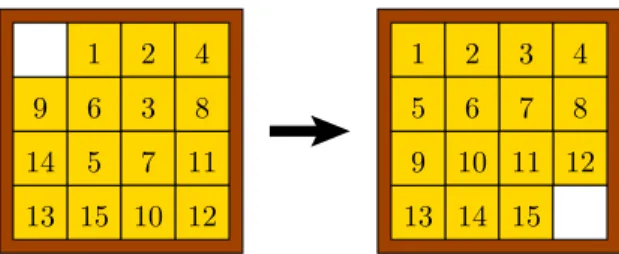
Figure 10: 15 puzzle: Can you get from the left configuration to the right in 16 unit slides? The Fifteen Puzzle or 15 Puzzle [BCG04, p. 864]
is a classic puzzle consisting of fifteen square blocks numbered 1 through 15 in a 4×4 grid; the remaining sixteenth square in the grid is a hole which permits blocks to slide. The goal is to order the blocks to be increasing in English reading order. The (six) hardest solvable positions require exactly 80 moves [BMFN99]. Slocum and Sonneveld [SS06] recently uncovered the history of this late 19th-century puz-zle, which was well-hidden by popularizer Sam Loyd since his claim of having invented it.
A natural generalization of the Fifteen Puzzle is then2
−1 puzzle on ann×ngrid. It is easy to determine whether a configuration of then2
−1 puzzle can reach another: the two permutations of the block numbers (in reading order) simply need to match inparity, that is, whether the number of inversions (out-of-order pairs) is even or odd. See, e.g., [Arc99, Sto79, Wil74]. When the puzzle is solvable, the required numbers moves is Θ(n3
) in the worst case [Par95]. On the other hand, it is NP-complete to find a solution using the fewest possible slides from a given configuration [RW90]. It is also NP-hard to approximate the fewest slides within an additive constant, but there is a polynomial-time constant-factor approximation [RW90].
6 5 4 3 2 1
Figure 11: The Tricky Six Puzzle [Wil74], [BCG04, p. 868] has six connected components of configurations. The parity technique for determining solvability of the n2
−1 puzzle has been generalized to a class of similar puzzles on graphs. Consider an
N-vertex graph in which N −1 vertices have tokens labeled 1 through
N−1, one vertex is empty (has no token), and each operation in the puz-zle moves a token to an adjacent empty vertex. The goal is to reach one configuration from another. This general puzzle encompasses the n2
−1 puzzle and several other puzzles involving sliding balls in circular tracks, e.g., the Lucky Seven puzzle [BCG04, p. 865] or the puzzle shown in Fig-ure 11. Wilson [Wil74], [BCG04, p. 866] characterized when these puzzles are solvable, and furthermore characterized their group structure. In most cases, all puzzles are solvable (forming the symmetric group) unless the graph the graph is bipartite, in which case half of the puzzles are solv-able (forming the alternating group). In addition, there are three special
situations: cycle graphs, graphs having a cut vertex, and the special example in Figure 11.
Even more generally, Kornhauser, Miller, and Spirakis [KMS84] showed how to decide solvability of puzzles with any number kof labeled tokens onN vertices. They also prove thatO(N3
) moves always suffice, and Ω(N3) moves are sometimes necessary, in such puzzles. Calinescu, Dumitrescu,
and Pach [CDP06] consider the number of token “shifts”—continuous moves along a path of empty nodes—required in such puzzles. They prove that finding the fewest-shift solution is NP-hard in the infinite square grid and APX-hard in general graphs, even if the tokens are unlabeled (identical). On the positive side, they present a 3-approximation for unlabeled tokens in general graphs, an optimal solution for unlabeled tokens in trees, an upper bound ofN slides for unlabeled tokens in general graphs, and an upper bound ofO(N) slides for labeled tokens in the infinite square grid.
[HD05], is PSPACE-complete.
Figure 12: A Subway Shuf-fle puzzle with one red car, four blue cars, one yellow car, and one green car. White nodes are empty. Moving the red car to the circled station requires 43 moves.
Subway Shuffle [Hea05b, Hea06b] is another constrained token-sliding puzzle on a graph. In this puzzle both the tokens and the graph edges are colored; a move is to slide a token along an edge of matching color to an unoccupied adjacent vertex. The goal is to move a specified token (the “subway car you have boarded”) to a specified vertex (your “exit station”). A sample puzzle is shown in Figure 12. The complexity of determining whether there is a solution to a given puzzle is open. This open problem is quite fas-cinating: solving the puzzle empirically seems hard, based on the rapid growth of minimum solution length with graph size [Hea05b]. However, it is easy to determine whether a token may move at all by a sequence of moves, evidently making the proof techniques used for Sliding Tokens and related problems useless for showing hardness. Subway Shuffle can also be seen as a generalized version of 1×1 Rush Hour (Section 5.7).
Another kind of token-sliding puzzle isAtomix, a computer game first published in 1990. Game play takes place on a rectangular board; pieces are either walls (immovable blocks) or atoms of different types. A move is to slide an atom; in this case the atom must slide in its direction of motion until it hits a wall (as in the PushPush family, below (Section 5.8)). The goal is to assemble a particular pattern of atoms (a molecule). Huffner, Edelkamp, Fernau, and Niedermeier [HEFN01] observed that Atomix is as hard as the (n2
−1)-puzzle, so it is NP-hard to find a minimum-move solution. Holzer and Schwoon [HS04a] later proved the stronger result that it is PSPACE-complete to determine whether there is a solution.
Lunar Lockout is another token-sliding puzzle, similar to Atomix in that the tokens slide until stopped. Lunar Lockout was produced by ThinkFun at one time; essentially the same game is now sold as “Pete’s Pike”. (Even earlier, the game was called “UFO”.) In Lunar Lockout there are no walls or barriers; a token may only slide if there is another token in place that will stop it. The goal is to get a particular token to a particular place. Thus, the rules are fairly simple and natural; however, the complexity is open, though there are partial results. Hock [Hoc01] showed that Lunar Lockout is NP-hard, and that when the target token may not revisit any position on the board, the problem becomes NP-complete. Hartline and Libeskind-Hadas [HLH03] show that a generalization of Lunar Lockout which allows fixed blocks is PSPACE-complete.
5.6 Rubik’s Cube and Generalizations
Alternatively, then2
−1 puzzle can be viewed as a special case of determining whether a permutation on N items can be written as a product (composition) of given generating permutations, and if so, finding such a product. This family of puzzles also includes Rubik’s Cube (recently shown to be solvable in 26 moves [KC07]) and its many variations. In general, the number of moves (terms) required to solve such a puzzle can be exponential (unlike the Fifteen Puzzle). Nonetheless, an
O(N5
)-time algorithm can decide whether a given puzzle of this type is solvable, and if so, find an implicit representation of the solution [Jer86]. On the other hand, finding a solution with the fewest moves (terms) is PSPACE-complete [Jer85]. When each given generator cyclically shifts just a bounded number of items, as in the Fifteen Puzzle but not in a k×k×k Rubik’s Cube, Driscoll and Furst [DF83] showed that such puzzles can be solved in polynomial time using just
only permitted moves are swapping adjacent elements on a line. See [KMS84, McK84] for other (not explicitly algorithmic) results on the maximum number of moves for various special cases of such puzzles.
5.7 Sliding Blocks and Rush Hour
Figure 13: Dad’s Puzzle [Gar64]: mov-ing the large square into the lower-left corner requires 59 moves.
A classic reference on a wide class of sliding-block puzzles is by Hordern [Hor86]. One general form of these puzzles is that rectangular blocks are placed in a rectangular box, and each block can be moved horizontally and vertically, provided the blocks remain disjoint. The goal is usually either to move a particular block to a particular place, or to re-arrange one configura-tion into another. Figure 13 shows an example which, according to Gardner [Gar64], may be the earliest (1909) and is the most widely sold (after the Fifteen Puzzle, in each case). Gardner [Gar64] first raised the question of whether there is an efficient algorithm to solve such puzzles. Spirakis and Yap [SY83] showed that achieving a specified target configuration is NP-hard, and conjectured PSPACE-completeness. Hopcroft, Schwartz, and Sharir [HSS84] proved PSPACE-completeness shortly afterwards, renaming the problem to the “Warehouseman’s Problem”. In the Warehouseman’s Problem, there is no restriction on the sizes of blocks; the blocks in the reduction grow with the size of the containing box. By contrast, in most sliding-block puzzles, the
blocks are of small constant sizes. Finally, Hearn and Demaine [HD02, HD05] showed that it is PSPACE-hard to decide whether a given piece can move at all by a sequence of moves, even when all the blocks are 1×2 or 2×1. This result is best possible: the results above about unlabeled tokens in graphs show that 1×1 blocks are easy to re-arrange.

![Figure 2: A natural start- start-ing configuration for 10 × 10 Checkers, from [FGJ + 78].](https://thumb-ap.123doks.com/thumbv2/123deta/6506633.166392/10.918.616.809.786.988/figure-natural-start-start-ing-configuration-checkers-fgj.webp)