New DFT Techniques of Non-Scan Sequential Circuits
with Complete Fault Efficiency
Debesh Kumar Das Satoshi Ohtake Hideo Fujiwara
Dept. of Comp. Sc. and Engg. Graduate School of Information Science
Jadavpur University Nara Institute of Science and Technology
Calcutta-700 032, India 8916-5, Takayama-Cho, Ikoma, Nara 630-0101, Japan
[email protected] {ohtake, fujiwara}@is.aist-nara.ac.jp
Abstract:
As opposed to scan schemes, a non-scan DFT allows at-speed testing. This paper suggests three techniques on non-scan DFT of sequential circuits. The proposed techniques guarantee 100% fault efficiency by using combinational ATPG tool. In all techniques, an additional circuit called CRIS is proposed to reach unreachable states on the state register of a machine. The second and third techniques use an additional hardware called differentiating logic (DL), that uniquely identifies a state appearing in a state register. The design of DL is universal, i.e., not dependent on the circuit structure. Hardware overhead of DL and CRIS is lower than that of full scan. Test generation and application time are found to compare favorably with those of earlier designs.
1. Introduction
To achieve a good design-for-testability (DFT) technique, the designers must have following goals – 1) to decrease test generation time, 2) to decrease test application time, 3) to have high fault efficiency∗, 4) to achieve at-speed testing, and 5) hardware overhead should also be less in the designs. One approach in DFT designs is scan technique. In full scan technique [1,2], the test generation problem of a sequential circuit is reduced to that of a combinational one and use of combinational ATPG guarantees complete fault efficiency. Partial scan [3,4] offers low hardware overhead than full scan, but as it uses sequential test generation methods, high fault efficiency cannot be achieved. However, scan techniques fail to provide at-speed testing. To avoid the problems of scan techniques, non-scan approaches are proposed in [6-9]. In [6], some flip- flops are controlled by multiplexers. In [7], DFTs are
∗The ratio of number of faults detected or proved redundant by a test algorithm to the total number of faults in a circuit is known as fault efficiency.
designed using locally available lines. In [8], non- scan design was targeted only to remove equivalent and isomorph redundancy. In all these approaches, though testing time may be improved, complete fault efficiency cannot be achieved. Non-scan DFT approach with complete fault efficiency using combinational ATPG is first proposed in [9].
This paper suggests three new non-scan DFT techniques for sequential circuits. In the proposed techniques, test sequences for different faults in a sequential machine are found by generating test patterns by a combinational ATPG tool used on combinational part of the machine and use of such ATPG tool guarantees complete fault efficiency. As each test pattern generated by this ATPG tool consists of values on primary inputs as well as state registers, some test patterns may consist some values that can never be reached by state transitions from reset states. To reach such values on state registers (invalid states), we propose a technique to append an extra logic called circuit to reach invalid states (CRIS) with the original machine. Among the three techniques, the first one requires k additional observable points (k is the number of flip-flops in the circuit). Use of one more additional circuit called as Differentiating Logic (DL) greatly reduces the number of additional observable points in second and third techniques. The DL part of the proposed additional hardware is universal (i.e., independent of the original machine). To increase the testability for PLA-based machines, the work in [11] appends an additional hardware. However, hardware overhead in [11] is higher and it depends on the original machine. Three proposed techniques, the method in [9] and full scan technique are compared on benchmarks. First two techniques have low hardware overhead. First and third techniques have low test application time. Test application time of the second technique is larger in comparison to those of first and third, but it is less than that of full scan. Test length and hardware overhead are found to compare favorably with those of scan and previous non-scan approaches.
IEEE the 8th Asian Test Symposium (ATS'99), pp. 263-268, Nov. 1999.
2. Preliminaries
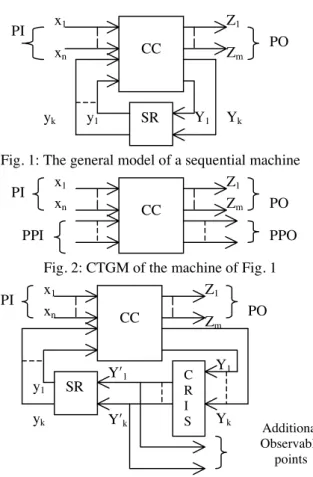
The general model of a synchronous sequential machine is shown in Fig. 1, consisting of a combinational circuit (CC) and a state register (SR). The machine has n primary input (PI) fed by Binary variables x1, x2,…, xn. The outputs [inputs] y1, y2,…, yk [Y1, Y2,…, Yk] of k memory elements of SR define the present [next] state of the machine. The behavior of the machine is described by the state transition diagram (STG). We assume that the machine has a reset state. Given an input, transition from a state Si means the state transitions and change in primary output (PO) lines, if that input is applied in the machine with state Si. If a fault f in a sequential machine changes the transitions from a state Si, then to detect f, we have to first initialize the machine to state Si (called initialization state for f). To do this, we have to apply a sequence of vectors (known as justification sequence [5] of Si), application of which to the machine in the reset state, changes the state to Si. However, there may not exist any such justification sequence for a state Si, as there may exist some states in the machine that are unreachable or cannot be reached in sufficient time (hard to reach) from the reset state. But some of these may be needed for initialization for testing. A state that cannot be reached or which is hard to reach from reset state is known as an invalid state, else it is a valid state. The list of invalid and valid states in a machine can be known from STG of the machine. To detect a fault, after the application of justification sequence, we to apply another sequence of vectors known as differentiating sequence. A differentiating sequence [5] for a pair of states Sj and Sk, in a sequential circuit is a minimal length sequence of input vectors, such that the output response obtained by applying the sequence when the circuit is initially in Sj, is different from that obtained when the circuit is initially in Sk. Let us extract the combinational circuit from a sequential machine, by replacing inputs [outputs] of SR by pseudo primary outputs (PPOs) [pseudo primary inputs (PPIs)]. Then this combinational circuit is known as the combinational test generation model (CTGM) of the sequential machine. For example, CTGM of the machine of Fig. 1 is shown in Fig. 2. Given the CTGM of a sequential machine, we try to generate the test vectors for this CTGM. Obviously each test vector is an ordered (n+k)-tuple, corresponding to n PIs and k PPIs. A state in a machine is called a test state, if it appears in PPI lines of any test vector of CTGM of the machine. A state of a machine which is a test state and also a valid [an invalid] state is known as valid test state [invalid test state]. In general, the number of test states is much smaller compared with the total number of states, 2k.
3. New DFT designs
From STG of the machine, first we find the set of valid and invalid states. Then we use combinational ATPG algorithm to find the set of test vectors of the CTGM. If such a test vector is a valid test state, then this state can be reached from the reset state. But if it is an invalid test state (i.e, it is unreachable from the reset state), the value of PPIs cannot be set to the SR using state transitions of the machine. The problem of state initialization to an unreachable state poses a major problem in the test generation of sequential circuits. In our designs, we adopt a new technique to reach these unreachable states. Notice that to test a circuit, we need not reach all invalid states, reaching only to invalid test states are sufficient.
3.1 The first technique
In our design to set the invalid test states to the SR, we append an extra logic called as CRIS (circuit to reach invalid states) to the original machine that generates all invalid test states of the machine. The DFT scheme is shown in Fig. 3. CRIS has the inputs as the next state lines of the original machine. In a similar approach recently [9], an additional circuit was also used to reach these invalid test states, where primary inputs are used as inputs to the extra logic.
CC
SR y1
yk
xn
x1 Z1
Zm
PI PO
Fig. 1: The general model of a sequential machine Y1 Yk
Fig. 2: CTGM of the machine of Fig. 1 CC
xn
x1 Z1
Zm
PI PO
PPI PPO
CC
SR y1
yk
xn
x1 Z1
Zm
PI PO
Fig. 3: DFT to achieve complete fault efficiency (Technique 1)
Y1
Yk
C R I
S Additional
Observable points Y′1
Y′k
(a) Designing CRIS: Let V [SITS] denotes the set of valid [invalid test] states in the machine. Then, any state Si ∈V [SITS] can [cannot] appear in next state lines by proper [any] transition from reset state. CRIS makes also the appearance of SITS at the inputs to SR. For this, CRIS takes PPOs (Y1, Y2, …, Yk) as the inputs, and produces (Y′1, Y′2,…, Y′k) as inputs to SR using some control inputs. The output of CRIS is the same as input when control inputs are at logic 0, and when one or more of them is 1, it produces some invalid test state. Optimization of number of control inputs and hardware of CRIS is an open problem. Here, we follow a heuristic approach. For each state Si ∈ SITS, we first find how Si can be produced from each state Sj ∈V. For example, say an invalid test state 0101 can be produced from a valid state 0011 by complementing 2nd and 3rd bits of 0011. This can be done by ORing Y2 and ANDing Y3 with a control input C, as shown in Fig. 4. For each state Si ∈ SITS, we find how Si can be produced from any state in V in this manner. Among these different possible productions, we implement one that with minimum hardware. If different invalid test states require same bit to be complemented, we use the same control line. If any line requires both ANDing and ORing, we replace the gate by XOR.
(b) Number of control inputs and hardware overhead of CRIS: Theoretically, the number of such control lines requirement can be maximum k, and that happens when there is only one valid state in the machine and there are at least 2k-1 invalid test states. But practically, as number of invalid test states is much smaller (can be at most the number of test states) in comparison to total number (=2k) of states, and that is not very high in comparison to number of valid states, control lines requirement and hardware overhead cannot be high. By our heuristic approach, benchmarks result depicts significantly low overhead. (c) Testing of CRIS: To detect a fault, the machine is initialized to its test state by justification sequence and controlling control inputs of CRIS. As all next state lines are observable, a state reached at next state lines after justification sequence can be identified. Thus, any fault in CRIS is also detected.
(d) Short test application time: When an initialization state Si for a fault is properly reached in present state lines of SR, hold mode is activated where the state of the machine is kept at Si, independently of the inputs at PIs. As several faults may have same test state Si, for all such faults test vectors are applied consecutively holding the machine at state Si. Moreover, with the observation of next state lines, the length of differentiating sequence is always null. Use of CRIS to reach unreachable states, use of no differentiating sequences and use of hold mode to avoid the repeated application of same justification sequence highly reduce test application time.
(e) Short test generation time and complete fault efficiency: Use of combinational ATPG tool decreases test generation time. Use of this tool and use of CRIS to ensure the machine to reach any test state make fault efficiency to be 100%.
3.2 The second technique
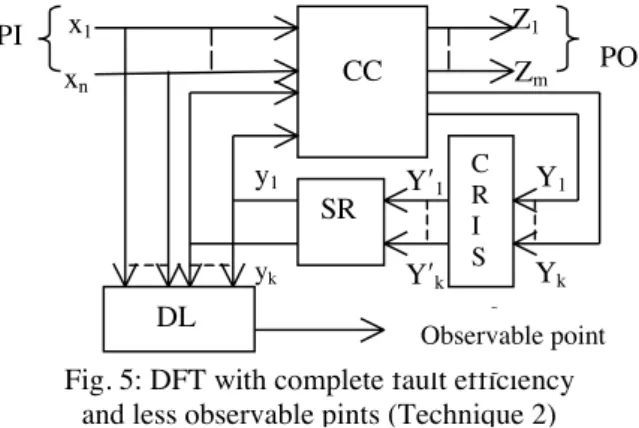
The drawback of the first technique is that it requires k additional observable points. To reduce the number of observable points, we use one more additional circuit known as differentiating logic (DL). The complete scheme is shown in Fig. 5.
(a) Design of (DL): Two cases need to be considered. Case 1: k < n: In this case, DL has one output, given by F =x1y1+x1y1+x2y2+x2y2+……+xkyk+ xkyk. The circuit to realize F is shown in Fig. 6. The function F has a unique property. For every combination of (y1, y2,…, yk), yi ∈ (0,1), the sub- function contains a unique pattern in xis, such that for a pattern (y1, y2,…, yk) at PPIs, if we apply a pattern X at PIs with (x1, x2,…, xk) = (y1, y2,…, yk), we get the output of DL as 0, and for any other pattern at PI the output is at logic 1. It implies that if the machine reaches a state Si(y1, y2,…, yk), then by applying a single input pattern, obtained by complementing each bit of (y1, y2,…, yk), this state can be uniquely identified. That is, differentiating sequence of any two states is of unit length.
Y1
Y2
Y3
Y4
Y’1
Y’2
Y’3
Y’4
C
Fig.4: An example of CRIS
CC
SR y1
yk xn
x1 Z1
Zm
PI PO
Fig. 5: DFT with complete fault efficiency and less observable pints (Technique 2)
Y′1
Y′k
C R I S
Observable point DL
Y1
Yk
Example 1: The K-map for k=3 is shown in Fig. 7. Variables xi’s (yi’s) are used to label the map horizontally (vertically). A horizontal line in k-map corresponds to a state. Note that any state can be uniquely identified by a single input pattern. For example, a state (y1,y2,y3) = (010), can be uniquely identified by the vector (x1,x2,x3)=(101).
Case 2: k > n: DL has r (= k/n) outputs, and each output line realizes Fi (1< i <r) s.t., Fj+1 = x1yjn+1
+x1yjn+1+x2yjn+2+x2yjn+2+……+ xayjn+a + xayjn+a
where a = n for (0<j<r-1), and a=k-(r-1)n for j=r-1. If a is found to be 1, then we replace Fj+1 by yjn+1. (b) DL is universal: Design of DL is dependent only on the number of PIs and flip-flops in the circuit, i.e., it is universal, not dependent on the circuit structure. Thus, any fault in DL does not interfere with the original circuit behavior.
(c) Use of Hold mode: It is used to identify a state. If a state (y1,y2,…,yk) is expected at present state lines, we activate hold mode and apply an input for case 1 (input sequence for case2) at PIs such that xi = yi ∀ i (1<i<n). If the output of DL is 0, then the state of the machine is identified as the expected state.
(d) Techniques to achieve low test application time: As differentiating sequence is of length r = k/n, test application time is greatly reduced, which is n in case of full scan. To decrease it further, we adopt following technique. Say, to detect a fault, the machine is initialized to a state Si. Now, application of the test vector may change the state to Sj. If Sj is a test state, we use it as an initialization state of another fault. If Sj is not a test state or there is no other fault left to be detected with initialization state Sj, then we attempt to initialize the machine to any other test state. Compared with full scan, our method results low test application time in benchmarks.
(e) Testing of CRIS and DL: Any fault in DL or CRIS can be detected, by observing the output of DL. (f) Hardware overhead: It equals to (2k+r) gates, where is less than that of full scan for r < n-1.
3.3 The third technique
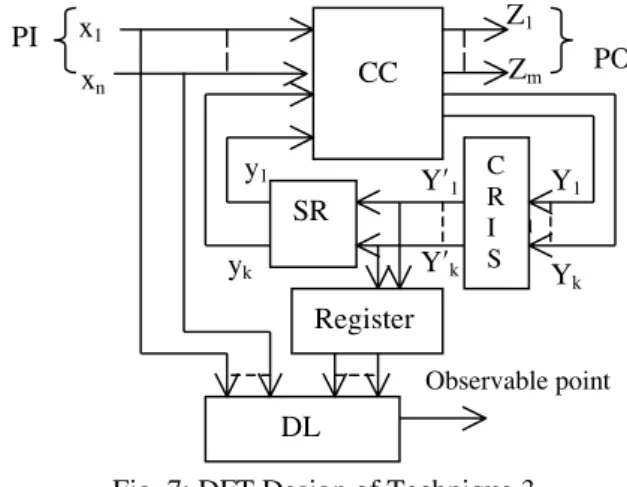
Drawback of second technique is that as observable points use present state lines, we cannot use the same justification sequence for different faults having same initialization state. To avoid this, the third technique is proposed, where a register R is used to load the values of the next state lines and outputs of R are fed into DL. The complete scheme is shown in Fig. 8. Use of hold mode is similar to that of first technique.
4. Experimental Results
General performance of the DFT Design can be described as in Table 1. Rows “scan”, “ATS-98”,
“case1”, “case2” and “case3” represent full scan, the method in [9], technique-1, technique-2 and technique-3 respectively. O(ISG) and O(CRIS) indicate the overhead of invalid state generator (ISG) in the paper of [9] and that of CRIS of this paper respectively. It is found experimentally that O(CRIS)
< O(ISG). O(CRIS) was found to be maximum of two two-input gates in MCNC benchmarks. The value c denotes the number of control inputs needed for CRIS and r equals to k/n, where n and k are the number of PIs and flip-flops in the machine respectively. In most cases of benchmarks, r is found to be 1 and c is 1, except in two cases, where it is found to be 2.
x1
y1
x2
y2
xk
yk
F
Fig. 6: Differentiating Logic (DL)
x1
x2 x3 x3
1 1 1 1 1 0 1 1 1 1 1 1 0 1 1 1 1 1 1 1 1 1 1 0 1 1 1 1 1 1 0 1 1 0 1 1 1 1 1 1 0 1 1 1 1 1 1 1 1 1 1 0 1 1 1 1 1 1 0 1 1 1 1 1
y1
y2
y3
y3
Fig. 7: K-map of DL for k=3 and n > 3
CC
SR y1
yk
xn
x1
Z1
Zm
PI PO
Fig. 7: DFT Design of Technique 3 Y′1
Y′k
C R I S
Observable point DL
Y1
Yk
Register
Z1
Table 1: Overall comparison
Method overhead TG TA At-speed Pin Area time time
scan 3 3k gates low high Not possible ATS-98 k+2 O(ISG) low low possible T-1 k+1+c O(CRIS) low low possible T-2 r+1+c O(CRIS)+ low higher than T-1, possible (2k+r) gates less than scan
T-3 r+1 O(CRIS)+ low low possible (9k+r) gates
Table 2: STG characteristic
name #PIs #POs #States #FFs
bbara 4 2 10 4
bbsse 7 7 16 4
bbtas 2 2 6 3
beecount 3 4 7 3
cse 7 7 16 4
dk14 3 5 7 3
dk15 3 5 4 2
dk16 2 3 27 5
dk17 2 3 8 3
ex1 9 19 20 5
ex2 2 2 19 5
ex3 2 2 10 4
ex4 6 9 14 4
ex5 2 2 9 4
ex6 5 8 8 3
ex7 2 2 10 4
keyb 7 2 19 5
kirkman 12 6 16 4
lion 2 1 4 2
lion9 2 1 9 4
mc 3 5 4 2
opus 5 6 10 4
planet 7 19 48 6
planet1 7 19 48 6
pma 8 8 24 5
s1 8 6 20 5
s1488 8 19 48 6
s1494 8 19 48 6
s208 11 2 18 5
s27 4 1 6 3
s298 3 6 218 8
s386 7 7 13 4
s420 19 2 18 5
s510 19 7 47 6
s820 18 19 25 5
s832 18 19 25 5
sand 11 9 32 5
sse 7 7 16 4
styr 9 10 30 5
tav 4 4 4 2
tbk 6 3 32 5
tma 7 6 20 5
train11 2 1 11 4
train4 2 1 4 2
Experimental results on benchmarks are also shown. Benchmark specifications are shown in Table 2. AutoLogic II (Mentor Graphics) tool synthesizes the circuits from MCNC benchmarks [10]. Columns
“name”, “#PIs”, “#POs”, “#states”, “#FFs” denote
the name, the number PIs, POs, states, and flip-flops of the original sequential machines respectively. In benchmark results, we show only those cases when number of inputs (n) > 1. For n=1, we apply only the first technique of our DFT designs.
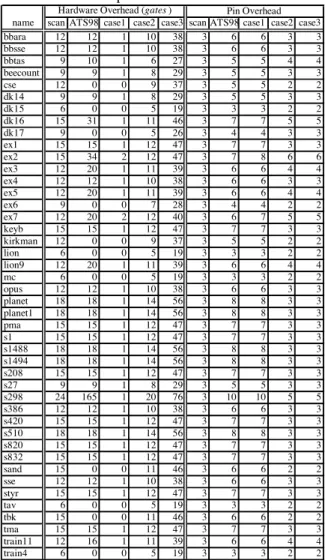
Table 3: Hardware/pin overhead
Hardware Overhead (gates ) Pin Overhead name scan ATS98 case1 case2 case3 scan ATS98 case1 case2 case3
bbara 12 12 1 10 38 3 6 6 3 3
bbsse 12 12 1 10 38 3 6 6 3 3
bbtas 9 10 1 6 27 3 5 5 4 4
beecount 9 9 1 8 29 3 5 5 3 3
cse 12 0 0 9 37 3 5 5 2 2
dk14 9 9 1 8 29 3 5 5 3 3
dk15 6 0 0 5 19 3 3 3 2 2
dk16 15 31 1 11 46 3 7 7 5 5
dk17 9 0 0 5 26 3 4 4 3 3
ex1 15 15 1 12 47 3 7 7 3 3
ex2 15 34 2 12 47 3 7 8 6 6
ex3 12 20 1 11 39 3 6 6 4 4
ex4 12 12 1 10 38 3 6 6 3 3
ex5 12 20 1 11 39 3 6 6 4 4
ex6 9 0 0 7 28 3 4 4 2 2
ex7 12 20 2 12 40 3 6 7 5 5
keyb 15 15 1 12 47 3 7 7 3 3
kirkman 12 0 0 9 37 3 5 5 2 2
lion 6 0 0 5 19 3 3 3 2 2
lion9 12 20 1 11 39 3 6 6 4 4
mc 6 0 0 5 19 3 3 3 2 2
opus 12 12 1 10 38 3 6 6 3 3
planet 18 18 1 14 56 3 8 8 3 3
planet1 18 18 1 14 56 3 8 8 3 3
pma 15 15 1 12 47 3 7 7 3 3
s1 15 15 1 12 47 3 7 7 3 3
s1488 18 18 1 14 56 3 8 8 3 3
s1494 18 18 1 14 56 3 8 8 3 3
s208 15 15 1 12 47 3 7 7 3 3
s27 9 9 1 8 29 3 5 5 3 3
s298 24 165 1 20 76 3 10 10 5 5
s386 12 12 1 10 38 3 6 6 3 3
s420 15 15 1 12 47 3 7 7 3 3
s510 18 18 1 14 56 3 8 8 3 3
s820 15 15 1 12 47 3 7 7 3 3
s832 15 15 1 12 47 3 7 7 3 3
sand 15 0 0 11 46 3 6 6 2 2
sse 12 12 1 10 38 3 6 6 3 3
styr 15 15 1 12 47 3 7 7 3 3
tav 6 0 0 5 19 3 3 3 2 2
tbk 15 0 0 11 46 3 6 6 2 2
tma 15 15 1 12 47 3 7 7 3 3
train11 12 16 1 11 39 3 6 6 4 4
train4 6 0 0 5 19 3 3 3 2 2
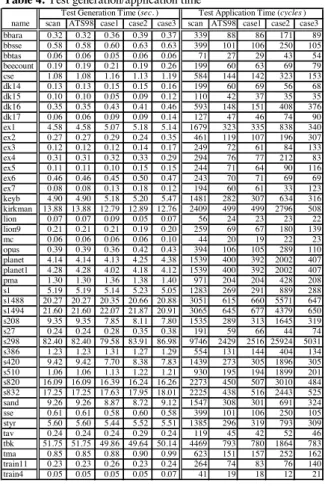
Table 3 shows hardware and pin overhead. Hardware overhead of first technique is lowest and significantly small. Hardware overhead of both first and second technique is smaller than that of full scan. The third technique needs more hardware as an additional register of k flip-flops (k= # of flip-flops) are used. We have considered 7 gates per flip-flop in third technique. In the techniques 2 & 3, number of gates are decreased by 3 from that given in the formula of Table 1, if the remainder in dividing k by n be 1. Pin overhead of proposed second and third techniques are same and in most cases it equals to that of full scan technique which is always 3. The first technique, requires more number of pins and it is same as that in the method of [9]. Test generation and application time for different methods are shown in Table 4. A combinational/sequential test generation tool
TestGen (Sunrise) is used. Results show that test generation time is almost equal in five cases. Test application time is highest in case of full scan method. This time is almost equal in the method of [9], first technique and third technique. Second technique requires larger test application time in comparison to those of first and third techniques, but this time is short in comparison to that of full scan.
Table 4: Test generation/application time
Test Generation Time (sec. ) Test Application Time (cycles ) name scan ATS98 case1 case2 case3 scan ATS98 case1 case2 case3
bbara 0.32 0.32 0.36 0.39 0.37 339 88 86 171 89
bbsse 0.58 0.58 0.60 0.63 0.63 399 101 106 250 105
bbtas 0.06 0.06 0.05 0.06 0.06 71 27 29 43 54
beecount 0.19 0.19 0.21 0.19 0.26 199 60 63 69 79
cse 1.08 1.08 1.16 1.13 1.19 584 144 142 323 153
dk14 0.13 0.13 0.15 0.15 0.16 199 60 69 56 68
dk15 0.10 0.10 0.05 0.09 0.12 110 42 37 35 35
dk16 0.35 0.35 0.43 0.41 0.46 593 148 151 408 376
dk17 0.06 0.06 0.09 0.09 0.14 127 47 46 74 90
ex1 4.58 4.58 5.07 5.18 5.14 1679 323 335 838 340
ex2 0.27 0.27 0.29 0.24 0.35 461 119 107 196 307
ex3 0.12 0.12 0.12 0.14 0.17 249 72 61 84 133
ex4 0.31 0.31 0.32 0.33 0.29 294 76 77 212 83
ex5 0.11 0.11 0.10 0.15 0.15 244 71 64 90 116
ex6 0.46 0.46 0.45 0.50 0.47 243 70 71 69 69
ex7 0.08 0.08 0.13 0.18 0.12 194 60 61 33 123
keyb 4.90 4.90 5.18 5.20 5.47 1481 282 307 634 316
kirkman 13.88 13.88 12.79 12.89 12.76 2409 499 499 2796 508
lion 0.07 0.07 0.09 0.05 0.07 56 24 23 23 22
lion9 0.21 0.21 0.21 0.19 0.20 259 69 67 180 139
mc 0.06 0.06 0.06 0.06 0.10 44 20 19 22 23
opus 0.39 0.39 0.36 0.42 0.43 394 106 105 289 110
planet 4.14 4.14 4.13 4.25 4.38 1539 400 392 2002 407 planet1 4.28 4.28 4.02 4.18 4.12 1539 400 392 2002 407
pma 1.30 1.30 1.36 1.38 1.40 971 204 204 428 208
s1 5.19 5.19 5.14 5.23 5.05 1283 269 291 889 288
s1488 20.27 20.27 20.35 20.66 20.88 3051 615 660 5571 647 s1494 21.60 21.60 22.07 21.87 20.91 3065 645 677 4379 650
s208 9.35 9.35 7.85 8.11 7.80 1535 289 313 1645 319
s27 0.24 0.24 0.28 0.35 0.38 191 59 66 44 74
s298 82.40 82.40 79.58 83.91 86.98 9746 2429 2516 25924 5031
s386 1.23 1.23 1.31 1.27 1.29 554 131 144 404 134
s420 9.42 9.42 7.70 8.38 7.83 1439 273 305 1896 305
s510 1.06 1.06 1.13 1.22 1.21 930 195 194 1899 201
s820 16.09 16.09 16.39 16.24 16.26 2273 450 507 3010 484 s832 17.25 17.25 17.63 17.95 18.01 2225 438 516 2443 525
sand 9.26 9.26 8.87 8.72 9.12 1547 308 301 691 324
sse 0.61 0.61 0.58 0.60 0.58 399 101 106 250 105
styr 5.60 5.60 5.44 5.52 5.51 1385 296 319 793 309
tav 0.24 0.24 0.24 0.29 0.24 119 45 42 52 46
tbk 51.75 51.75 49.86 49.64 50.14 4469 793 780 1864 783
tma 0.85 0.85 0.88 0.90 0.99 623 151 157 252 162
train11 0.23 0.23 0.26 0.23 0.24 264 74 83 76 140
train4 0.05 0.05 0.05 0.05 0.07 41 19 18 12 21
5. Conclusions
The paper suggests three new techniques on non-scan DFT. As state initialization is a major problem in testing of sequential circuits, it solves that problem by using an additional hardware called as CRIS (circuit to reach invalid states). It is found experimentally that hardware overhead of CRIS is also low. The techniques use combinational ATPG tool to find the test sequences of the machine. Among the three techniques, hardware overhead of the first technique is the lowest, but it requires k additional observable points. To decrease the number of observable points, a notion of differentiating logic (DL) is proposed in technique 2. Even with the use of this DL, hardware overhead is less than that of full scan. Use of this DL increases test application time in comparison to that of first technique, but this time is
less than that of full scan. To achieve the test application time, same as that of first technique, an additional register is used in third technique. The novelty of these techniques is that they guarantee complete fault efficiency with at-speed testing. Hardware overhead, test generation time and test application time compare favorably with those of earlier designs. Future work includes the application of the same technique for larger circuits.
Acknowledgement: Debesh Kumar Das is supported by JSPS-INSA fellowship during the preparation of this work. Satoshi Ohtake is under JSPS research fellowship. This work was supported in part by Semiconductor Technology Academic Research Center (STARC) under the Research Project and in part by the Ministry of Education, Science, Sports and Culture, Japan under Grant-in-Aid for Scientific Research B(2) (no.09480054). Authors would like to thank Toshimitsu Masuzawa, Tomoo Inoue, and Michiko Inoue of Nara Institute of Science and Technology for their helpful discussion.
References:
1. H. Fujiwara, Logic Testing and Design for Testability, The MIT Press, 1985.
2. M. Abramovici, M. A. Breuer and A. D. Friedman, Digital Systems Testing and Testable Design, W. H. Freeman & Co., New York 1990.
3. S. T. Chakradhar, A. Balkrishnan and V. D. Agrawal,
“An exact algorithm for selecting partial scan flip flops,” Proc. DAC-94, pp. 81-86.
4. P. S. Parikh and M. Abramovici, “A cost based approach to partial scan,” Proc. DAC-93. 5. S. Devadas and K. Keutzer, “A unified approach to
the synthesis of fully testable sequential machines,” TCAD, vol.10, pp. 39-50, 1991.
6. V. Chickermane, E. M. Rudnick, P. Banerjee and J. H. Patel, “Non-scan design-for-testability techniques for sequential circuits,” Proc. DAC-93, pp. 236-241. 7. I. Pomeranz and S. M. Reddy, “Design for testability for sequential circuits using locally available lines,” Proc. DATE-98, pp. 983-984.
8. D. K. Das and B. B. Bhattacharya, “Testable design of non-scan sequential circuits using extra logic,” Proc. ATS-95, pp. 176-182.
9. S. Ohtake, T. Masuzawa and H. Fujiwara, “A non- scan DFT method for controllers to achieve complete fault efficiency,” Proc. ATS-98.
10. S. Yang, “Logic synthesis and optimization benchmarks user guide,” Technical Report 1991- IWLS-UG-Saeyang, Microelectronics Center of North Carolina.
11. S. T. Chakradhar, S. Kanjilal, V. D. Agrawal, “Finite state machine synthesis with fault tolerant test function,” Journal of Electronic Testing: Theory and Applications, pp. 57-69, 1993.