Results & Discussion II
スケジュール
9/4( 火 ) 9/5( 水 ) 9/6( 木 ) 9/7( 金 )
3 限 導入 Method Results &
Discussion Abstract &
Title
4 限 Introduction Results Conclusion Revision
5 限 Introduction Discussion Conclusion まとめ
スケジュール
9/4( 火 ) 9/5( 水 ) 9/6( 木 ) 9/7( 金 )
3 限 導入 Method Results &
Discussion Abstract &
Title
4 限 Introduction Results Conclusion Revision
5 限 Introduction Discussion Conclusion まとめ
Writing for Academic Purposes
英作田地文を卒業して英語論文を書く
田地野 彰、ティム・スチュワート、デビッド・ダルスキー 編 ひつじ書房
京都大学で使われている英語教科 書
EGAP に関する研究とカリキュラ ムに基づく
Writing for Academic Purposes
英作田地文を卒業して英語論文を書く
田地野 彰、ティム・スチュワート、デビッド・ダルスキー 編 ひつじ書房
• Part I Key Issues in Academic Writing
Chapter 1 The Primary Features of Academic Writing
Chapter 2 Understanding the Structure of Research Papers Chapter 3 Academic Vocabulary and Academic Writing Chapter 4 Critical Thinking and Reading Research Papers Chapter 5 Critical Reading : An Application of Critical Thinking Part II Writing an Academic Paper
Chapter 6 Writing the Outline and the First Draf Chapter 7 Researching an Academic Paper
Chapter 8 Writing the Abstract Chapter 9 Writing the Introduction Chapter 10 Writing the Body Section Chapter 11 Writing the Conclusion
Chapter 12 Citing Sources and Writing the References Section Part III Academic Writing Classes at Kyoto University Chapter 13 Focusing on Structure: Comparison and Contrast Chapter 14 Peer Review: Editing an Academic Paper
Chapter 15 Academic Writing in the Hybrid Classroom
Writing Academic English
Alice Oshima, Ann Hogue
レポート、エッセイの基礎を しっかり押さえるのに最適 パラグラフライティング エッセイライティング
Rhetorical modes ( 比較、議論、説明 ) 文体
Academic writing for graduate students
John Swales, Christine Feak
定義文、要約 ( レポート ) 、批評、 学術論文の書き方など
大学院で必要なライティングスキルにつ いて
理系英語のライティング ( 理系たまごシリーズ 3)
野口ジュディー監修・著 / 深山晶子・岡本真由美著
英語で学術論文を書くための解説 ( 日本語 )
ムーブ分析などに基づく
Results
Results( 結果 ) と Discussion( 考察 ) の違いと
は?
Results Discussion
Describe Explain
Depict Interpret
Demonstrate
Show
Results
(1) Results のムーブを知る。
(2) 時制とコロケーションに気を付ける。
本時の目標
Results の構造
ムーブ
観点 分析の観点を示す
発見 調査から得た発見を示す
図表 図表を参照する
例示 発見の具体例を示す
対象 調査の対象をふり返る
予告 次に来る情報を予告する
Results セクション
Results の構造
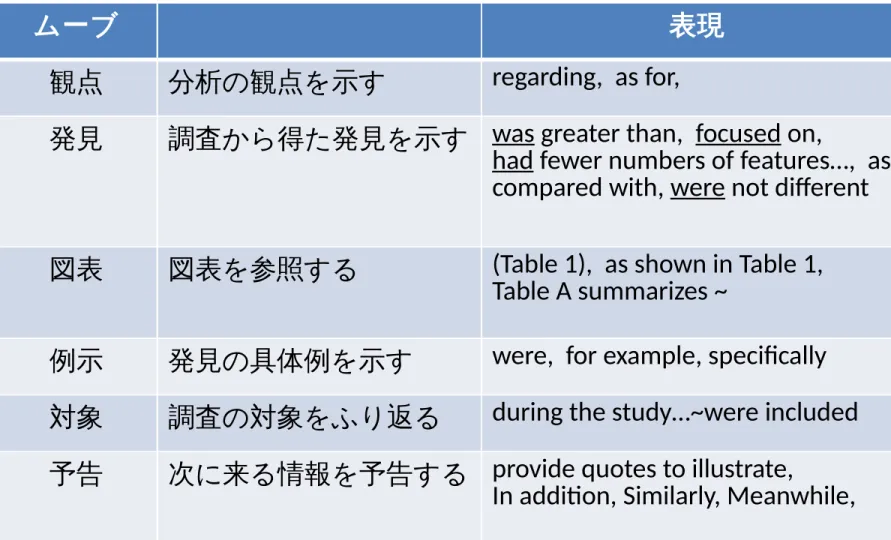
ムーブ 表現
観点 分析の観点を示す regarding, as for,
発見 調査から得た発見を示す was greater than, focused on,
had fewer numbers of features…, as compared with, were not different 図表 図表を参照する (Table 1), as shown in Table 1,
Table A summarizes ~
例示 発見の具体例を示す were, for example, specifically 対象 調査の対象をふり返る during the study…~were included 予告 次に来る情報を予告する provide quotes to illustrate,
In addition, Similarly, Meanwhile,
Results セクション
Discussion
Discussion
(1) Discussion のムーブを知る。
(2) 解釈する。
(Results で発見したことに関して意味付けをし、論
じる )
(3) 位置づける。
( 先行研究との比較 )
本時の目標
Discussion の構造
ムーブ
結果 調査の結果をまとめる
解釈 先行研究をふり返る
先行研究と本研究との相違を指摘する 本研究で発見したことを論じる
限界 本研究の問題点を示す
本研究の問題点を検討する
Discussion セクション
Discussion の構造
ムーブ 表現
結果 調査の結果をまとめる In our study, X are focusing on Y
解釈 先行研究をふり返る found that, X was not associated with B, were preferred for,
先行研究と本研究との相 違を指摘する
have identified few studies… that provide evidence
本研究で発見したことを 論じる
add to the literature by providing empirical evidence , submit that~, this result could be interpreted as~ 限界 本研究の問題点を示す our study has some limitations,
the sample size was small,
our findings may not apply to other types of presentations.
本研究の問題点を検討す る
However, allowed us to explore areas without cueing
Discussion セクション