
The Attraction of Korean Unification
Inter-Korean and International Costs and Benefits
Kyuryoon Kim et al.
Research on Uniication Costs and Beneits 2013-2
Kyuryoon Kim et al.
Research on Unification Costs and Benefits 2013-2
The Attraction of Korean Unification
Inter-Korean and International Costs and Benefits
The Attraction of Korean Unification
Inter-Korean and International Costs and Benefits
Printed December 2013 PublishedDecember 2013
Published by Korea Institute for National Unification(KINU) Publisher President, Korea Institute for National Unification Editor Center for International Relations Studies
Registration Number No.2-02361 (April 23, 1997)
Address 123, 4.19-ro (Suyudong), Gangbuk-gu, Seoul 142-728, Korea Telephone (82-2) 900-4300; (82-2) 901-2521
Fax (82-2) 901-2541
Homepage http://www.kinu.or.kr Design․Print
ISBN 978-89-8479-751-2 93340 Price ₩15,500
Copyright Korea Institute for National Unification, 2013
All KINU publications are available for purchase at all major book store in Korea. Also available at Government Printing Office Sales Center. Store (82-2) 734-6818; Office (82-2) 394-0337
The Attraction of Korean Unification
Inter-Korean and International Costs and Benefits
Kyuryoon Kim et al.
The analyses, comments and other opinions contained in this book are
Vxklgik シシシシシシシシシシシシシシシシシシシシシシシシシシシシシシシシシシシシシシシシシシシシシシシシシシシシシシシシシシシシシシシシシシシシシシシシシシシシシシシシシシシシシシシシシシ~ooo
Ghyzxgiz シシシシシシシシシシシシシシシシシシシシシシシシシシシシシシシシシシシシシシシシシシシシシシシシシシシシシシシシシシシシシシシシシシシシシシシシシシシシシシシシシシシシシシシ~|o
Otzxuj{izout シシシシシシシシシシシシシシシシシシシシシシシシシシシシシシシシシシシシシシシシシシシシシシシシシシシシシシシシシシシシシシシシシシシシシシシシシシシシシシシシシシシシシ7 4& M{ojotm& Z。vk& ul& [toloigzout シシシシシシシシシシシシシシシシシシシシシシシシシシシシシシシシシシシシシシシシシシシシシシ? 4& Znxkk3Yzgmk3Znxkk3Gxkg& Iuyzy& gtj& Hktklozy& Sujkr シシシシ7>
Vgxz& 74& Iuyzy& gtj& Hktklozy& ul& Quxkgt& [toloigzout@&
Otzkx3Quxkgt& Josktyout シシシシシシシシシシシシシシシシシシシシシシシシシシシシシシシシシシシシシシシシシシシシ8= 4& U|kx|ok}& ul& znk& Kiutusoi& Sujkr シシシシシシシシシシシシシシシシシシシシシシシシシシシシシシシシシシ8? 4& Kiutusoi& Kllkizy& ul& znk& [toloigzout& Vxkvgxgzout&
Vkxouj& gtj& znk& Jo|oyout& Joyyur|otm& Yzgmk シシシシシシシシシシシシシシシシシシシシ;6 4& Kiutusoi& Kllkizy& ul& znk& Y。yzks& Otzkmxgzout& Yzgmk シシシシ=; 4& Kiutusoi& Kllkizy& ul& znk& Tgzout& H{orjotm& Yzgmk& gtj&
znk& [tolokj& Tgzout& Vkxouj シシシシシシシシシシシシシシシシシシシシシシシシシシシシシシシシシシシシシシシシシシシシシシシシ?; 4& Y{ssgx。& ul& Kiutusoi& Kllkizy& u|kx& Grr& Yzgmky シシシシシシシシ77=
Vgxz& 84& Iuyzy& gtj& Hktklozy& ul& Quxkgt& [toloigzout@&
Otzkxtgzoutgr& Josktyout シシシシシシシシシシシシシシシシシシシシシシシシシシシシシシシシシシシシシシシシシシシ7;? 4& Znk& Iuyzy& gtj& Hktklozy& ul& Quxkgt& [toloigzout& lux&
znk& [tozkj& Yzgzky シシシシシシシシシシシシシシシシシシシシシシシシシシシシシシシシシシシシシシシシシシシシシシシシシシシシシシシシシシシシシ7<7 4& Znk& Iuyzy& gtj& Hktklozy& ul& Quxkgt& [toloigzout&
lux& Inotg シシシシシシシシシシシシシシシシシシシシシシシシシシシシシシシシシシシシシシシシシシシシシシシシシシシシシシシシシシシシシシシシシシシシシシシシシシシ7?; Research on Unification Costs and Benefits 2013-2
Contents
4& Znk& Iuyzy& gtj& Hktklozy& ul& Quxkgt& [toloigzout&
lux& X{yyog シシシシシシシシシシシシシシシシシシシシシシシシシシシシシシシシシシシシシシシシシシシシシシシシシシシシシシシシシシシシシシシシシシシシシシシシシ89: 4& Znk& Iuyzy& gtj& Hktklozy& ul& Quxkgt& [toloigzout&
lux& Pgvgt シシシシシシシシシシシシシシシシシシシシシシシシシシシシシシシシシシシシシシシシシシシシシシシシシシシシシシシシシシシシシシシシシシシシシシシシシシ8==
Iutir{yout シシシシシシシシシシシシシシシシシシシシシシシシシシシシシシシシシシシシシシシシシシシシシシシシシシシシシシシシシシシシシシシシシシシシシシシシシシシシシシシシシシシ96? 4& Y{ssgx。& ul& Xkykgxin& Lotjotmy シシシシシシシシシシシシシシシシシシシシシシシシシシシシシシシシシシシシ977
^OOO4& Vuroi。& Iutyojkxgzouty シシシシシシシシシシシシシシシシシシシシシシシシシシシシシシシシシシシシシシシシシシシシシシシシシシシシシシ98;
Xklkxktiky シシシシシシシシシシシシシシシシシシシシシシシシシシシシシシシシシシシシシシシシシシシシシシシシシシシシシシシシシシシシシシシシシシシシシシシシシシシシシシシシシシシ997
Xkiktz& V{hroigzouty シシシシシシシシシシシシシシシシシシシシシシシシシシシシシシシシシシシシシシシシシシシシシシシシシシシシシシシシシシシシシシシシシシ99?
BZghrk& 7D Z。vky& ul& [toloigzout シシシシシシシシシシシシシシシシシシシシシシシシシシシシシシシシシシシシシシシシシシシシシシ76 BZghrk& 8D Sgot& Uhpkizo|ky& gtj& Zgyqy& ul& Jo|oyout&
Joyyur|otm& Yzgmk シシシシシシシシシシシシシシシシシシシシシシシシシシシシシシシシシシシシシシシシシシシシシシシシシシシシシ7; BZghrk& 9D Sgot& Uhpkizo|ky& gtj& Zgyqy& ul& Y。yzks&
Otzkmxgzout& Yzgmk シシシシシシシシシシシシシシシシシシシシシシシシシシシシシシシシシシシシシシシシシシシシシシシシシシシシ7< BZghrk& :D Sgot& Uhpkizo|ky& gtj& Zgyqy& ul& Tgzout&
H{orjotm& Yzgmk シシシシシシシシシシシシシシシシシシシシシシシシシシシシシシシシシシシシシシシシシシシシシシシシシシシシシシシシ7= BZghrk& ;D Y{ssgx。& ul& Kiutusoi& Vuroi。& Ingtmky シシシシシシシシシシシシシ:> BZghrk& <D [toloigzout& Vxkvgxgzout& Vkxouj& .867:3868>/ シシシシシシシ;8 BZghrk& =D Jo|oyout& Joyyur|otm& Yzgmk& .868>38696/ シシシシシシシシシシシシシシ<: BZghrk& >D Tut3Xgtjus& \gr{ky& ul& Xgzouy& ul& Qk。& Vkx&
Igvozg& \gxoghrky シシシシシシシシシシシシシシシシシシシシシシシシシシシシシシシシシシシシシシシシシシシシシシシシシシシシシ=6 BZghrk& ?D Y。yzks& Otzkmxgzout& Yzgmk& .8696386:6/ シシシシシシシシシシシシシシシ== BZghrk& 76D Tgzout& H{orjotm& Yzgmk& .86:6386;6/ シシシシシシシシシシシシシシシシシシシシシ?= BZghrk& 77D Znk& [tolokj& Tgzout& Vkxouj& .86;6386<6/ シシシシシシシシシシシ76> BZghrk& 78D Grr& Vkxoujy& gtj& Yzgmky& .867:386<6/ シシシシシシシシシシシシシシシシシ77> BZghrk& 79D Tut3Kiutusoi& Iuyzy& gtj& Hktklozy& lux& Inotg シシシ 878 BZghrk& 7:D Kiutusoi& Iuyzy& gtj& Hktklozy& lux& Inotg シシシシシシシシシシ87? BZghrk& 7;D Inotg y& Sgpux& Iutikxty シシシシシシシシシシシシシシシシシシシシシシシシシシシシシシシシシシシシシシ88= BZghrk& 7<D Sgpux& Tut3Kiutusoi& Iuyzy& gtj& Hktklozy&
lux& znk& Tkomnhuxotm& Vu}kxy シシシシシシシシシシシシシシシシシシシシシシシシシシシシシシシ986 BZghrk& 7=D Sgpux& Kiutusoi& Iuyzy& gtj& Hktklozy&
lux& znk& Tkomnhuxotm& Vu}kxy シシシシシシシシシシシシシシシシシシシシシシシシシシシシシシシ988
List of Tables
Research on Unification Costs and Benefits 2013-2
BLom{xk& O37D Iutikvz{gr& Jogmxgs@& znk& M{ojotm& Z。vk& ul& [toloigzout シシシシシシシシシシシシシシシシシシシシシシシシシシシシシシシシシシシシシシシシシシシシシシシシシシシシ78 BLom{xk& O38D [toloigzout& Vxuikyy シシシシシシシシシシシシシシシシシシシシシシシシシシシシシシシシシシシシシシシシシシ7: BLom{xk& 37D Znxkk3Yzgmk3Znxkk3Gxkg& Iuyzy& gtj&
Hktklozy& Sujkr シシシシシシシシシシシシシシシシシシシシシシシシシシシシシシシシシシシシシシシシシシシシシシシシシシ7> BLom{xk& 37D Tut3Xgtjus& Zosk& Vgzny& lux& MJV&
gtj& Iuty{svzout シシシシシシシシシシシシシシシシシシシシシシシシシシシシシシシシシシシシシシシシシシシシシシ;; BLom{xk& 38D Tut3Xgtjus& Zosk& Vgzny& lux& ]gmky シシシシシシシシシシ;< BLom{xk& 39D Tut3Xgtjus& Zosk& Vgzny& lux& \gxou{y&
Igvozgr& Yzuiqy シシシシシシシシシシシシシシシシシシシシシシシシシシシシシシシシシシシシシシシシシシシシシシシシシシシ;= BLom{xk& 3:D Tut3Xgtjus& Zosk& Vgzny& lux& Otzkxkyz&
Xgzky シシシシシシシシシシシシシシシシシシシシシシシシシシシシシシシシシシシシシシシシシシシシシシシシシシシシシシシシシシシシシシシシシシシ;= BLom{xk& 3;D Zosk& Vgzny& }ozn& Iutlojktik& Hgtjy& lux&
Qk。& \gxoghrky シシシシシシシシシシシシシシシシシシシシシシシシシシシシシシシシシシシシシシシシシシシシシシシシシシシ;> BLom{xk& 3<D Tut3Xgtjus& Zosk& Vgzny& lux& MJV&
gtj& Iuty{svzout シシシシシシシシシシシシシシシシシシシシシシシシシシシシシシシシシシシシシシシシシシシシシシ<< BLom{xk& 3=D Tut3Xgtjus& Zosk& Vgzny& lux& ]gmky シシシシシシシシシシ<= BLom{xk& 3>D Tut3Xgtjus& Zosk& Vgzny& lux& \gxou{y&
Igvozgr& Yzuiqy シシシシシシシシシシシシシシシシシシシシシシシシシシシシシシシシシシシシシシシシシシシシシシシシシシシ<> BLom{xk& 3?D Tut3Xgtjus& Zosk& Vgzny& lux& Otzkxkyz&
Xgzky シシシシシシシシシシシシシシシシシシシシシシシシシシシシシシシシシシシシシシシシシシシシシシシシシシシシシシシシシシシシシシシシシシシ<? BLom{xk& 376D Zosk& Vgzn& lux& N{sgtozgxogt& Goj シシシシシシシシシシシシシシシシシ<? BLom{xk& 377D Zosk& Vgzny& }ozn& Iutlojktik& Hgtjy& lux&
Qk。& \gxoghrky シシシシシシシシシシシシシシシシシシシシシシシシシシシシシシシシシシシシシシシシシシシシシシシシシシシ=7
List of Figures
BLom{xk& 37D Tut3Xgtjus& Zosk& Vgzn& lux& \gxou{y&
Zxgtylkx& Vg。sktzy シシシシシシシシシシシシシシシシシシシシシシシシシシシシシシシシシシシシシシシシシシ>6 BLom{xk& 38D Tut3Xgtjus& Zosk& Vgzn& lux& Sorozgx。&
Igvozgr シシシシシシシシシシシシシシシシシシシシシシシシシシシシシシシシシシシシシシシシシシシシシシシシシシシシシシシシシシシシシシシシ>8 BLom{xk& 39D Tut3Xgtjus& Zosk& Vgzny& lux& Otzkxkyz&
Xgzky シシシシシシシシシシシシシシシシシシシシシシシシシシシシシシシシシシシシシシシシシシシシシシシシシシシシシシシシシシシシシシシシシシシ>: BLom{xk& 3:D Zosk& Vgzn& lux& Igvozgr& Somxgzout& lxus&
Yu{zn& zu& Tuxzn シシシシシシシシシシシシシシシシシシシシシシシシシシシシシシシシシシシシシシシシシシシシシシシシシ>: BLom{xk& 3;D Zosk& Vgzn& lux& Rghux& Somxgzout& lxus&
Tuxzn& zu& Yu{zn シシシシシシシシシシシシシシシシシシシシシシシシシシシシシシシシシシシシシシシシシシシシシシシシシ>; BLom{xk& 3<D Tut3Xgtjus& Zosk& Vgzny& lux&
Otzkxtgzoutgr& Yg|otmy シシシシシシシシシシシシシシシシシシシシシシシシシシシシシシシシシシシシシシシ>< BLom{xk& 3=D Tut3Xgtjus& Zosk& Vgzny& lux& MJV&
gtj& Iuty{svzout シシシシシシシシシシシシシシシシシシシシシシシシシシシシシシシシシシシシシシシシシシシシシシ>= BLom{xk& 3>D Tut3Xgtjus& Zosk& Vgzny& lux& ]gmky シシシシシシシシシシ>> BLom{xk& 3?D Tut3Xgtjus& Zosk& Vgzny& lux&
Tuxzn3zu3Yu{zn& Xgzouy& ul& Qk。& \gxoghrky シシシシ>? BLom{xk& 376D Tut3Xgtjus& Zosk& Vgzny& lux& \gxou{y&
Igvozgr& Yzuiqy シシシシシシシシシシシシシシシシシシシシシシシシシシシシシシシシシシシシシシシシシシシシシシシシシシシ>? BLom{xk& 377D Zosk& Vgzny& lux& U}tkj& Igvozgr& |y4&
Kllkizo|k& Igvozgr シシシシシシシシシシシシシシシシシシシシシシシシシシシシシシシシシシシシシシシシシシシシシシシ?6 BLom{xk& 378D Zosk& Vgzn& lux& Vxuj{izo|oz。& ot& znk&
Tuxzn& Xkrgzo|k& zu& g& 74=+& Mxu}zn& Zxktj シシシシ?7 BLom{xk& 379D Zosk& Vgzny& }ozn& Iutlojktik& Hgtjy& lux&
Qk。& \gxoghrky シシシシシシシシシシシシシシシシシシシシシシシシシシシシシシシシシシシシシシシシシシシシシシシシシシシ?8 Research on Unification Costs and Benefits 2013-2
BLom{xk& 37D Tut3Xgtjus& Zosk& Vgzny& lux& MJV&
gtj& Iuty{svzout シシシシシシシシシシシシシシシシシシシシシシシシシシシシシシシシシシシシシシシシシシシシシシ?> BLom{xk& 38D Tut3Xgtjus& Zosk& Vgzny& lux& ]gmky シシシシシシシシシシ?? BLom{xk& 39D Tut3Xgtjus& Zosk& Vgzny& lux& Tuxzn3zu3
Yu{zn& Xgzouy& ul& Qk。& Vkx& Igvozg& \gxoghrky シシシ766 BLom{xk& 3:D Tut3Xgtjus& Zosk& Vgzny& lux& Otzkxkyz&
Xgzky シシシシシシシシシシシシシシシシシシシシシシシシシシシシシシシシシシシシシシシシシシシシシシシシシシシシシシシシシシシシシシシシシ766 BLom{xk& 3;D Tut3Xgtjus& Zosk& Vgzny& lux& \gxou{y&
Igvozgr& Yzuiqy シシシシシシシシシシシシシシシシシシシシシシシシシシシシシシシシシシシシシシシシシシシシシシシシシ767 BLom{xk& 3<D Zosk& Vgzny& lux& U}tkj& Igvozgr& |y4&
Kllkizo|k& Igvozgr シシシシシシシシシシシシシシシシシシシシシシシシシシシシシシシシシシシシシシシシシシシシシ768 BLom{xk& 3=D Tut3Xgtjus& Zosk& Vgzn& lux& Igvozgr&
Somxgzout& lxus& Yu{zn& zu& Tuxzn シシシシシシシシシシシシシシシシシシ769 BLom{xk& 3>D Tut3Xgtjus& Zosk& Vgzny& lux&
Otzkxtgzoutgr& Yg|otmy シシシシシシシシシシシシシシシシシシシシシシシシシシシシシシシシシシシシシ769 BLom{xk& 3?D Zosk& Vgzny& }ozn& Iutlojktik& Hgtjy& lux&
Qk。& \gxoghrky シシシシシシシシシシシシシシシシシシシシシシシシシシシシシシシシシシシシシシシシシシシシシシシシシ76: BLom{xk& 376D Tut3Xgtjus& Zosk& Vgzny& lux& MJV& gtj&
Iuty{svzout シシシシシシシシシシシシシシシシシシシシシシシシシシシシシシシシシシシシシシシシシシシシシシシシシシシシ776 BLom{xk& 377D Tut3Xgtjus& Zosk& Vgzny& lux& ]gmky シシシシシシシシ776 BLom{xk& 378D Tut3Xgtjus& Zosk& Vgzny& lux& Tuxzn3zu3
Yu{zn& Xgzouy& ul& Qk。& Vkx& Igvozg& \gxoghrky シシシ777 BLom{xk& 379D Tut3Xgtjus& Zosk& Vgzny& lux& \gxou{y&
Igvozgr& Yzuiqy シシシシシシシシシシシシシシシシシシシシシシシシシシシシシシシシシシシシシシシシシシシシシシシシシ778 BLom{xk& 37:D Zosk& Vgzny& lux& U}tkj& Igvozgr& |y4&
Kllkizo|k& Igvozgr シシシシシシシシシシシシシシシシシシシシシシシシシシシシシシシシシシシシシシシシシシシシシ778
BLom{xk& 37;D Tut3Xgtjus& Zosk& Vgzn& lux& Igvozgr&
Somxgzout& lxus& Yu{zn& zu& Tuxzn シシシシシシシシシシシシシシシシシシ779 BLom{xk& 37<D Tut3Xgtjus& Zosk& Vgzny& lux&
Otzkxtgzoutgr& Yg|otmy シシシシシシシシシシシシシシシシシシシシシシシシシシシシシシシシシシシシシ779 BLom{xk& 37=D Zosk& Vgzny& }ozn& Iutlojktik& Hgtjy& lux&
Qk。& \gxoghrky シシシシシシシシシシシシシシシシシシシシシシシシシシシシシシシシシシシシシシシシシシシシシシシシシ77: BLom{xk& 37D Tut3Xgtjus& Zosk& Vgzny& lux& Otzkxkyz&
Xgzky シシシシシシシシシシシシシシシシシシシシシシシシシシシシシシシシシシシシシシシシシシシシシシシシシシシシシシシシシシシシシシシシシ789 BLom{xk& 38D Tut3Xgtjus& Zosk& Vgzny& lux& MJV&
gtj& Iuty{svzout シシシシシシシシシシシシシシシシシシシシシシシシシシシシシシシシシシシシシシシシシシシシ78: BLom{xk& 39D Tut3Xgtjus& Zosk& Vgzny& lux& \gxou{y&
Igvozgr& Yzuiqy シシシシシシシシシシシシシシシシシシシシシシシシシシシシシシシシシシシシシシシシシシシシシシシシシ78; BLom{xk& 3:D Tut3Xgtjus& Zosk& Vgzny& lux& ]gmky シシシシシシシシ78; BLom{xk& 3;D Zosk& Vgzny& lux& U}tkj& Igvozgr& |y4&
Kllkizo|k& Igvozgr シシシシシシシシシシシシシシシシシシシシシシシシシシシシシシシシシシシシシシシシシシシシシ78< BLom{xk& 3<D Tut3Xgtjus& Zosk& Vgzny& lux&
Otzkxtgzoutgr& Yg|otmy シシシシシシシシシシシシシシシシシシシシシシシシシシシシシシシシシシシシシ78= BLom{xk& 3=D Tut3Xgtjus& Zosk& Vgzny& lux& Qk。&
[tolokj& \gxoghrky シシシシシシシシシシシシシシシシシシシシシシシシシシシシシシシシシシシシシシシシシシシシ78> BLom{xk& 3>D Tut3Xgtjus& Zosk& Vgzn& lux& [tolokj&
Otzkxtgzoutgr& Yg|otmy シシシシシシシシシシシシシシシシシシシシシシシシシシシシシシシシシシシシシ78> BLom{xk& 3?D Tut3Xgtjus& Zosk& Vgzny& lux&
Tuxzn3zu3Yu{zn シシシシシシシシシシシシシシシシシシシシシシシシシシシシシシシシシシシシシシシシシシシシシシシ78? BLom{xk& 376D Zosk& Vgzn& }ozn& Iutlojktik& Hgtjy& lux&
Iuty{svzout& ot& znk& Yu{zn シシシシシシシシシシシシシシシシシシシシシシシシシシシシ797 Research on Unification Costs and Benefits 2013-2
BLom{xk& 37D Inotkyk& V{hroi y& \ok}& ut& znk& Quxkgt&
[toloigzout シシシシシシシシシシシシシシシシシシシシシシシシシシシシシシシシシシシシシシシシシシシシシシシシシシシシシシシ7?> BLom{xk& ^37D X{yyog y& Kiutus。& Mxu}zn& .866;38678/ シシシシシ 8<: BLom{xk& 37D Tut3Xgtjus& Zosk& Vgzny& lux& MJV& gtj&
Iuty{svzout& ot& Grr& [toloigzout& Yzgmky シシシシシシ97<
Preface
Korea Institute for National Unification (KINU) has made every effort to enhance understanding about the future shape of unification between the two Koreas since its foundation in 1991. To meet the recent quest for new approaches in the unification studies, KINU launched five year-long research project in 2011 under the theme of the Comprehensive Research on the Costs and Benefits of Korean Unification. As the word
‘comprehensive’ indicates, this research aims at the complete investigation about the potential effects of the unification in the Korean peninsula.
For the purpose of building a strong foundation for the multi-year research project, we identified the most contested questions and figured out solutions to the problematic issues related with the research on the costs and benefits of the Korean unification during the first year of the research project. We also built a comprehensive architecture for the research as briefly explained in the introduction. Based upon this research framework, we constructed a systematic analytical model and tried to find out related factors as much as possible during the second year of the research. We also delineated a plausible path named as
“Guiding Type of Unification” in order to present more detailed explanation and to offer more realistic description about the future unification.
We, then, decided to share our research efforts with the international community in 2013. Our preceding researches indicated that it was necessary for us to consider dual dimensions of the Korean unification:
inter-Korean and international aspects. A research on the effects of the unification about the inter-Korean factors has been carried out using computer simulation based upon the conditions suggested by our previous research. International aspects were analyzed by the international experts from the four neighboring countries, i.e., the United States, China, Russia and Japan.
Professor Kerk Phillips and Professor Scott Bradford from Brigham Young University performed the research related to the inter-Korean dimensional effects. Dr. Kongdan Oh and Ralph Hassig elucidated the United States’ interests and attitudes, and the study of Dr. Keyu Gong showed Chinese viewpoints. Dr. Alexander Fedorovskiy and Dr. Natalia Toganova contributed to Russian perspectives. Dr. Sachio Nakato’s study explicates Japanese concerns and expectations.
We would like to express appreciation for the research assistants, who devoted their times and efforts to complete the current research. Ryne Bellistion of Brigham Young University assisted in running computer simulations and Soohwan Hwang and Junyoung Kim at KINU made great efforts in running the research project and in publishing this book.
During the course of running this year’s research project, we have closely maintained communication among the participated experts throughout the year of 2013. Especially, we had intensive discussion sessions during July and August regarding the potential effects of the unification on the economies of the North and the South for the purpose of specifying conditions to be used in the computer simulation. Another important brainstorming seminar was held to iron out costs and benefits
of the four neighboring countries with sincere participation of the international co-authors and domestic commentators, who stimulated our new thoughts on the international aspects of the Korean unification. We also offered an open seminar to the audiences in Korea under the title of “Future of Korean Unification: Costs and Benefits of the U.S., China, Russia and Japan,” on November 3rd, 2013.
We hope this book could help the peoples to better understand the Korean question and to broaden knowledge about the potential effects of the unification between the two Koreas. We would like to note that the views expressed in this book do not necessarily reflect the views of any organization with which the participating experts are affiliated.
Abstract
The Attraction of Korean Unification:
Inter-Korean and International Costs and Benefits
Kyuryoon Kim et al.
In purposes to overcome the negative publicity toward the Korean unification and to provide a more feasible and practical unification preparation, the Korea Institute for National Unification has conducted a five-year research project to build a comprehensive architecture for the unification costs and benefits. The project, through several brainstorming sessions and seminars with a variety of experts, has developed a scenario and a model: the Guiding Type of Unification and the Three-Stage-Three-Area Costs and Benefits Model. The Guiding type scenario suggests a gradual and asymmetrical unification process that describes a South Korea-led unification under an agreement by all parties, including South and North Korea and the international community. The Three-Stage-Three-Area Costs and Benefits Model is an analytical tool to reveal and examine major factors of the process. For the first time in this area of research, the model includes political and social areas. It divides the unification and integration process into three stages - Division Dissolving, System Integration and Nation Building.
For the third phase of the five-year project, this study expands its focus to international research cooperation: A quantitative model-based approach to the economic changes in the Korean peninsula, and the
costs and benefits of the Korean unification for neighboring powers. Accordingly, this book consists of three major parts: first, Chapters I and briefly review our scenario and analytic model. The structure and process of unification depicted in these chapters function as the basic premises and assumptions of the studies in the following inter-Korean and international dimensions chapters. Second, Part 1 calculates the major macroeconomic unification variables using a general equilibrium model. The study adopts the dynamic stochastic general equilibrium (DSGE) model because the model is a proper device to estimate overall costs and benefits during the unification process. Especially, it captures the developments of various economic values by year during unification process.
The DSGE model covers three main periods: the Unification Preparation period (2014-2028), the Unification Process period (2028-2050), and the Unified Nation period (2050-2060). The Unification Process period is again divided into the Division Dissolving stage (2028-2030), the System Integration stage (2031-2040), and the Nation Building stage (2041-2050).
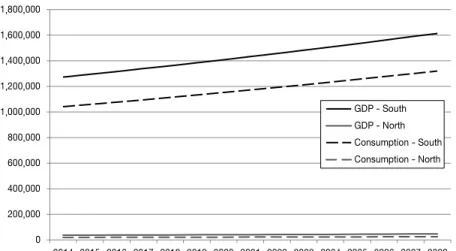
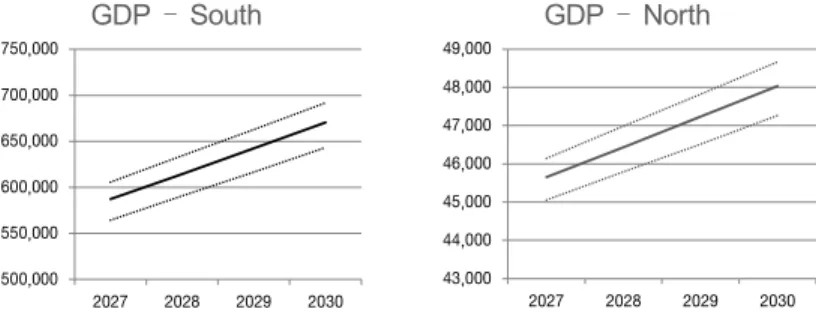
During the two-year Division Dissolving stage, South Koreans pay an extra 0.5% tax on their income, while the North gets a big boost to consumption by 37%. A dramatic growth begins after the System Integration stage. North Korean GDP and wages increase by 10 times, while consumption rises by 13 times over the decade between 2030-2040 period. Since the gains from free markets and trade are not a zero sum, South Korea would continue its steady growth even while providing
the North with massive aid, and opening up labor and capital flows between the two sides. The model implies that Southern part’s GDP, consumption, and wages would grow by a solid 1-2% per year in real terms. The pattern of rapid growth in the North and steady growth in the South continues during the Nation Building stage.
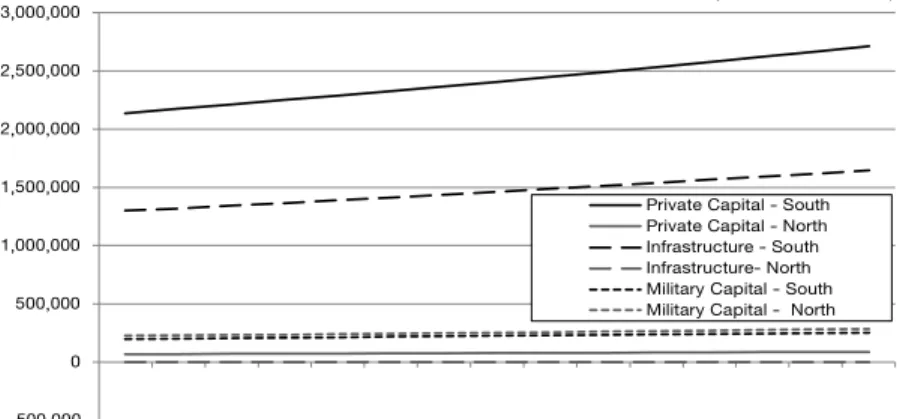
Throughout the unification process, Northern part completely transforms from one of the most impoverished to one that achieves middle class status. All indicators of North Korea increase more than 25 times, including GDP, consumption, and wages. Its private capital stock would also strengthen, increasing more than 15 times in value. These gains are made possible in large part because of substantial aid from the South, but it continues to experience steady growth, even after that aid ends. The levels of GDP, consumption, wages and private capital do not actually drop in the South, but steadily grow. The South will enjoy the fruits of its investments in the North.
Part 2 analyzes the costs and benefits of the four powers during the unification process. The future of the Korea-U.S. relation is the biggest concern for both the U.S. and China. It has a huge impact on whether each side perceives unification as a cost or benefit. For the U.S., vulnerable alliance with Korea and the relocation of the U.S. troops in the South during the unification process would be a cost, while China worries about bordering with Korea or the U.S.-Korea alliance after losing its long-time buffer zone, North Korea.
All four powers expect that the Korean unification would lessen the security vulnerability caused by the North Korean regime. This would
be one of the biggest benefit to them. They all agree that controlling and finally dismantling WMD from the Korean Peninsula would be a great benefit. Even China perceives North Korean WMD as a cost, especially after the third nuclear test by North Korea, and it will continue to benefit from WMD control over all unification stages. Russia also wants to end the instability in the Northeast Asia, so the economy of the Russian Far East can prosper. During the System Integration and Nation Building stages, a unified Korea would socially and economically be benefit both the Far East and Northern areas. In Japan’s case, finding solutions of the Japanese abductee issues is the highest priority.
In sum, this study could be useful for the policy makers in Korea and the neighboring four powers. It should also be noted here that the efforts for achieving the unification were begun when the Korea were divided against its will by the international arrangements. It is necessary for the two Koreas and international actors to continue making every effort to solve the problems stemming from the division of the Korean peninsula in a peaceful manner.
Keywords: DSGE Model, U.S., China, Russia, Japan, Unification Costs, Unification Benefits, Economic, Non-economic
요 약
본 연 는 ‘선도형 통일’의 경로와 과제와 통일비용·편 분 형
을 통해 도출된 통일의 나리오와 형을 바탕으로 다음과 같은 두였
과제를 수행하 다. 첫째는 통일과정을 수행하는 과정에 남 얻게
될 비용편 을 거 경제적인 차원에 분 하는 것 다. 둘째는 한반도의 통일에 따라 향을 게 되는 주변 들 인 하는 비용과 편 의 요인을
히는 것 다.
본 연 의 제 1 에 는 통일비용·편 의 거 경제적 분 을 표로 제 된 나리오 안에 주요 표의 총량적 변 과정을 파 할 수 있는 동태 률적 일반균형(DSGE) 형을 도입하여 통일 한 의 경제였 맞게 될 변 를 정하 다. 제 2 에 는 한반도와 밀 한 해관계를 갖는 미 , 중 , 러 , 일본 4서 의 입장에 생되는 영 단계별 통일비용·편
을 경제·비경제 문으로 파 하 다.
본 연 는 통일 후 맞게 될 경제적 변 를 석관적인 영을 통해 예측하 여 긍정적 미래의 였능성을 조명한다는 에 바람 한 통일정책 마련에
기여할 수 있다. 연 를 통해 얻어진 영 의 공통된 과 입장 차 에
대한 해는 향후 한 주도적 고 협력적인 통일 환경을 조성하기
위한 정책적 자료로 활용할 수 있다.
부색어: DSGE 형, 미 , 중 , 러 , 일본, 통일비용, 통일편 , 경제, 비경제
Introduction
Since the fall of Berlin Wall, numerous studies on Korean unification have been conducted by both Korean and foreign scholars. A few studies have concentrated on the unification processes of the two Koreas; in most cases, the focus has been on the economic aspects or merely on the costs, and estimates have been based on one or two macro variables. Still, there is a need to scrutinize and articulate what will be necessary to prepare, what will likely happen, and what should be done to witness that silver lining―a successful and prosperous unified Korea―remains to be studied. Thus, the main purpose of this five-year project of the Korea Institute for National Unification (KINU) is to build a comprehensive architecture for unification costs and benefits during the entire unification process.
During the two years of research, we have conducted various sub-studies including: identifying major debates on unification, various case studies, and categorizing major factors. Especially, in order to balance against pessimism caused by cost-oriented unification studies, we have borrowed cost and benefit concepts and re-identified them. While adopting the generally used cost and benefit terms from economics, we extended conceptual denotation of the two concepts. In our analysis, the term cost contains burden, anxiety, efforts, and tasks, while benefit covers expectations, favor and effects. The reason for this conceptual stretch is our study comprehensively covers the entire unification process. To apply political and social factors that will significantly influence unification losses, gains, and the unification process itself, these non-economic factors be must taken into consideration. Based on this,
we have developed an analytical tool to identify, gauge and evaluate costs and benefits during the unification process: the Three-Stage-Three-Area Costs and Benefits Model. While sharing the basic premises composed in the model, we also produced a scenario after engaging in a long debate with experts in various areas. After reviewing preceding studies on the unification processes, the experts have reached a provisional conclusion regarding a path of unification― The Guiding Type of Unification. It consists of pre-unification conditions, three stages of unification, and the main objectives of each stage and each area.
Unification and integration consist of a multi-faceted and complex process influenced by domestic inter-Korean relations and the international environment. For the third phase of the five year project, this study expands its focus on to international research cooperation: A quantitative model-based approach to the economic changes in the Korean peninsula, and the costs and benefits of the Korean unification for neighboring powers. Accordingly, this has three parts. First, Chapters I and briefly review our scenario and analytic model. The structure and process of unification depicted these chapters are the basic premises and assumptions to analyze, followed by the inter-Korean and international dimensions chapters. Distinctive features of the scenario and model: include, among various unification scenarios, the study illustrating the process under the principles of desirability, feasibility and probability. The analytic model also has unique characteristics. It has three stages of the unification processes―Division Dissolving, System
Integration and Nation Building, and three costs and benefits areas― political, social and economic. The designing of the scenario and the model necessarily includes a periodic time line at each stage. Both the scenario and the model share basic concepts and stages. Among them, political and social areas are substantially considered in the analyses. In this study, we have assumed two years for the Division Dissolving stage, and ten years each for the System Integration stage and the Nation Building stage. During the previous studies, we have intentionally omitted the starting year of the unification process, in other words, the year triggering the Division Dissolving stage. However, we have found that we need to assume a provisional starting year to calculate and compare costs and benefits in both inter-Korean and international dimensions. The Division Dissolving stage begins in 2028 and lasts two years; other two stages each have ten-year periods; and all unification processes end in 2050. Each chapter of this book is written in accordance with this guideline.
Guiding Type of Unification and the Three-Stage-Three-Area Costs and Benefits Model
The Guiding Type scenario is the most plausible scenario examined under the principles of desirability, feasibility and probability. It assumes a gradual and asymmetrical unification process in a circumstance where North Korea begins to admit South Korea’s economic achievements and embarks on asymmetrical unification conversations, based on a consensus by both parties.
Considering unification cost-benefit factors have periodical attributes, the analytical model consists of eighteen sub-models, with the model dividing the unification and integration process into three stages―the Division Dissolving, the System Integration, and the Nation Building. In addition, for the first time in this area of research, the model includes political and social factors into the model frame. Rather than calculate the unification costs and benefits by macro-level, a unit-cost and a unit-benefit approach has been adopted.
The Three-Stage-Three-Area analytic model is a micro approach based on unit-cost and unit-benefit. The eighteen sub-models have various advantages: One can individually review a specific stage and a specific area’s costs or benefits by purpose. All indicators can be re-sorted by cost payers and beneficiaries, and each government department of the unified Korea can identify its tasks and achievements using the model’s categories.1) During the conceptualization and estimation process,
1)_Kyuryoon Kim, et al., Analytical Model for Unification Cost and Benefit (in Korean) (Seoul: Korea Institute for National Unification, 2012), p. viii.
however, we found some factors cannot be calculated into dollar units. Those qualitative factors are the price of democracy, making a new community between those who have different contemporary histories, fears of war―just to name a few. those factors make up another task that we will need to solve next year.
Costs and Benefits of Korean Unification: Inter-Korean Dimension
Part 1 calculates the major macroeconomic unification variables using a general equilibrium model. Chapter describes a model of each Korea’s economy, which is used in the following chapters’ simulations. Chapter evaluates North Korea’s reform effects during the Division Dissolving and System Integration stages. Chapter , the most important stage in this macroeconomic analysis, deals with various variable changes during the System Integration period. Economics of the Nation Building stage and a unified Korea that finishes the unification process will be described in Chapter . Chapter summarizes the economic effects over all stages. During two face-to-face meetings with additional communications, the process of unification and economic policy changes by stages were keenly discussed. Due to the characteristics of this book, we separated out the model formulae and model descriptions into the Technical Appendix.
In the inter-Korean dimension, this study analyzes the unification and integration process by using the dynamic stochastic general equilibrium (DSGE) model. DSGE modeling is widely accepted as an
influential macroeconomic tool to explain aggregate economic phenomena, such as economic growth and the effects of monetary and fiscal policy. The model is useful to predict an economy that is affected by random shocks, such as technological change. It is a useful device to understand North Korea’s impact on the South Korean economy as well as growth on the Northern part.
Costs and Benefits of Korean Unification: International Dimension
Part 2 analyzes the costs and benefits of neighboring states during the Korean unification and integration process. Chapters through
examine the concerns and expectations of Korea’s four neighboring states―the U.S., China, Russia, and Japan―as well as the economic and non-economic (political and social) factors that the four powers will bear and acquire during the three stages.
During the long division of Korea, the four powers have experienced both tangible and intangible costs and benefits. After the unification of the Korean Peninsula, some gains and losses will be maintained and new cost-benefit factors will appear. Furthermore, they will depend on the process of Korean unification and integration. To avoid confusion, we proposed the scope and process of unification as explained in Chapters and . Scholars of the four states examined their countries’ costs and benefits of Korean unification during the stages of Division Dissolving, System Integration, Nation Building.
The purpose of this scenario is to draw a rational and future-oriented policy solution for Korean unification on the basis of positive perspectives, while recognizing previous studies on unification have long been emphasized on the negative scenarios. With that purpose in mind, we collected experts from their respective fields of study, each has long been engaged in the study of unification. During the expert panel’s several brainstorming sessions, various subjects are given by areas and stages and all idea has consecutively been accumulated. The most important orientation of this scenario is that unification is considered as the birth of a new unified Korea rather than a return back to the past.3)
Before building the scenario, various types of unification have been reviewed by the criteria of speed and relative responsibilities. By speed, most unification scenarios are divided into being gradual or radical. Gradual process refers to a gradual South-North unification negotiation after successful internal reform in North Korea, while radical process supposes a speedy unification process after unexpected sudden change
2)_The following explanation on the Guiding type in this chapter is summarized from Kyuryoon Kim, et al., Guiding Type of Unification: The Route and Tasks (in Korean) (Seoul: Korea Institute for National Unification, 2012).
3)_Ibid., p. xxiv.
Guiding Type of Unification
2)in the North. Meanwhile, the process again merges into symmetrical and asymmetrical relative efforts by each side. The symmetrical assumes the South and the North enter a unification process under the equal weight of efforts, while the asymmetrical presumes that unification is led by one side. By two criteria, four types of unification are identified: Equivocal type, Abrupt type, Guiding type and Absorptive type (see Table 1).
Table 1 Types of Unification
Gradual Radical
Symmetrical Equivocal type Abrupt type
Asymmetrical Guiding type Absorptive type
After identifying four types of unification, each type has been discussed by panel experts: the basic evaluation principles are desirability, feasibility and probability. The two symmetrical types have been rejected due to their infeasibility and improbability, while the absorptive type has denied, considering the international favor of the situation. The panel concludes that the Guiding type of unification is expected to be the most desirable, feasible and probable path toward unification.
The Guiding type is hypothetical, yet it is the most plausible scenario which describes a situation where North Korea starts to acknowledge South Korea’s economic success and begins asymmetrical unification talks according to a consensus agreed by both parties. The leading role of South Korea in North Korea’s reform process would be positively
acknowledged by North Koreans. Since the world witnessed the economic achievements of South Korea, its modern and liberal economic reform can be an alternative system for the North. North Korea’s positive perspective towards the South Korean system could effectively promote the idea and need for a transformation of its current system.4)
In line with the Three-Stage-Three-Area Costs and Benefits model which is described in Chapter , it adopts spatial and periodical dimensions suggested by the model: first, it includes the political and the social areas as well as the economic area. Also, considering that unification has periodical attributes, the unification process is divided into a Unification Preparation period, a Unification Process period, and a Normal State period. The Unification Process period again is divided into three stages―Division Dissolving, System Integration, and Nation Building.
Three major actors will engage in the Unification Process―South Korea, North Korea, and the neighboring powers including the U.S. and China. The Guiding type unification will not begin unless pre-conditions are satisfied during the unification preparation period. The first condition assumes that North Korea starts a process of internal economic reform and pro-unification policy. The second condition is the South Korean people’s consensus towards unification. And finally, international support for the Guiding type scenario is needed.
4)_Ibid., p. xxviii.
Figure I-1 Conceptual Diagram: the Guiding Type of Unification
Goal Realization of human security led by good player
Goodness
New peace structure Nuclear-free peace
Unification preparation period
Unification process period Normal state period Division
Dissolving stage
System Integration
stage
Nation Building
stage Market economy
peace Democratic peace
Pluralism Effectiveness Principle
Foundation
Path
As shown in Figure I-1, the Guiding type of unification includes goals, principles, foundation, and path. First, the word “Guiding,” translated from Korean language, “seon-do,” does not only carries the meaning of “leading” but also connotes “leading to the right direction.” The ultimate goal of the Guiding type of unification is the realization of human security led by the leadership of respectable international actors. As the most advanced concept in international relations of the 21st century, human security provides fundamental conditions for living. This type of unification guarantees that it is not only the strong superpowers domination that exercise control over the weaker states, but rather the process assures that middle and small powers can also equally participate in the unification process. Also, nontraditional concepts of security, such as health and environmental issues, are linked
together with the traditional concept of security.5)
There are three pillars in the Guiding type of unification: goodness means that unification does not aim to return back to the time of division, but rather pursues a future-oriented policy and the creation of a brand new, unified Korea. Pluralism means a convergence of diverse opinions, derived from cooperation and mutual understanding, from the citizens of both Koreas, as well as their governments, throughout the unification process. Effectiveness implies that by proceeding to the gradual path of unification, the South Korean people will be given adequate time to evaluate the expected costs and benefits through various steps and stages toward unification. As a result, the potential costs of unification would be minimized.6) In order to achieve these three pillars, each stage needs an essential foundation: a nuclear-free peace, a market economy peace, and a democratic peace. Thus, to guarantee each stage’s foundation and principle, political efforts would be highlighted during the Division Dissolving stage while economic and social tasks would play central roles in the System Integration and Nation Building stages, respectively.
The Guiding type scenario identifies major policy objectives and issues that will occur during the three stages. In order to calculate and compare costs and benefits by inter-Korean and international dimensions, we suggest the duration of each stage. Deciding the triggering year of Division Dissolving stage is not meaning we are expecting the
5)_Ibid., p. xxx.
6)_Ibid., p. xxxi.
process begins at that moment. We have intentionally ignored the exact starting point or unification declaration day. We assume Division Dissolving stage begins in 2028 and lasts two years; while other two stages have ten-year periods each. That is, the range of unification process is 2028-2050. Each area’s objectives at each stage are listed below.
Figure I-2 Unification Process
Unification
Preparation period Unification Process period Unification Declaration
Division
Dissolving IntegrationSystem BuildingNation
Normal State period
a. Division Dissolving Stage
The Division Dissolving stage is a period when South Korea attempts to stabilize chaos in the North before official unification is declared. This stage is from the beginning of the actual unification process until just before institutional integration begins. The starting point of this stage is the moment when our government takes the initiative in the actual unification process, with both governments politically consenting on unification, and the South’s government starts to implement unification plans with full commitment: de facto unification starts.
Table 2 Main Objectives and Tasks of Division Dissolving Stage
Area Main Objectives and Tasks
Political Area
Objective: Establish a unification committee and begin political dialogue for a unified Korea
․ Agree on building a unified political system and power structure
․ Unify on the establishment of a Constitution
․ Build a unification-friendly international environment
․ Minimize anti-unification movements and internal turmoil
․ Declare national unification
Social Area
Objective: Support to build a civil society in North Korea and begin inter-Korean citizen integration
․ Promote a pro-unification public opinion in the North
․ Establish inter-Korean civil joint meetings
․ Support building a civil society in North Korea
Economic Area
Objective: Secure support for unification of North Korean citizens and elites, and prepare a North Korean economic reform program
․ Prepare and supply emergency aid to guarantee North Korean citizens’ basic livelihood security which would induce unification-friendly public opinion in North Korea.
․ Prepare North Korean economic reconstruction plan, budget support, and monetary union
․ Budget support towards the North
b. System Integration Stage
The starting point of the System Integration stage is the end of the Division Dissolving stage at the moment of the official declaration of unification. This stage finishes when the two countries’ political, social, and economic systems are completely unified. The System Integration stage would begin with a legal proclamation and end with political, administrative, and economic integration―de jure unification. We
consider completion of this integration as realization of the actual unification process. The System Integration stage requires the biggest economic efforts compared to those of the other stages.
Table 3 Main Objectives and Tasks of System Integration Stage
Area Main Objectives and Tasks
Political Area
Objective: Establish a unified Korean government based on a liberal democracy
․ Build an amicable international environment in Northeast Asia
․ Democratize in North Korea: Plural party system, general election
․ Dismantle North Korea party-government and military system with abolition of WMD
Social Area
Objective: Build a civil society based on pluralism, integrated social welfare, and stabilize population mobilization
․ Integrate public education
․ Stabilize real income to prevent massive mobilization, and achieve labor market integration
․ Establish nation-wide NGOs
Economic Area
Objective: Stabilize a macro economy in North Korea, liberalization, and privatization
․ Achieve economic integration between South and North Korea, economic reconstruction, and promoting production capability
․ Stabilize the North Korean economy and marketize
․ Mitigate international anxiety regarding early unification costs
․ Secure available international funds, including IMF, World Bank and IBRD, and expanding currency swaps with the U.S., China and Japan
․ Announce the succession of North Korean debt
․ Privatize state-owned properties in North Korea by stages
․ Train and educate North Korean people
c. Nation Building Stage
This stage is a situation where the North Korean people are no longer discriminated legally or institutionally. In this stage, the political, social, and economic integration process conducted through the System Integration stage would be completed. This stage internalizes the social norms of unification that people in both Koreas do not want to return to the past or repeat the way it was. The Nation Building stage will require a great deal of social measurement as a social and psychological identity integration stage takes place. Policy towards a unified civil society (Lebenswelt) will take place to complete the creation of a unified civil society.
Table 4 Main Objectives and Tasks of Nation Building Stage
Area Main Objectives and Tasks
Political Area
Objective: Establish and settle upon a democratic and effective political-administrational system, and become an international peace-leading country
․ Integrate political parties and induce moderate multi-party system
․ Build an effective integrated administration-judicial system
․ Adopt a local democracy
․ Enlarge a unified Korea’s international role
․ Introduce ODA, peace-keeping operation, NE Asian collective security organization
Social Area
Objective: A unified civil society (Lebenswelt)
․ Integrate a substantially equivalent welfare system
․ Create a socially and culturally justified unified Korea―where pro-division discourse becomes a socially deviant behavior
․ Lebenswelt/Lebensraum (unified living space) Economic Area
Objective: Stable and sustainable development based on substantial economic integration
․ Build sustainable economic capability in the North
․ Build infrastructure continuously
․ Stabilize labor mobility
The purpose of the Three-Stage-Three-Area Costs and Benefits model is to build a more synthetic and comprehensive model for unification costs and benefits. As per the Guiding type scenario in Chapter I, the unification process is divided into three stages. The starting point of the Division Dissolving stage is shared with this scenario. All relevant parties―South and North Korea, and the international environment―are prepared and agree with the start of the unification process. All three stages consist of political, social and economic areas, and all areas are divided into the costs and benefits factors.
Figure Ⅱ-1 Three-Stage-Three-Area Costs and Benefits Model
Division Dissolving Stage Benefits
Political Benefits Economic Benefits
Social Benefits
Political Costs Economic Costs Social Costs
Political Costs Economic Costs Social Costs
Political Costs Economic Costs Social Costs Political Benefits
Economic Benefits Social Benefits
Political Benefits Economic Benefits
Social Benefits System Integration Stage
Benefits
Nation Building Stage Benefits
Unified Korea
Division Dissolving Stage Costs
System Integration Stage Costs
Nation Building Stage Costs
7)_The following explanation on the Three-Stage-Three-Area Costs and Benefits Model in this chapter is summarized from Kyuryoon Kim, et al., Analytical Model for Unification Cost and Benefit (in Korean).
Three-Stage-Three-Area Costs and
Benefits Model
7)As of Figure -1, the Three-Stage-Three-Area Costs and Benefits model consists of eighteen sub-models divided into three stages, three areas, and costs and benefits. The 18 sub-models have various advantages: each sub-model can be combined with other sub-models so that one can easily review specific stages and specific each area’s costs or benefits by purpose. For instance, one can look at the social benefits by stages or all costs in that stage. It also has a practical function that relevant government departments can identify their tasks and gains by using the model’s categories before and during unification.
The model adopts a unit-cost and unit-benefit approach rather than calculate the costs and benefits by macro-level analysis. While macro-level analysis provides major variables of the overall trend, it has limits to project what is needed and what is expected at each stage and area during the long unification and integration process. From the initial process of model building, this study borrowed the well-known economic costs and benefits dichotomy. The concept, however, has been conceptually stretched from its economic term to be available in the following political and social areas: Cost, in our study, connotes burden, anxiety, efforts and tasks, while benefit implies expectation, favor and effects. The unit-approach also premises that all sub-models have mutually exclusive and exhaustive attributes; that is, all costs and benefits factors in the sub-model should be estimated separately. Under this premise, modularized eighteen sub-models have their own justification. For example, the total sum of the unit-costs of each variable will be the total cost of unification. Clearer conceptualization and identifying factors
of each sub-models and converting all factors into countable amounts are the most challenging tasks that next year’s study should bear. Major factors of each sub-model are listed below.
1. Cost and Benefit Factors of Political Area
The political area requires intensive government efforts in the Division Dissolving stage for loosening the existing tension between the two states. If we carry out those political tasks successfully, it would provide an economically and socially stable unification process. The political purpose of the Division Dissolving stage is to secure future political integration and control possible chaos in North Korea. In this stage, numerous political policies and measurements for relieving the tension and other related problems would take place.
The political area, especially in the System Integration stage, aims for democratic nation building as well as legal and institutional integration. Also, legal and institutional foundations will be realized, such as the creation of elections and a unified legislature. With these political efforts and their results, we can expect to see a regime transformation towards democracy and a resolution of the North-South conflict. Based on unification talks conducted during the Division Dissolving stage, a unified government will be created with administrative measures for future nation building. Lastly, during the System Integration stage, lustration policy would be exercised with related costs and benefits being incurred.
Finally, the political purpose of the Nation Building stage is




![For copies of the original instructions see [7]](data:image/gif;base64,R0lGODlhAQABAIAAAP///wAAACH5BAEAAAAALAAAAAABAAEAAAICRAEAOw==)