Team C
2
M: Two Cooperative Robots for Picking and Stowing
in Amazon Picking Challenge 2016
Hironobu Fujiyoshi
1, Takayoshi Yamashita
1, Yuji Yamauchi
1, Takahiro Hasegawa
1,
Manabu Hashimoto
2, Shuichi Akizuki
2, Yukiyasu Domae
3, Ryosuke Kawanishi
3I. INTORODUCTION
At the Amazon.com logistics warehouse in the United States, the Kiva Pod robot made by Kiva Systems (Amazon Robotics as of 2016) automatically conveys products from the storage shelves to the people responsible for picking. Manual labor is still needed to pick these products from the shelves, but it is expected that this task will eventually be automated by introducing picking robots. In an e-commerce business where there are many types of products stored ran-domly on shelves, the key to the introduction of automation is being able to perform stable pick-and-place operations by recognizing diverse objects on the shelves and gripping them correctly. Against this background, Amazon set up the Amazon Picking Challenge (APC) as a competitive event for robots in the automation of logistics. The first such event was APC 2015, which focused on the problem of picking diverse items. Contestants were required to build picking robots that could extract 25 different items from 12 frames (called “bins”) on a shelf [1]. At APC 2016 in the following year, the scope of the competition was made more realistic by having the contestants compete on two different tasks (“Pick” and “Stow”). This paper introduces the robot system of Team C2
M at Amazon Picking Challenge 2016, and its image recognition system.
II. TWOCOOPERATIVEINDUSTRIALROBOTS
In this section, we discuss the Team C2
M robot system and its features.
A. Robot System
As shown in Fig. 1, the Team C2
M robot system consists of two MELFA industrial robots with load capacities of 7 kg (RV-7FL) and 4 kg (RV-4FL), both equipped with 3D vision sensors (MELFA-3D Vision), force sensors (4F-FS001) and multifunctional hands. The robot with a 7-kg load capacity
1
H. Fujiyoshi, T. Yamashita, Y. Yamauchi, and T. Hasegawa are with the Machine Perception and Robotics Group, Chubu University, 1200 Matsumoto-cho, Kasugai-shi, Aichi 487-8501, JAPAN. {hf@cs., yamashita@cs., yuu@isc., tkhr@mprg.}chubu.ac.jp
2
M. Hashimoto, and S. Akizuki are with the Intelligent Sensing Laboratory, Chukyo University, 101-2 Yagoto Honmachi, Showa-ku, Nagoya-shi, Aichi 466-8666, JAPAN. {mana@, akizuki@}isl.sist.chukyo-u.ac.jp
3
Y. Domae, and R. Kawanishi are with the Advanced Technology R&D Center, MITSUBISHI Electric Corporation, 8-1-1, Tsukaguchi-honmachi, Amagasaki-shi, Hyogo 661-8661, JAPAN.{Domae.Yukiyasu@cb, Kawanishi.Ryosuke@bx}.MitsubishiElectric.co.jp
Fig. 1. Overall view of the Team C2
M robot system.
was installed on a single-axis sliding platform. The robot that directly accesses the shelf needs to be able to pick up randomly placed items. We used the robot with a 7-kg load capacity for this purpose because it has a longer reach and can carry heavier loads. For the robot that extracts items from the tote, we used a robot with a 4-kg load capacity, which has sufficient reach and load capacity for this purpose.
A force sensor is mounted at the end of the robot arm to prevent collisions and breakages by judging if unnec-essary force is being applied to the robot, shelf or item when gripping products. Also, by touching the shelf with a hand equipped with a force sensor, we were able to judge the fine positional offset from the reference position, and implemented automatic calibration between the shelf and robot. The 3D vision sensors produced RGB image and depth image outputs by employing an active stereo method comprising a camera and projector. This sensor is used for three-dimensional measurement and recognition of items.
B. Features
Fig. 2. Workflow of object recognition for pick-and-place unit.
putting away items on the shelf.
III. VISIONSTRATEGY
Here, we describe vision strategy of the Team C2
M.
A. Grasping Position Based Object Recognition by CNN
A Convolutional Neural Network (CNN) identifies items that appear in the input images. In general, the recognition of objects by a CNN is performed as shown in Fig. 2(a), where candidate object regions called “region proposals” are extracted and provided as input to the CNN for identification. To detect as many region proposals as possible to avoid missing out any picking items, this type of CNN must run many times, resulting in a large computational load.
To reduce this load, we used the approach shown in Fig. 2(b), where the image is first analyzed to detect grasping positions, and the CNN is only then used to identify these items based on the image regions surrounding these detected grasping positions. By detecting the grasping positions first, we can limit the recognition processing to these detected positions. This approach is much more efficient because the robot can then move directly on to picking actions. The grasping positions can be detected at high speed by using Fast Graspability Evaluation [2].
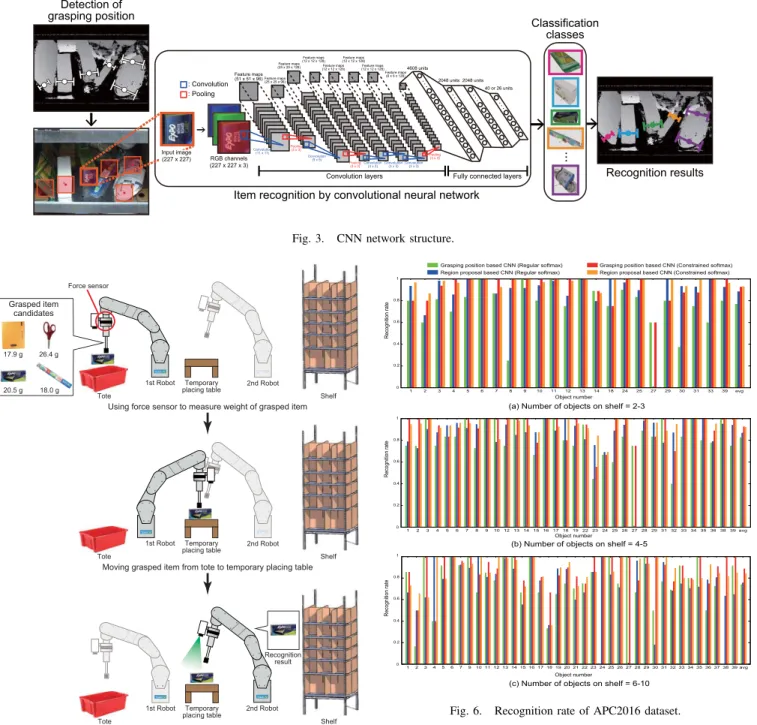
As shown in Fig. 3, the CNN in the proposed method consists of convolution layers and fully connected layers. The convolution layers use batch normalization in layers{1, 2}, and max pooling in layers{1, 2, 5}. We used the ReLU activation function for all layers. In class identification by a CNN, the class probabilities are generally calculated by the
softmaxfunction. Here, the class probabilities are calculated by the softmax functionPr(·)as shown in Eq. (2), wherehi
represents the values of the CNN output units andC is the
number of classes.
Pr(hi) = exp(hi)
C
∑
j=1
exp(hj)
(1)
Fig. 4. Picking strategy.
In the task set by the Amazon Picking Challenge, the robot system received a JSON file containing the names of items stored in the bin, and the names of the items to be picked. The robot system thus knows what items are in the bin before it performs object recognition. We propose a constrained softmaxfunction where the CNN output layer only calculates class probabilities for output units corresponding to items that are present in the bin. For example, when the bin contains items corresponding to the set of output units {1, 3, 4}, the constrained softmax functionPc(·)can be defined
as shown in Eq. (2).
Pc(hi) = ∑exp(hi)
j={1,3,4}
exp(hj) (2)
Using the constrained softmax function, it is possible to eliminate the possibility of mistakenly recognizing items that are not in the bin.
B. Picking Strategy
The Pick task involves moving each of the twelve items in a bin by picking them up one at a time and putting them in a box called a “tote”. In this task, a JSON file containing the names of the items in the bin is read in and applied to the constrained softmax function. Fig. 4 shows the item recognition procedure. First, the target bin is photographed to acquire an image. Information about the items inside the bin is then read in from the JSON file. Next, the items to be picked are recognized by the constrained softmax function using only the output units that correspond to the items in the bin.
C. Stowing Strategy
Fig. 3. CNN network structure.
Fig. 5. Stowing strategy.
output units corresponding to these four possibilities based on the item’s weight.
IV. EXPERIMENTS
We performed an evaluation experiment to confirm the effectiveness of the proposed method. We compared the recognition accuracy and processing time of the conventional method (CNN based on region proposal) and the proposed method (CNN based on grasping position). We compared the recognition accuracy when using an ordinary softmax function and a constrained softmax function in the output layer of each method.
Fig. 6. Recognition rate of APC2016 dataset.
A. Recognition Results
We compared the recognition accuracy of CNN based on region proposal with the proposed method of CNN based on grasping position. Fig. 6 shows the recognition accuracy of each item in the APC2015 data set. We performed separate evaluations with 2–3 objects, 4–5 objects and 6–10 objects on the shelf. The horizontal axis of the graph represents the object number, and the final column shows the average recognition rate of all objects. Using constrained softmax, we confirmed that CNN based on grasping position can achieve an average recognition accuracy at least as high as that of CNN based on region proposal.
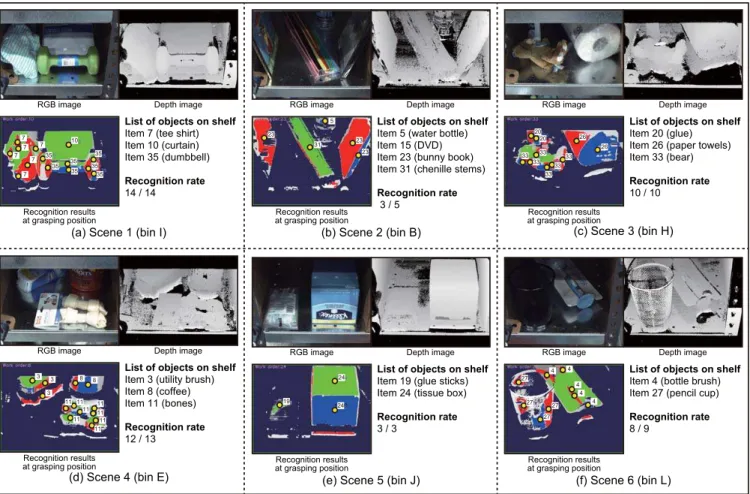
Fig. 7. Recognition results in APC 2016.
to six scenarios, and achieved a recognition accuracy of 92.6% (i.e., 50 correct recognition results out of 54 detected grasping positions).
B. Computational Time
The processing times of CNN based on region proposal and CNN based on grasping position are shown in Table I. We measured the processing times on a system with a 3.5 GHz Intel Core i7 CPU and an NVIDIA GeForce GTX 780M GPU. We detected an average of five grasping positions in CNN based on grasping position, and an average of 17 regions in CNN based on region proposals.
Compared with CNN based on region proposal, the pro-cessing speed of CNN based on grasping position was about 3.7 times faster when running on the CPU, and about 2.7 times faster when running on the GPU.
TABLE I
COMPARISON OF COMPUTATIONAL TIMES[MS]. CPU processing GPU processing Grasping position based CNN 269.7 62.4
Region proposal based CNN 1008.7 173.3
V. CONCLUSION
Although APC 2016 featured harder problems than APC 2015, the problem scenarios were still somewhat artificial due to characteristics such as the low incidence of occlusion between items. Since real problems are more complex, it
is expected that future events will have a higher level of difficulty in both the Pick task and the Stow task in order to approximate real-world problems more closely. We also felt the need to concentrate more on robot safety, following an accident where someone’s arm was injured by colliding with a robot hand during the competition. Picking and storing items more flexibly is likely to be a key subject for future study. The purpose of the Amazon Picking Challenge is to analyze and discuss technical issues by building robot systems, analyzing their performance, and competing them against one another. Although there are still various issues that must be overcome before such systems become a practi-cal reality, the open sharing of knowledge at this event aims to promote the resolution of key issues. Through the Amazon Picking Challenge, it is hoped that large advances will be made in picking robot technology.
REFERENCES
[1] N. Correll, K. E. Bekris, D. Berenson, O. Brock, A. Causo, K. Hauser, K. Okada, A. Rodriguez, J. M. Romano, and P. R. Wurman, “Lessons from the Amazon Picking Challenge,” arXiv preprint arXiv:1601.05484, 2016.