JAPELAS: Supporting to Learn Japanese Polite Expressions with PDA
Hiroaki Ogata Chengjiu Yin, and Yoneo Yano
Department of Information Science and Intelligent Systems
University of Tokushima, Japan
[email protected]
Abstract: It is very difficult for overseas students to learn Japanese
polite expressions because the expressions change in a complicated way
according to the context, e.g. social distance, and the conversation
scene. Moreover, the feeling of social distance in Japan often varies
from that in the learner's country. This difference may result in
misunderstanding for the overseas students. Therefore, it is very
important for the learners to understand the social situation in Japan,
and to use polite expressions properly and accordingly. We have
implemented a context-aware language-learning support system for
Japanese polite expressions learning, which is called JAPELAS
(Japanese polite expressions learning assisting system).
Keywords: Context-aware learning support, CALL, PDA, right-time and
right-place learning.
Contact information:
Hiroaki Ogata
Department of Information Science and Intelligent Systems,
Faculty of Engineering, University of Tokushima
2-1, Minamijosanjima, Tokushima 770-8506, Japan
[TEL/FAX] +81 88 656 7498
mailto:[email protected]
http://www-yano.is.tokushima-u.ac.jp/ogata/
SUB-THEME AUTHOR
CHOICE
CONFERENCE TOPICS
INDICATEYOURCHOICEENTER1,2,AND3BESIDEBESTFIT AI and
Networked Learning
……3……
…………
…………
…………
Interactive learning environments Intelligent tutoring systems
Pedagogical agents & agent technology Virtual reality in education
Distance Learning Education
…………
……1……
…………
Building learning communities on the web Mobile/wireless education
Virtual universities e-Learning and
Knowledge Management
…………
…………
…………
…………
…………
…………
…………
Application of instructional design theories Developing an organizational e-Learning strategy Devising mentoring and coaching programmes Human resource management/development Instructional design for e-learning
Knowledge construction and navigation Life-long learning
Evaluating Teaching and
Learning Technologies
…………
…………
…………
…………
…………
…………
…………
…………
Accreditation of new competencies and evaluation Assessing the use of technology in teaching and learning Educational software and hardware
Equity and social issues
Evaluation and performance measurement Evaluation of e-Learning programmes Evolution of national policies
Tutor role in virtual communities Leadership in
e-Education
…………
…………
…………
…………
Innovative pedagogical methods
Policy and strategy for technology implementation Training and education
Vocational training Learning
Technologies
…………
…………
……2……
…………
…………
…………
…………
…………
…………
Architecture and system design issues Authoring systems and tools
Computer-Supported Collaborative Learning (CSCL) Human-computer interaction and education
Learning companions
Learning Object Metadata (LOM) Ontology in education
Standardization of learning technologies Student modeling
Web-Mediated Learning Tools
…………
…………
…………
…………
…………
Multimedia and hypermedia
Networked and distributed learning systems Teleconferencing
Web-based ITS
Web-based Training Systems
JAPELAS: Supporting to Learn Japanese Polite Expressions with PDA
Abstract: It is very difficult for overseas students to learn Japanese polite expressions because the expressions change in a complicated way according to the context, e.g. social distance, and the conversation scene. Moreover, the feeling of social distance in Japan often varies from that in the learner's country. This difference may result in misunderstanding for the overseas students. Therefore, it is very important for the learners to understand the social situation in Japan, and to use polite expressions properly and accordingly. We have implemented a context-aware language-learning support system for Japanese polite expressions learning, which is called JAPELAS (Japanese polite expressions learning assisting system).
Keywords: Context-aware learning support, CALL, PDA, right-time and right-place learning.
Introduction
Context-aware computing (Abowd & Mynatt, 2000) will help in the organization and mediation of social interactions wherever and whenever these contexts might occur (Lyytinen and Yoo 2002). Its evolution has recently been accelerated by improved wireless telecommunications capabilities, open networks, continuous increases in computing power, improved battery technology, and the emergence of flexible software architectures. With those technologies, an individual learning environment can be embedded in daily real life. The main characteristics of ubiquitous learning are shown as follows (Chen et al., 2002; Curtis et al., 2002): (1) Permanency: Learners never lose their work unless it is purposefully deleted. In addition, all the learning
processes are recorded continuously everyday.
(2) Accessibility: Learners have access to their documents, data, or videos from anywhere. That information is provided based on their requests. Therefore, the learning involved is self-directed.
(3) Immediacy: Wherever learners are, they can get any information immediately. Thus learners can solve problems quickly. Otherwise, the learner can record the questions and look for the answer later.
(4) Interactivity: Learners can interact with experts, teachers, or peers in the form of synchronies or asynchronous communication. Hence, the experts are more reachable and the knowledge becomes more available.
(5) Situating of instructional activities: The learning could be embedded in our daily life. The problems encountered as well as the knowledge required are all presented in their natural and authentic forms. This helps learners notice the features of problem situations that make particular actions relevant.
Moreover, ubiquitous learning can be Computer Supported Collaborative Learning (CSCL) (O’Malley, 1994) environments that focus on the socio-cognitive process of social knowledge construction and sharing.
The challenge in an information-rich world is not only to make information available to people at any time, at any place, and in any form, but specifically to say the right thing at the right time in the right way (Fischer, 2001). A ubiquitous computing environment enables people to learn at any time and any place. But the fundamental issue is how to provide learners with the right information at the right time in the right way. This paper tackles the issues of right time and right place learning (RTRPL) in a ubiquitous computing environment.
Especially, this paper focuses on learning polite expressions in Japanese as an application domain of CSUL, because Japanese polite expressions are strongly influenced by situations. This paper proposes the context-aware language-learning support system called "JAPELAS (Japanese Polite Expressions Learning Assisting System)." Users of this system are overseas students of Universities in Japan, who want to learn
scenes. Moreover, the feeling of social distance in Japan often varies from that in the learner's country. This difference may result in misunderstanding for the overseas students. Therefore, it is very important for the learners to understand the social situation in Japan, and how to use polite expressions properly and accordingly. This paper describes the elements that cause the changes of the polite expressions, how the system has been developed, and the initial experimentation of this system.
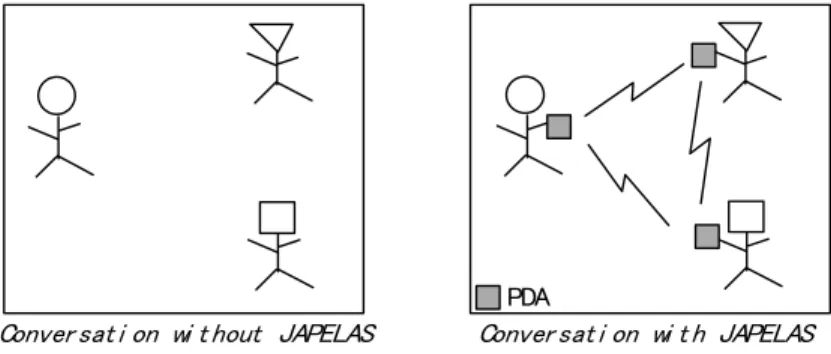
Figure 1: Overview of JAPELAS
As for the previous research, Yano and Ochi (1999) developed the knowledge base system for Japanese polite expression learning, which is called JEDY (Japanese Expressions Dictionary system). JEDY is an online dictionary for supporting the learning of changes in polite expressions. After the user inputs the information of the conversational partner, the relationship, and the situation, JEDY shows the learner the appropriate examples in that situation. In order to construct an understanding of language, conversation with other people in daily life is very important. In this process, actively pursuing (designing) knowledge rather than passively consuming it is also essential (Sharples 2002). Therefore, this paper tackles with context-aware support in the conversation in everyday life without any input of the context information (see figure 1).
Learning Theories for CSUL
CSUL (Computer Supported Ubiquitous Learning) is advocated by pedagogical theories such as on-demand learning, hands-on or minds-on learning, and authentic learning (Ogata & Yano, 2003). CSUL system provides learners on-demand information such as advices from teachers or experts at the spot at the precise moment they want to know something. Brown, Collins, and Duguid (1989) define authentic learning as coherent, meaningful, and purposeful activities. When the classroom activities are related to the real world, students receive great academic delights. There are types of learning to ensure authentic learning: action, situated, incidental learning (Hwang, 2002). Action learning is a practical process where students learn by doing, by observing and imitating the expert, and by getting feedback from teachers and their fellow pupils. Usually, learning is promoted by connecting knowledge with workplace activities. Situated learning is similar to action learning because trainees are sent to school-like settings to learn and understand new concepts and theories to be applied later on practice. Knowledge is developed through the authentic activities and important social interactions. Cognitive apprenticeship methods try to enculturate students into authentic practices through activity and social interaction in a similar way evident in craft apprenticeship” (Brown, Collins, & Duguid, 1989; p.37). Incidental learning includes unintentional and unexamined learning from mistakes, unexpected incidents, etc. For example, a child can acquire an unexpected result in the science lab by the mistake of dropping some other liquid to the given experiment that may lead to a great discovery. Knowledge from incidental learning develops self-confidence and increases self-knowledge in learning. We believe authentic learning in everyday life is very important because learners construct an understanding of Japanese polite expressions.
Japanese polite expression
Generally, learning the four skills (reading, writing, hearing, and speaking) are main objectives in language
e a JAPLAS
PA
e a JAPLAS
learning. It is a main aim of a beginner's class to learn honorific expressions especially for the learner's daily life. However, recently it is important to learn not only vocabulary, pronunciation and grammar of the target language, but also the cultural knowledge in order to have good communication with the native speakers. In Japanese language learning, polite expressions relate to Japanese culture closely. Using polite expressions, Japanese people usually adapt the manner of speaking to suit the situation. However, it is difficult for the overseas students to use the polite expressions because these expressions change according to the context. If polite expressions are not used properly, they might sound comical and strange. Moreover, it might lead to misunderstanding in conversation. Therefore, it is very important for foreigners to have the solid understanding of the context of conversation.
Level of politeness
Japanese polite expressions are divided into two types that are honorific words and modest words. The former is used to express a speaker's respect for a conversational companion. The latter is used to express a humble attitude from the speaker. For example, for the Japanese word “hanasu” that means “tell”, the honorific equivalent is “ossharu," and the modest one is "mousu." The alteration of Japanese polite expressions usually occurs in the verb, noun, adjective, and adverb. Moreover, there are three polite expression level (PEL), which are casual, basic, and formal. Table 1 shows an example of PEL and Japanese sentences. There are two kinds of changing patterns: the first one is irregular change to a different word; the second one is regular change incorporating a prefix and/or postfix word. According to the former, there is no limitation or pattern like an irregular verb. The students usually learn only the basic form in the Japanese language class. This makes Japanese expressions difficult for the overseas learners.
Table 1: Level of Japanese polite expressions and its example.
Table 2: Factors of changes in Japanese polite expressions. Factor Elements
Hyponymy affiliation, age, position (social status) Social distance colleague, friends, relatives
Formality ceremony, party, meeting (scene)
Table 3: Hyponymy rule
Affiliation Position Age Hyponymy
Upper Any Upper
Same Upper Upper
Same Same or lower Same Same (group, department, or organization)
Lower Any Lower
Upper Any Upper
Same Same or lower Same Different
Lower Any Lower
Table 4: Social distance rule
Level Example (Please wait a minute.) Casual ちょっと待って。
Basic ちょっと待って下さい。 Formal 少々お待ち下さい。
Table 5:JAPER rule
Formality Hyponymy Social distance Level of polite expression
Formal Any Any Formal
Any Outside Formal
Upper Inside Formal
Same Inside Basic
Informal
Lower Inside Casual
The factors of changes of Japanese polite expression
There are three factors of changes in Japanese polite expressions (Table 2).
(i) Hyponymy: Generally, people use a term of respect to elder or superior people. Social status depends on affiliations, the length of career, age and so on.
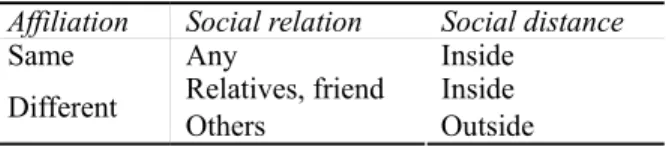
(ii) Social distance: Japanese polite expressions are often expressed in a familiar sense. However, the familiar sense is often different from country to country. For example, the Japanese familiar sense is narrower than the American one. The Japanese familiar sense depends on social relationships, which are classified into an inside group and an outside group. If the relation is family or colleague, then they consider being inside a group and using a casual level of polite expressions. If the relation is not so close, people use formal expressions.
(iii) Formality: The situation of a conversation influences polite expressions. For example, Japanese people often use more formal expressions in the formal situation (giving a talk at ceremony, writing a letter, and so on).
Rules for changes of Japanese polite expression
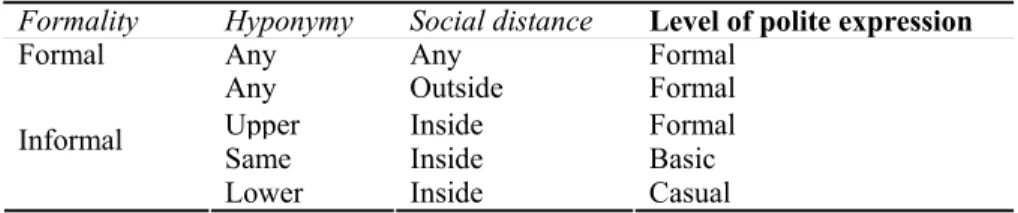
The learner must understand not only vocabulary but also the situations to use the right polite expression. This paper proposes JAPER (Japanese polite expression rule) to provide an appropriate level of expressions (formal, basic, or casual) according to the situation (see Table 5). This system has social distance rule, hyponymy rule, and JAPER (Japanese Polite Expressions rule). The hyponymy-rule derives the social relation of the standing speaker and the listener focusing on their affiliation, position, and age. The social distance rule derives a degree of intimacy focusing on their affiliation and friendship. In the JAPER, the formality is divided into "formal" and
"informal". Finally, the JAPER derives the level of polite expressions: formal, basic, and casual.
Implementation of JAPELAS
We have developed the prototype system of JAPELAS on a PDA (Toshiba Genio-
e
) with Pocket PC 2002, infrared data communication port, RFID (Radio Frequency Identification) tag reader/writer, GPS, and wireless LAN (IEEE 802.11b). The program has been implemented with Embedded Visual C++ 3.0.System configuration
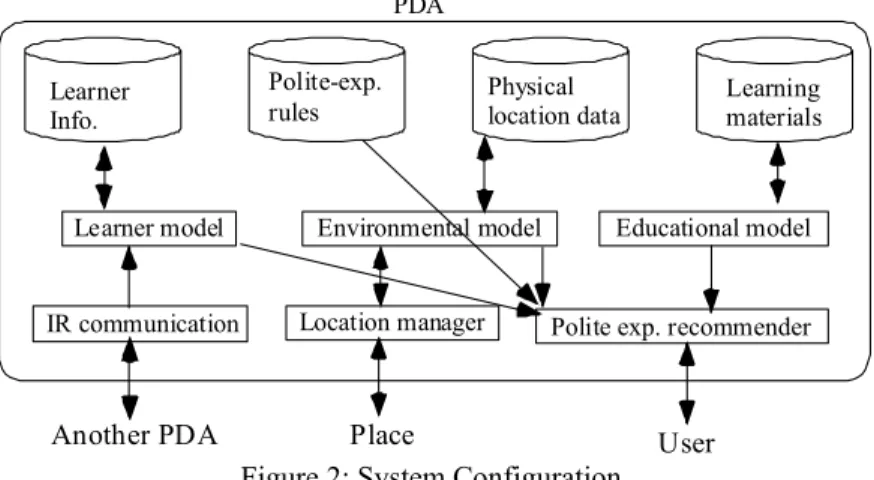
As shown in figure 2, JAPELAS has the following modules:
(1) Learner model: This module has the learner’s profile such as name, age, gender, occupation, interests, etc, and the comprehensive level of each expression. Before using this system, each learner enters those data. In addition to the explicit method like this, JAPELAS detects learner’s comprehensions during the system use. Moreover, this system records the information of the other learners whom the leaner have met. The learner can use this information for individual learning. By selecting someone as a conversational partner, the learner can learn polite expressions alone through the simulation.
(2) Environmental model: This module has the data of rooms in a certain area. The room is detected in the location manager using RFID tag and GPS. The location is used to determine the formality. For example, meeting rooms are included informal situations. If the learner enters a meeting room, more formal expressions are provided there without reference to hyponymy and social distance.
(3) Educational model: This module manages expressions as learning materials. Teacher enters the basic
expressions. Both learners and the teacher can add or modify expressions during the system use.
(4) IR communication: IR requires no fixed infrastructure and no configuration. In addition, IR simplifies the designation of communication targets. Instead of entering target names, users can point to the person. (5) Location manager: With RFID tags and GPS, this module detects the learner’s location, e.g. store, private
room, home, etc. RFID tags are used indoors, while GPS is for outdoors. RFID tags are attached in the entrance doors in the room, and identity the rooms.
(6) Polite expression recommender: Based on polite expression rules, this module provides the appropriate expression at the situation.
Polite exp. recommender Learner model Environmental model Educational model
PDA
IR communication Learner
Info.
Physical location data
Learning materials Polite-exp.
rules
Another PDA User
Location manager
Place
Figure 2: System Configuration. User Interface
As shown in figure 4, the users input their individual personal data, e.g., name, gender, work, age, relationship etc. When the user talks to a conversational partner, the system gets the information of the person via the infrared data communication of PDA as shown in (B) settings window, and then it suggests the suitable polite expressions for the user as shown in (A) expression window. In this case, the system recommends the user to use formal or more formal expressions. The data of the partners is stored into the database in order to facilitate personal learning. The user can select one person from the database, and s/he can simulate the conversation.
Figure 5 shows a scene of learning polite expressions with JAPELAS. Every user has a PDA and inputs his information into the database, e.g., name, grade, age etc. When Mr. X talks to Mr. Z, the system tells Mr. X a casual expression. That is because Mr. X is older than Mr. Z. On the other hand, when Mr. X turns to Mr. Y in order to talk, the system tells Mr. X a formal expression. That is because the year of Mr. X is lower than the year of Mr. Y.
Experimentation
We arranged 18 users to evaluate JAPELAS with questionnaire. The average of the users’ age was 16.9. The users were high school students, 16 boys and 2 girls, that did not have a PDA. However, 56 percent of the users had their own computers. The user played a role, e.g. teacher, elder brother, father, guest, etc who were given by us. The user played one role of them, walked in the room, and randomly made a pair for the conversation (see figure 5). When the user begun the conversation, JAPELAS helped him/her use the right polite expressions. The user could sometimes change the role, and totally used JAPELAS for 30 minutes. After the experimentation, they gave a number between one and five to each of nine questions, with one being the lowest, and five being the highest. The average of the points was 3.78. Table 6 and figure 6 show the results of the questionnaire. According to Question (1), the system provided the appropriate information for the users. Question (2) didn’t obtain a good point. That is because this experiment was the first time for all the users to use PDA. We should have carefully explained them how to use it.
In terms of language learning, question (3) shows this system was quite useful for it. A learner gave a comment that this system was easy to understand the appropriate level of politeness by changing roles and situations. From the results of question (4), we should make the response of the system a little faster. Question (5) and (6) show the users were very interested in this system, and liked to keep using it. Some learners commented that they could learn how to use polite expressions using this system. In Japan, there is a social problem that some of young people cannot use appropriate polite expressions. Therefore, we found this system is very useful even for Japanese people.
Figure 5: Scene of experimentation with JAPELAS.
Table 6: The results of questionnaires.
No. Questionnaire Ave. S.D.
Q1 Did this system provide appropriate polite expressions? 4.06 0.80 Q2 Do you think this system easy to use? 3.06 0.94 Q3 Do you think this system useful for language learning? 4.06 0.54 Q4 Is the response of this system is adequate to use? 3.28 1.27 Q5 Do you think this system very interesting? 4.11 0.68 Q6 Do you want to keep using this system? 4.11 0.58
Figure 6: Graph of the results. 4.06
3.06 4.06
3.28 4.11 4.11
Q1 Q2 Q3 Q4 Q5 Q6 1
2 3 4 5
Conclusions
This paper described a context-aware language-learning support system for Japanese polite expressions learning, which is called JAPELAS. JAPELAS provides the right polite-expression that is derived from hyponymy, social distance, and situation through the identification of the target user and the place. The experiment showed JAPELAS was very useful to learn Japanese polite expressions. As for the future work, this system requires the user to input the verb s/he wants to speak. Therefore, we will try to adapt natural language interface to detect the verb in the future research without any input from the user. In addition, software agent will be introduced as conversational partners. The agent will enable collaborative learning when learner is alone. Moreover, formality should be detected from not only location but also the time schedule. For example, meeting rooms are not always in conference.
Acknowledgements
This work was partly supported by the Grant-in-Aid for Scientific Research No.15700516 from the Ministry of Education, Science, Sports and Culture in Japan.
References
Abowd, G.D., and Mynatt, E.D.: Charting Past, Present, and Future Research in Ubiquitous Computing, ACM Transaction on Computer-Human Interaction, Vol.7, No.1, pp.29-58, 2000.
Brown, J. S., Collins, A., and Duguid, P.: Situated Cognition and the Culture of Learning. Educational Researcher, ( Jan.-Feb.), pp.32-42, 1989.
Lyytinen, K. and Yoo, Y.: Issues and Challenges in Ubiquitous Computing, CACM, Vol. 45, No. 12, pp.63-65, 2002.
Chen, Y.S., Kao, T.C., Sheu, J.P., and Chiang, C.Y.: A Mobile Scaffolding-Aid-Based Bird -Watching Learning System, Proceedings of IEEE International Workshop on Wireless and Mobile Technologies in Education (WMTE'02), pp.15-22, IEEE Computer Society Press, 2002.
Curtis, M., Luchini, K., Bobrowsky, W., Quintana, C., and Soloway, E.: Handheld Use in K-12: A Descriptive Account, Proceedings of IEEE International Workshop on Wireless and Mobile Technologies in Education (WMTE'02), pp.23-30, IEEE Computer Society Press, 2002.
Fischer, G.: User Modeling in Human-Computer Interaction, Journal of User Modeling and User-Adapted Interaction (UMUAI), Vol. 11, No. 1/2, pp 65-86, 2001.
Ogata, H., and Yano, Y.: How Ubiquitous Computing can Support Language Learning, Proc. of KEST 2003, pp.1-6, 2003.
Ogata, H., and Yano, Y.: Supporting Knowledge Awareness for a Ubiquitous CSCL, Proc. of eLearn 2003, (in press)
O’Malley, C. (1994). Computer supported collaborative learning, NATO ASI Series, F: Computer & Systems Sciences, Vol.128.
Sharples, M. (2002) Distuptive Devices: Mobile technology for conversational learning, International Journal of Continuing Engineering Education and Lifelong Learning, Vol. 12, Nos. 5/6, pp.504-520.
Yano, Y. and Ochi, Y. (1999). Design and Evaluation of Example-deriving Knowledge-base System for Japanese Polite Expressions Learning, ICCE99, pp.566-573.
Hwang. K.S.: Authentic Tasks in Second Language Learning, http://tiger.coe.missouri.edu/~vlib/Sang's.html