The “Dynamic” Nature of Stative Mimetic Verbs in Japanese
*Kimi AKITA, Nagoya University
Abstract
Many stative mimetic verbs in Japanese exhibit morphological alternation between reduplicated and non-reduplicated, suffixed forms (e.g., {karikari/kariQ-to}-si-ta umebosi ‘a crunchy salt plum’). This paper argues that this morphological contrast reflects the aspectual contrast between the (often
“fictive”) dynamic events associated with these stative verbs. The aspectual duality of these verbs corroborates the hypothesis that the sound-symbolic system of Japanese mimetics has a bipartite architecture that appears to be consistent with Talmy’s (1988, 2000) view that language consists of two cognitive subsystems. A frame-semantic approach is employed to describe the dual sound-symbolic system.
Keywords
aspect, frame, mimetic, reduplication, sound symbolism
1. Introduction
Mimetics (also known as ideophones and expressives) are iconic words that depict a wide variety of eventualities from dynamic to static. Focusing on Japanese, this paper proposes that mimetics refer to some dynamic aspect of eventualities even in their stative verb use. This proposal corroborates the following two views on mimetic semantics: 1) mimetics generally evoke highly specific semantic frames (Akita 2012; Yu 2014), and 2) the sound-symbolic system of mimetics is composed of two subsystems (Akita 2008).
The aspectual semantics of mimetics has repeatedly been discussed in Japanese linguistics (Izumi 1976; Herlofsky 1997; Kita 1997; Hamano 1998; Toratani 1999, 2005, 2007, to appear; Tsujimura & Deguchi 2007; Akita 2009, to appear; see Nuckolls 1996 for a related discussion in Quechua). Japanese mimetics have some productive morpho(phono)logical templates, such as reduplication of bimoraic bases (e.g., C1'V1C2V2-C1V1C2V2, C1'V1N-C1V1N, C1'V1V1-C1V1V1, C1'V1i-C1V1i) and non-reduplicated, “suffixed” forms (e.g., C1V1C2'V2-Q, C1V1C2V2-N',
* I am grateful to the editors of JCL for giving me the opportunity to contribute to this issue. I also thank Seizi Iwata, KJ Nabeshima, Atsuko Nishiyama, Kiyoko Toratani, and Takeshi Usuki for their insightful comments on an earlier draft of this paper. Any remaining errors are mine. This study was partly supported by a JSPS Grant-in-Aid for Young Scientists (B) (No. 15K16741), a JSPS Grant-in-Aid for Scientific Research (A) (No. 16H01928; PI: Mutsumi Imai), and a Spanish Ministry of Economy and Competitiveness grant for the MovEs II project (No. FFI2013-45553-C3; PI: Iraide Ibarretxe-Antuñano).
C1V1C2'V2-ri). The morphological contrast between reduplicated and non-reduplicated forms is known to iconically reflect the aspectual contrast in boundedness (Toratani 1999, 2005; see Akita, to appear, for other views), which is concerned with whether “the situation is described as having reached a temporal boundary” (Depraetere 1995: 3). For example, as Toratani (2005: 342) argues, the reduplicated mimetics batabata ‘continuous thudding’ and zaazaa ‘continuous flow’ represent unbounded events — a repetitive falling event and a non-segmented water flow, respectively — whereas the suffixed mimetics bataN ‘a thud’ and zaaQ ‘a flow’ represent bounded events — an object’s falling event and a segment of the flow of water, respectively. These boundedness specifications of mimetics have limited compatibility with counted NPs and frequency adverbials, as in (1) and (2).1, 2
(1) a. Reduplicated = unbounded:
{*Iti-mai/Takusan}-no to-ga batabata taore-ta. 1-CL/many-COP door-NOM MIM fall-PST
‘{*A door/Many doors} fell down with a thud.’ b. Non-reduplicated = bounded:
{Iti-mai/#Takusan}-no to-ga bataN-to taore-ta. 1-CL/many-COP door-NOM MIM-QUOT fall-PST
‘{A door/#Many doors} fell down with a thud.’ (#: acceptable if many doors fell down all at once)
(2) a. Reduplicated = unbounded:
Ame-ga zaazaa-to {??ik-kai/nan-kai-mo} hut-ta. rain-NOM MIM-QUOT 1-CL/what-CL-even fall-PST
‘It poured continuously {??once/many times}.’ b. Non-reduplicated = bounded:
Ame-ga zaaQ-to {ik-kai/?nan-kai-mo} hut-ta. rain-NOM MIM-QUOT 1-CL/what-CL-even fall-PST
‘It poured {once/?many times}.’
1 The abbreviations and symbols used in this paper are as follows: bd = bounded; C = consonant; CL = classifier; COP = copula; GER = gerundive; MIM = mimetic; N = moraic nasal (only for mimetics); NOM = nominative; NPST = nonpast; Q = the first half of a geminate cluster (word-medially), a glottal stop (word-finally) (only for mimetics); QUOT = quotative; PST = past; TOP = topic; V = vowel; ' = accent nucleus (realized as a pitch fall; only for mimetic templates).
2 The quotative marking is obligatory for non-reduplicated, suffixed mimetics (e.g., umebosi-o {kariQ-to/*kariQ} kazir- ‘bite a salt plum with a crunch’) but optional for fully reduplicated mimetics (e.g., umebosi-o {karikari-to/karikari} kazir- ‘bite a salt plum repeatedly with a crunch’). See Akita & Usuki (2016) for an integrated account of this phenomenon.
Although these aspectual observations have focused exclusively on dynamic events, many stative mimetic verbs consisting of a mimetic and the dummy verb su- ‘do’ exhibit the same morphological contrast, as illustrated in (3).
(3) a. Kono umebosi-wa {karikari/kariQ-to} -si-te i-ru. this salt.plum-TOP MIM/MIM-QUOT -do-GER be-NPST
‘This salt plum is crunchy.’
b. Watagasi-wa {huwahuwa/huwari-to} -si-te i-ta. cotton.candy-TOP MIM/MIM-QUOT -do-GER be-PST
‘[I] found the cotton candy fluffy.’ c. {bosabosa/bosaQ-to} -si-ta kami
MIM/MIM-QUOT -do-PST hair
‘unkempt hair’
d. {sarasara/sarari-to} -si-ta suna MIM/MIM-QUOT -do-PST sand
‘dry and smooth sand’
Unlike the dynamic examples, such as batabata vs. bataN ‘thudding’ and zaazaa vs. zaaQ
‘flowing’, these pairs of stative expressions (seemingly) have no aspectual divergence; both reduplicated and non-reduplicated forms are unbounded. These mimetic verbs are classified as Kindaichi’s (1950) “Type 4” verbs, which always appear in a stative construction (see Hamano 1998; Kageyama 2007; Suzuki 2012). They take the -te i- (GER be) form in their predicative use and the -ta (PST) form in their attributive use (see (3)). Unlike some stativized verbs, such as kawai-te i- (get.dry-GER be) ‘be dry’, Type 4 verbs cannot occur in their simple past (or nonpast) predicate forms to represent a change of state, as shown in (4).
(4) a. *Umebosi-ga {karikari/kariQ-to} -si-ta. salt.plum-NOM MIM/MIM-QUOT -do-PST
‘The salt plum got crunchy.’ (intended)
b. *Watagasi-ga {huwahuwa/huwari-to} -si-ta. cotton.candy-NOM MIM/MIM-QUOT -do-PST
‘The cotton candy got fluffy.’ (intended) cf. Zimen-ga kawai-{te i-ru/ ta}. ground-NOM get.dry-GER be-NPST/ PST
‘The ground {is dry/got dry}.’
Being Type 4 verbs, reduplicated and non-reduplicated stative mimetic verbs appear to have the
same aspectual specification. However, assuming that the morphology of mimetics is an iconic reflection of their meaning, one may want to ask what allows stative mimetic verbs to have two morphological realizations. In this paper, we show that the morphological contrast in stative mimetic verbs is attributed to the aspectual difference of events associated with the states depicted.
The organization of this paper is as follows. Section 2 summarizes some previous findings on the “fictive” nature of stative mimetic expressions in Japanese. Section 3 delves into the semantic contrast between reduplicated and non-reduplicated stative mimetic verbs and proposes a frame-based account. Section 4 reinforces this discussion by looking at stative mimetic verbs that do not alternate between the two morphological forms. Section 5 places the findings in the general context of the two cognitive subsystems of sound symbolism. Section 6 presents conclusions.
2. Stative Mimetic Expressions and Frames
Mimetics have highly specific meanings. For example, the falling scene depicted by the mimetic bataN ‘a thud’ is specified as involving a somewhat heavy object that has a flat surface, hard ground, and a loud reverberating noise when the two surfaces come into contact. Because of this semantic specificity, mimetics often undergo metonymical extension (i.e., semantic extension within a domain/frame; Croft 1993), and the extension may even involve “fictive” types of events (see Talmy 1996, 2000).
Two types of fictive metonymy have been identified for mimetic state expressions (Mikami 2006; Akita 2013, 2014; Usuki & Akita 2013; Yu 2014).3 For stative mimetics, “conditional” metonymy is a type of metonymy in which a state is expressed by referring to the sound of the contact with the object that has the state (cf. Nakamoto et al. 2004). This type of metonymy is
“conditional” because the expression refers to the sound that the object is expected to emit if one acts on it. For example, the ‘crunchy’ meaning of karikari in (3a) is a result of conditional-metonymical extension from its original sound-emission meaning ‘crunching’. Similarly, the rough texture represented by the mimetic zarazara is a property of the object that may emit a zarazara sound if it is rubbed.
“Vestigial” metonymy, in contrast, refers to the sound or manner that the object’s change of state is expected to have involved (cf. Kunihiro 1985). For example, biribiri can represent not only the sound and manner of ripping a piece of paper or cloth but also the resultant state of the torn paper or cloth. Likewise, gorogoro can depict a scene with many scattered rocks, which is
3 There is another productive stative construction for mimetics called the nominal-adjectival use (Hamano 1998; Toratani 2013; Usuki & Akita 2015). This construction consists of a reduplicated mimetic without an accent nucleus and a copula. Nominal-adjectival mimetics represent extreme properties (e.g., karikari-da ‘be extremely crunchy’, huwahuwa-da ‘be extremely fluffy’) (Toratani 2013). We leave it open for future research how these mimetic expressions are related to stative mimetic verbs discussed in this paper (cf. Suzuki 2012).
considered a result of the rocks’ rolling movement that this mimetic primarily represents.4
The prevalence of fictive metonymy reflects the specific and complex semantics of mimetics, which is captured in “encyclopedic” frameworks for linguistic semantics, such as Frame Semantics (Fillmore 1982; see also Usuki & Akita 2013 for a Generative Lexicon approach). (Cognitive) frames are defined as “any of the many organized packages of knowledge, beliefs, and patterns of practice that shape and allow humans to make sense of their experiences” (Fillmore & Baker 2010: 314). The well-known Commercial_transaction frame and related frames have been discussed as a background context against which a set of lexical units, such as buy, client, purchase, retail, sell, sale, and vendor, are understood. Each frame involves frame-specific entities and properties called “frame elements.” For example, according to Berkeley FrameNet (accessed 18 June 2016), the Commercial_transaction frame involves BUYER, GOODS, MONEY, SELLER, MEANS, RATE, and UNIT. Frames are related to each other to form a network.
The notion of frame helps to describe the fictive events evoked by mimetics (Akita 2014; Yu 2014). Conditional events typically involve physical contact, such as hitting, pushing, and rubbing. Therefore, the relevant frames contain a human agent, an object, its property (e.g., crunchiness), manner of contact, an instrument, and sound (e.g., a crunching sound). Vestigial events typically involve a change of state or location, such as breaking, bending, and scattering. The relevant frames may contain a causer, an object, its initial state, its resultant state (e.g., being torn), means of causation, an instrument, and sound (e.g., a ripping sound). Fictive metonymy takes place within these frames, between one frame element and another.
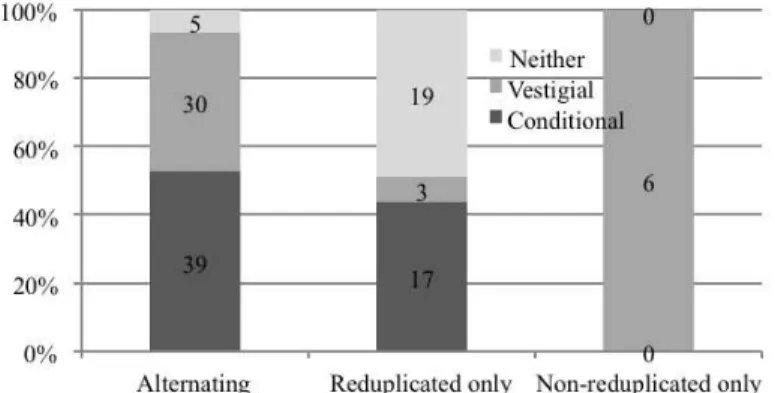
The distribution of the two types of fictive metonymy differs across the morphological types of stative mimetic verbs. Our list of stative mimetic verbs (see Appendix) contains 74 pairs of reduplicated and non-reduplicated items (henceforth, “alternating stative mimetic verbs”), 39 reduplicated items that have no non-reduplicated counterparts, and 6 non-reduplicated items that have no reduplicated counterparts. Figure 1 shows the semantic types of alternating and non-alternating stative mimetic verbs. Items that were judged as involving neither conditional nor vestigial metonymy include monosemous stative verbs (e.g., karaQ-to-si-te i- ‘be pleasantly dry or crispy’) and cases of non-fictive (or “factive”) metonymy that refer to actual concomitant events (e.g., hokahoka-si-te i- ‘be steaming hot’ < ‘steaming’).
4 There is some analytical ambiguity in fictive mimetic expressions. For example, the fluffiness represented by huwahuwa ‘fluffy’ may be analyzed as a property of an object that will expand back if pressed (conditional reading) or as a result of expansion (vestigial reading). However, it should be noted that what is crucial here is not the distinction between conditional and vestigial metonymies but the fact that the meanings of mimetics are specific enough to involve fictivity.
Figure 1. The morphological and semantic types of stative mimetic verbs
We discuss alternating and non-alternating stative mimetic verbs separately. We begin with alternating verbs to clarify the relationship between the morphology and semantics of stative mimetic verbs. The discussion is then reinforced by non-alternating cases.
3. Stative Mimetic Verbs with Morphological Alternation
In this section, we discuss the semantic difference between the reduplicated and non-reduplicated stative mimetic verbs with special attention to alternating verbs. Some examples are added in (5).
(5) Alternating stative mimetic verbs:
a. {korokoro/koroQ-to}-si-ta imo ‘a small round potato’ b. {kurukuru/kuruQ-to}-si-ta me ‘cute, round eyes’ c. {torotoro/toroQ-to}-si-ta kudamono ‘a pulpy fruit’ d. {turuturu/turuN-to}-si-ta yuka ‘a slippery floor’ e. {purupuru/puruN-to}-si-ta kutibiru ‘plump lips’ f. {zitozito/zitori-to}-si-ta ame-no hi ‘a damp rainy day’
The main idea is that the two morphological types of stative mimetic verbs do have an aspectual difference, but it resides in their encyclopedic semantics. The morphological contrast iconically reflects the aspectual contrast of the events — conditional or vestigial — that are associated with the states represented.
This hidden aspectual contrast can be detected by coding the associated events explicitly. The stative mimetic verbs in (6) and (7) involve conditional metonymy. The reduplicated forms prefer the unbounded conditional events (i.e., contact events) described in the (a)-sentences, whereas the non-reduplicated forms are only compatible with the bounded conditional events described in the (b)-sentences.
(6) a. Sono umebosi-wa yoku kam-u-to
that salt.plum-TOP well chew-NPST-when {karikari/*kariQ-to} -si-te i-ta.
MIM/MIM-QUOT -do-GER be-PST
‘[I] found that salt plum crunchy when [I] chewed it well.’ b. Sono umebosi-wa hito-kami-su-ru-to
that salt.plum-TOP 1-bite-do-NPST-when {??karikari/kariQ-to} -si-te i-ta.
MIM/MIM-QUOT -do-GER be-PST
‘[I] found that salt plum crunchy when [I] gave it a bite.’
(7) a. Kabe-wa kurikaesi hure-ru-to wall-TOP repeatedly touch-NPST-when {betabeta/*betaQ-to} -si-te i-ta. MIM/MIM-QUOT -do-GER be-PST
‘[I] found the wall sticky when [I] touched it repeatedly.’ b. Kabe-wa ik-kai hure-ru-to {??betabeta/betaQ-to}
wall-TOP 1-time touch-NPST-when MIM/MIM-QUOT -si-te i-ta.
-do-GER be-PST
‘[I] found the wall sticky when [I] touched it once.’
The mimetic verbs in (8) and (9) involve vestigial metonymy. Although the semantic contrast is less clear than the conditional cases, reduplicated forms are again associated with unbounded events (i.e., the continuing state changes in the (a)-sentences), whereas non-reduplicated forms are associated with bounded events (i.e., the sudden (complete) state changes in the (b)-sentences).
(8) a. Kami-ga yukkuri nobi-tuzuke-te hair-NOM slowly extend-continue-GER {bosabosa/?bosaQ-to} -si-te i-ru. MIM/MIM-QUOT -do-GER be-NPST
‘[My] hair has continued to grow slowly and is unkempt.’ b. Kami-ga paama-de sippai-si-te
hair-NOM perm-in failure-do-GER {?bosabosa/bosaQ-to} -si-te i-ru. MIM/MIM-QUOT -do-GER be-NPST
‘[My] hair is unkempt because [I] got a perm and messed up.’
(9) a. Inu-wa zyozyoni hutot-te {bukubuku/?bukuQ-to} dog-TOP gradually get.fat-GER MIM/MIM-QUOT -si-te i-ta.
-do-GER be-PST
‘The dog gradually got fat and looked like a balloon.’ b. Inu-wa totuzen hutot-te {?bukubuku/bukuQ-to}
dog-TOP suddenly get.fat-GER MIM/MIM-QUOT -si-te i-ta.
-do-GER be-PST
‘The dog suddenly got fat and looked like a balloon.’
The present data show that the morphology of stative mimetic verbs represents the boundedness of the dynamic events with which they are associated. In other words, these verbs may have two aspectual values — depicting two parts of the same frame — with the help of their iconic morphology.
4. Stative Mimetic Verbs without Morphological Alternation
Not every stative mimetic verb exhibits morphological alternation. Given the aspectual duality of alternating verbs discussed in Section 3, we can predict that events associated with non-alternating verbs have only one aspectual possibility (i.e., either bound or unbound). This prediction holds true for at least a subset of the non-alternating verbs. However, a close look reveals that different accounts are required for the two types of non-alternating stative mimetic verbs: reduplicated-only and non-reduplicated-only verbs.
Non-reduplicated stative mimetic verbs that do not have their reduplicated counterparts concern unambiguously bounded events. As exhaustively listed in (10), these verbs represent desirable properties of people or objects.
(10) Non-reduplicated-only verbs:
a. {bisiQ-to/*bisibisi}-si-ta kakkoo ‘a smart dress’
b. {gasiQ-to/*gasigasi}-si-ta karada-tuki ‘a solidly built body’ c. {gatiQ-to/*gatigati}-si-ta karada-tuki ‘a solidly built body’ d. {karaQ-to/*karakara}-si-ta tenki ‘pleasantly dry weather’ e. {kiriQ-to/*kirikiri}-si-ta kao ‘a clear-cut face’
f. {suraQ-to/*surasura}-si-ta hito ‘a slender person’
These mimetic verbs appear to involve vestigial events that lead to the properties they depict. The properties are conceptualized as being achieved as a result of a temporally bounded change of state, such as dressing up, hardening of muscles, drying of air, sharpening of looks, and becoming tall and slender. The boundedness of the vestigial events may be supported by the fact that these verbs represent high-degree properties, as shown by their incompatibility with the low-degree adverbial yaya ‘a little’ in (11) (cf. Toratani 2013).5
(11) a. {??yaya/totemo} bisiQ-to-si-ta kakkoo
‘{??a little/very} smart dress’
b. {??yaya/totemo} gasiQ-to-si-ta karada-tuki
‘a {??little/very} solidly built body’ c. {??yaya/totemo} gatiQ-to-si-ta karada-tuki
‘a {??little/very} solidly built body’ d. {??yaya/totemo} karaQ-to-si-ta tenki
‘{??a little/very} pleasantly dry weather’ e. {??yaya/totemo} kiriQ-to-si-ta kao
‘a {??little/very} clear-cut face’ f. {??yaya/totemo} suraQ-to-si-ta hito
‘a {??little/very} slender person’
The same is not true for the alternating non-reduplicated verbs discussed above, as in (12).
(12) a. {yaya/totemo} betaQ-to-si-ta kabe
‘a {little/very} sticky wall’ b. {yaya/totemo} bukuQ-to-si-ta inu
‘a {little/very} balloon-like dog’ c. {yaya/totemo} huwari-to-si-ta watagasi
‘{a little/very} fluffy cotton candy’ d. {yaya/totemo} kariQ-to-si-ta umebosi
‘a {little/very} crunchy salt plum’
Thus, the high degree specified for the non-alternating stative verbs in (12) appears to serve as the endpoint of the posited vestigial events. Note that suraQ ‘slender’ in (12f) allows for another
5 “High-degree properties” here are not equal to properties with a so-called “maximum standard” (Kennedy
& McNally 2005) that should be compatible with hobo ‘almost’ (e.g., *hobo bisiQ-to-si-ta kakkoo ‘almost smart dress’, *hobo gasiQ-to-si-ta karada-tuki ‘an almost solidly built body’). Further scrutiny is needed for a precise description of the scalar property in question.
interpretation. We recognize a person as slender by looking at the individual from head to foot or from foot to head. This mimetic verb is not reduplicated because this visual scanning is normally unidirectional (i.e., either upward or downward).
At least some reduplicated-only stative mimetic verbs represent events that can be conceptualized as properties when they are long-lasting. The examples in (13) involve activities for which manners may be considered properties. Specifically, the manners of speaking represented by bosoboso ‘speaking in a low voice’ in (13a) and hakihaki ‘speaking clearly’ in (13b) qualify as the speaker’s (speech) properties only when the speaker utters some words. The utterance of a single word is not enough to judge the entire manner of speech. Similarly, the briskness of a person’s movement represented by kibikibi ‘moving briskly’ in (13c) and tekipaki ‘working efficiently’ in (13d) cannot be recognized until it has been sufficiently observed.
(13) Reduplicated-only activity verbs:
a. {bosoboso/??bosoQ-to}-si-ta syaberi-kata ‘an unclear way of speaking’ b. {hakihaki/*hakiQ-to}-si-ta syaberi-kata ‘a clear way of speaking’ c. {kibikibi/*kibiQ-to}-si-ta ugoki ‘brisk motion’
d. {tekipaki/*tekiQ-to}-si-ta hataraki-buri ‘an efficient way of working’
A similar account applies to some reduplicated-only verbs that involve cyclic, semelfactive events. Some momentary events are conceptualized as participants’ properties when they are iterated. The mimetic verbs in (14) evoke emission events: light emission in (14a, b), gas emission in (14c-e), and substance emission in (14f) (for verbs of emission, see Levin 1993: 233; Levin & Rappaport Hovav 1995: 91-92). These emission events may be recognized as the emitters’ properties when iterated (see Kiyama & Akita 2015 for the stative nature of mimetic emission verbs). These verbs do not have their non-reduplicated counterparts because a single emission is unlikely to be regarded as a property.
(14) Reduplicated-only emission verbs:
a. {giragira/*giraQ-to}-si-ta taiyoo ‘the glaring sun’
b. {tyaratyara/*tyaraQ-to}-si-ta hito ‘a flashy person (with jingling jewelry)’ c. {hokahoka/*hokaQ-to}-si-ta bentoo ‘a steaming hot lunchbox’
d. {hokuhoku/*hokuQ-to}-si-ta imo ‘a steaming hot potato’ e. {mokumoku/*mokuQ-to}-si-ta kumo ‘rising clouds’ f. {zikuziku/*zikuQ-to}-si-ta kizu ‘an oozing wound’
The mimetic verbs in (15) involve non-emissive cyclic movements that may also qualify as objects’ properties through iteration.
(15) Reduplicated-only movement verbs:
a. {birabira/*biraQ-to}-si-ta bira ‘a fluttering poster’ b. {guragura/*guraQ-to}-si-ta isu ‘a wobbly chair’ c. {pitipiti/*pitiQ-to}-si-ta sakana ‘a fresh (jumping) fish’ d. {poroporo/*poroQ-to}-si-ta gohan ‘crumbly rice’ e. {posoposo/*posoQ-to}-si-ta gohan ‘dry, crumbly rice’ f. {taputapu/?tapuQ-to}-si-ta onaka ‘a flabby (swaying) belly’
In summary, at least two semantic factors block the morphological alternation of stative mimetic verbs. On the one hand, non-reduplicated-only verbs do not alternate because they involve a bounded change to a high-degree state. On the other hand, some of the reduplicated-only verbs do not alternate because the events they evoke can be conceptualized as properties only when they last for a while or are iterated.
5. A Dual Sound-Symbolic System
In the previous sections, we have shown that stative mimetic verbs may morphologically exhibit a dynamic aspectual value in addition to state. This aspectual value is more or less predictable from the lexical meaning of each mimetic, as we discussed in Section 4. These observations lead us to posit a bipartite sound-symbolic system for mimetics in which morpho(phono)logy and segmental phonology have separate phonosemantic mappings (Akita 2008, 2009). Here, we begin with a frame-semantically informed description of the dual sound-symbolic system that will be placed in the general framework of “the cognitive subsystems of language” developed by Talmy (1988, 2000).
As mentioned in Section 2, the highly complex semantic structure and the prevalence of metonymical extensions, including fictive extensions, render Japanese mimetics a suitable subject for Frame Semantics. To highlight the dual nature of the sound-symbolic system of mimetics, we adopt the feature-based notation of frames developed by Osswald & Van Valin (2014) (see also Baker 1999). This descriptive framework allows us to incorporate event-structural information into the lists of frame elements, such as those given in Berkeley FrameNet. Figure 2 is the partial attribute-value matrix (AVM) for the frame-semantic and morphophonological content of the alternating stative mimetic verbs karikari-si-te i- and kariQ-to-si-te i- ‘be crunchy’, which involve conditional metonymy (see (3a)). (Some of the frame names used below were taken from Berkeley FrameNet.)
Figure 2. {karikari/kariQ-to}-si-te i- ‘be crunchy’
In both verbs, the conditional biting event is specified as an event that causes sound. The crunchy state that is profiled (or “perspectivized”; marked in boldface) is specified as the tactile property of the food that is bitten and is the sound source in the caused event (Usuki & Akita 2013; Akita 2014). Crucially, as represented by the curved lines, the morphological templates of the two mimetics are iconically linked with the boundedness value of the causing event, whereas the segmental properties of the mimetic roots are phonosemantically linked with the state (Usuki & Akita 2015).6
The AVM for the alternating vestigial mimetic verbs bukubuku-si-te i- and bukuQ-to-si-te i-
‘be fatty like a balloon’ in (9) is given in Figure 3. The state represented by the verbs is specified as a result of the vestigial change-of-state event (i.e., body expansion). The morphological templates of the mimetics are linked with the boundedness of this vestigial event. Meanwhile, the mimetic root /buku/ is phonosemantically associated with the state (i.e., the result size).
6 Further research is needed to determine whether segmental properties of stative mimetic verbs depict stative events, the dynamic events associated with them, or both.
Figure 3. {bukubuku/bukuQ-to}-si-te i- ‘be fatty like a balloon’
The present frame-semantic approach also accounts for the non-alternating cases. Figure 4 shows the AVM for the non-reduplicated-only verb bisiQ-to-si-te i- ‘be smartly dressed’ in (10a). The Dressing_up frame evoked by this mimetic verb has an inherent boundedness specification ([+bd]) in the frame element CLOTHING, which explains the unavailability of the reduplicated version *bisibisi-si-te i-.
Figure 4. bisiQ-to-si-te i- ‘be smartly dressed’
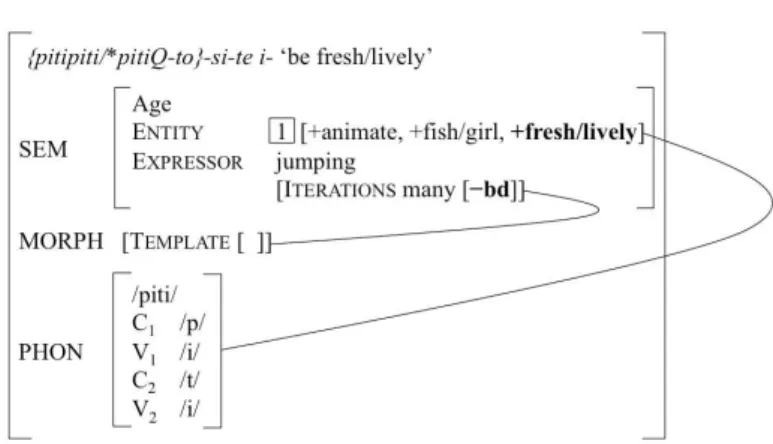
Similarly, the reduplicated-only verb pitipiti-si-te i- ‘be fresh/lively’ in (15c) evokes the Age frame. [−bd] specified in the frame element EXPRESSOR (an expression that indicates a certain age) predicts the infelicity of the non-reduplicated form *pitiQ-to-si-te i-. A single jump is not enough to characterize age.
Figure 5. pitipiti-si-te i- ‘be fresh/lively’
The dual sound-symbolic system outlined here may be reinterpreted in terms of Talmy’s (1988, 2000) two cognitive subsystems of language. Talmy argues that linguistic forms, including morphemes, grammatical categories, and grammatical relations, can be divided into two.
“Closed-class” elements constitute “the grammatical subsystem” that is responsible for the structural contours of cognitive representation, whereas “open-class” elements constitute “the lexical subsystem” that is responsible for the content of cognitive representation. The closed-class elements in the well-known example in (16) include the indefinite article a, the agentive nominal suffix -er, the past tense marker -ed, the definite article the, and the plural suffix -s as well as the active voice and the grammatical specifications, such as V, NPs, subject, and direct object. The open-class elements in the same sentence are the verbs rustle and lasso and the noun steer.
(16) A rustler lassoed the steers.
(Talmy 2000: 33)
Even an individual who knows none of the meanings of these open-class items can capture the schematic event-structural meaning of this sentence (i.e., ‘An agent acted on (and affected) definite entities’) from the closed-class elements.
The morphological templates of mimetics, such as reduplicated and non-reduplicated, suffixed forms, constitute a closed class and represent the aspectual contours of events (Akita 2009). The segmental properties of mimetic roots, such as the combination of a voiceless velar stop and a flap, are also limited in number but considered to form a less-closed class. For example, we can playfully use nonlinguistic sounds, with the templates fixed, to enhance the quality of our animal mimicry. These segmental properties contribute to the phonosemantic depiction of events in a minute fashion, as illustrated by a voiceless velar stop specifying the object involved as hard (Hamano 1998). These facts may allow us to argue that the morphological templates and segments
of mimetics, which are responsible for the dual architecture of the sound-symbolic system, are a word-level illustration of the two cognitive subsystems of language.7 Put differently, it appears that the sound-symbolic system of mimetics has two separate subsystems as a reflection of the bipartite structure of language.
6. Conclusions
In this paper, we have discussed the dynamic aspect of stative mimetic verbs that causes the morphological contrast between reduplicated and non-reduplicated forms. This hidden aspectual specification reflects the semantic complexity of mimetics that is straightforwardly described within the framework of Frame Semantics. More generally, we argued that the observed division of labor between the morpho(phono)logical templates and segmental properties of mimetics corroborates the dualistic view of the sound-symbolic system of Japanese mimetics. This dual sound-symbolic system may be understood as a word-level microcosm of language that comprises two cognitive subsystems. Stative mimetic verbs, depicting two different events rather than two different aspects of the same event, have provided a clear illustration of the two iconic subsystems.
It is to be hoped that future research will cover the resultative adverbial use of stative mimetics, which exhibits no morphological alternation (e.g., imo-o {kariQ-to/*karikari(-to)} age-
‘deep-fry a potato crispy’) (Usuki & Akita 2013). Moreover, the crosslinguistic applicability of the dual sound-symbolic system is worth a serious look.
References
Akita, K. (2008). Two cognitive subsystems of sound symbolism in Japanese. Proceedings of the Thirty-Second Annual Meeting of Kansai Linguistic Society (KLS), 28, 23-33.
Akita, K. (2009). A grammar of sound-symbolic words in Japanese: Theoretical approaches to iconic and lexical properties of mimetics. Unpublished doctoral dissertation, Kobe University, Hyogo, Japan.
Akita, K. (2012). Toward a frame-semantic definition of sound-symbolic words: A collocational analysis of Japanese mimetics. Cognitive Linguistics, 23(1), 67-90.
Akita, K. (2013). Constraints on the semantic extension of onomatopoeia. The Public Journal of Semiotics, 5(1), 21-37.
Akita, K. (2014). Fictivity and frames in mimetic state expressions. In Gengo-bunka kyoodoo-kenkyuu-purozyekuto, 2013: Sizen-gengo-e-no riron-teki-apurooti [Joint project on language & culture, 2013: Theoretical approaches to natural language] (pp. 1-10). Osaka: Osaka University.
Akita, K. (to appear). Grammatical and functional properties of mimetics in Japanese. In N. Iwasaki,
7 In Peircean semiotics, the morphological templates and segments of mimetics would be classified as diagrammatic and imagic icons, respectively (Peirce 1932). I owe this analogy to William J. Herlofsky.
P. Sells, & K. Akita (Eds.), The grammar of Japanese mimetics: Perspectives from structure, acquisition and translation (Chapter 2). London: Routledge.
Akita, K., & Usuki, T. (2016). A constructional account of the “optional” quotative marking on Japanese mimetics. Journal of Linguistics, 52(2), 245-275.
Baker, C. F. (1999). Seeing clearly: Frame semantic, psycholinguistic, and cross-linguistic approaches to the semantics of the English verb see. Unpublished doctoral dissertation, University of California, Berkeley.
Berkeley FrameNet. https://framenet.icsi.berkeley.edu (last accessed 19 June 2016).
Croft, W. (1993). The role of domains in the interpretation of metaphors and metonymies. Cognitive Linguistics, 4(4), 335-370.
Depraetere, I. (1995). On the necessity of distinguishing between (un)boundedness and (a)telicity. Linguistics and Philosophy, 18, 1-19.
Fillmore, C. J. (1982). Frame semantics. In the Linguistic Society of Korea (Ed.), Linguistics in the morning calm (pp. 111-137). Seoul: Hanshin.
Fillmore, C. J., & Baker, C. (2010). A frames approach to semantic analysis. In B. Heine & H. Narrog (Eds.), The Oxford handbook of linguistic analysis (pp. 313-340). Oxford: Oxford University Press.
Hamano, S. (1998). The sound-symbolic system of Japanese. Stanford: CSLI.
Herlofsky, W. J. (1997). Imitative words, sound-symbolic grammar, and interlocutionary involvement in Japanese discourse. Journal of Japanese Linguistics and Education, 4, 21-40. Nagoya Gakuin University.
Izumi, K. (1976). Giseigo/gitaigo-no tokusitu [Some characteristics of mimetics]. In T. Suzuki (Ed.), Nihongo-no goi-to hyoogen [Japanese vocabulary and expressions] (pp. 105-151). Tokyo: Taishukan.
Kageyama, T. (2007). Explorations in the conceptual semantics of mimetic verbs. In B. Frellesvig, M. Shibatani, & J. Smith (Eds.), Current issues in the history and structure of Japanese (pp. 27-82). Tokyo: Kurosio.
Kakehi, H., Tamori, I., & Schourup, L. (1996). Dictionary of iconic expressions in Japanese. Berlin/New York: Mouton de Gruyter.
Kennedy, C., & McNally, L. (2005). Scale structure and the semantic typology of gradable predicates. Language, 81(2), 345-381.
Kindaichi, H. (1950) Kokugo-doosi-no iti-bunrui [A proposal for Japanese verb classification]. Gengo Kenkyu, 15, 48-63.
Kita, S. (1997). Two-dimensional semantic analysis of Japanese mimetics. Linguistics, 35(2), 379-415.
Kiyama, N., & Akita, K. (2015). Gradability and mimetic verbs in Japanese: A frame-semantic account. In A. E. Jurgensen, H. Sande, S. Lamoureux, K. Baclawski, & A. Zerbe (Eds.),
Proceedings of the Forty-First Annual Meeting of the Berkeley Linguistics Society (BLS 41): Vol 41. General Session and Special Session on Fieldwork Methodology (pp. 245-265).
Kunihiro, T. (1985). Ninti-to gengo-hyoogen [Cognition and linguistic expressions]. Gengo Kenkyu, 88, 1-19.
Levin, B. (1993). English verb classes and alternations: A preliminary investigation. Chicago: University of Chicago Press.
Levin, B., & Rappaport Hovav, M. (1995). Unaccusativity: At the syntax-lexical semantics interface. Cambridge, MA: MIT Press.
Mikami, K. (2006). Nihongo-no giongo/gitaigo-ni okeru imi-no kakutyoo: Konseki-teki-ninti/yoki-teki-ninti-no kanten-kara [Semantic extension in Japanese mimetics: From the perspective of vestigial and prospective cognition]. Studies on Japanese Language and Literature, 57, 199-217.
Nakamoto, K., Kotani, K., & Isahara, H. (2004). Yoki-teki-ninti-to keiyoo-hyoogen: Huan-ni motozuku zyookyoo-haaku [Prospective cognition and interpretation of adjectives]. Papers from the 4th National Conference of the Japanese Cognitive Linguistics Association, 4, 34-44. Nuckolls, J. B. (1996). Sounds like life: Sound-symbolic grammar, performance, and cognition in
Pastaza Quechua. Oxford: Oxford University Press.
Osswald, R., & Van Valin, R. D., Jr. (2014). FrameNet, frame structure and the syntax-semantics interface. In T. Gamerschlag, D. Gerland, R. Osswald, & W. Petersen (Eds.), Frames and concept types: Applications in language and philosophy (pp. 125-156). Berlin: Springer. Peirce, C. S. (1932). Collected papers of Charles Sanders Peirce, Vol. 2: Elements of logic.
Cambridge, MA: Harvard University Press.
Suzuki, A. (2012). Nihongo-onomatope-zyutugo-no keisiki-ni tuite: Suru/siteiru/da-no sentaku-kizyun-o tyuusin-ni [Mimetic predicates in Japanese: Focusing on the criteria for selecting the predicative forms, suru, siteiru, and da]. Journal of Japanese Grammar, 12(2), 162-178.
Talmy, L. (1988). The relation of grammar to cognition. In B. Rudzka-Ostyn (Ed.), Topics in cognitive linguistics (pp. 165-205). Amsterdam/Philadelphia: John Benjamins.
Talmy, L. (1996). Fictive motion in language and ‘ception.’ In P. Bloom, M. A. Peterson, L. Nadel,
& M. F. Garrett (Eds.), Language and space (pp. 211-276). Cambridge, MA: MIT Press. Talmy, L. (2000). Toward a cognitive semantics, Vol. 1: Concept structuring systems. Cambridge,
MA: MIT Press.
Toratani, K. (1999). Aspectual matching and mimetics in Japanese. Western Conference on Linguistics, 11, 495-507.
Toratani, K. (2005). A cognitive approach to mimetic aspect in Japanese. In R. T. Cover & Y. Kim (Eds.), Proceedings of the Thirty-First Annual Meeting of the Berkeley Linguistics Society (BLS 31): Vol 31. General Session and Parasession on Prosodic Variation and Change (pp.
335-346).
Toratani, K. (2007). An RRG analysis of manner adverbial mimetics. Language and Linguistics, 8(1), 311-342.
Toratani, K. (2013). Hukusi-teki-onomatope-no tokusyusei: Tagisei/zisyoosei-kara-no koosatu [The uniqueness of adverbial mimetics in terms of polysemy and eventivity]. In K. Shinohara & R. Uno (Eds.), Onomatope-kenkyuu-no syatei: Tikazuku oto-to imi [Sound symbolism and mimetics: Rethinking the relationship between sound and meaning in language] (pp. 85-99). Tokyo: Hituzi Syobo.
Toratani, K. (to appear). The position of to/Ø-marked mimetics in Japanese sentence structure. In N. Iwasaki, P. Sells, & K. Akita (Eds.), The grammar of Japanese mimetics: Perspectives from structure, acquisition and translation (Chapter 3). London: Routledge.
Tsujimura, N., & Deguchi, M. (2007). Semantic integration of mimetics in Japanese. In J. Cihlar, A. Franklin, D. Kaiser, & I. Kimbara (Eds.), Papers from the 39th Regional Meeting of the Chicago Linguistic Society (CLS 39): Vol. 39. The main session (pp. 339-353).
Usuki, T., & Akita, K. (2013). Fiction in an encyclopedia: A Generative Lexicon approach to fictive mimetic resultatives in Japanese. In Fukuoka Linguistic Circle (Ed.), Gengogaku-kara-no tyooboo 2013: Hukuoka-gengo-gakkai 40-syuunen-kinen-ronbunsyuu [A view from linguistics 2013: Papers on the 40th anniversary of Fukuoka Linguistic Circle], 308-321. Kyushu: Kyushu University Press.
Usuki, T., & Akita, K. (2015). What’s in a mimetic?: On the dynamicity of its iconic stem. In M. K. Hiraga, W. J. Herlofsky, K. Shinohara, & K. Akita (Eds.), Iconicity: East meets West (pp. 109-123). Amsterdam/Philadelphia: John Benjamins.
Yu, W. (2014). Nit-tyuu-ryoo-gengo-ni okeru giongo-no imi-to imi-kakutyoo: Hureemu-imiron-no kanten-kara-no apurooti [The meaning and semantic extension of onomatopoeia in Japanese and Chinese: A frame-semantic approach]. Unpublished doctoral dissertation, Kobe University, Hyogo, Japan.
Appendix: Lists of Stative Mimetic Verbs
The following lists of stative mimetic verbs were compiled by analyzing Akita’s (2009) mimetic list that is primarily based on Kakehi et al. (1996). Only the mimetic parts of the verbs are listed for simplicity.
(i) Alternating verbs: a. Conditional:
betabata/bataQ ‘sticky’, betobeto/betoQ ‘sticky’, betyobetyo/betyoQ ‘mushy’, buyobuyo/buyoQ ‘flabby’, dabodabo/daboQ ‘baggy (of clothing)’, dabudabu/dabuQ
‘baggy (of clothing)’, dorodoro/doroQ ‘muddy’, hirahira/hiraQ/hirari ‘fluttering, frilly’,
hunyahunya/hunyaQ ‘too soft’, huwahuwa/huwaQ/huwaN/huwari ‘fluffy’, karikari/kariQ
‘crispy’, korikori/koriQ ‘crunchy’, korokoro/koroQ/koroN/korori ‘small and round’, kurukuru/kuruQ/kururi ‘cute and round’, mutimuti/mutiQ ‘plump’ nebaneba/nebaQ ‘gluey’, netineti/netiQ ‘persistent’, netoneto/netoQ ‘sticky’, netyanetya/netyaQ ‘sticky’, numenume/numeQ ‘slimy’, nuranura/nuraQ/nurari ‘slimy’, nurunuru/nuruQ/nururi
‘slimy’, nyurunyuru/nyuruQ ‘slippery’, parapara/paraQ/parari ‘not sticky (of small round objects)’, paripari/pariQ ‘crisp’, pasapasa/pasaQ ‘dry and crumbly’, petapeta/petaQ/petaN/petari ‘wet (of hair)’, puripuri/puriQ ‘plump’, purupuru/puruQ/puruN ‘gelatinous, plump’, sakusaku/sakuQ ‘crisp’, sarasara/saraQ/sarari ‘dry and smooth’, sinasina/sinaQ ‘soft and elastic’, syakisyaki/syakiQ ‘crisp (of vegetables)’, syarisyari/syariQ ‘crisp (e.g., of fruits and shaved ice)’, taratara/?taraQ ‘slow and boring (e.g., of life and speech)’, tekateka/tekaQ ‘shining’, torotoro/toroQ/torori ‘pulpy’, turuturu/turuQ/turuN/tururi ‘slippery, smooth’, zarazara/zaraQ/zarari ‘rough, coarse’
b. Vestigial:
bokeboke/bokeQ ‘absent-minded’ bosabosa/bosaQ ‘unkempt’, botebote/boteQ/boteri
‘bulky, ungainly’, bukubuku/bukuQ ‘fatty like a balloon’, butubutu/butuQ ‘many (of a rash)’, debudebu/debuQ ‘fatty’, gizagiza/gizaQ ‘serrated’, gotyagotya/gotyaQ ‘untidy, messy’, gunyagunya/gunyaQ/gunyari ‘limp, bent’, gusyagusya/gusyaQ ‘wet, untidy’, gutyagutya/gutyaQ ‘squashed’, gyorogyoro/gyoroQ ‘goggle-eyed’, hyorohyoro/hyoroQ/hyorori ‘lanky’, kitikiti/kitiQ/kitiN/kitiri ‘neat’, kunekune/kuneQ
‘twisted, meandering’, kunyakunya/kunyaQ/kunyari ‘twisted, limp’, kusyakusya/kusyaQ
‘crumpled’, kutakuta/kutaQ/kutaN ‘worn out’, mosamosa/mosaQ/mosari ‘hairy, dull’, mosyamosya/mosyaQ ‘hairy’, mowamowa/mowaQ ‘foggy’, moyamoya/moyaQ ‘hazy’, mozyamozya/mozyaQ ‘bushy’, potepote/poteQ ‘chubby’, potyapotya/potyaQ/potyari ‘plum’, pukupuku/pukuQ/pukuri ‘plump’, putuputu/putuQ ‘small and many (of dots)’, sitosito/sitoQ
‘moist’, uneune/uneQ ‘winding’, zimezime/zimeQ ‘humid’ c. Neither:
deredere/dereQ ‘slovenly’, kurikuri/kuriQ/kuriN ‘cute and round’, nayonayo/nayoQ
‘slender, wishy-washy’, yuruyuru/yuruQ/yururi ‘leisurely’, zitozito/zitoQ/zitori ‘damp’
(ii) Reduplicated-only verbs: a. Conditional:
birabira ‘flickering’, bukabuka ‘baggy’, giragira ‘glaring’, gisigisi ‘damaged (of hair)’, gisugisu ‘unfriendly (of a personal relationship)’, gotugotu ‘rugged’, gowagowa ‘coarse (of cloth)’, guragura ‘wobbly’, hukahuka ‘fluffy’, husahusa ‘thick (of hair)’, kirakira ‘glittery’, pitipiti ‘fresh’, poroporo ‘crumbly’, posoposo ‘dry and crumbly’, sikosiko ‘al dente’,
taputapu ‘flabby’, tyaratyara ‘flashy, frivolous’ b. Vestigial:
gotagota ‘too busy’, mokumoku ‘rising (of clouds)’, morimori ‘very muscular’ c. Neither:
bosoboso ‘speaking in a low voice’, gatugatu ‘greedy’, hakihaki ‘speaking clearly’, hokahoka ‘steaming hot (e.g., of rice)’, hokuhoku ‘steaming hot (e.g., of potatoes)’, kebakeba ‘gaudy’, kibikibi ‘moving briskly’, kosekose ‘fussy’, marumaru ‘chubby’, pokapoka ‘pleasantly warm’, posoposo ‘muttering’, sabasaba ‘open-hearted’, syobosyobo
‘bleary’, tekipaki ‘working briskly’, timatima ‘small and neatly arranged’, togetoge ‘spiny’, tyakatyaka ‘restless’, tyakityaki ‘trueborn’, zikuziku ‘oozing’
(iii) Non-reduplicated-only verbs (all vestigial):
bisiQ ‘smartly dressed’, gasiQ ‘solidly built’, gatiQ ‘solidly built’, karaQ ‘pleasantly dry, crispy’, kiriQ/kiriri ‘clear-cut (of a face)’, suraQ/surari ‘slender’