A Decentralized Cooperation Model for Disaster Simulation
Bipin Khanal, Nobuhiro Ito
Department of Information Science, Aichi Institute of Technology
Aichi Prefecture, Japan
Abstract: In Disaster Simulation, multiple heterogeneous agents work together, forming a cooperative team, in a common environment to achieve a common goal. Researches related to agents’ action in dynamic environment are still countable. As the expected results using dynamic environment may not be very certain/effective, the current Disaster Simulations are forced to use centralized system in which the central agent is handling the communication, cooperation and coordination activities of all other agents. In centralized system, if the central agent (that is controlling the whole system) fails then the whole system could crash. Also, if we cannot skip the effect of dynamic environmental conditions in centralized system, there could arise a question mark in the performance of the whole system. This paper focuses on such performance bottlenecks caused by centralized model introducing a decentralized model for cooperation. Change in the environment of the whole system is also being one of the main issues in current Disaster Simulation projects. We describe how the decentralized model could be the best solution for robustness of the performance of the Disaster Simulation and we also introduce an algorithm for decentralized cooperation model in dynamic environment.
1. Introduction
Disaster Simulation is a Multi-Agent System where multiple heterogeneous agents work together, forming a cooperative team, to achieve a common goal. A Multi-Agent System (MAS) is a system composed of multiple interacting intelligent agents. Multi-agent systems can be used to solve problems that are difficult or impossible for an individual agent or a monolithic system to solve. Multi-agent systems can be used to solve problems that are difficult or impossible for an individual agent to solve [1]. Natural disasters are becoming very common these days. Disaster Simulation (hereafter DS) is an approach for studying ways to rescue victims of disaster and reduce disaster damage. In DS, participating agents such as the fire brigade, ambulance team, and police force work together to achieve the common goal of rescuing victims of disaster in a given environment [2]. In other words, Instead of human beings, Robocups (Agents) with different capacities play the role of rescuers and save people in the case of large-scale disaster.
1.1 Existing concept of DS
Current DS is using centralized system in which the central agent that controls the whole system is handling the communication, cooperation and coordination activities of all other agents. A number of researches
related to the change in environment, i.e. dynamic environment in MAS are ubiquitous but the implementation of their results is still lacking. Because of this, the expected results using dynamic environment could not be very certain/effective. Hence, the current DS is using the centralized system. The use of central system can slow down the performance of the whole system. Specifically, having one agent in charge of handling the communication, cooperation and coordination of the activities of all other agents could result in a performance bottleneck [4]. In centralized system, if the central agent, the heart of the whole system, fails then the whole system could crash.
1.2 Current issues in DS
All other things except agents are their environments in MAS and same in DS. According to Gemma Bel-Enguix and M. Dolores Jiménez-López (2007) [3], “the environment has been recognized as an explicit and exploitable element to design Multi-Agent Systems (MAS). It can be assigned a number of responsibilities that would be more difficult to design with the sole notion of agents”. In other words, environment is a first-class abstraction that provides the surrounding conditions for agents to exist and that mediates both the interaction among agents and the access to resources. From above explanation of the environment, we can say that any changes in the environment can have enormous effect in
the movement of agents in MAS. This is one of the main issues in MAS as well as in DS. If we skip the effect of dynamic environment, then the use of centralized system could be the best approach. But when we have to consider the dynamic environment, the use of centralized system could arise a question mark in the performance of the whole system.
Only considering the dynamic environment will not solve the problem of current DS. Modeling the cooperation of agents in a dynamic environment is of utmost importance. In this paper, we mainly focus on these issues. To make the system decentralized, we need to re-structure the DS and re-model the cooperation of the agents.
2. Environment as an agent
According to Nobuhiro Ito, Kouichi Nakagawa, Takahiro Hotta, Xiaoyong Du, Naohiro Ishii (1998) [6], we got a clear concept of modeling environment as an agent in MAS. In this research, we consider environment as an agent because of the following reasons.
1. To decrease the unnecessary communication with the central agent so that the performance speed gears up. Global Environment sends the required information to the Local Environment and from there it is conveyed to other agents. The main objective of Env (as an agent) is to provide the updated information to the agents. Agents can communicate only with its Local Environment (Env) irrespective of the communication to the Global Environment (ENV) so that any unnecessary communication is avoided. Event if the other agents in the given local environment are busy, the environment agent, Env, can receive the information from the ENV and get updated.
2. To allow agents to do calculations independently. Since the Environment agent (Env) sends all the required data to every agent, they can make calculations independently and update the results irrespective of the Global Environment (ENV).
3. To provide a medium for data transfer for all agents within its area.
After calculation, agents update their results to their Local Environment and it holds the data so that other environment agents can access it at any time they need. 4. To take part in cooperation, so that an effective
cooperative team could be generated.
If the environment agent also takes part in cooperation, a team including the environment can be created and thus the updated information can be tracked by all agents when necessary so that the cooperation is not violated unnecessarily.
Considering Environment as an agent, the system will be decentralized providing independent calculation and communications among all the agents. Now we discuss about the new approach of the decentralized disaster simulation.
2.1 A new structure of DS
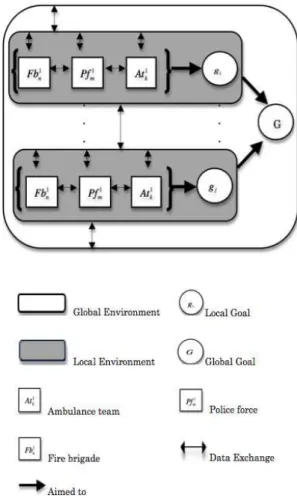
We consider Environment as one of our agents in our new structure of DS. The figure below describes the clear view of our new structure.
Fig. 1.: Structural diagram showing relations between agents
In Fig.1, we have a Global Environment (ENV) that contains sub environments and a common goal. Sub environment here is considered as Local environment (Env) that includes Fire brigade (Fb: varying in number from 1 to n), Police force (Pf: varying in number from 1 to m), Ambulance team (At: varying in number from 1 to
k) and Buildings as local goals (g: varying in number from 1 to j). All the agents Fb, Pf and At work together to achieve a local goal (g) within a local environment (Env) provided that the number of all the agents taking part in the action may vary correspondingly. Once all the local goals (g=number of buildings: varying from 1 to j) are accomplished, then global goal G is supposed to be accomplished.
2.2 A new approach to DS
In this approach, we consider environment as an active agent that has a big role in DS. Fire Brigade, Police Force and Ambulance Team are other active agents that too have very big role in DS. We are introducing some additional attributes to the agents like Status, Priority and Free Flag, which are of utmost necessity while working in a dynamic environment.
Agents and their parameters are as follows:
Status S: It describes the current environmental status as compared to the previous one and is defined by using 0 or 1. Initially it is 0, if there is a change in environment, it is set to 1 and it is 0 for next change and so on.
Priority P: It is describes the priority of each agent. Priority can be categorized into three levels.
1. High (2): Agents that have a very active role have high priority. Initially all agents have high priority.
2. Medium (1): Agents whose role is not very active have this priority. For example, in the case of heavy rain, the use of Fire Brigade can be either suppressed or avoided. These types of agents are considered to have a medium priority.
3. Low (0): Agents that are out of order or that do not have active role in the team. For example, while working in a team, if any individual agent completes its task, and if it does not have any more stamina, its priority is comparatively set to low so that the cooperation of the rest team is not disturbed by it. From above explanation, we can say that the attribute Priority is very important in case of dynamic environment. The Priority is necessary to avoid the unnecessary involvements of disturbing agents in the cooperation. Agents enter the cooperation on the basis of priority.
Free Flag F: This attribute defines whether the agent is free or not. For free agents, it is set to 1 and 0 is set for busy agents.
In this research, we suppose that the communication between agents is always possible. The step-wise explanation of our new approach is as under.
STEP 1: Global Environment (ENV) sends data to all other agents by setting the attributes S to 0, P to 2, and F to 1.
send_to_all_agents(S,P,F,…)
STEP 2: As all agents know their position, they can calculate their distance to the buildings in a given environment and send necessary data to all other agents. The data includes myID(my_id), BuildingID(Bld_id), Distance(D),Status(S), Priority(P), Free Flag(F) etc.
receive_from_ENV(S,P,F,…) calculate_Distance()
send_to_Agents(my_id, Bld_id, D,S, P, F,…)
STEP 3: The agents always accept messages from the Environment and messages from other sources only when they are free (initially all agents accepts messages from each other). All agents create their own task list using the data sent by other agents based on the priority and the shortest distance. As a result, the agent with the shortest distance to the building with high priority comes on the top of the list and so on. This task list is updated to the Local Environment (Env), for the access by other agents. Env sends signal to agents to start cooperation and work by setting the F to 0 for all agents within it. A simple example of program flow of agent when it is free can be as under:
if(free){
if(msg_from_agents){
receive_From_Agents(my_id, Bld_id, D,S, P, F,…) create_task_list()
update_Task_List_To_Env() }else if(msg_from_Env){ receive_msg_of_Env() cooperate()
if(finished){ set Free_flg=1;
send_to_Env(finished_task,F,…) }else{
work(); } } }
Once the task is accomplished, F is set to 1 so that agents can take part in another task.
STEP 4: After the completion of the task in the task list, Env updates the accomplished task to ENV and all the above steps from STEP 2 are repeated recursively unless all the local goals are accomplished.
If there is change in Env, it re-allocates the task to the agents within it without disturbing the other Env agents. But if ENV is changed, all the processes are repeated from STEP1.
3. A Cooperation Model
A cooperative system is defined to be a system of multiple dynamic entities that share information or tasks to accomplish a common, though perhaps not singular, objective [7]. In this paper, we can consider agents as our multiple dynamics entities that share information to achieve a common target/goal. Cooperation occurs when the agents with different capabilities have a goal in common, and their actions tend to achieve the goal. For cooperation, the most important point is communication. Wrong information may lead to the wrong result. So there should be proper message sharing in cooperation. In this paper, we suppose that there is a very good message-sharing environment between the agents. In DS, all the agents have a common goal of rescuing victims of disaster.
Now in this section, we model the cooperation for the agents.
, ,
,
The sets written above are possible sets of Ambulance Team, Police Force, Fire Brigade and Environment respectively.
The rescue team can be expressed as RA = {AT , PF, FB, Env}
In Disaster simulation, we can consider the building as a goal for agents.
G = {Bld1, Bld2 , ...., Bld j }
Here the number of buildings and Local environments are same because each goal is provided an environment in our new approach.
Common objective is defined as a finite set of global goals.
Oc={G1,G2,...,Gm|Gi∈G,m≥1}.
In disaster simulation, since the common objective of all the agents is only one, i.e. to rescue, m is 1.
Model of cooperation can be related to the common objective as below:
Mod = def
(Ra, Oc ) where Ra ⊆ RA where Att ⊆ At, Pft ⊆ Pf , Fbt ⊆ Fb, Envt ⊆ Env
where t can be one of the time steps in simulation. Relation between agent and common objective can be expressed as Rel _ Agent:RA×Oc→P(LG) where LG⊆G. Cooperation Capability can be defined as a set of services and functionalities needed to support cooperation, such as negotiation, collaboration and coordination which can be expressed as below.
CF = def
{ATcf , PFcf , FBcf , ENVcf }
where ATcf = {Atcf1,Atcf2, ...,Atcfn } PFcf = {Pfcf1,Pfcf2, ...,Pfcfm } FBcf = {Fbcf1,Fbcf2, ...,Fbcfk}
ENVcf = {Envcf1,Envcf2, ...,Envcfj}
We represent service or control functionality by a function that brings the system from a control state to another. CS is the set of Control state.
cfi : CS → CS csti cst+1i CC : RA → P(CF )
Ra {Atcft,Pfcft,Fbcft,Envcft} where
Atcft ⊆ATcf , Pfcft ⊆PFcf , Fbcft ⊆FBcf , Envcft ⊆ENVcf where t is the one of the time steps in simulation.
The function Cooperation measures the ability of a society of agents to achieve the cooperation control of a global goal.
Cooperation : P( RA) × Gg → {true, false}whereGg ⊆ Oc AT = {At1, At2,...., Atn}
PF = {Pf1,Pf2,....,Pfm}
FB = {Fb1, Fb2,...., Fbk}
ENV= {Env1, Env2,...., Envj}
Ra ={Att,Pft,Fbt,Envt}
An agent is able to support the cooperation needed to reach a goal Bld1 if its cooperation capability allows to bring the system from the initial control state to a state of describing a goal.
Cooperation( At1, Bld1) = true iff
∃Exec ∈ (Cap(At1)) * .Exec(si ) = State(Bld1) [f1, ...., fn ](si ) =
def
fn (....( f1(si )))...)
The functionalities here are only concerned with performing domain task.
Completeness of local goals:
Let G = {Bld1, Bld2 , ..., Bld3} be a global goal and RA = {AT , PF, FB, Env}bse a society of agents. Comp( RA, G ) = true iff
{Bld1, Bld2 , ..., Bld3} =t=1n Rel _ Agent ( At,G ) where
At = {Att,Pft,Fbt,Envt}
Efficiency of local goals:
It states the fact that only one agent will realize the local goal.
Effic( RA, G ) = true iff
∀i, j.i ≠ j ⇒ Re l _ Agent ( Ai , G) ∩ Re l _ Agent(A j , G) = {}
Consistency of local goals:
It states that no agent of the society can destroy the results achieved by another agent.
Cons( RA, G ) = true iff
∀i, j. Rel _ Agent ( Ai , G) ⊂
(Rel _ Agent ( Ai , G) ⊕ Re l _ Agent(A j , G))
The operation is defined on the set of local goals as follows: if the result of an agent is the opposite of the result achieved by another agent then the addition ( ) of their local goals corresponds to the neutral goal represented by the empty set.
For the proper implementation of the cooperation in DS, we need to consider the following points.
Role: The notion of role allows distinguishing and specifying a particular agent. It also allows
characterizing the responsibilities associated to each agent.
Role : RA × P(Oc ) → P(LG)
(A, Bld1) Bgk∈OcRel _ Agent ( A, Bgk ) where
A = {Att , Pft , Fbt , Envt }
where t is the time step of the simulation.
Mode of Cooperation: It regroups the role of cooperative
agents. Let Mod = ({Att , Pft , Fbt , Envt }, Oc ) where t is the time step of the simulation. A mode of cooperation is represented by n-tuple of roles.
where
At = {Att , Pft , Fbt , Envt }
where t is the time step of the simulation.
A mode of cooperation is said to be optimal if same goal will not achieved by two different agents within the same mode.
A cooperation strategy: A strategy of cooperation is a process that controls the well functioning of the mode of appropriate cooperation in a given situation. This depends on the mode of cooperation and environment.
Esysbe the set of environmental states. Esys = {Env1, Env2 , ...., Env j }
we can define cooperation strategy as ST : M × Esys → M
(m, Env1) m '
Us( m,Esys) describes the states of agents and environment. A model m is adopted in Envi of the system if and only if the condition Us (m, Envi ) satisfied.
ST (m, Envi ) = m ' iffUs (m, Envi , m ') = true
!
!
m =
def
(r1,r2,....,rn)
M (mod) =
def
{(r1,....rn) | ri!Role(Ai,Oc),i !{1,....,n}}
!i, j.ri" rj= #
4. Conclusion and Future work
In this research, we discussed about the issues in current DS and concluded that the change in environmental condition is one of the main issues. To solve the problem, we introduced a new approach of decentralized model and described how the decentralized model could be the best solution for effective performance of the DS in comparison with the centralized one. The benefits of decentralized system over centralized one are as under. 1. Calculations are equally divided to all agents,
2. Agents can work independently irrespective of the action of other agents.
3. All agents equally share communication, cooperation and coordination.
4. Even if one part of the system crashes, other parts can be working properly.
To implement the effect of the dynamic environment, we modeled environment as an agent and re-structured the current DS. We described that the performance of the whole system could be more effective if we use the decentralized approach considering the environment as an agent. Our cooperation model helped us to make a clear view of good cooperation between the agents in a dynamic environment.
In future, we are planning to implement it in currently running Disaster Simulation, i.e. Robocup Rescue Simulation. Our result should satisfy the following condition; if control and responsibilities are sufficiently shared among different agents, the system can tolerate the failure of one or more of the agents resulting in effective performance. We will continue our research to find out a possible way of cooperation even in the case when the communication channels are off; i.e. when there is no communication between agents and their environments.
References :
[1] http://en.wikipedia.org/wiki/Multi-agent_system [2] Bipin Khanal, Nobuhiro Ito, Takashi Syamoto, Kazunori
Iwata: RoboCupRescue2011–RescueSimulationLeague Team Description Paper<Naito Rescue 2011> (2011). [3] Gemma Bel-Enguix and M. Dolores Jiménez-López,
Agent-Environment Interaction in a Multi-agent System: A Formal Model in: Genetic and Evolutionary Computation Conference (2007)
[4] Talal Rahwan, Algorithms for Coalition Formation in Multi-Agent Systems: A PHD thesis, University of Southampthon (2007)
[5] Mohamed Jmaiel and Hadj Kacem, A Formal Model for Cooperation and Agency in Multi-Agent System :University of Sfax LARIS Laboratory(1999) [6] Nobuhiro Ito, Kouichi Nakagawa, Takahiro Hotta,
Xiaoyong Du, Naohiro Ishii, EAMMO: an environmental agent model for multiple objects: Information and Software Technology 40 (1998)
[7] http://www.springer.com/series/5788