Nanocluster Catalysts
Haesuwannakij Setsiri
Doctor of Philosophy
Department of Functional Molecular Science
School of Physical Sciences
SOKENDAI (The Graduate University for
Advanced Studies)
Size and Interfacial Effect on Gold Nanocluster Catalysts
Haesuwannakij Setsiri
SOKENDAI (The Graduate University for Advanced Studies)
School of Physical Sciences
Department of Functional Molecular Science
Chapter 1: General Introduction
1.1 The Gold Nanoclusters as Catalyst 3
1.2 Size-dependent Properties of Gold Nanoclusters-Catalyzed Reaction
6
1.3 Heterogeneous Gold Nanoclusters as Catalysts 8 1.4 The Role of Stabilized Matrix on the Catalytic Activity of
Colloidal Gold Nanoclusters
9
1.5 Objectives 13
1.6 References 14
Chapter 2: Size-selective Preparation of Colloidal Gold Nanoclusters
2.1 Introduction 21
2.2 Experimental Section
2.2.1 General 26
2.2.2 Preparation of Polymers-stabilized Gold Nanoclusters by Microflow Technique
26
2.2.3 Preparation of Poly(N-vinylpyrrolidone) (K-15)-
stabilized Gold Nanoclusters by Seed-mediated Growth Method
27
2.2.4 Preparation of Poly(N-vinylpyrrolidone) (K-15)- stabilized Gold Nanoclusters by Slow Reduction Method
28
2.2.5 Characterization by UV-vis Spectroscopy 28 2.2.6 Characterization by Transmission Electron Microscopy
(TEM)
28
2.2.7 Characterization by X-ray Absorption Spectroscopy (XAS)
29
2.3 Results and Discussion
2.3.1 Preparation and Characterization of High Molecular Weight Poly(N-vinylpyrrolidone)-Stabilized Gold Nanoclusters
29
2.3.2 Preparation and Characterization of Star poly(2- Methoxyethyl Vinyl Ether) (MOVE)200
33
2.3.3 Preparation and Characterization of Poly(N-
vinylpyrrolidone) (K-15)-Stabilized Gold Nanoclusters by Seed- mediated Growth Method
34
2.3.4 Preparation and Characterization of Poly(N-
vinylpyrrolidone) (K-15)-Stabilized Gold Nanoclusters by Slow Reduction Method
37
2.4 Conclusion 38
2.5 References 39
Chapter 3: Size-controlled Preparation of Gold Nanoclusters-Supported on Hydroxyapatite and the Size Effect for Aerobic Oxidation of 1-Indanol
3.1 Introduction 45
3.2.1 General 48
3.2.2 Characterization Studies 48
3.2.3 X-ray Absorption Spectroscopy (XAS) Data Analysis 48 3.2.4 Preparation of Hydroxyapatite-supported Gold
Nanoclusters
49
3.2.5 General Procedure for Deposition-precipitation Method 49 3.2.6 General Procedure for Physical Method 49 3.2.7 General procedure for Aerobic Alcohol Oxidation
Reaction
50
3.2.8 General procedure for Recyclability Study of Aerobic Alcohol Oxidation Reaction
50
3.3 Results and Discussion
3.3.1 Preparation and Characterization of Heterogeneous Gold Nanoclusters
50
3.3.2 The Aerobic Alcohol Oxidation Reaction and Reusability Studies
57
3.3.3 The Size-dependent Study 60
3.4 Conclusion 62
3.5 References 62
Chapter 4:
4.1 Introduction 67 4.2 Experimental Section
4.2.1 General 71
4.2.2 General Procedure for Aerobic Homocoupling Reaction of PhBF3K
72
4.2.3 General Procedure for Aerobic Homocoupling Reaction of PhB(OH)2
72
4.2.4 Procedure for Partially Fluoride-substituted HAP (F-HAP)
73
4.2.5 Procedure for Fluorapatite (FAP) 73 4.2.6 General Procedure for Deposition-precipitation Method 73 4.3 Results and Discussion
4.3.1 Homocoupling Reaction of PhBF3K Catalyzed by Au:HAP
73
4.3.2 Characterizations of Au:HAP 75
4.3.3 The Structural Dependence on Catalytic Activity of Au:HAP
80
4.4 Conclusion 86
4.5 References 86
Chapter 5: Size Effect and Matrix Effect on the Gold Nanoclusters Reaction
5.2 Experimental Section
5.2.1 General 95
5.2.2 Preparation of Polymers-stabilized Gold Nanoclusters 96 5.2.3 General Procedure for Aerobic Oxidation of 1-indanol
Catalyzed by Au:PVP
96
5.2.4 General Procedure for Aerobic Homocoupling of Potassium phenyltrifluoroborates catalyzed by Au:PVP
96
5.2.5 General Procedure for Intramolecular Hydroalkoxylation of 1,1-diphenyl-4-penten-1-ol catalyzed by Au:PVP
97
5.3 Results and Discussion
5.3.1 The Aerobic Oxidation of Alcohol 97 5.3.2 The Aerobic Homocoupling of PhBF3K Reaction 101 5.3.3 The Intramolecular Hydroalkoxylation Reaction 103 5.3.4 The Electronic and Physical Structure of Gold
Nanoclusters
105
5.4 Conclusion 112
5.5 References 113
Chapter 6: Structural Induced Asymmetric Gold Catalyzed Reaction
6.1 Introduction 117
6.2 Experimental Section
6.2.1 General 123 6.2.2 Synthesis of Optically Pure (R)-5-benzyl-1-vinyl-2-
pyrrolidinone
124
6.2.3 Synthesis of Optically Pure (S)-5-methyl-1-vinyl-2- pyrrolidinone
126
6.2.4 General Procedure for Chiral Polymers Synthesis 128 6.2.5 Preparation of Polymers-stabilized Gold Nanoclusters 129 6.2.6 General Procedure for Aerobic Intramolecular
Hydroamination of Toluenesulfonamide Catalyzed by Au:PVP
129
6.3 Results and Discussion
6.3.1 Co-polymerization of (S)- and (R)-5-benzyl-1-vinyl-2- pyrrolidinone with N-vinyl-2-pyrrolidinone
130
6.3.2 Co-polymerization of (S)- and (R)-5-methyl-1-vinyl-2- pyrrolidinone with N-vinyl-2-pyrrolidinone
133
6.3.3 Gold Nanoclusters Stabilized by Chiral Polymers 135 6.3.4 Aerobic Intramolecular Hydroamination Reaction
Catalyzed by Au:Chiral_PVP
139
6.4 Conclusion 143
6.5 References 143
Chapter 7: Conclusion 149
List of Abbreviation
1 | P a g e
Chapter 1 General Introduction
Ph.D. Thesis Chapter 1: General Introduction
2 | P a g e
3 | P a g e
1 General Introduction
1.1 Gold Nanoclusters as a Catalyst
Nanoclusters (NCs) have attracted great interests as a bridge between bulk materials and atomic or molecular structures. Bulk materials have constant physical properties independent from the size in contrast to nanoscale materials. Recently, the nanoclusters research area has been recognized as an interesting field, due to a wide variety of potential applications in biology, physics and chemistry such as drug delivery, bio-sensing, quantum dots and catalyst.1
Gold metal has been known as a valuable and highly sought-after precious metal for jewelry, accessory and arts. Although the metallic gold is a good conductor of heat and electricity, it is inert to air, moisture and most corrosive reagent. Thus, the gold metal is believed to be chemically inactive.
Figure 1-1-1 Development of gold cluster-based catalysts. The figure was reprinted from reference 2.
In 1987, the pioneering work was reported by Haruta that metal oxide-supported gold nanoclusters (AuNCs) is a novel catalyst for CO oxidation. The metal oxide-supported AuNCs exhibited high turnover frequency (TOF) even under low temperature and a size-dependent property that the smaller AuNCs has superior activity to that has larger size.3 Since then, the gold-catalyzed reactions become an interesting topic in the last three decades. In 2002, Landman and co-workers reported that the bare gold can catalyze CO gas oxidation by O2 in gas phase catalytic cycle by generation of a superoxo-like species which is key intermediate in this reaction. The activation of AuNCs by electron transfer from metal oxide support was
BULK
Catalytically Inactive
Ph.D. Thesis Chapter 1: General Introduction
4 | P a g e
followed by the electron transfer to dioxygen molecule.4 Rossi and co-workers demonstrated the aerobic oxidation of glucose catalyzed by AuNCs, which was the first example for AuNCs to catalyze organic transformation reaction.5 These results arise from the decreased size of the nanomaterial whose property changes drastically from that of bulk, and also have motivated the researchers to develop the gold-catalyzed organic reactions. Heterogeneous AuNCs were first applied as the catalyst for oxidation of organic compounds, for example, D-glucose,6 glycerol,7 propene,8 cyclohexene,9 and so on (Scheme 1-1-1). Consequently, the homogeneous catalytic system is expected to have higher catalytic activity than heterogeneous system.10,11 The colloidal AuNCs have been used as quasi-homogeneous catalyst to provide an ideal system. Weak stabilization by non-covalent bond between organic molecules allows the intrinsic ability of the AuNCs to take part in the reaction. Thus, the surface of gold nanoclusters was exposed to keep the reaction site.
Scheme 1-1-1 The supported gold nanoclusters catalyzed oxidation reaction.
Previous studies of the author’s laboratory have demonstrated poly(N- vinylpyrrolidone) (PVP)-stabilized gold nanoclusters (Au:PVP) which exhibited the excellent catalytic activity. PVP has a good profile as a stabilizer on the gold surface via weak coordination of carbonyl group to gold surface without deactivating the catalytic activities of
The oxidation of D-glucose to D-gluconic acid
The aerobic oxidation of glycerol
The oxidation of propene
The oxidation of cyclohexene
5 | P a g e
gold nanoclusters. Various types of Au:PVP catalyzed oxidation and bond formation reactions have been developed as shown in Figure 1-1-2.12
Figure 1-1-2 Aerobic oxidative transformation of organic compounds catalyzed by Au:PVP. This figure was reprinted from reference 12.
Au:PVP is an excellent catalyst in aerobic oxidation reaction, which can catalyze both of primary12 and secondary alcohol13 giving the corresponding oxidative products. The C-C bond formation via aerobic homocoupling of organoboron compounds can also be catalyzed by Au:PVP.14 The reaction proceeds in water under ambient conditions without any additional co-oxidant such as peroxides with excellent yield within several hours.
Scheme 1-1-2 Aerobic oxidation of primary alcohols catalyzed by Au: PVP.
Scheme 1-1-3 Aerobic oxidation of secondary alcohols catalyzed by Au: PVP.
Scheme 1-1-4 Aerobic homocoupling of arylboronic acids catalyzed by Au: PVP.
Ph.D. Thesis Chapter 1: General Introduction
6 | P a g e
Au:PVP behaves as a formal Lewis acid for hydroamination of unactivated alkenes in the presence of O2. Au:PVP catalyzes not only the intramolecular hydroamination of toluenesulfonamide15 but also primary amine to unactivated alkenes (Scheme 1-1-5).16
Scheme 1-1-5 Au: PVP-catalyzed hydroamination.
Both reactions are initiated by the adsorption of the dioxygen molecule on the gold surface, generating the Lewis acidic intermediate, which activates the alkene to promote anti attack of amine, followed by the selective hydrogen transfer from the sacrificial reducing agent such as formic acid, ethanol, or DMF as shown in Scheme 1-1-6.
Scheme 1-1-6 Possible mechanism of hydroamination of toluene sulfonamides.
1.2 Size-dependent Properties of Gold Nanoclusters-Catalyzed Reaction
It is well-known that the catalytic activity of AuNCs is highly dependent on its size and in general, smaller AuNCs shows superior activity. For example, Au:PVP (K-30)-catalyzed p- hydroxybenzyl alcohol oxidation was extremely faster using the clusters with 2 nm or less in
7 | P a g e
mean size, and the catalytic activity increased rapidly with decreasing of core size (Figure 1- 2-1).12b,18
Figure 1-2-1 Size-dependent properties of PVP-stabilized gold nanoclusters on aerobic alcohol oxidation. The figure was reprinted from reference 18.
Tsukuda and co-workers reported the size-dependent catalytic activity of the silica supported gold cluster (Au:SBA-15).11 The solid-supported gold cluster also exhibited the size-dependent property, that is, the smaller clusters show superior activity to larger ones for alcohol oxidation. However, there are several reports indicating an optimum size and smaller cluster is not always better as shown in Figure 1-2-2.19 They also reported the oxidation of cyclohexane catalyzed by AuNCs supported on hydroxyapatite (Au:HAP). The turnover frequency (TOF) increased with an increasing of the size, reaching to the highest value at 39 atoms gold, and thereafter decreased with a further increase in size up to 85 atoms gold.19c Goodman and co-workers demonstrated CO oxidation catalyzed by gold cluster supported on titania (Au:TiO2). The TOF increases with decreasing in cluster diameter. A further decreasing TOF was also found as diameter below 3.5 nm. However, the reason of the existence of optimum size is still uncleared.19e
Ph.D. Thesis Chapter 1: General Introduction
8 | P a g e
Figure 1-2-2 Size-dependent properties of solid supported Au clusters. (left) Au:HAP-catalyzed oxidation of cyclohexane to corresponding cyclohexanol and cyclohexanone. (right) Au:TiO2-catalyzed oxidation of CO.
These figures were reprinted from reference 19c and 19e respectively.
1.3 Heterogeneous Gold Nanoclusters
A breakthrough in heterogeneous AuNCs catalyst reported by Haruta et al.,3 solid- supported gold nanoclusters have been demonstrated to be useful in many catalytic reactions.20 The activity was found to be highly dependent on the cluster size, the type of solid support (Figure 1-3-1) and the preparative method.21
Figure 1-3-1 Metal oxide supports effect on NO reduction catalysed by metal oxide-supported nanogold. This figure was reprinted from reference 21.
9 | P a g e
Goodman and co-worker reported the effect of preparation method on catalytic activity over CO oxidation. That is, well-dispersed AuNCs is active catalyst, while non-dispersed AuNCs exhibits poor activity toward oxidation reaction.22 Various preparation methods for heterogeneous AuNCs have been developed such as deposition-precipitation (DP),23 co- precipitation (CP)23 and vapor deposition (VP),19e,24 though all of them employ highly disperse heterogeneous AuNCs.
In addition, the support can also affect to the particle size distribution through parameters such as Au diffusion rate or nucleation-site density on the oxide surface.25Schüth and co-workers reported that the support influences the shape of the deposited particles, leading to faceting and possibly creating defect sites. Different faceting may be related to the catalyst activity.26
As discussed above, catalytic activity of heterogeneous AuNCs is dependent on many factors, and many of them are attributable to the interface environments between metal surface and the support.
1.4 The Role of Organic Matrix on the Catalytic Activity of Colloidal Gold Nanoclusters
Various types of AuNCs have been prepared in both homogeneous18.27 and heterogeneous19e,28 catalytic systems. In typical system of homogeneous NCs, stabilizing polymers (Table 1-4-1) is important to inhibit agglomeration of the clusters through the steric bulkiness of the stabilizing polymer. They bind weakly to the metal’s surface via heteroatom on the polymer skeleton similarly to the ligands in conventional metal complex catalysts.29
In general, strongly coordinating ligand on metal surface such as thiol derivatives was recognized to inhibit the catalytic activity in the reaction.30 Thus, the weakly coordinating stabilizers are desirable for protecting metal cluster catalysts.
Ph.D. Thesis Chapter 1: General Introduction
10 | P a g e
Table 1-4-1 Structure of stabilizing polymers12
Description Structure
PVP
PVA
PEO-PPO
THPC
Star-EOEOVE
PNIPAM
PS
PAA-1 PAA-2 PAA-3
PoPD
11 | P a g e
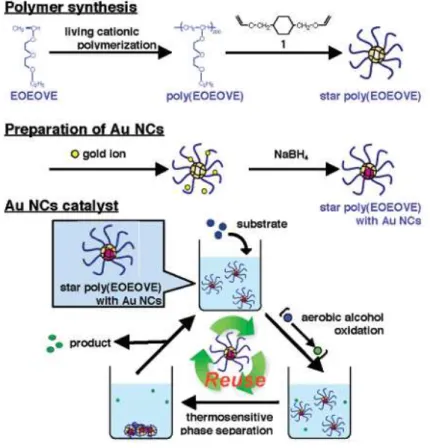
Among various types of colloidal metal NCs, PVP is known as a common stabilizer for metal nanoclusters such as platinum, palladium and rhodium.31,32 Although PVP is good as both a stabilizer and an electron donor to the metal core, there are big difficulties to apply PVP- stabilized nanometals to reuse process, and aggregation of the cluster is often observed. To achieve a reusable system of AuNCs catalyst, thermosensitive star-shaped polymer was used as a stabilization polymer.33 The AuNCs stabilized by the star-shaped polymer showed excellent catalytic activity toward the aerobic oxidation of alcohol with excellent reusability. The catalyst can be recovered by increasing the temperature up to 60 oC, followed by decantation of the aqueous phase (Scheme 1-4-1).
Scheme 1-4-1 Preparation and catalytic use gold nanoclusters stabilized by thermo-sensitive polymer. This figure was reprinted from reference 33.
The matrix must affect physical property as well as the electronic property of AuNCs. For example, Haruta and co-workers reported the effects of the type of the polymer supports on AuNCs. In case of the decomposition reaction of H2O2 and glucose oxidation reaction, they found that the catalytic activity was highly dependent on the type of polymers rather than the size of AuNCs.34 Previous experimental and theoretical studies have revealed that the weak interaction between stabilizing polymer and AuNCs induces the negative charge on AuNCs
Ph.D. Thesis Chapter 1: General Introduction
12 | P a g e
surface, which played an important role in the mechanism of aerobic oxidation.35 In comparison with other hydrophilic polymers such as poly(allylamine) (PAA), PVP shows higher electron donating properties (Scheme 1-4-2).36 In addition, the surface charge induction is preferred in NCs with smaller core size due to the charge distribution on gold surface.18 Thus, reactivity and selectivity of any reaction can be tuned by changing the polymer matrix, strongly indicating that the interface environment between the metal surface and the polymer matrix is also important to understand the catalytic activity.
Scheme 1-4-2 The role of PVP on the dioxygen molecule activation.29
In contrast to the effects of the cluster size and the type of the polymers, few attention has been paid for the effect of the molecular weight of the polymers.37 So far there are only limited number of reports about the molecular weight effect of the polymers including the author’s laboratory example, catalytic activity of the Au:PVP toward homocoupling reaction of phenylboronic acid. It was tested by changing of stabilizing polymer into a different molecular weight of PVP (K-15) (Mw = 10,000), PVP (K-30) (Mw = 40,000) and PVP (K-90) (Mw = 360,000). Conversion of phenylboronic acid to the product is higher in the order of 1.3 nm of Au:PVP (K-15) < 1.3 nm of Au:PVP (K-30) < 1.6 nm of Au:PVP (K-90), while Au:PVP (K- 30) gave the best selectivity of biphenyl as a main product against phenol, a byproduct (Figure 1-4-1)37b In principle, the matrix effect must be compared by using the clusters having the same core size in order to exclude the size effect. However, Au:PVP (K-90) with small core size was not able to be prepared because of the high viscosity of PVP (K-90), which impeded efficient homogeneous mixing in the preparation to avoid the growth of the cluster size. Therefore, for the discussion of the molecular weight effect, appropriate preparative method of the AuNCs even affordable in the presence of polymers with high viscosity should be developed.
13 | P a g e
Figure 1-4-1 Typical TEM images and particle size distributions of (a) Au:PVP (K-15), (b) Au:PVP (K-30), and (c) Au:PVP (K-90). These figures were reprinted from reference 37b.
1.5 Objectives
As discussed above, catalytic activity of AuNCs is dependent on many factors including their sizes and the interface environments between the metal surface and the matrices. In particular, interaction with polymer matrix and the molecular weight effect of the polymers has rarely been studied before. However, understanding these effects is indispensable to develop novel and efficient cluster catalyst. The objective of this thesis is to understand the effect on the catalytic activity of AuNCs by clusters’ sizes as well as types of matrices. However, prior to the investigation of these effects, preparation method of AuNCs with various sizes should be developed. Especially, development of the method for small size of AuNCs using polymers with high viscosity is critical.
In chapter 2, the practical method using metal-free microflow reactors for size-controlled preparation of AuNCs stabilized by high viscosity hydrophilic polymers as PVP (K-90) and MOVE200 to obtain wide range of the diameters from 1-9 nm is described. In addition, highly reproducible slow reduction as well as seed mediated growth method for the synthesis of larger size of AuNCs stabilized by the smaller molecular weight PVP (K-15 and K-30) was also described.
In chapter 3, development of a new trans-deposition method from Au:PVP (K-15) to Au:HAP is described. This trans-deposition takes place without significant size-change through the process, affording the selective Au:HAP with the wide range of the diameters from 1 nm to 8 nm with ease. Size dependency of Au:HAP on the aerobic oxidation of 1-indanol to 1-indanone is also investigated.
In chapter 4, the importance of the interface modification to improve the catalytic activity of AuNCs is described through the example of the fluoride ion-induced structural change from Au:HAP catalyst. In the course of the study on the Au:HAP-catalyzed aerobic homocoupling
Ph.D. Thesis Chapter 1: General Introduction
14 | P a g e
of PhBF3K, structure of the solid support is found to change from HAP to fluoroapatite (FAP), and then finally to CaF2 fluoride ion during the catalytic cycle. Finally it is found that the partially fluoride-substituted structure (F-HAP) is the most suitable support for the aerobic homocoupling of phenylboronic acid, indicating the importance of the surface/interface modification in the design of the catalyst.
In chapter 5, molecular weight effect of PVP is described. Remarkable chain length effect is observed and it can be concluded that the matching of the metal core size and the polymer chain length greatly influences to the catalytic activity. As a result, 7 nm sized-Au:PVP(K-90) exhibited superior catalytic activity toward various types of the AuNCs-catalyzed reactions in general.
In chapter 6, preliminary study of a new insight into the chirality induction of gold nanoclusters by chiral polymer is described. Various types of copolymers between chiral-vinylpyrrolidone (chiral-VP) and vinylpyrrolidone (VP) were prepared in different molecular weight. The chiral- PVP-protected AuNCs can act as the catalysts and give high enantioselectivity toward hydroamination reaction only in case that they possess particular metal core size and the polymer chain length.
In chapter 7, summary and the perspectives of the thesis are described.
1.6 References
1. (a) G. Ajnai, A. Chiu, T. Kan, C.-C. Cheng, T.-H. Tsai, J. Chang, J. Exp. Clin. Med. 2014, 6, 172.; (b) E.C. Dreaden, L.A. Austin, MA, Mackey, M.A. El-Sayed, Ther Deliv. 2012, 3, 457.; (c) D. Pissuwan, T. Niidome, M. B. Cortie, J. Control. Release 2011, 1, 65.; (d) X. Cao, Y. Ye, S. Liu, Anal. Biochem. 2011, 1, 1.; (e)J.N. Anker, W.P. Hall, O. Lyandres, N.C. Shah, J. Zhao, R.P. Van Duyne, Nature Materials 2008, 7, 442.; (f) A. Samanta, Y. Zhou, S. Zou, H. Yan, Y. Liu, Nano Lett., 2014, 14, 5052.;(g)N.A. Harun, M.J. Benning, B.R. Harrocks, D.A. Fulton, Nanoscale, 2013,5, 3817.; (h)B. Ji, E. Giovanelli, B. Habert, P. Spinicelli, M. Nasilowski, X. Xu, N. Lequeux, J.-P. Hugonin, F. Marquir, J.-J. Greffet, B. Dubertret, Nature Nanotechnology 2015, 10,170.; (i)M. Turner, V.B. Golovko, O.P.H. Vaughan, P. Abdulkin, A. Berenguer-Murcia, M.S. Tikhov, B.F.G. Johnson, R.M. Lambert, Nature 2008, 454, 981.
15 | P a g e
2. H. Tsunoyama, Y. Liu, T. Akita, N. Ichikuni, H. Sakurai, S. Xie, T. Tsukuda, Catal. Surv. Asia 2011, 15, 293.
3. M. Haruta, T. Kobayashi, H. Sano, N. Yamada, Chem. Lett. 1987, 405.
4. L. D. Socaciu, J. Hagen, T. M. Bernhardt, L. Wöste, Ulrich Heiz, H. Häkkinen, U. Landman, J. Am. Chem. Soc. 2003, 125, 10437.
5. M. Comotti, C. Della Pina, R. Matarrese, M. Rossi, Angew. Chem. 2004, 116, 5936; Angew. Chem. Int. Ed. 2004, 43, 5812.
6. S. Biella, L. Prati, M. Rossi, J. Catal. 2002, 206, 242.
7. S. Carrettin, P. McMorn, P. Johnston, K. Griffin, G. J. Hutchings, Chem. Commun. 2002, 7, 696
8. H. Kono, T. Kumazawa, Jpn. Pat., 62228034, 1987
9. M. Alvaro, C. Aprile, A. Corma, B. Ferrer, H. Garcia, J. Catal. 2007, 245, 249 10. A. Corma, H. Garcia, Chem. Soc. Rev. 2008, 37, 2096.
11. Y. Liu, H. Tsunoyama, T. Akita, T. Tsukuda, Chem. Lett. 2010, 39, 159 12. T. Tsukuda, H. Tsunoyama, H. Sakurai, Chem. Asian J. 2011, 6, 736
13. (a) H. Tsunoyama, H. Sakurai, Y. Negishi, T. Tsukuda, J. Am. Chem. Soc. 2005, 127, 9374;(b) H. Tsunoyama, H. Sakurai, T. Tsukuda, Chem. Phys. Lett. 2006, 429, 528.
14. (a) H. Tsunoyama, T. Tsukuda, H. Sakurai, Chem. Lett. 2007, 36, 212; (b) A. Murugadoss, H. Sakurai, J. Mol. Catal. A: Chemical 2011, 341, 1.
15. H. Kitahara, I. Kamiya, H. Sakurai, Chem. Lett. 2009, 38, 908. 16. H. Kitahara, H. Sakurai, Chem. Lett. 2010, 39, 46.
17. H. Kitahara, H. Sakurai, J. Organomet. Chem. 2011, 696, 442.
18. H. Tsunoyama, N. Ichikuni, H. Sakurai, T. Tsukuda, J. Am. Chem. Soc. 2009, 131, 7086. 19. (a) J. Wanger, T. Kirner, G. Mayer, J. Albert, J. M. Köhler, Chem. Eng. J., 2004, 101, 251.; (b) R. Zanella, S. Giorgio, C. H. Shin, C. R. Henry, C. Louis, J. Catalys., 2004, 222, 357.;
Ph.D. Thesis Chapter 1: General Introduction
16 | P a g e
(c) Y. Liu, H. Tsunoyama, T. Akita, S. Xie, T. Tsukuda, ACS Catal. 2011, 1, 2.; (d) R. Fenger, E. Fertitta, H. Kirmse, A. F. Thünemann, K. Rademann, Phys. Chem. Chem. Phys. 2012, 14, 9343.; (e) M. Valden, X. Lai, D.W. Goodman, Science 1998, 281, 1647.
20. G.C. Bond, C. Louis, D.T. Thomson, Catalysis by Gold, Imperial College Press. London, 2006.
21. M. Haruta, Catal. Surv. Jpn. 1997, 1, 61-73.
22. T.V. Choudhary, D.W. Goodman, Top. Catal. 2002, 21, 25-34.
23. (a) M. Haruta, Catal. Today 1997, 36, 153-166.; (b) S. Tsubota, D.A.H. Cunningham, Y. Bando, M. Haruta, Stud. Surf. Sci. Catal. 1995, 91, 227-235.
24. M. Haruta, N. Yamada, T. Kobayashi, S. Iijima, J. Catal. 1989, 115, 301-309.
25. M. Okumura, S. Nakamura, S. Tsubota, T. Nakamura, M. Haruta, Stud. Surf. Sci. Catal. 1998, 118, 277-284
26. M. Comotti, W.C. Li, B. Spliethoff, F. Schüth, J. Am. Chem. Soc. 2006, 128, 917-924. 27. (a) M. K. Corbierre, N. S. Cameron, R. B. Lennox, Langmuir 2004, 20, 2867.; (b) P. Alexandridis, Chem. Eng. Technol. 2011, 34, 1, 15.; (c) H. Liu, W. P. Goh, M. Y. Leung, Y. Li, Sol. Energ. Mat. Sol. Cells, 2012, 96, 302.
28. (a) M. Okumura, S. Nakamura, S. Tsubota, T. Azuma, M. Haruta, Catal. Lett. 1998, 51, 53.; (b) S. J. Lee and A. Gravriilidis, J. Catal., 2002, 206, 305.
29. D. Astruc, F. Lu, J. R. Aranzaes, Angew. Chem. Int. Ed. 2005, 44, 7852. 30. J. Han, Y. Liu, R. Guo, J. Am. Chem. Soc. 2009, 131, 2060.
31. T. Yonezawa, N. Toshima in Advanced Functional Molecules and Polymers (Ed. : H. S. Nalwa), OPA, Amsterdam 2001, 65
32. (a) T. Teranishi, M. Hosoe, M. Miyake, Adv. Mater. 1997, 9, 65; (b) T. Teranishi, M. Miyake, Chem. Mater. 1998, 10, 594; (c) N. Toshima in Nanoscale Materials (Eds. : L. M. Liz-Marzan, P. V. Kamat), Kluwer Academic Publishers, Norwell, MA,2003, 79; (d) R. Narayanan, M. A. El-Sayed, J. Phys. Chem. B 2005, 109, 12663;(e) Y. Zhang, M. E. Grass, J.
17 | P a g e
N. Kuhn, F. Tao, S. E. Habas, W. Huang, P. Yang, G. A. Somorjai, J. Am. Chem. Soc. 2008, 130, 5868.
33. S. Kanaoka, N. Yagi, Y. Fukuyama, S. Aoshima, H. Tsunoyama, T. Tsukuda, H. Sakurai, J. Am. Chem. Soc. 2007, 129, 12060.
34. T. Ishida, K. Kuroda, N. Kinoshita, W. Minagawa, M. Haruta, J. Colloid Interface Sci. 2008, 323, 105.
35. (a) K. Bobuatong, S. Karanjit, R. Fukuda, M. Ehara, H. Sakurai, Phys. Chem. Chem. Phys., 2012, 14, 3103; (b) A. Lyalin, T. Taketsugu, J. Phys. Chem. C 2009, 113, 12930. 36. H. Tsunoyama, N. Ichikuni, H. Sakurai, T. Tsukuda, J. Am. Chem. Soc., 2009, 131, 7086.
37. (a) R. G. Shimmin, A.B. Schoch, P.V. Braun, Langmuir 2004, 20, 5613.; (b) H. Tsunoyama, H. Sakurai, N. Ichikuni, Y. Negishi, T. Tsukuda, Langmuir 2004, 20, 11293.
Ph.D. Thesis Chapter 1: General Introduction
18 | P a g e
| P a g e 19
Chapter 2
Size-selective Preparation of Colloidal Gold Nanoclusters
S. Haesuwannakij, W. Karuehanon, V. L. Mishra, H. Kitahara, H. Sakurai, S. Kanaoka, S. Aoshima, Monatch. Chem. 2014, 145, 23-28
DOI: 10.1007/s00706-013-1001-z
Ph.D. Thesis Chapter 2: Size-selective Preparation of Colloidal Gold Nanoclusters
| P a g e 20
| P a g e 21
2.1 Introduction
Colloidal gold nanoclusters (AuNCs) have recently been studied intensively due to their potential applications as quasi-homogeneous catalyst for many reactions,1 such as C-C bond coupling,2 selective-alcohol oxidation,3 oxidation of amines,4 and other bond forming reactions.5 One of the benefits is the size selective synthesis of the clusters by kinetic control, due to the homogeneity achieved during preparation. Therefore, colloidal clusters have often been used as precursors of the heterogeneous clusters with uniform cluster size. Control of the cluster size is indispensable in the investigation of AuNCs, especially in the field of catalysis, because of highly size-depending on catalytic activity NCs. A smaller cluster size generally results in better catalytic activity.6,7 However, some results indicate an optimum size and smaller is not always better.8
Rademann and co-workers demonstrated the reduction of p-nitrophenol by AuNCs which were prepared by the seed-mediated growth method. The AuNCs with a diameter of 13 nm is the most efficient catalyst (Figure 2-1-1, left).8b Furthermore, Tsukuda and co-workers reported AuNCs-supported on hydroxyapatite (Au:HAP) catalyzed the oxidation of cyclohexane. The Au:HAP was synthesized by mixing glutathione (GS)-stabilized AuNCs and hydroxyapatite (HAP) under basic conditions, then AuNCs were calcined at high temperature in order to remove of GS. The turnover frequency (TOF) increased with an increasing of the size as mentioned in the introduction part (Figure 2-1-1, right).8c Although it cannot be explained in terms of geometries such as surface area or coordination on the surface, the observed optimum size may be associated with the electronic structure. Therefore, precise control of the size at the sub-nanometer scale is highly desirable.
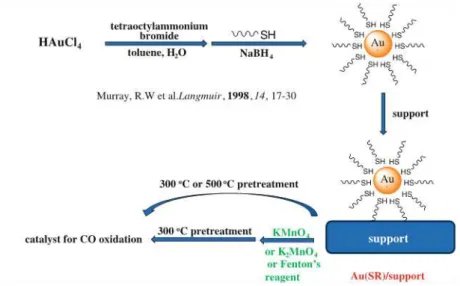
The synthesis of AuNCs with size controlled at the atomic level has been achieved using strongly coordinating ligands such as thiol derivatives. The obtained AuNCs were found in discrete structure at the atomic level determined by MALDI-TOF analysis, for example Au10GS10, Au18GS14, Au25GS18, Au39GS24.8c However, such strong coordination inhibits the catalytic activity.9 Thus, an additional process to remove the ligands, such as annealing, is required to activate the catalyst. By the composite of strong binding organic stabilizer- supported AuNCs as gold precursor and solid-supported was calcined in order to remove the organic stabilizer.8b,9b,10 The obtained heterogeneous AuNCs were also found in the same discrete structure that the agglomeration process can be avoided during calcination. The preparation method is shown in Figure 2-1-2.
Ph.D. Thesis Chapter 2: Size-selective Preparation of Colloidal Gold Nanoclusters
| P a g e 22
Figure 2-1-1 Size-dependency properties of AuNCs catalyzed reaction; a) AuNCs catalyzed the reduction of p- nitrophenol to p-aminophenol. b) AuNCs catalyzed the oxidation of cyclohexane to corresponding cyclohexanol
and cyclohexanone. These figures were reprinted from reference 8b and 8c, respectively.
On the other hand, in AuNCs, which are protected by polymers to show high catalytic activity are stabilized through weak non-covalent interaction, which is poorly resistant to further agglomeration. However, such a trade-off between activity and structure could be customized to achieve a high level of kinetic control during the agglomeration process.
Figure 2-1-2 The activation of dodecanethiol-capped gold catalyst for CO oxidation by oxidation-calcination. This figured was reprinted from reference 9b.
Indeed, various types of preparative method for the colloidal AuNCs have been reported, for example, the reduction by alcohol11 or by ascorbic acid12 in the presence of the polymers. However, the obtained clusters have broad size distribution because of the reaction conditions under high temperature and slow reduction rate. To achieve the preparation with small size and narrow distribution, kinetic reduction is important. Thus, strong reducing agents as sodium
| P a g e 23
borohydride (NaBH4) is used to reduce tetrachloroauric acid (HAuCl4) in the presence of PVP at 0 °C. By this kinetic process, the small NCs with unified size was obtained as a brownish dispersion,1 since the shorter time of the nucleation process leads to the simultaneous formation of NCs.
Another problem in the synthesis of colloidal AuNCs is the viscosity of polymers, which also impedes the kinetic control of agglomeration due to inefficient physical mixing. The small size of AuNCs cannot be obtained when using stabilizing polymer with high viscosity. As already described in the introduction part, a batch process, the reduction of tetrachloroauric acid (HAuCl4) by sodium borohydride (NaBH4) in the presence of PVP, afforded a mean cluster size of 1.3 nm when using poly-(N-vinylpyrrolidone) (PVP) K-15 (Mw = 10 kDa, Viscosity = 1 cps) or K-30 (Mw = 40 kDa, Viscosity = 3 cps), while a mean size of only 1.6 nm was obtained using K-90 (Mw= 360 kDa, Viscosity = 150 cps).2a As the 1.3 nm of Au:PVP was not available by batch method, the comparison of catalytic activity between polymer chain length with the same size was not able to study. Thus, alternative method to overcome the viscosity problem was required. Another example of the high viscosity polymer for the matrix of AuNCs is Aoshima and co-workers’ star-shaped polymers as also shown in Chapter 1. Their thermos-sensitive star-shaped polymers which were prepared by the introduction of appropriate moieties in the coronal arms afforded a micellar matrix with reversible gelation responsivity by lower critical solution temperature (LCST)-type phase- separation in water.12 One of the most attractive applications of these polymers involves utilization as a stabilizing matrix for AuNCs, because the micellar structure is suitable for stabilization of AuNCs in water. Their thermosensitivity allows easy separation and reuse. However, by the batch method, the AuNCs with core size more than 2 nm were obtained in the preparation of star-shaped polymers-stabilized AuNCs. The significant large size of AuNCs may possibly be caused by its large molecular weight of 900 kDa.
To solve two major problems as described above, the size distribution and preparation using polymer with high molecular weight as well as viscosity, recently, microflow reactors have been proposed for the synthesis of NCs due to their efficient and homogeneous mixing. The microreactors are suggested for nanoparticle synthesis because the nucleation process continuously occurs during the reaction time in the lower volume of the reaction mixture, leads to sufficiently lower polydispersity of nanoparticles.11, 13 Microflow reactors have also been reported for the control of particle size, shape and aggregation rate in the preparation of AuNCs.14 Various types of microflow reactor have been designed and applied for the synthesis
Ph.D. Thesis Chapter 2: Size-selective Preparation of Colloidal Gold Nanoclusters
| P a g e 24
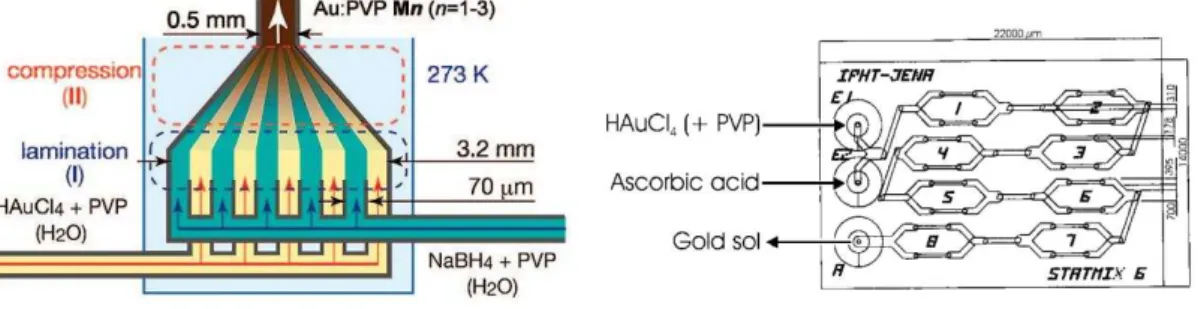
of gold starting from Au seed15 and Au solution.16 Wagner and co-workers demonstrated Au:PVP synthesized by ascorbic acid-reduced gold via continuous flow process using the IPHT microreactor. The obtained AuNCs were shown smaller size distribution than obtained from conventional batch method.15,16 Tsukuda and co-workers also reported the efficient synthesis of monodisperse Au:PVP clusters with an average diameter of ∼1 nm by using sodium borohydride as reducing agent under continuous flow condition using a micromixer. These clusters exhibited higher catalytic activity for aerobic alcohol oxidation than prepared Au:PVP using a batch reactor (Scheme 2-1-1, left).7b
Scheme 2-1-1 Schematic diagram for the synthesis of PVP-stabilized gold nanoclusters by using microflow reactor. These figures were reprinted from reference 7b and 15.
However, there is a severe requirement in the choice of the micro mixer for the preparation of AuNCs to avoid any metal contaminant. The common metal component in stainless® steel, Ni and Mo, are found to leach out in the presence of acid such as HAuCl4. Contamination of impure metals must induce the drastic change of electronic structure of NCs as well as the activity toward catalytic reactions by doping effect.17 Therefore, among commercially available micromixers with reasonable price and free from stainless® steel in the flow channel, two different types of microflow reactors were carefully selected for the investigation; Techno-Applications COMET X-1 and Sigma-Aldrich type S02 microflow reactors were shown in Figure 2-1-3.
Figure 2-1-3 Microflow reactors used in this study. a) Techno-Applications COMET X-1 and b) Sigma-Aldrich type S02.
| P a g e 25
In order to carry out the polymer matrix effect, various and wide range of size of the clusters in the presence of the different types of polymers as well as the small size of them is necessary. Two important methods for the size-selective preparation of relatively large sized clusters have been reported, a seed-mediated growth method and a slow reduction method. Therefore, applicability of these two methods to the preparation of the high viscosity polymer- protected AuNCs should also be tested.
In case of seed-mediated growth method, small metal particles are initially prepared and later used as seeds to prepare larger particles in the presence of a metal salt and a weak reducing agent. The concept of seed-mediated growth method was developed by Zsigmondy and Thiessen.18 Natan and co-workers investigated the use of citrate- and borohydride-reduced AuNCs as seeds for the preparation of larger AuNCs with diameters between 30-100 nm employing citrate or hydroxylamine as the growth stage reducing agent.19 Murphy and co- workers reported seed-mediated growth method by using 12 nm AuNCs as seeds to grow various sizes of larger AuNCs under the presence of ascorbic acid.20 The size of AuNCs could be controlled by additional rate of reducing agent and seed concentration. A series of nearly monodisperse Au:PVP ranging from 1-10 nm has been prepared by seed-mediated growth method. By using 1.3 nm Au:PVP as seed, subsequence reduction of Au salt by Na2SO3 yielded a series of larger Au:PVP. Significantly larger size of Au:PVPs were obtained under basic condition (Figure 2-1-4).3b
Figure 2-1-4 TEM images and core size distributions of Au:PVP (K-30) prepared by seed-mediated growth method; upper : in the absence of K2CO3; lower : in the presence of K2CO3. This figure was reprinted from
reference 3b.
The larger particle size can also be obtained by the slow reduction method. Stellacci and co-workers reported shape-controlled growth of gold nanocrystal under reflux condition in the presence of oleylamine or dodecylamine. The morphology of gold nanocrystal was controlled by varying the concentration of amine.21 Tsukuda and co-workers recently
reported a slow reduction to prepare thiolate-protected AuNCs under basic conditions.
Ph.D. Thesis Chapter 2: Size-selective Preparation of Colloidal Gold Nanoclusters
| P a g e 26
The obtained AuNCs, which was larger than those prepared by sodium borohydride reduction, exhibited a strong near-infrared absorption band at 1340 nm.22
In current studies, various methods were used to apply to size-control preparation of hydrophilic polymers-stabilized AuNCs. The two different types of micromixers, Techno- Applications COMET X-1 and Sigma-Aldrich type S02 microflow reactors (Figure 2-1-3), were selected for the preparation of AuNCs stabilized by hydrophilic polymers with high viscosity; a) PVP (K-90) and b) star 2-methoxyethyl vinyl ether (MOVE)200 (Scheme 2-1-2). In addition, the various sizes of PVP (K-15, 30, 60 and 90) (Mw = 10, 40, 160, and 360 kDa, respectively)-stabilized AuNCs were prepared by both slow reduction under basic conditions and seed-mediated growth methods in order to obtain wide range of the cluster size from 1-9 nm.
Scheme 2-1-2 Structures of a) PVP and b) star(MOVE)200.
2.2 Experimental Section 2.2.1 General
All chemicals and solvents were used as received without further purification unless otherwise noted. Hydrogen tetrachloroaurate tetrahydrate (HAuCl4.4H2O, Tanaka Kikinzoku), sodium tetraborohydride (NaBH4, Wako) and poly (N-vinylpyrrolidone) (K-15, 60 and 90) (Mw = 10, 160, and 360 kDa respectively) (Kishida chemicals) were used as precursors for the preparation of AuNCs. Milli-Q grade water was used in all the experiments.
2.2.2 Preparation of Polymers-stabilized Gold Nanoclusters by Microflow Technique
The instrumental set up for the preparation of AuNCs by microflow method was shown in Scheme 2-2-1. The molar ratio of tetrachloroauric acid (HAuCl4): polymers: sodium
| P a g e 27
tetraborohydride (NaBH4) was set at 1:100:10, which was the same ratio as the standard batch process. Two aqueous solutions were prepared: one (solution A) is the mixed solution of HAuCl4 and polymers (0.025 mmol for HAuCl4 and 2.5 mmol for PVP, respectively) in 25 ml of water, and the other one (solution B) is a solution of NaBH4 (0.25 mmol of NaBH4) in 5 ml of water. Solutions, micro-reactor, flow channel, and the receiver were kept cooling at 0 °C. The flow rate was controlled by the syringe pump. The resulting colloidal AuNCs were dialyzed three times to remove the inorganic impurities such Na+ and Cl- by centrifugal ultrafiltration at 4800 rpm by using a membrane with a molecular weight cut off of 100 kDa using 10ml of water. The resulting solution mixture was concentrated to 10 ml. The purified AuNCs was kept as a solid form in a dry place after freeze-drying by using Freeze Dryer (EYELA FDU-2200).
Scheme 2-2-1 Instrument set up for polymers-stabilized gold nanoclusters preparation.
2.2.3 Preparation of Polymers-stabilized Gold Nanoclusters by Seed-mediated Growth Method of Au:PVP (K-15, 60, 90)
The seed-mediated growth method was carried out according to the reported procedure3b after slight modification.
The seed Au:PVP was prepared by rapid reduction of HAuCl4 by NaBH4 in aqeous solution of PVP under 0°C to yield a brown hydrosol of seed-Au:PVP. The molar ratio of HAuCl4 and monomer unit of PVP (K-15) was kept at 1:50, while the 1:100 molar ratio was kept when using PVP (K-60) and PVP (K-90).
To the mixture of degassed aqueous solution of HAuCl4, PVP and seed-Au:PVP, the 300 mol% of degassed 90 mM Na2SO3 was quickly added. The solution was kept stirred at 300 K for 3 h under N2 atmosphere. The resulting solution mixture was concentrated to 10 ml by using a membrane with a proper molecular weight cut off, and washed with pure water three
Ph.D. Thesis Chapter 2: Size-selective Preparation of Colloidal Gold Nanoclusters
| P a g e 28
times. The purified AuNCs were kept as a solid form in dry place after freeze-drying by using Freeze Dryer (EYELA FDU-2200).
2.2.4 Preparation of Polymers-stabilized Gold Nanoclusters by Slow Reduction Method
The slow reduction of HAuCl4 was carried out under weak basic conditions. To a 40 ml of aqueous solution of 0.025 mmol of HAuCl4, PVP was added. The molar ratio of HAuCl4
and monomer unit of PVP (K-15) was kept at 1:50, while the 1:100 molar ratios was keep when using PVP (K-30, 60). The mixture was stirred at 0 °C for 5 min. A freshly prepared aqueous solution of Na2SO3 (9.45 mg, 0.075 mmol) in 5 ml pured water was rapidly added into the mixture and kept vigorous stirring at 1700 rpm for 3 min. Then, 5 ml of NaBH4 (9.46 mg, 0.25 mmol) was rapidly added to the mixture to yield brown hydrosol of Au:PVP. The mixture was kept vigorous stirring at 1700 rpm for 3 h at 0 °C. The resulting solution mixture was concentrated to 10 ml by using a membrane with a molecular weight cut off, and washed with pure water three times. The purified AuNCs was kept as a solid form in dry place after freeze- drying by using Freeze Dryer (EYELA FDU-2200).
2.2.5 Characterization by UV-vis Spectroscopy
The 0.2 mM concentration of AuNCs was used for UV-vis spectra measured on a JASCO V-670 spectrophotometer at 25 °C. The obtained UV-vis spectra showed the SPR band at 520 nm.
2.2.6 Characterization by Transmission Electron Microscopy (TEM)
After the purification and concentration of the AuNCs solution by centrifugation at 4800 rpm, a drop of concentrated solution was put on the TEM grid, pre-treated with hydrophilic treatment, followed by vacuum dried before TEM measurement. The high- resolution TEM images of PVP stabilized AuNCs were recorded on a JEOL JEM-2100F at an accelerating voltage of 200 kV. A histogram of the size distributions was obtained by measuring the core diameter more than 300 counts.
| P a g e 29
2.2.7 Characterization by X-ray Absorption Spectroscopy (XAS)
Synchrotron radiation EXAFS experiments were performed at the BL01B1 station at SPring-8, Japan Synchrotron radiation Research Institute (JASRI). A Si(111) single crystal was used to obtain a monochromatic X-ray beam. The data were recorded in the quick mode at room temperature, and analyzed by using the REX2000 ver. 2.5.9 program (Rigaku Co.). Fourier transform of k3χ(k) data was perform in k ranges of 30-129 nm-1 for analysis of the Au L3-edge EXAFS spectra. The inversely Fourier-filtered data were analyzed using common curve-fitting method. The phase shift and amplitude for Au-Au was extracted from the data using the FEFF code (ver. 8) with Au foil. The data were collected with the transmission mode using ion-chamber detector.
2.3 Results and Discussion
2.3.1 Preparation and Characterization of High Molecular Weight PVP- Stabilized Gold Nanoclusters
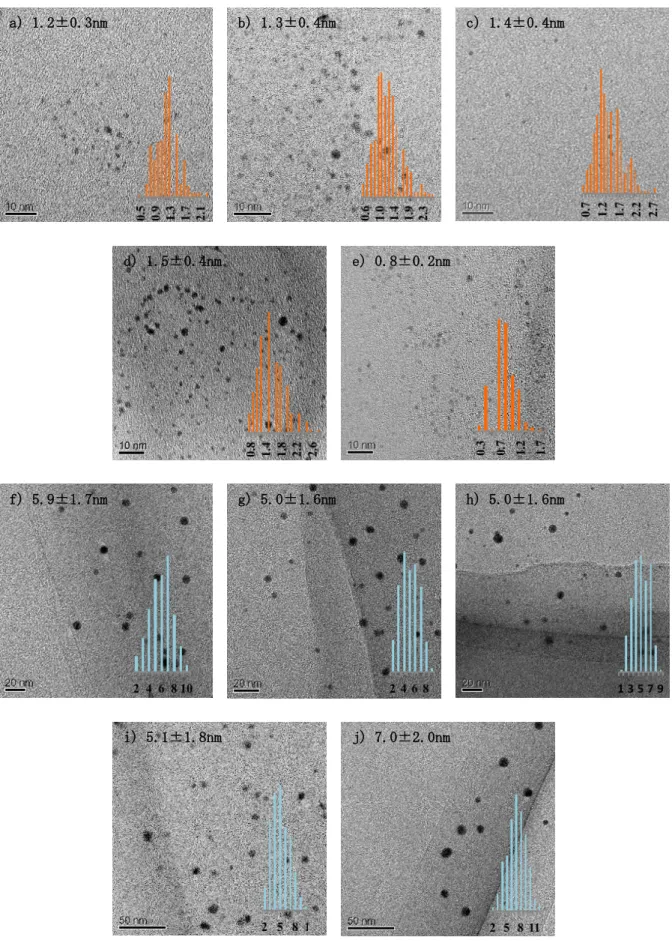
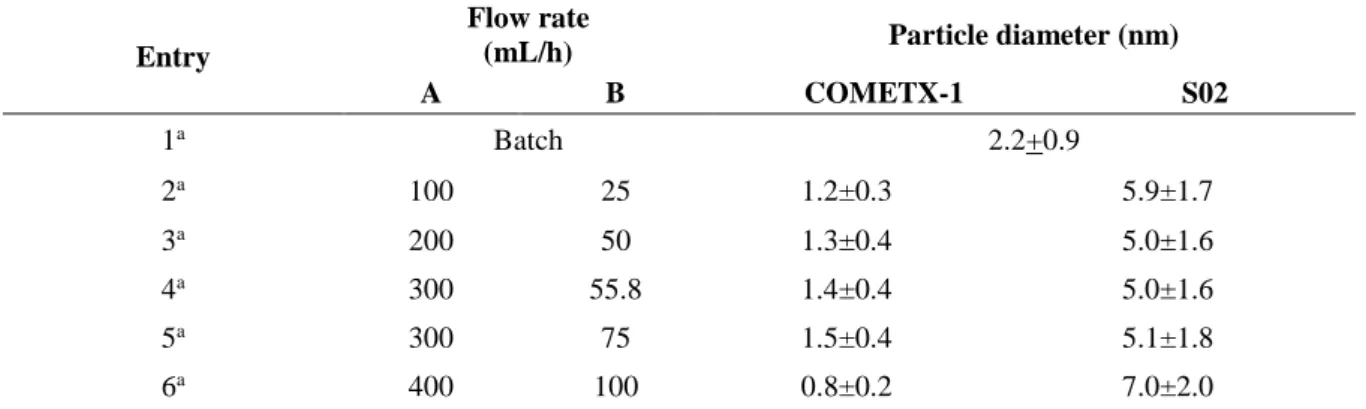
PVP (K-90) was selected to optimize the reaction conditions. The effect of various flow rates of solutions A and B for the preparation of AuNCs using the two types of microflow reactors is summarized in Table 2-3-1. The TEM images and core size distributions were shown in Figure 2-3-1. The COMET X-1 produced smaller AuNCs with a narrow distribution. The combination of flow rates for metal solution (solution A) and reducing agent solution (solution B) at 100 and 25 ml/h, respectively, produced clusters with the mean size of 1.2±0.3 nm (entry 2), while the conventional batch process afforded a mean size of 2.2±0.9 nm (previous report: 1.6±0.3 nm) (entry 1).1a Entries 2-6 of Table 2-3-1 show that the mean size of Au:PVP (K-90) increased with increasing of flow rates for solution A up to 300 ml/h and for solution B up to 75 ml/h; however, the smallest were obtained when the rate of solution A and B were set as 400 and 100 ml/h, respectively (entry 6).
In contrast, the S02 microflow reactor had inferior results by producing cluster sizes of more than 5 nm and with a wider distribution. The mixing mechanism23 might play a significant role in this application. The major difference between both two micro-reactors is the component of microstructure or mixing channel elements. Since the B solution came out from the inner tube into a cylindrical shape of COMET X-1 micro-reactor, the A solution wraps over its entire surface area of the B solution, resulting in large contact area before enter to split-and-
Ph.D. Thesis Chapter 2: Size-selective Preparation of Colloidal Gold Nanoclusters
| P a g e 30
recombine mixing channel. In the case of Sigma-Aldrich type S02 micro-flow reactor, both A and B solution passed through the Y-mixer in which the components get contacts for the first time, then the mixer was mixed in winding channel and lead to a homogeneous mixture. Nonetheless, the injection mixer together with split-and-recombine element of COMET X-1 is more suitable for the production of small cluster size than Y-mixer with a winding channel of Sigma-Aldrich type S02 micro-flow reactor (Figure 2-3-2).
The PVP (K-90)-stabilized AuNCs (Au:PVP (K-90)) catalyst with different particle sizes were characterized by EXAFS spectroscopy as shown in Table 2-3-2. As the core size increasing, the Au-Au coordination number increased as same as increasing in the interatomic bond length. Compared with 2.88 Å for Au foil, the Au:PVP (K-90) showed a noticeable decrease in the Au-Au bond length. Due to the contraction of the metallic bond distance for AuNCs, it leads to the changing in the electronic properties of nanoclusters.25
Further discussion, especially electronic structure of these clusters will be described in Chapter 5.
| P a g e 31
Figure 2-3-1 TEM images and size distribution of Au:PVP(K-90) prepared by using a microflow reactor. These figurs were reprinted from 21 and 22 respectively.
a) 1.2±0.3nm b) 1.3±0.4nm c) 1.4±0.4nm
d) 1.5±0.4nm e) 0.8±0.2nm
f) 5.9±1.7nm g) 5.0±1.6nm h) 5.0±1.6nm
i) 5.1±1.8nm j) 7.0±2.0nm
Ph.D. Thesis Chapter 2: Size-selective Preparation of Colloidal Gold Nanoclusters
| P a g e 32
Figure 2-3-2 A typical micromixer; upper : split-and-recombine element, lower: winding channel. These figures were reprinted from reference 24 and 25 respectively.
Table 2-3-1 Effect of flow rate on the preparation of Au:PVP (K-90). Entry
Flow rate
(mL/h) Particle diameter (nm)
A B COMETX-1 S02
1a Batch 2.2+0.9
2a 100 25 1.2±0.3 5.9±1.7
3a 200 50 1.3±0.4 5.0±1.6
4a 300 55.8 1.4±0.4 5.0±1.6
5a 300 75 1.5±0.4 5.1±1.8
6a 400 100 0.8±0.2 7.0±2.0
a solution A = 1mM HAuCl4 and 100mM PVP in 25mL aqueous solution, solution B = 10mM of NaBH4 in 5mL aqueous solution
Table 2-3-2 The EXAFS parameter for Au:PVP (K-90).
Entry Core size (nm) CN R
(Å)
ΔE0 (eV)
DW (Å)
Rf
(%)
1 0.8±0.2 6.0 2.773 -5.3 0.078 2.0
2 1.3±0.4 6.0 2.780 -2.8 0.083 3.6
3 5.0±1.6 8.8 2.814 0.0 0.089 1.8
4 7.0±2.0 8.6 2.811 -0.6 0.089 1.4
CN= coordination number, R = distance, ΔE0 = inner core correction, DW = Debye-Waller factor
| P a g e 33
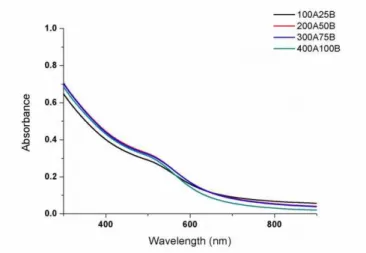
Figure 2-3-3 UV-vis absorption spectra of Au:PVP (K-90) prepared by using the techno-applications COMET X-1 microflow reactor.
Figure 2-3-4 UV-vis absorption spectra of Au:PVP (K-90) prepared by using the Sigma-Aldrich S02 microflow reactor.
2.3.2 Preparation and Characterization of Star (2-Methoxyethyl Vinyl Ether) (MOVE) 200
The optimized conditions were applied for the preparation of AuNCs stabilized using a star-shaped poly(vinyl ether). Recent development of Lewis acid-catalyzed living/controlled cationic polymerization has realized the selective preparation of star-shaped polymers with narrow molecular weight distribution through one-pot linking reactions with bifunctional vinyl compounds.26
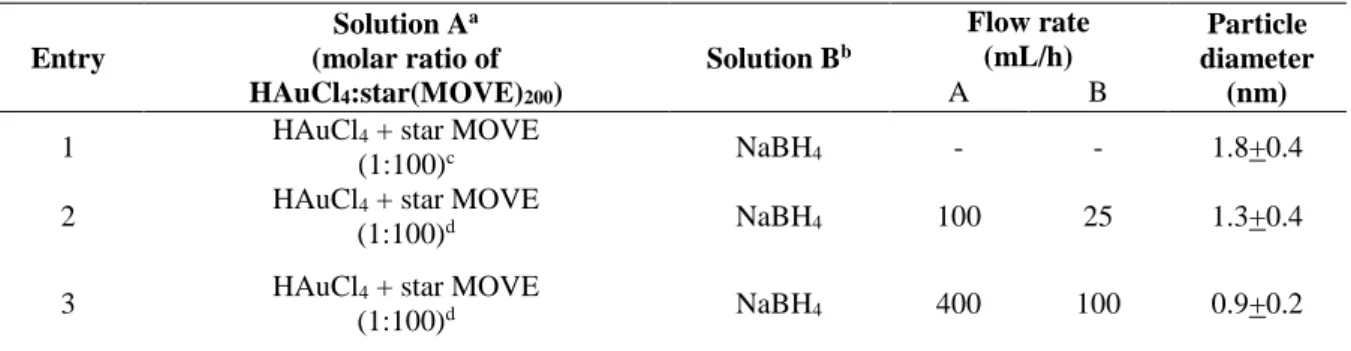
Star (MOVE)200 was selected as a representative star-shaped poly(vinyl ether). The results for the preparation of Au:star poly(MOVE)200 are presented in Table 2-3-3 and TEM images of the AuNCs are shown in Figure 2-3-5. Firstly, a batch process was conducted, which
Ph.D. Thesis Chapter 2: Size-selective Preparation of Colloidal Gold Nanoclusters
| P a g e 34
AuNCs with a mean size of 1.8±0.4 nm (entry 1). Two conditions were varied, as shown in Table 2-3-3; the flow rate of solution A at 100 ml/h and solution B at 25 ml/h (entry 2), and that with solution A at 400 ml/h and solution B at 100 ml/h (entry 3). In both cases, smaller size clusters were obtained, while the latter condition resulted in smaller AuNCs (1.3±0.4 and 0.9±0.4 nm, respectively).
Figure 2-3-5 TEM images and size distribution of Au:star(MOVE)200 prepared using a microflow reactor.
Table 2-3-3 Preparation of Au:star(MOVE)200 by using the micro-flow reactor.
a solution A = 1mM HAuCl4 and 100mM PVP in 12.5mL aqueous solution; bsolution B = 10mM of NaBH4 in 2.5mL aqueous solution; cbatch process; dmolar ratio of HAuCl4: NaBH4 = 1:10
Entry
Solution Aa (molar ratio of HAuCl4:star(MOVE)200)
Solution Bb
Flow rate (mL/h)
Particle diameter
(nm)
A B
1 HAuCl4 + star MOVE
(1:100)c NaBH4 - - 1.8+0.4
2 HAuCl4 + star MOVE
(1:100)d NaBH4 100 25 1.3+0.4
3 HAuCl4 + star MOVE
(1:100)d NaBH4 400 100 0.9+0.2
0.6 1.1 1.6 2.1 0.6 1.0 1.4 1.8
0.5 0.9 1.3 0.8 1.4 2.0 2.6
0.6 1.0 1.4 1.8
a) 1.3±0.3nm b) 1.2±0.3nm
c) 0.9±0.2nm d) 1.8±0.4nm
| P a g e 35
Figure 2-3-6 UV-visible absorption spectra of Au:star(MOVE)200
2.3.3 Preparation and Characterization of Poly(N-vinylpyrrolidone)-Stabilized Gold Nanoclusters by Seed-mediated Growth Method
The seed-mediated growth method was carried out according to the reported procedure (Scheme 2-3-1).3b The details of the experiment protocols are summarized in Table 2-3-4. The core size distribution of 300 particles was measured and plotted as the histogram as shown in Figure 2-3-7. The average diameter was proportional to the atomic ratio between seed-Au:PVP and HAuCl4. The 1:7 ratio yielded around 5 nm of Au:PVP (Entry 1), while the ratio of 1:21 yield around 7 nm of Au:PVP (Entry 2). When using PVP (K-90) as stabilizer, the particle size was larger than those obtained from the shorter polymer chain as PVP (K-15) and PVP (K-60) (Entry 3; Figure 2-3-8).
Scheme 2-3-1 The preparation method for Au:PVP; upper : the rapid reduction of HAuCl4 by NaBH4 in the presence of PVP; lower : the consecutive growth of seed-Au:PVP.
Ph.D. Thesis Chapter 2: Size-selective Preparation of Colloidal Gold Nanoclusters
| P a g e 36
Table 2-3-4 The preparation condition of Au:PVP by seed-mediated growth method.
Entry
Atomic Ratio of Seed-Au:PVP:
HAuCl4
Seed- Au:PVP/
μmol
HAuCl4/ μmol
90 mM Na2SO3/
μL
Diameter of Au:PVP / nm
(K-15) (K-60) (K-90)
1 1:7 3.125 21.8 727 5.1±0.7 5.3±1.3
2 1:21 1.136 23.9 797 7.4±1.1 7.0±1.4
3 1:21 1.136 23.9 797 - - 9.1±3.0
Figure 2-3-7 TEM images and size distribution of Au:PVP; a) Au:PVP (K-15), upper : 1.6±0.3 nm of seed- Au:PVP (K-15); middle : 5.1±0.7 nm 1:7 atomic ratio of Au:PVP (K-15); lower : 7.4±1.1 nm 1:21 atomic ratio
of Au:PVP (K-15); b) Au:PVP (K-60), upper : 1.1±0.2 nm of seed-Au:PVP (K-60); middle : 5.3±1.3 nm 1:7 atomic ratio of Au:PVP (K-60); lower : 7.0±1.4 nm 1:21 atomic ratio of Au:PVP (K-60).
Figure 2-3-8 TEM images and size distribution of 9.1±3.0 nm 1:21 atomic ratio Au:PVP (K-90) prepared by seed-mediated growth method.
| P a g e 37
2.3.4 Preparation and Characterization of Poly(N-vinylpyrrolidone)-Stabilized Gold Nanoclusters by Slow Reduction Method
The slow reduction method was carried out under the presence of Na2SO3 (Scheme 2- 3-2). The core size distribution of 300 particles was measured and plotted as the histogram as shown in Figure 2-3-9, upper. The average diameter around 2.5 nm with a nearly uniform size of the Au:PVP (K-15) was obtained with this method.
Scheme 2-3-2 The preparation method of Au:PVP by slow reduction method.
Slightly larger in core size was obtained due to the presence of Na2SO3 in the reaction.
Moreover, the time gap between the addition of Na2SO3 and NaBH4 does not affect the core size of AuNCs (Figure 2-3-9). It was suggested that the Na2S2O4 which generated from
the reaction between Na2SO3 and NaBH427 can reduce the Au ion with slower rate than NaBH4.
Moreover, this method could be applied to longer chain length of PVP as PVP (K-30, Mw = 40000) and PVP (K-60, Mw = 160000) to obtain similar core size (Figure 2-3-10).
Figure 2-3-9 TEM images and size distribution of Au:PVP (K-15) prepared by slow reduction method. Upper : 2.6±0.4 nm of 3 min time lag between aqeous solution of Na2SO3 and NaBH4. Lower : 2.4±0.5 nm of 30 min
time lag between aqeous solution of Na2SO3 and NaBH4.