Grand Design for An Asian Inter-Regional Professional Securities Market (AIR-PSM)
March 2008
Shigehito Inukai
National Institute for Research Advancement (NIRA) Capital Markets Association for Asia (CMAA)
21st Century Center of Excellence,
Waseda Institute for Corporation Law and Society
Editor and Author Shigehito Inukai
March 31, 2008
Publisher: LexisNexis Japan Co., Ltd. Tel 813-5787-3513 / Fax 813-5787-3512
URL: http://www.lexisnexis.jp
Sales agency: Yushodo Press Co., Ltd.
3-42-3, Ohtsuka, Bunkyo-ku, Tokyo 112-0012, Japan Tel 813-3943-5791 / Fax 813-3943-6024
Copyright Ⓒ 2008 by NIRA Printed in Japan, 2008 ISBN: 978-4-8419-0493-2
年
1
Note
This report presents an English translation of revised excerpts from Ajia ikinai kokusai-sai sijou sousetsu koso – Ajiabondo sijou e no roudomappu (“Vision for the Establishment of an Asian Inter-Regional Bond Market – Road Map to an “Asian Bond” Market”), by Shigehito Inukai, published on March 31, 2007 by LexisNexis Japan.
The report was produced as a collaboration between the National Institute for Research Advancement (NIRA), the Capital Markets Association for Asia (CMAA), and the 21st Century Center of Excellence of the Waseda Institute for Corporation Law and Society.
Shigehito Inukai wishes to thank the SWIFT Group for its generosity in granting permission to reprint the text of an address he presented at Sibos2007 in Boston on October 2, 2007.
March 31, 2008 Shigehito Inukai
注記
本英文報告書 7 年 月 日に ク ネク ャパン 発刊 た単行
本 犬飼重仁編著 ア ア域内国際債市場創設構想-ア アボンド市場へ ドマップ
改定抜粋英訳版 あ
本書 I ア ア資本市場協議会 び 早稲田大学 世紀 企
業法制 法創造 総合研究所 3者に っ 完成 た あ
また 犬飼重仁 7 7年 月 日 に け 講演記録 本書へ
掲載 WI ャパンを WI 皆様 厚意に っ 実現 た
あ 場を 借 謝意を表 たい
編著者 犬飼重仁
2
Contents
Executive Summary - Shigehito Inukai’s speech at Sibos2007, Boston, 02 October 2007 ---P.3 1. The Need for Common Financial and Capital Markets in Asia
---P.13 2. International Bonds: Definitions and Explanations - What are Eurobonds and Foreign Bonds? ---P.28 3. Proposal for the Establishment of an Asian Inter-Regional Professional
Securities (Asian Bond) Market - A Road Map to an Asian Bond Primary Market - ---P.30 4. Proposal concerning a Road Map for an Asian Inter-Regional Bond (Asian Bond) Primary Market ---P.39 I. Initiative to Establish the Capital Markets Association for Asia
(CMAA) ---P.41 II. Points for Consideration concerning Practical Legal Issues related to
the Creation of an Asian Inter-Regional Bond Market ---P.44 III. Framework for a “Dual Core Asian Inter-Regional CSD” ---P.47 5. Some Supplementary Remarks on a Common Currency Unit ---P.52 6. NIRA-ADB Joint Forum: “The Prospects for an Asian Bond Market”
(March 27, 2006) Questionnaire Results ---P.53 7. An Asian Bond Market and Cross-Border Securities Settlement - Towards Cooperation between Japan and Korea ---P.54 8. Issues related to Bond Market Legal Systems in Asia ---P.69 9. Experience of a Japanese Law Firm in Legal Practice related to
Cross-Border Securities: Considerations concerning Euro & Samurai Bonds, Foreign Exchange Control and Governing Law ---P.73 10. Development of a Securities Clearing System in Japan by the Japan
Securities Depository Center (JASDEC) ---P.87 Appendix: The Charter of the Capital Markets Association for Asia (CMAA) ---P.93
3
Executive Summary
Shigehito Inukai’s speech at Sibos2007, Boston, 02 October 2007
Asian Inter-Regional Professional Securities Market (AIR-PSM)
It is a great honor and pleasure for me as a representative of the Asian region to have this opportunity to speak at Sibos2007. (Please refer P.9-11 for session information)
Today I would like to offer a brief outline of issues involved in the future establishment of a common Asian Inter-Regional Professional Securities Market or AIR-PSM as a venue for companies in Asian countries to issue securities and for sophisticated regional investors to conduct securities transactions.
In preparation for my presentation today, I read the summary of the discussions at last year’s Sibos session regarding the reform of Asian securities markets.
I was impressed by the seriousness of the discussion of the issues involved on that occasion.
Asian Regional Economy and Trade
• Some Asian countries focus on their areas of comparative advantage, and specialise in producing intermediate goods
• A sophisticated division of labour structure has been formed across national borders in the region
• The result is superior and competitive “Made in Asia” products, e.g. electrical appliances and vehicles
• Deeper trade interdependency between Japan and other Asian countries has developed
Last year the question was posed as to whether securities market reform in Asia represents heaven, hell or purgatory.
The session record suggests that the majority opinion was that, regarding this issue, we are in purgatory. However, in my opinion, such reform also represents a significant opportunity for Asia.
When we discuss Asian market harmonisation, we should think about the issue by dividing the market into two areas, a regional economy/trade side and a capital market side.
Within Asia, manufacturing and trade are increasingly integrated, but in a way that differs from the EU and NAFTA.
For example, trade in the Asian region is characterised by the fact that
(1) some countries focus on their areas of comparative advantage, and specialise in producing intermediate goods, and
(2) a sophisticated division of labour has been formed across national borders in the region.
The result is increased regional productivity and the manufacture of superior and
4
competitive “Made in Asia” products such as electrical appliances and motor vehicles. Deeper trade interdependency is also developing between Japan and other Asian countries.
As far as manufacturing and trade in the Asian region are concerned, this type of structure has formed over the past ten years, driven by necessity.
Features of Capital Markets
Markets are achieving a good balance in their domestic financing profiles despite the prevalence of bank-centered indirect financing systems in the region
%
%
%
%
%
%
%
%
%
%
%
Domestic Financing Profile Dec‐
Domestic Credit Local CCY Bonds Equity
However, despite the fact that finance and the flow of goods are two sides of the same coin, the success achieved in trade cooperation in the region has not been matched by a comparable level of success in the development of a common regional capital market in order to increase regional competitiveness. However, I do not by any means want to indicate that the situation is hopeless.
The discussion of the issue requires that we correctly understand the status of the domestic capital markets in the major Asian countries.
There are two features of regional capital markets in particular that I would like to mention as background to the discussion.
First, domestic capital markets in the Asian region are achieving a good balance in their domestic financing profiles despite the prevalence of bank-centered indirect financing systems in the region. Asian financial markets have long been known as bank-centered markets. However, over the past few years, the proportion of financing in the bond market has increased in China, Korea and other countries.
As this graph shows, the domestic financing profile, the split between banks, bonds
5
and shares, is becoming well balanced in almost all the major Asian countries other than Hong Kong and Singapore.
The second feature of Asian financial markets is the policy of dividing the domestic and foreign markets.
Apart from Japan, many countries are applying strict control of foreign exchange, funds, and securities, and are limiting cross-border funds transfers between domestic and foreign markets, based on their experience in the currency and financial crisis of 1997-98.
The Absence of Common Infrastructure
• Domestic markets evolving
• Cooperation and alignment between Japan, Korea and China is key
• Common infrastructure needed to create common capital markets in Asia
, , , , ,
Domestic Financing Profile in U.S.$Billions Dec‐
Equity
Local CCY Bonds Domestic Credit
While domestic markets in Asian countries have evolved, we still face the problem of the absence of common infrastructure for the creation of a common capital market in Asia.
An Asian Inter-Regional Professional Securities Market, which would enable the abundant savings in the region to be circulated within the region, is yet to be developed as an important element in a common capital market.
As indicated in this graph, Japan, China and Korea are the largest domestic markets in the region, and cooperation between them will therefore be important in the development of an integrated inter-regional capital market.
Please focus on the size of the markets. The total size of the regional market is
6
equivalent to more than 30 trillion US dollars.
There are two camps in discussions related to the development of Asian Bond markets.
One prioritises the further development of domestic markets, or, alternatively, believes that the level of development of domestic markets is sufficient.
The other camp seeks to further develop domestic markets and to promote a cross-border inter-regional (offshore) market in the region at the same time.
This does not mean simply connecting domestic markets. A cross-border market would be, rather, a non-domestic market that co-exists within the region with domestic markets, but features the involvement of different players, rules and taxation schemes.
As an image of such a cross-border market, we might consider self-regulating markets like the Eurobond market. While the EU has recently tightened regulations and reduced the freedom of the market, the Eurobond market has traditionally been regarded as a freely accessible market.
Cooperation between market players and regulators in Asian countries will be extremely important in the development of a free and open market of this type in the region. Because Japan is by far the largest market in the region, Japan should play a leadership role, and discussions involving Japanese market participants should be promoted and facilitated.
However, harmonisation of traditional independent market practice in each of the region’s countries may not be viable. If many to many interoperability among domestic markets in the region is sought, the matrix will be extremely complex, and not optimal for the region as a whole.
A preferable approach is to develop a common integrated market infrastructure for the requirements of professionals. Professor Hal S. Scott of Harvard Law School also indicates that off-shore integration is far more important than on-shore integration in the Asian region.
Local Bond Market (Domestic Bond Market)
9 Fostering government bond markets 9 Creation of benchmark yield curves 9 Fostering corporate bond markets 9 Circulation of savings in domestic markets
Cross-border Bond Markets (Foreign Bond Markets
and Eurobond Market)
• Issuance by non-residents
• Cross-border circulation of savings
• Different stages of economic development and heterogeneity
in legal and institutional systems and infrastructure
in Asian countries
Asian Inter-Regional Professional Securities Market
(AIR-PSM)
• Harmonisation of heterogeneous rules and regulations for professionals
• Inter-regional circulation of savings
• Creation of self-regulated regional off-shore market for professional (qualified) market participants Heterogeneity
Homogeneity
We need a Road Map
Off-Shore
On-Shore
Development of
Asian Bond Markets
7
Harmonised Markets?
• Need to recognise diversity in Asia
• Harmonisation – what degree is required?
• Focus on common infrastructure i.e. a cross-border market accessible by Asian countries
• The concept of an Asian Inter-Regional Professional Securities Market (AIR-PSM) as a self-contained market, enabling savings accumulated in the region to circulate within the region
Given the level of diversity in the region, I do not believe that harmonisation is required at the level of the operations of each domestic capital market in the region. This is a virtually unachievable goal.
Instead, as I have indicated, a common, integrated infrastructure will be necessary. By this I mean a cross-border market commonly accessible by Asian countries together, created by means of harmonising rules and infrastructure for professionals.
We may call such a market an AIR-PSM (Asian Inter-Regional Professional Securities Market).
The AIR-PSM would be a self-contained market enabling savings accumulated in the region to circulate within the region.
We can certainly see development in each of the domestic markets in the region as a result of several arrangements in which the ADB, central banks and governments have co-operated in the last several years.
However, it is time for us to concentrate on the establishment of an open and free market for professionals similar to the Eurobond market. Such a market would be different from domestic markets and also different from NY and London.
An Asian Investment Banker’s Perspective
• Huge Asian capital reserves provide an opportunity for Asian financial institutions to take the lead in capital markets in Asia
• Asian financial institutions are not leading the market in terms of capital disbursement and price making – European and US financial institutions still dominate in this area
• Why is it that Asian issuers need to raise capital in London or New York?
• Advanced Asian financial institutions have a responsibility to take the lead
• Why not integrate Asian capital markets to create a viable alternative to London and New York?
Purpose of Capital Markets Association for Asia (CMAA)
• Formulate self-governing rules for issuing entities and other users
• Coordinate opinions regarding legal systems and rules
• Foster dialogue with CMAA participants
• Conduct research, formulate proposals, increase awareness
• The ultimate purpose of the CMAA is to increase reliability and convenience for all financial and capital markets in Asia and to establish appealing markets for all users
8
The Capital Markets Association for Asia, or CMAA, has recently been formed with the aim of establishing an AIR-PSM. The members of the CMAA are mainly Japanese and Korean market professionals and practitioners. The screen shows the objectives of the CMAA.
Given the recognition that the Eurobond market is becoming more regulated under EU rules, expectations are growing regarding a self-regulated off-shore professional securities market in Asia. Naturally it is desirable that such a market should respect the principles of globalisation and should involve participants from around the world. For example, all the professional market players in attendance at SIBOS.
The value of such a market infrastructure will ultimately depend on how easy it is to use from the perspective of market participants, i.e., the extent to which it enables regional savings to circulate within the region.
Road Map to an Asian Inter-Regional Bond (Asian Bond) Primary Market
• Financial markets are becoming increasingly integrated and globalised
• In Asia, markets are fragmented because of regulatory and legal systems, different stages of market development and economic size
• Common rules for professionals would facilitate development of an efficient and liquid cross-border Asian Bond market
The CMAA proposes a road map to an Asian Inter-Regional Bond (Asian Bond) Primary Market including issuing procedures, syndicate rules, governing law, regional settlement mechanisms etc… (Please refer P.39-51)
If you would like to learn more about the CMAA or the concept of an AIR-PSM, we would be very happy to provide you with further information.
Shigehito Inukai CMAA Proposes
Road Map to an Asian Inter-Regional
Bond (Asian Bond) Primary Market
Harmonisation
Cooperation 9Issuing procedure
9Syndicate rule 9Governing law 9Settlement (RSI) 9Withholding tax 9Accounting standards 9Disclosure (filing) 9Electronic disclosure 9Documentation 9Credit rating 9etc…
Market Characteristics
CMAA Proposes
Road Map to an Asian Inter-Regional
Bond (Asian Bond) Primary Market
Harmonisation
Cooperation 9Issuing procedure
9Syndicate rule 9Governing law 9Settlement (RSI) 9Withholding tax 9Accounting standards 9Disclosure (filing) 9Electronic disclosure 9Documentation 9Credit rating 9etc…
Market Characteristics
9
Related Information
EXTRACT From the SWIFT Home Page
Asia momentum - News for Asia Pacific customers and partners
New this year, Asia Momentum looks at Sibos from an Asian perspective, bringing you news from the conference that is relevant to Asia. We will share with you session highlights and comments from some of the 600 participants attending Sibos 2007 from the Asia Pacific region.
・・・・・・・・・・・・・・・・・・・・・・・・・・・・・・・・・・・・・・・・・ MARKET HARMONISATION IN ASIA PACIFIC: DESIRABLE, DO-ABLE?
Asia Pacific must harmonise to
stay competitive
The ‘Market harmonisation in Asia Pacific: desirable, do-able?’ session took up the challenge laid down at Sibos last year that “Asia Pacific has to look after Asia Pacific” if it wants a more harmonised market in the region. In the
absence of region-wide regulatory impetus, efforts for harmonisation will depend on the desire and involvement of the market players – and a spirit of cooperation rather than competition.
Speakers from the public sector, commercial banking, technology and academia put forward their views.
Ian Johnston
Session moderator Ian Johnston, Head of Asia Pacific, SWIFT, opened the discussion making an important observation “today we are focusing on harmonisation not integration.” He added that “harmonisation is more of an Asian concept like yin and yang.” Karen Fawcett
A compelling call to action to create a single Asia Pacific market was issued by Karen Fawcett, Group Head, Transaction Banking, Standard Chartered Bank, at the session.
A single market could bring huge benefits to the region, said Fawcett, while failure to act could be harmful to the region’s current growth, particularly as labour costs have been “increasing astronomically” over the past couple of years. “What historically has been a relatively competitive environment is going to suffer tremendously if we don’t sort out the complexity of dealing with a myriad of small, highly differentiated markets around Asia Pacific,” she observed.
“Imagine a harmonised economic block of three billion people. That would have real power.” Karen Fawcett, Standard Chartered Bank
In terms of infrastructure, Fawcett’s “picture of Asia Pacific nirvana 涅槃 至福 解脱 境地 ” includes a single payments infrastructure, a single clearing house for commodities, bonds and equities and CLS across all currencies.
She also suggested a full commitment to electronic communication, and universal use of the English language for cross-border communication, leading eventually to a single Asian currency and a single economic environment.
10
“Given the number of countries involved in Asia Pacific, it is up to the people in this room to help this process of harmonisation,” she said. Recognising that Asia Pacific is “messy”, she suggested that the banking and business community needs to be far more proactive in working with the public sector. “So far, lots of groundwork has been done but there have been very few results,” she said. “Imagine a harmonised economic block of three billion people. That would have real power.”
Harmonisation, stressed Fawcett, is essential in order to reduce business costs, speed up transactions and simplify day-to-day practice.
However, it would not be good for everybody. “For the smaller, weaker players in the market, it will mean potentially less revenues and a tougher competitive environment.”
On the government side, she added, there will be concerns about lack of differentiation and pressure to accept the forces of consolidation among the smaller players.
“But we believe that Asia Pacific must harmonise in order to stay competitive,” she reiterated.
Shigehito Inukai (Please refer P.3-8 for full speech)
“I do not believe that harmonisation is required at the level of the operations of each domestic capital market in the region. This is virtually an unachievable goal.”
Shigehito Inukai, National Institute for Research Advancement
On the other hand, Shigehito Inukai, Director of Policy Study and Senior Fellow, National Institute for Research Advancement, said “given the level of diversity in the region, I do not believe that harmonisation is required at the level of the operations of each domestic capital market in the region. This is virtually an unachievable goal.”
He instead spoke about the need for a common, integrated infrastructure. “By this I mean a cross-border market commonly accessible by Asian countries together, created by means of harmonising rules and infrastructure for professionals.”
Inukai went on to describe an Asian Inter-Regional Professional Securities Market as a self-contained market enabling savings accumulated in the region to circulate in the region.
George Pilakis
“Asia Pacific can potentially leapfrog generations of infrastructure legacy, like it did with the mobile phone.” George Pilakis, ANZ
On the role of technology in harmonisation, George Pilakis, Chief Information Officer and Head of Technology, ANZ, said the region could benefit from its lack of legacy and high level of IT literacy. “Technology is the pivotal tool that is the enabler for opportunity,” he said.
“Asia Pacific can potentially leapfrog generations of infrastructure legacy, like it did with the mobile phone. The region doesn’t need to reinvent business solutions that have already been created, but take them to the next step. But what is developed internally should also be extendable outwards.”
Esmond Lee
Esmond Lee, Head of Market Systems Development, Monetary Management & Infrastructure, Hong Kong Monetary Authority, added: “The objective of harmonisation is not another working group or conference but to boost business and reduce cost. What the market needs are more facilitators. Ideal solutions should be regional. Asia systems should be part of global.”
11 SWIFT standards
Responding to a question from the floor, the panelists agreed that SWIFT has an important role to play in Asia Pacific. Inukai, said he had “tremendous hope of relations with SWIFT,” particularly in the field of cash management. “In Europe, businesses do cash management very effectively,” he commented. “Asian countries can learn about cash management processing from Europe – and that definitely requires the help of SWIFT.”
Acknowledging that SWIFT now has far more representation in the region, Fawcett suggested this greater presence will make a “big difference” to all market participants. She called for a constructive dialogue between SWIFT and public sector entities – but this does not mean trying to achieve everything at once. “We should focus on specific things, like the use of SWIFT standards for clearing systems in the various countries,” she suggested. “What if everybody chose SWIFT for their standard? That would move us immediately down a path that is very easy to follow. If we had all the clearing systems on the same standards that would do a huge amount.”
Making progress in the next 12 months
To conclude the session, Johnston asked the speakers to provide a realistic assessment of what delegates should go away and do, as the first steps towards harmonisation.
Over the next 12 months, Fawcett said, she hoped to see two more countries in the region using SWIFT for clearing and settlement services, two more Asian currencies added to CLS and ten more banks in the region on SWIFTNet TSU. “Those are capabilities that are in place already to be adopted,” she said.
Pilakis said he hoped to see more agreement on the understanding of the barriers, such as price, legacy systems and education, and a roadmap which defines where we are now as a basis to move forward.
Inukai hopes to see greater acceptance of global standards, especially in Japan.
More thought on harmonisation for post trade settlement was highlighted by Lee as a focus area for the next 12 months, as well as moving from thinking about projects to completing projects.
12
An academic perspective on market harmonisation in Asia
Q&A with Shigehito Inukai, Director of Policy Study and Senior Fellow, National Institute for Research Advancement, Japan and Secretary-General, The Capital Markets Association for Asia.
Q. How can the Asian capital market benefit from market harmonisation?
Asia has enormous capital reserves, and is rapidly forming capital via trade surpluses and economic growth. Given this, there is no reason that Asian financial institutions cannot take the lead in Asian capital markets.
Isn’t it somewhat strange that Asian bond issuers have to go to London or New York to obtain funds from Asian investors? Why not integrate Asia capital markets to create a viable option in addition to London and New York?
Q. What do you see as some of the challenges for an Asian Inter-Regional Professional Securities Market?
Cooperation from financial institutions is necessary but Japanese financial institutions are not necessarily proactive in dealing with business opportunities outside Japan. Regulation and market practice favours a focus on the domestic market – this is a challenge.
Q. Initially the focus for your Asian Inter-Regional Professional Securities Market is Japan and Korea, when do you plan to bring together a wider group of Asian countries?
In the next stage we plan to bring in China, Taiwan, Hong Kong and Singapore. We plan to do this by the end of 2008.
Q. Do you believe that some of the topics and issues being discussed at Sibos are relevant to Japan?
I feel that the topics being discussed at Sibos are extremely relevant to Japan, as well as helpful and potentially very influential.
This networking occasion is extremely helpful. Unfortunately, in Japan we do not have this type of event so I feel very privileged to be here. In Japan there is no equivalent cross industry dialogue or opportunity to come together.
Asia
“What was said about Asia was generally impressive, but I disagree with the comment that institutions in the region are finding it hard to come together to achieve a collective view. I can say from my experience that Asian institutions are very willing to change.”
Shigehito Inukai, Director of Policy Study and Senior Fellow, National Institute for Research Advancement (NIRA)
13
1. The Need for Common Financial and Capital Markets in Asia While the liberalisation of the flow of goods has made headway as a result of negotiations on free trade agreements (FTAs) among Asian countries, the need to establish a common foundation for the financial sector remains.
The Experience of the Asian Financial Crisis and Consensus on Strengthening the Competitiveness of the Asian Region
Since the Asian financial crisis of 1997, Thailand the Republic of Korea and other Asian countries have been putting into place a variety of measures to prevent a similar crisis from recurring. In 2000, the Association of Southeast Asian Nations and Japan, China and Korea (ASEAN+3) concluded an agreement on the Chiang Mai Initiative a mutually supportive network designed to help countries in the event of a crisis. This marked the first in a series of cooperative crisis-prevention measures in Asia.
It has also been pointed out that the absence of infrastructure that would enable Asian countries to circulate their abundant savings within the region was one of the causes of the 1997 crisis.
It was this perspective that gave rise to the idea that in order to prevent a recurrence of a similar crisis, Asia needs to establish common and joint financial and capital markets in which Asian capital can be invested within the region over the long term. What specific problems have to be addressed in order to establish a common foundation for Asia’s financial sector?
A Common Foundation (1) - Harmonisation of Market Infrastructure
First and foremost, there is a need to harmonise laws and regulations governing regional cross-border financial and capital markets and to establish a common foundation of settlement and payment systems for cross-border transactions within Asian countries. To enable the establishment of a viable bond and securities market, a market for long-term capital, a variety of market infrastructures must be put in place, including legal and accounting systems, tax treatment (including a tax-exempt environment for professional market players), a rating system, a credit insurance system and an international securities clearing and settlement system.
For example, the European Union (EU) has established common principles governing regulations in financial markets modeled after British laws, and is now working to incorporate those regulations into each member state’s legal system.
What is noteworthy is the relationship between the EU and Britain. Market integration may suggest monetary union, but Britain has retained its own currency while taking the initiative toward financial market integration among the 27 EU member states.
While it remains to be seen how successful this initiative is, this relationship could serve as a very useful reference as Asian countries embark on the establishment of a common foundation.
A Common Foundation (2) - The Asian Economic Community Model
What type of economic community should be established in Asia? Although Japan and other Asian countries are currently involved in establishing FTAs, it remains to be seen what type of model for economic community will be explored after these
14
agreements are finalised. However, what seems very clear is that Japan, Korea and China - the countries with the largest markets – need to take the initiative within the region.
The “Double Goose” Model as A New Development Model in Asia
In 2004, Professor Kang Xie of the Institute of World Economy, Shanghai Academy of Social Sciences, proposed a new Asian development model called the “Double Goose” Model, which calls for China on the one hand and Japan and Korea together on the other to cooperate in taking the leadership role in the region, forming a “Double Goose” that will fly in harmony.
This model merits serious consideration.
A Common Foundation (3) - Consensus on Strengthening the Competitiveness of the Asian Region
The development of a consensus regarding the strengthening of competitiveness in Asia as a whole is crucial. FTAs govern the flow of goods, but finance and the flow of goods form two sides of the same coin.
The competitiveness of the Asian region as a whole will not increase unless both develop simultaneously. It is first necessary, however, to forge a consensus regarding the strengthening of Asia’s competitiveness through a cooperative structure similar to the EU or the North American Free Trade Agreement (NAFTA).
To that end, rather than remaining at the conventional level of government-led initiatives, as in the case of the Chiang Mai Initiative, this effort must come in the form of a partnership between the public and private sectors and academia as well as market professionals in the region, enabling actors from all fields across Asia to come together to proactively explore ideas for building a harmonised Asian market.
The most important factor in ensuring sustainable growth of Asia’s economies is to strengthen the international competitiveness of individual Asian countries as well as the regional market as a whole.
For some time now there has been a great deal of discussion in Japan on the subject of the nation’s revival. However, this discussion has generally been conducted without any awareness of the relationship between Japan’s revival and development in Asia. Given the present reality, mutual cooperation of increasingly interdependent Asian communities and strengthening of the regional market’s international competitiveness appear to be more important than any other issues.
Ever-Closer Trade Relations among Asian Countries
Here, the trade relationships in East Asia in recent years will be examined using the
“degree of trade linkage,” an indicator of the closeness of bilateral trade relations. In the case of Japan’s exports among six East Asian countries (China, Korea, and Asean-4) and the United States, the linkage is strongest with Korea. The next highest index is for exports to the four ASEAN countries (Thailand, Malaysia, Philippines and Indonesia), followed by China and then by the United States, with the lowest index. China has the deepest ties with Japan in its exports, followed by Korea, the United States and four ASEAN countries, in that order. In the case of Korea, the closest linkages are with China, Japan and the four ASEAN countries for both exports and imports, with the East Asian countries dominating the first to third slots. In short, Korea, China and Japan
15
mutually maintain the closest relations in terms of exports.
When we discuss Asian market harmonisation, we should think about the issue by dividing the market into two areas, a regional economy/trade side and a capital market side.
Within Asia, manufacturing and trade are increasingly integrated, but in a way that differs from the EU and NAFTA.
For example, trade in the Asian region is characterised by the fact that
(1) some countries focus on their areas of comparative advantage, and specialise in producing intermediate goods, and
(2) a sophisticated division of labour has been formed across national borders in the region.
The result is increased regional productivity and the manufacture of superior and competitive “Made in Asia” products such as electrical appliances and motor vehicles.
As stated above, deeper trade interdependency is also developing between Japan and other Asian countries.
As far as manufacturing and trade in the Asian region are concerned, this type of structure has formed over the past ten years, driven by necessity.
However, despite the fact that finance and the flow of goods are two sides of the same coin, the success achieved in trade cooperation in the region has not been matched by a comparable level of success in the development of a common regional capital market in order to increase regional competitiveness.
Who finances the U.S. current account deficit?
The close relationship among Asian countries is evident in the link between the U.S. current account and foreign currency reserves held by Asian nations such as China, Japan and South Korea. The U.S. current account deficit has increased sharply since 2000, reaching $811.5 billion at the end of 2006 (Figure 1-a, b).
(Figure 1-a)
‐
‐
‐
‐
‐
‐
‐
‐
‐
U.S. Current Account Balances )n $ Billions ‐
Source: US Department of Commerce, Bureau of Economic Analysis International Economic Accounts "Balance of Payments“
16
(Figure 1-b) (In U.S. $ Billions)
1991 1992 1993 1994 1995 1996 1997 1998 1999 2000 2001 2002 2003 2004 2005 2006
2.9 -50.1 -84.8 -121.6 -113.6 -121.6 -140.7 -215.1 -301.6 -417.4 -384.7 -459.6 -522.1 -640.1 -754.8 -811.5
Failure to Circulate Accumulated Capital was One Cause of the Asian Economic Crisis
It is noteworthy that of more than $2 trillion in U.S. government bonds held overseas, more than half are held by Japan, China and other Asian nations (Figure 2-a,b).
(Figure 2-a)
, , , Unit : US$ Billions
Foreign Countries (olding U.S.Government Bonds
Japan China Korea Taiwan (ong Kong Singapore Thailand U.K.
Benelux countries Germany Switzerland France )taly OPEC
Caribbean banking centers Brazil
Mexico Canada Others
From Left to Right
Source: U.S. Department of the Treasury
(Figure 2-b) Holdings of U.S. Government Bonds
(Unit: U.S. $ Billions) 2002 2003 2004 2005 2006
Japan 378.1 550.8 689.9 670.0 622.7
China 118.4 159.0 222.9 310.0 398.0
Korea 38.0 63.1 55.0 69.0 66.7
Taiwan 37.4 50.9 67.9 98.1 59.3
Hong Kong 47.5 50.0 45.1 40.3 53.8
Singapore 17.8 21.0 30.3 33.0 31.3
Thailand 17.2 12.0 15.0 16.1 16.9
U.K. 80.8 82.2 95.8 146.0 93.7
Benelux countries 49.9 52.1 74.4 68.3 80.8
Germany 37.3 47.8 50.3 49.9 45.9
Switzerland 34.0 46.1 41.7 30.8 34.3
France 22.9 17.0 20.1 30.9 26.4
Italy 16.3 13.0 12.9 15.4 13.2
OPEC 49.6 42.6 62.1 78.2 110.0
Caribbean banking centers 50.3 47.3 51.1 77.2 79.8
Brazil 12.7 11.8 15.2 28.7 52.1
Mexico 24.9 27.4 32.8 35.0 34.9
Canada 10.4 24.2 33.3 27.9 26.9
Others 192.1 204.8 233.5 209.1 268.0
Total Foreign Holdings 1,235.6 1,523.1 1,849.3 2,033.9 2,114.7
(Year-end figures)
17
This can be said to indicate that the U.S. current account deficit is being financed by investments in U.S. government bonds mainly conducted by Asian countries.
As of the end of September 2007, China held U.S. $1,433.6 billion in foreign exchange reserves (the largest in the world) and Japan U.S. $945.6 billion (the second largest), followed by Taiwan, Korea and India. Together, the Asian region’s foreign exchange reserves exceed U.S. $3.7 trillion, accounting for over half of the entire world’s foreign currency reserves (about U.S. $6.5trillion)(Figures 3-a and 3-b).
(Figure 3-a)
, .
.
. . .
. .
. .
. ,
, , ,
China Japan Taiwan Korea )ndia Singapore (ong Kong Malaysia Thailand )ndonesia
Official Reserve Assets of the Asian Countries Sept/ *August
Source: IMF, etc.
(Figure 3-b) (In U.S. $ Billions)
China 1,433.6 Sep-07
Japan 945.6 Sep-07
Taiwan 261.4 Aug-07
Korea 257.3 Sep-07
India 256.7 Sep-07
Singapore 147.6 Aug-07
Hong Kong 140.8 Sep-07
Malaysia 96.8 Aug-07
Thailand 81.0 Sep-07
Indonesia 52.8 Sep-07
Total 3,673.6
It can therefore be said that savings in Asia have financed the bulk of the U.S. current account deficit in recent years.
Lack of Infrastructure for Utilising Internal Funds in Asia
Funds accumulated in Asia are flowing into the United States and Europe through international intermediaries, and the bulk of those funds are then being cycled back into
18
Asia as direct investment by the United States and Europe.
The problem lies in the fact that the intermediation of this flow of funds is largely being handled by “international financial institutions and international clearing and settlement systems outside the Asian region.”
Fundamental Issue underlying Asian Bond Market Scheme
For example, non-Asian financial institutions are dominant as lead managers in international bond and securities markets, even for Asia-related bond business. Furthermore, they are effectively managing global custody services, or international securities depository business in the region.
In other words, there may be a hollowing-out of the international financial intermediation service function for Asia-based regional financial institutions in Asia. From this perspective, it can be argued that an Asian Bond and securities market is needed as a regional mechanism for directing savings in Asia toward investment in Asia.
In addition, Japan’s proactive involvement in initiatives to foster a bond and securities market in Asia will be instrumental in facilitating the globalisation of Japan’s financial sector and the enhancement of its competitiveness, which has declined significantly since the collapse of the bubble economy.
Former Malaysian Prime Minister Mahathir Mohamad and former Thai Prime Minister Thaksin Shinawatra have both advocated the establishment of an Asian Bond market in recent years. Their proposals are of tremendous importance and significance from the perspective of the region as a whole.
Good balance in the domestic financing profiles of Asian Countries
Any discussion of the issue of an Asian Bond and securities market requires that we correctly understand the status of the domestic capital markets in the major Asian countries.
There are two features of regional capital markets in particular that should be mentioned as background to the discussion.
First, domestic capital markets in the Asian region are achieving a good balance in their domestic financing profiles despite the prevalence of bank-centred indirect financing systems in the region.
Asian financial markets have long been known as bank-centred markets. However, over the past few years, the proportion of financing in the bond market has increased in China, Korea and other countries.
As Figure 4 shows, the domestic financing profile, the split between banks, bonds and shares, is becoming well balanced in almost all the major Asian countries other than Hong Kong and Singapore.
The second feature of Asian financial markets is the policy of dividing the domestic and foreign markets.
Apart from Japan, many Asian countries are still applying strict control of foreign exchange, funds, and securities, and are limiting cross-border funds transfers between domestic and foreign markets, based on their experience in the currency and financial crisis of 97-98.
19 (Figure 4)
%
%
%
%
%
%
%
%
%
%
%
Domestic Financing Profile Dec‐
Domestic Credit Local CCY Bonds Equity
Source: BIS Quarterly Review, June 2007; data for Taiwan provided by the Taiwan Stock Exchange and the Central Bank of Taiwan.
Necessity for an AIR-PSM (Asian Inter-Regional Professional Securities Market) While the domestic markets of Asian countries have evolved, we still face the problem of the absence of common infrastructure for the creation of a common capital market in Asia.
An Asian Inter-Regional Professional Securities Market, which would enable the abundant savings in the region to be circulated within the region, is yet to be developed as an important element in a common capital market.
As indicated in Figures 5-a and 5-b, Japan, China and Korea are the largest domestic markets in the region, and cooperation between them will therefore be important in the development of an integrated inter-regional capital market.
The total scale of the markets in the region is more than 30 trillion US dollars.
(Figure 5-a)
, , , , ,
Domestic Financing Profile in U.S.$Billions Dec‐
Equity Local CCY Bonds Domestic Credit
Source: BIS Quarterly Review, June 2007; data for Taiwan provided by the Taiwan Stock Exchange and the Central Bank of Taiwan.
20
(Figure 5-b) (In U.S. $ Billions) Market Domestic
Credit
Local CCY Bonds
Equity Total
Japan 9,527.3 8,401.2 4,614.1 22,629.2
China 3,699.3 1,183.6 1,145.5 6,029.7
Korea 976.3 1,010.0 834.4 2,821.1
Hong Kong 255.1 51.0 1,715.0 2,036.1
Taiwan 818.9 173.0 595.6 1,587.5
Malaysia 193.8 146.2 235.6 576.3
Singapore 99.4 79.2 384.3 570.3
Thailand 223.3 109.7 140.2 475.0
Indonesia 154.6 87.6 138.9 381.1
Philippines 53.6 44.9 67.9 166.3
Total 16,001.7 11,286.4 9,871.2 37,272.5
Source: BIS Quarterly Review, June 2007; data for Taiwan provided by the Taiwan Stock Exchange and the Central Bank of Taiwan.
Given the level of diversity in the region, we do not believe that harmonisation is required at the level of the operations of each domestic capital market in the region. This is a virtually unachievable goal.
Instead, a common, integrated infrastructure will be necessary. By this we mean a cross-border market commonly accessible by Asian countries together, created by means of harmonising rules and infrastructure for professionals.
We may call such a market an AIR-PSM (Asian Inter-Regional Professional Securities Market).
The AIR-PSM would be a self-contained market enabling savings accumulated in the region to circulate within the region.
We can certainly see development in each of the domestic markets in the region as a result of several arrangements in which the ADB, Asian central banks and Asian governments have co-operated in the last several years.
However, it is time for us to concentrate on the establishment of an open and free market for professionals similar to the Eurobond market. Such a market would be different from domestic markets and also from NY and London.
One Asian investment banker’s perspective
One Asian investment banker has commented as follows:
Asia has enormous capital reserves, and is rapidly forming capital via trade surpluses and economic growth.
Given this, there is no reason that Asian financial institutions cannot take the lead in Asian capital markets.
Isn’t it somewhat strange that Asian issuers have to go to London or New York to obtain funds from Asian investors?
Asia’s capital markets are diverse, but it is essential for advanced financial institutions to integrate Asian capital markets to provide Asian issuers with an option other than London or New York.
Scale of Asian Bond Markets
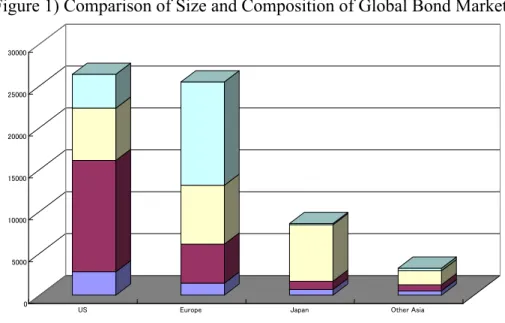
The combined size of Asian bond markets is estimated at more than U.S. $ 11 trillion, comprising nearly one-quarter of the total value (U.S. $50 trillion) of the
21
world’s domestic bond markets (Figure 6).
(Figure 6) Breakdown of the World’s Bond Market Balances (2006)
(In U.S. $ Billions)
Corporate Financial
Institutions Governments Total Domestic Region by residence of issuer
a b c a + b + c
International Bonds
Global - Grand Total 5,746.7 20,530.2 24,008.6 50,285.5 18,448.9
U.S. 2,790.6 13,294.6 6,230.3 22,315.5 4,040.5
U.K. 23.1 379.4 835.1 1,237.6 2,509.1
Developed Europe (other than U.K.) 1,406.4 4,277.1 6,187.3 11,870.8 8,735.3
Offshore centers (other than HK,SG) 0.0 0.0 0.0 0.0 1,100.2
Japan 672.6 980.8 6,747.8 8,401.2 152.5
Offshore centers in Asia (i.e. HK,SG) 12.7 43.7 73.8 130.2 96.6
Asia other than Japan, HK and SG 496.9 673.2 1,910.6 3,080.7 227.7
Total Asia 1,182.2 1,697.7 8,732.2 11,612.1 476.8
Asia’s ratio to World 20.6% 8.3% 36.4% 23.1% 2.6%
Others 450.4 881.6 1916.8 3,248.8 999.3
International organisations 0.0 0.0 0.0 0.0 587.7
Source: BIS Quarterly Review, June 2007; data for Taiwan provided by the Taiwan Stock Exchange and the Central Bank of Taiwan. International bonds are classified by residence of issuer.
At the same time, Japan has the highest level of debt securities outstanding in the Asian region. The second largest bond markets in the region are those of China and Korea, which are significantly smaller than the Japanese market (Figure 7-a, b).
(Figure 7-a)
, , , , , , , , , ,
Domestin Bond Market Outstandings in Asia U.S.$ Billions
Source: BIS Quarterly Review, June 2007; data for Taiwan provided by the Taiwan Stock Exchange and the Central Bank of Taiwan, etc.
22
(Figure 7-b) Domestic Bond Market Outstanding
In U.S. $ Billions
2001 2002 2003 2004 2005 2006
Japan 5,509.7 6,416.8 7,882.4 8,858.1 8,369.9 8,401.2
China 238.3 342.2 448.8 623.7 895.2 1,183.6
Korea 438.7 538.2 759.9 751.3 847.7 1,010.0
India 0.2 0.2 0.7 249.5 279.1 325.7
Taiwan 113.3 123.8 135.6 151.5 166.3 173.0
Malaysia 82.8 84.4 98.8 110.6 123.5 146.2
Thailand 37.2 48.3 59.6 68.0 80.5 109.7
Indonesia 49.2 58.2 65.7 61.2 54.7 87.6
Singapore 51.4 56.4 61.5 72.7 74.9 79.2
Hong Kong 52.1 58.1 60.5 62.9 65.8 51.0
Philippines 24.2 27.6 30.7 35.6 41.2 44.9
Total 6,597.1 7,754.2 9,604.1 11,045.1 10,998.6 11,612.1
Source: BIS Quarterly Review, June 2007, Taiwan Central Bank, ADB, etc.
These figures make the Asian bond markets collectively a close rival to the U.S. bond market in terms of scale. Asia’s bond markets should not remain isolated as they are now. It is imperative to establish a common “market” to facilitate the effective allocation and efficient flow of long-term capital accumulated in Asia.
There are two camps in discussions related to the development of Asian bond markets. (Figure 8)
One prioritises the further development of domestic markets, or, alternatively, believes that domestic markets are sufficiently developed.
The other camp seeks to further develop domestic markets and at the same time to promote a cross-border inter-regional (offshore) market in the region.
This does not mean simply connecting domestic markets. A cross-border market would be, rather, a non-domestic market that co-exists within the region with domestic markets, but features the involvement of different players, rules and taxation schemes.
As an image of such a cross-border market, we might consider self-regulating markets like the Eurobond market. While the EU has recently tightened regulations and reduced the freedom of the Eurobond market, it has traditionally been regarded as a freely accessible market.
Cooperation between market players and regulators in Asian countries will be extremely important in the development of a free and open market of this type in the region. Because Japan is by far the largest market in the region, Japan should play a leadership role, and discussions involving Japanese market participants should be promoted and facilitated.
However, harmonisation of traditional independent market practice in each of the region’s countries may not be viable. If many to many interoperability among domestic markets in the region is sought, the matrix will be extremely complex, and not optimal for the region as a whole.
A preferable approach is to develop a common integrated market infrastructure for the requirements of professionals. Professor Hal S. Scott of Harvard Law School also indicates that off-shore integration is far more important than on-shore integration in the Asian region.
23 (Figure 8)
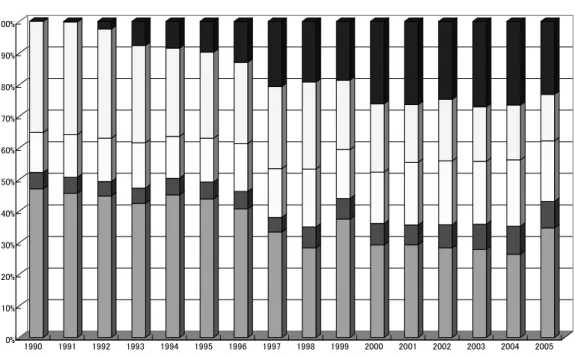
Looking at the individual bond markets in Japan, Korea, China and other Asian countries, we find that their composition is extremely simple for their size (Figures 9 and 10).
Although Japan has by far the largest outstanding balance of bonds, 80% are government and other public bonds, with only 20% made up of private sector bonds, including bank debentures and ordinary corporate bonds. Unfortunately, the balance of private sector bonds has not shown much growth in Japan (Figures 9-a, b, and c).
(Figure 9-a)
, , , , , , , , ,
, Size of Japanese LCY Bond Market in US$ Billions
Fin )nst Corp Govt
Source: BIS Quarterly Review, June 2007 Local Bond Market (Domestic Bond Market)
9 Fostering government bond markets 9 Creation of benchmark yield curves 9 Fostering corporate bond markets 9 Circulation of savings in domestic markets
Cross-border Bond Markets (Foreign Bond Markets and Eurobond Market)
• Issuance by non-residents
• Cross-border circulation of savings
• Different stages of economic development and heterogeneity
in legal and institutional systems and infrastructure
in Asian countries
Asian Inter-Regional Professional Securities Market
(AIR-PSM)
• Harmonisation of heterogeneous rules and regulations for professionals
• Inter-regional circulation of savings
• Creation of self-regulated regional off-shore market for professional (qualified) market participants Heterogeneity
Homogeneity
We need a Road Map
Off-Shore
On-Shore
Development of
Asian Bond Markets
24
(Figure 9-b) Size of Japanese Local Currency Bond Market
(In U.S. $ Billions)
Date Govt. Corp. Fin. Inst. Total
1995 2,479.5 583.0 1,675.1 4,737.6
1996 2,393.6 562.1 1,574.9 4,530.6
1997 2,284.4 508.4 1,410.1 4,202.9
1998 2,832.7 648.6 1,422.6 4,903.8
1999 3,664.8 751.4 1,634.9 6,051.0
2000 3,618.1 678.5 1,440.6 5,737.2
2001 3,630.6 629.6 1,249.9 5,510.0
2002 4,543.7 701.9 1,171.4 6,417.0
2003 5,831.2 797.1 1,254.1 7,882.4
2004 6,836.7 787.4 1,234.0 8,858.1
2005 6,604.7 704.8 1,060.4 8,369.9
2006 6,747.8 672.6 980.8 8,401.2
Source: BIS Quarterly Review, June 2007, etc.
(Figure 9-c)
, , , , , , , , , , , , , , , , , , , , ,
Unit: Million¥Breakdown of Funding Sources for Japanese Corporations
Other Borrowings LT Other Borrowings ST Bank Borrowings LT Bank Borrowings ST CP ST
Bond LT Equity
Source: Bank of Japan, Japanese MOF.