multiplex-hidden display technique for music entertainment system
Wataru FUJIMURA
1)Yukua KOIDE
1)Takuya SAKAI
1)Songer ROBERT
2)Takayuki KOSAKA
1)Akihiko SHIRAI
1)May 17, 2012
1) Kanagawa Institute of Technology, Atsugi, Japan 2) Kanazawa Technical College, Kanazawa, Japan
paraoke (at) shirai.la
Abstract
This project is focusing on the development of a new generation of karaoke entertainment system using augmented reality techniques. It has a multiplex hidden image display using stereoscopic projection and the hiding algorithm “ScritterH”, a special device to see hidden images with a wireless controller called “Fil-Con”, and a dance motion analyzer using Kinect for natural dancing support. The audience can participate in multilingual karaoke by singing and dancing. This system expands the possibility of karaoke entertainment from current karaoke systems meant exclusively for singers.
1 Motivation:
Next generation of Karaoke
Figure 1: Karaoke is a singing entertainment system. This project focuses on extending it for wider range of people.
Currently, karaoke, which means “empty orches- tra”(in Japanese) is a type of entertainment media used throughout the world. It was invented in 1971, in Japan by Daisuke Inoue who was awarded the “Ig Nobel Peace Prize” in 2004 for his inventing karaoke, thereby providing an entirely new way for people to
learn to tolerate each other [1]. This project attempts to extend karaoke so a wider range of people can en- joy it.
The “PARAOKE” project is focused on solving the exclusiveness of current karaoke entertainment. If the media system can include support for audience mem- bers who currently only listen to the singers with- out interfering, it may be possible to create a new entertainment system that can continuously extend current entertainment culture and user habits. Es- pecially, current karaoke users may be satisfied when there are only a few singers at a time because the sys- tems are designed only for the singer and, in private karaoke rooms, a price is charged to every participant according to the amount of time in some country like Japan. User satisfaction may depend on the amount of singing, not listening.
2 Concept of PARAOKE
PARAOKE is an acronym of “Parallel Augmented Reality for Audience-Oriented Entertainment”.
With modern karaoke systems where the singer is at the heart of the action, any content that would inhibit a song (such as games) cannot be played at
the same time. The display of a karaoke system is an especially important device. Fig.2 shows an isolated singer who is singing in front of an audience that is not looking in the same direction where the song in- formation is being displayed. If a multiplexed display can be applied to a karaoke system, it may be possi- ble to realize a new kind of entertainment that more naturally involves not only karaoke singers but also karaoke audience members.
Figure 2: An issue with current karaoke systems: Most are designed only for the singer, not for the audience, making the singer may feel isolated.
If a multiplexed information display is used for karaoke, it may enhance not only the singer but also dancers and musicians, expanding the enjoyment to be had in arrangement with music.
Fig.3 is a concept image describing the idea be- hind the PARAOKE (Parallel Augmented Reality for Audience-Oriented Entertainment) system. The singer is on the right but the audience members can freely dance and play guitar. PARAOKE elicits dancing and playing along with the same music from audience members to make the singer feel more comfortable.
Some current music game systems like “Dance Evo- lution” or “Guitar Hero” motivate players but do not focus on collaboration with the singer. Additionally, conventional music game systems require play in ac- cordance with symbolic scoring within the system. But audience members should not be forced to join the singing by design.
3 System architecture
3.1 ScritterH: Mutliplex-Hidden Im-
agery
This project involves the development of a new hid- ing algorithm called “ScritterH” to realize multiplex- hidden imagery[2, 3, 4, 5, 6, 7, 8]. Scritter is a new application of stereoscopic projectors. It can make multi-channels using polarization filtered glasses. The
Figure 3: Concept sketch of PARAOKE: Only the singer can see the lyrics through special glasses.
user can see completely different images. ScritterH is an advanced algorithm of Scritter. It has realized free image generation for the naked eye. When users look through a polarization filter, they can see a hidden image. This can enhance current karaoke captions by adding content like music games or menus.
This technology is also compatible with current stereo projectors. Not only for current karaoke sys- tems, Scritter and its series of application can also give new value to the future of stereo 3D imagery.
Figure 4: Multilingual subtitles with Scritter
3.2 Fil-Con
“Fil-Con”, is a controller with a filter for use with ScritterH. In particular, it consists of a polarization filter and a wireless controller. When using this con- troller to project multiplexed images from a pair of projectors onto a silver screen, users can see the hid- den parallel image. This allows for the configuration of an augmented reality display using optics free of any electronic devices. The prototype (Fig.5) utilizes
Figure 5: ScritterH: This method can show parallel im- ages without any electronic devices.
a WiiRemote as a wireless controller. It can detect its direction and control an alternate menu system (fig.6). Multiplexed imagery with a stable controller is useful in karaoke environment.
Figure 6: Fil-Con: Polarization filter and controller
3.3 Natural Dance Analyzer
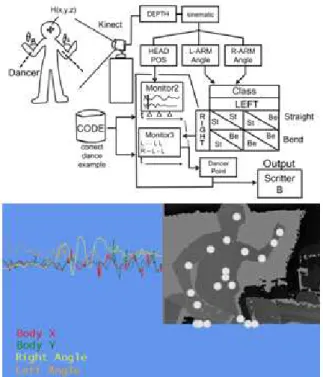
Natural Dance Analyzer (NDA) is a real-time motion capture and motion evaluation system which is based on a Microsoft Kinect sensor and the past research and game development projects as GAMIC algorithm by Fujimura et al. [9, 10] and tools by Misumi et al. [11].
Dancers who join as audience members in karaoke may make swinging motions along with the music. These body movements can be captured by the Kinect sensor as a depth image then processed with the Mi- crosoft Kinect SDK to obtain kinematic bone posi- tions of the target without any need for calibration.
Dance movement can be described as a non-discrete process. The NDA recognition algorithm is based on multiple kinematics evaluation functions which are
Figure 7: Fil-Con shows an alternate menu system for karaoke environment.
Figure 8: Prototype of Natural Dance Analyzer
configured by dot product between target gesture Ti and the current user’s bone posture Vi.
fn= 1 k
k
∑
i=0
( Ti· Vi
∥Ti· Vi∥ )
(k : bones) (1)
K is the number of bones, which total at 20 for the entire body in Microsoft Kinect SDK. Each key dance motions have evaluation functions f0, f1,..., fn and they evaluate audience players’ motion continu- ously for some characteristic parts like arms. These functions output similarity of the user’s posture to a target motion which is defined by ideal or arbitrary values.
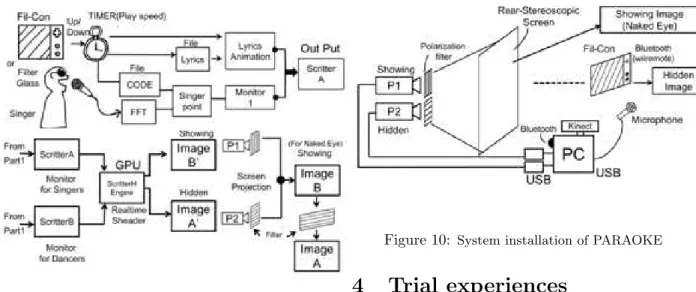
Figure 9: Karaoke evaluation system and ScritterH en- gine
NDA takes the body position coordinates (x, y) as well as left and right arm angles (θL, θR) from the full kinematics data set. These are then classified ac- cording to four possible conditions such as “straight” or “bend” for each arm. Fig. 8 is a screenshot of the prototype. When the system has target dance data captured as the ideal pose in advance, it evaluates the similarity and rewards points. The point and move- ment monitors show on the main screen in real-time to further motivate audience activity.
3.4 Karaoke evaluation
To realize the enhancement of current karaoke expe- riences for an international scene like Laval Virtual ReVolution, a karaoke evaluation system specialized for the ScritterH environment is being developed.
Fig.9 describes a real-time process for singers. The singers who use special glasses or the Fil-Con and microphone can see lyrics with markers (referred to as “Code”) that are generated in advance from the music.
The singer’s voice is processed using a FFT (Fast Fourier Transform) and if it matches the Code, the evaluation function will reward points. The Code and FFT results are shown along with the lyrics in the hidden image to help singers perform foreign or un- known songs more easily. This system also can sup- port karaoke beginners, because the hidden image has an advantage over double screens which are shown to all audience members.
Figure 10: System installation of PARAOKE
4 Trial experiences
Currently, this system is the alpha version of the project concept. Now it is obtaining actual user ex- periences in natural entertaining conditions. As a field test, it will be exhibited at Laval Virtual 2012. This version allows French people to sing Japanese P·P music with our dance-karaoke system. Audience members viewing the screen without special glasses will see lyrics written in French phonetics. French and Japanese participants both can freely enjoy karaoke together without the language barrier.
Figure 11: Experience of PARAOKE
ACKNOWLEDGMENTS: We would like to say thanks to Anne FERRERO (Nolife TV) for her internation- alization of the lyrics with phonetically corrections.
Figure 12: Beta version of PARAOKE, exhibition in Laval Virtual ReVolution 2012
References
[1] Stephen Drew. The ig nobel acceptance speeches. Annals of Improbable Research, Vol. 10, No. 6, 2004.
[2] Masao. K. Michimi. I., Mie. S. and Naoki. H. High dynamic range with multiple projectors. ITE Technical Report, vol.35, no.8, pp. pp. 45– 48, 2011.
[3] Ian E. McDowall, Mark T. Bolas, Perry Hober- man, and Scott S. Fisher. Snared illumination. In ACM SIGGRAPH 2004 Emerging technolo- gies, SIGGRAPH ’04, pp. 24–, New York, NY, USA, 2004. ACM.
[4] Pranav Mistry. Thirdeye: a technique that en- ables multiple viewers to see different content on a single display screen. In ACM SIGGRAPH ASIA 2009 Posters, SIGGRAPH ASIA ’09, pp. 29:1–29:1, New York, NY, USA, 2009. ACM. [5] Koki N. Takeru U. Takeo, H. and S. Akihiko.
Scritter: A multiplexed image system for a pub- lic screen. Proceedings of Virtual Reality In- ternational Conference Laval Virtual ReVolution 2010, pp. pp. 321–323, 2010.
[6] Oliver Bimber and Daisuke Iwai. Superimposing dynamic range. ACM Trans. Graph., Vol. 27, pp. 150:1–150:8, December 2008.
[7] Cinema subtitle glasses give promise to deaf film fans. BBC NEWS TECHNOLOGY, pp. http://www.bbc.co.uk/news/technology– 14654339, 2011.
[8] Koki Nagano, Takeru Utsugi, Kazuhisa Yanaka, Akihiko Shirai, and Masayuki Nakajima. Scrit- terhdr: multiplex-hidden imaging on high dy- namic range projection. In SIGGRAPH Asia 2011 Posters, SA ’11, pp. 52:1–52:1, New York, NY, USA, 2011. ACM.
[9] SHIRAI Akihiko FUJIMURA Wataru, IW- DATE Shoto. Cartoonect: Sensory motor play- ing system using cartoon actions. In Virtual Re- ality International Conference (VRIC 2011), pp. pp.27–30, 2011.
[10] KOSAKA Takayuki HATTORI Motofumi SHI- RAI Akihiko FUJIMURA Wataru, MISUMI Ha- jime. Development of serious game which use full body interaction and accumulated motion. In NICOGRAPH International 2011, p. P13, 2011. [11] Hajime Misumi, Wataru Fujimura, Takayuki Kosaka, Motofumi Hattori, and Akihiko Shirai. Gamic: exaggerated real time character anima- tion control method for full-body gesture in- teraction systems. In ACM SIGGRAPH 2011 Posters, SIGGRAPH ’11, No. 5, pp. pp. 5:1–5:1, Vancouver, British Columbia, Canada, 2011.