177
nences in Pun Formation: Experimen-
tal Evidence for Positional Faithfulness
SHIGETO KAWAHARA
Rutgers University
KAZUKO SHINOHARA
Tokyo University of Agriculture and Technology
1. Introduction
This paper addresses two issues. The first issue is similarity effects in pho- nology. We commonly observe that speakers maximize the similarity be- tween corresponding segments (e.g. input and output). In particular, several previous studies have noted that speakers can simplify their articulation so long as its consequence is perceptually non-conspicuous (Johnson, 2003; Kawahara, 2006; Kohler, 1990; Steriade, 2001). For example, Japanese speakers can devoice geminates when they occur with another voiced ob- struent (Nishimura, 2003, 2006). Kawahara (2006) argues that devoicing of a geminate occurs because it is perceptually non-conspicuous i.e. voiced geminates and voiceless geminates are “perceptually similar enough”. This example illustrates another point: various contextual factors contribute to the measure of similarity. In the Japanese example, geminates can devoice, but singletons do not (when they co-occur within another voiced obstruent). Based on acoustic and perception experiments, Kawahara (2006) argues that this asymmetry arises because a voicing contrast is less perceptible in geminates than in singletons. In other words, the perceptibility of a voicing
contrast depends on whether the contrast is hosted by a singleton consonant or a geminate consonant. In general, the position of a contrast matters for the perceptibility of the contrast (Steriade, 2001, and others). To summa- rize, this paper supports two themes about the similarity effects in phonol- ogy: speakers minimize the differences between corresponding elements, and the measure of similarity depends on contextual factors.
The second aim of this paper is to bear on the controversy between positional faithfulness theory and positional markedness theory. Some phonological contrasts are maintained in some positions but neutralized elsewhere (the situation referred to as “positional neutralization”) (Trubet- koy, 1939/1969). For example, Tamil allows mid vowels and rounded vow- els only in initial syllables (Beckman, 1997, p.6). In the current framework of Optimality Theory (Prince and Smolensky, 1993/2004), two major theo- ries exist to account for positional neutralization patterns. On the one hand, the positional faithfulness theory posits that speakers prohibit changes in phonetically or psycholinguistically prominent positions (Beckman, 1997). On the other hand, positional markedness theory posits that speakers exert a strong pressure against having a particular contrast/structure in non- prominent positions (Zoll, 1998). Evidence for either position has been put forth in the recent OT literature (positional faithfulness: Casali 1997; Kawahara 2006; Kawahara and Hara 2009; Lombardi 1999; Steriade 2001, among others; positional markedness: Ito! and Mester 2003; Prince and Te- sar 2004; Smith 2002; Zhang 2004, among others). To bear on this debate, this paper provides independent experimental support for the positional faithfulness theory.
To address these two questions—the issue of similarity effects in pho- nology and the controversy between the positional faithfulness theory and positional markedness theory—this paper analyzes Japanese puns (dajare). Punning is a common practice in Japanese, at least for some speakers. They create sentences using two identical or similar sounding words or phrases, as in buta-ga butareta ‘A pig was hit’, aizusan-no aisu ‘Ice cream from Aizu’ and okosama-o okosanaide ‘Don’t wake up a kid’. Paired words can contain identical sound sequences as in the first example, but they can also contain non-identical pairs of sounds ([z] vs. [s] in the second example, and [m] vs. [n] in the third example). Speakers nevertheless attempt to maxi- mize the similarity between the corresponding words in Japanese imperfect puns (Cutler and Otake, 2002; Kawahara, 2009; Kawahara and Shinohara, 2009; Shinohara, 2004). Our experiments below show that the positions of mismatches affect the wellformedness of imperfect puns—speakers dis- prefer mismatches in certain phonological positions, in our case in initial syllables and long vowels. We argue that these positional effects are
grounded in phonetic and psycholinguistic prominences of these phonological positions, and that positional faithfulness, not positional markedness, can account for our observation.
Finally, before closing this introductory discussion, a remark on our theoretical context is in order. We would like to situate our work in a larger theoretical context, which is growing in interest, in using verbal art patterns to probe our linguistic knowledge especially by way of an experimen- tal/corpus-based method (Fabb, 1997; Fleischhacker, 2000, 2005; Ito! et al., 1996; Kawahara, 2007, 2009; Kawahara and Shinohara, 2009; Shinohara, 2004; Steriade, 2003; Yip, 1999; Zwicky, 1976; Zwicky and Zwicky, 1986, among others). To the extent that our arguments successfully address the above-mentioned phonological questions, this paper supports a general ap- proach which addresses phonological questions through experimental stud- ies of verbal art.
2. Experiment 1
2.1 Introduction and Background
The first experiment tested whether speakers avoid mismatches in initial positions. If speakers attempt to maximize the similarity between corre- sponding words in puns, we expect that they do avoid mismatches in initial positions, because initial syllables play an important role in word recogni- tion and hence mismatches in these positions would be perceptually salient. Here we briefly review the evidence for the psycholinguistic prominence of initial syllables (the following summary builds on Beckman 1997: see Beckman 1997; Hawkins and Cutler 1988; Smith 2002 for more compre- hensive reviews). First, hearing initial portions of words helps listeners to retrieve the whole words in short-term memory recall tasks (Horowitz et al., 1968, 1969; Nooteboom, 1981). Second, in “tip-of-the-tongue” phenomena, speakers can only vaguely remember the word they are trying to pronounce, but cannot remember its exact phonological shape, and in such cases speak- ers can guess the first sounds more accurately than non-initial sounds (Brown, 1991; Brown and MacNeill, 1966). Third, in tip-of-the-tongue situations, initial sounds help retrieve the whole word (Freedman and Lan- dauer, 1966). Fourth, listeners are faster when detecting mispronunciations in non-initial positions (Cole, 1973; Cole and Jakimik, 1980)—once they hear initial syllables, that input activates words starting with those syllables, and hence the listeners can anticipate what is coming next. Finally, sound symbolism—particular images associated with particular sounds—is stronger word-initially than non-word-initially, at least in Japanese (Bruch, 1986; Kawahara et al., 2008a).
Because of their psycholinguistic prominence, initial syllables exhibit
a privileged status in phonology as well (Beckman, 1997). For example, in Sino-Japanese, while initial syllables can contain a variety of consonants, second syllables only allow [t] and [k] (Kawahara et al., 2002; Tateishi, 1990). Viewed from the perspective of Optimality Theory (Prince and Smolensky, 1993/2004), if there were an underlying form like /sasu/ (as per Richness of the Base), then speakers avoid changing the initial [s] but not the second [s] (perhaps to [satu]).1 In other words, speakers avoid making changes particularly in initial syllables.
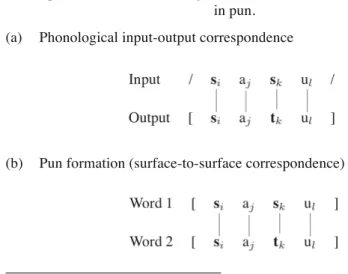
To the extent that phonological patterns and pun patterns are governed by the same principles, we would expect that speakers avoid mismatches in initial syllables in puns as well. Correspondence Theory (McCarthy and Prince, 1995) helps us to illustrate this prediction.2 As shown in Table 1(a), in Sino-Japanese phonology speakers allow changes in word-internal posi- tions (/sk/ ! [tk]), but do not allow changes in word-initial positions (/si/ ! [si]). If a parallel exists between phonological patterns and pun patterns, then speakers should disprefer mismatches in word-initial positions in puns, as in (b). In both cases, the identity restriction should be stronger word- initially than word-internally. The following experiment supports this pre- diction.
2.2 Method
In order to control for factors other than positional effects, we performed wellformedness judgment experiments. The first experiment tested whether speakers avoid mismatches in initial positions. The stimuli were minimal pairs that contain a pair of sounds that minimally differ in voicing ([t-d], [d- t], [k-g], [g-k], [s-z], [z-s]).3 To control for the phonological distance be-
1 Kawahara et al. (2002) develop an analysis of these patterns using positional faithfulness constraints. Initial syllables are protected by special faithfulness constraints, which dominate markedness constraints that collectively rule out all consonants but [t, k]. These markedness constraints dominate general faithfulness constraints for Sino-Japanese, which results in neu- tralization of all consonants to [t, k] in non-initial syllables. A positional-markedness based analysis is also possible, which would use constraints that prohibit consonants other than [t, k] in non-initial syllables.
2 Our formalization based on Correspondence Theory is not new. Several authors have pro- posed a correspondence theory of rhymes and other language games (Holtman, 1996; Ito! et al., 1996; Steriade, 2003; Steriade and Zhang, 2001; Yip, 1999).
3 We could not control for matches in accents for two reasons. First, we could not find enough minimal pairs if we controlled accents. Second, lexical accents are subject to high interspeaker variability due to dialectal and generational differences, and therefore it was impossible to find minimal pairs that match in accents for all speakers.
We chose a [voice] mismatch because we found it easiest to create the stimuli this way. Rep- licating our result with other featural mismatches would strengthen our claim about position sensitivity, but we will leave it for future research.
tween the punning constituents, the stimuli all had the same structure, [X- particle Y]. The punning constituents X and Y were all three syllables long. In one condition the mismatch occurred in the initial syllables (e.g. sasetsu- ni zasetsu ‘I gave up making a left turn’), and in another condition, the mismatch occurred in the second syllables (hisashi-ni hizashi ‘Sunlight on the sun roof’).4 (Due to space limitation, we cannot provide a full list of the stimuli—please contact the authors to obtain the list.) Additional filler items were interwoven with the target questions. The participants rated both the funniness and the acceptability of each pun sentence on a 1-to-4 scale for both questions. We were interested in the second question, but we included the first question, so that the participants would tease apart these questions. We put the funniness rating before the wellformedness rating to make it clear that the wellformedness rating should not be based on funniness. The questionnaire started with two sample questions, with one example which is
TABLE 1 A correspondence theoretic illustration of the parallel between phonology and pun formation. The top figure (a)=phonological input-output
correspondence. The bottom figure (b)=surface-to-surface correspondence in pun.
(a) Phonological input-output correspondence
(b) Pun formation (surface-to-surface correspondence)
4 We also included pairs which contained mismatches in final syllables in our experiment (re- ported in Kawahara et al. 2008b). These syllables behaved just like initial syllables. This result is a bit unexpected because it is known that initial syllables are psycholinguistically more prominent than final syllables, at least in a lexical retrieval task (Nooteboom, 1981). It may be that recency effects (Gupta, 2005; Gupta et al., 2005) are playing a role here—speakers re- member the final syllables of the first word most vividly when they find the second punning word, and therefore they avoid mismatches in final syllables because of the vivid memory. See also Brown & McNell (1966) for evidence that speakers remember word-final segments as much as word-initial segments in tip-of-the-tongue phenomena. See also Walter (2002) for some evidence that final syllables are positionally strong in phonology.
clearly an example of a Japanese pun (arumikan-no ue-ni aru mikan ‘An orange on a can’) and one example which clearly is not (hana-yori dango
‘Foods are more important than cherry blossom’). The latter example does not involve a pair of similar words/phrases, and hence it is not a good ex- ample of a pun. A total of 37 speakers participated in this study, but we excluded eight of them because they did not consider the first example arumikan-no ue-ni aru mikan as a good pun or considered hana-yori dango as a perfect pun.
FIGURE 1 Well formedness of puns with initial mismatches and those with internal mismatches. Error bars = 95% CIs calculated across 29 speakers. 2.3 Results and Discussion
Figure 1 illustrates the wellformedness ratings of puns with initial mis- matches and those with internal mismatches. As observed, speakers judged mismatches in initial syllables less acceptable than those in non-initial syl- lables (average ratings: initial 2.85 vs. internal 2.99). One may argue that this difference is too small to be conclusive. Indeed speakers have different standards about pun-wellformedness, and so the effect of the positional dif- ference may look small with respect to relatively large variability. However, the difference is robust within each speaker, and hence statistically signifi- cant according to a non-parametric within-subject Wilcoxon signed-rank test (z = 2.59, p = .01) (we used this within-subject non-parametric test be- cause we could not assume normality).
initial internal
Wellformendess rating 1.01.52.02.53.03.54.0
3. Experiment 2
3.1 Introduction and background
Experiment 1 supports the principle of positional faithfulness in that speak- ers avoid mismatches in initial positions, but a question arises whether we observe other kinds of positional effects. The second experiment thus tested whether speakers avoid mismatches in long vowels. Long vowels are, by definition, phonetically long. Different long vowels are more different from each other than different short vowels (Steriade, 2003)—an [aa]-[ii] pair is more different than an [a]-[i] pair. A change in long vowels would be more perceptible also because speakers hyperarticulate long vowels more than short vowels in Japanese, and as a result, long vowels are more (psycho-) acoustically dispersed than short vowels (Hirata and Tsukuda 2003; Hisagi et al., 2008).
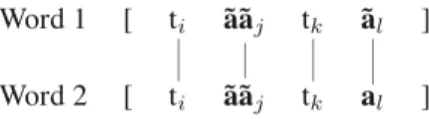
TABLE 2 A correspondence theoretic illustration of the parallel between phonology and pun formation.
(a) Phonological input-output correspondence
(b) Pun formation (surface-to-surface correspondence)
Just as in initial syllables, we observe that in phonology speakers avoid long vowel mismatches. Hindi for example allows a surface nasality contrast in long vowels, but not in short vowels (Steriade 1994 and references cited therein). A hypothetical underlying /tããtã/would map to [tããta]. As illus- trated in Table 2(a), in phonology speakers avoid making changes—or neu- tralizing contrasts—more in long vowels (/ããj/ ! [ããj]) than in short vowels (/ãl/ ! [ai]). Similarly, we expect that speakers avoid mismatches in long vowels more than in short vowels in imperfect puns, as in (b).
3.2 Method
The method is almost identical to Experiment 1, except that we had four practice questions. In addition to the two examples used in the previous experiment, we had manjuu-o mittsu moratta Akechi Mitsuhide-ga “A, ke- chi, mittsu hidee” ‘Akechi Mitsuhide was given three pieces of manjuu, and said “that’s mean, only three?”’—an example of a good pun—and dakara, kore-wa zura dewa arimasen ‘I am telling you that this is not a wig’—an example of a non-pun sentence. The design had three fully crossed factors: 10 vowel combinations ([a-i], [a-u], [a-e], [a-o], [i-u], [i-e], [i-o], [u-e], [u- o], [e-o]) ! 2 orders (e.g. [a-i] vs. [i-a]) ! 2 lengths (short vs. long). An ex- ample of a crucial pair was: jookuu-no jookaa ‘A joker in the sky’ vs. rippu-ga rippa ‘The lips are fine’. Additional fillers were added and inter- woven with the target items. 26 speakers participated in the study. All the participants judged the sample good puns as good puns and sample non- puns as non-puns, and hence the data from all the participants were included in the analysis.
FIGURE 2 Wellformedness of puns with long vowel mismatches and short vowel mismatches. Error bars represent 95% CIs across 26 speakers. 3.3 Results and Discussion
Figure 2 illustrates the results. Speakers rated those with long mismatches as worse than short mismatches (average ratings: long 2.09 vs. short 2.30) and the difference is statistically significant according to a within-subject Wilcoxon sign-ranked test (z = 2.93, p < .01). Mismatches in long vowels are perceptually salient because of their long duration and their hyperarticu- lated nature, and hence avoided by the participants.
long short
Wellformendess rating 1.01.52.02.53.03.54.0
4. Conclusion 4.1 Summary
In summary, speakers avoid mismatches in initial syllables and long vowels in Japanese imperfect puns, just as in phonology. We thus find the same principle both in phonology and in pun formation. In this regard we find non-trivial parallels between phonology and verbal art patterns.
4.2 Bearing on the Positional Faithfulness vs. Markedness Debate The principle of positional faithfulness can explain our results, because we observe that speakers avoid mismatches in strong positions in puns, and the avoidance of mismatches in strong positions is what positional faithfulness demands (Beckman, 1997). Positional markedness on the other hand has nothing to say about the results because it evaluates the wellformedness of one form only, but it does not demand anything about the relation between two forms (Zoll, 1998).5 Overall, therefore, our experiments provide inde- pendent support for the principle of positional faithfulness that speakers avoid mismatches in phonetically and psycholinguistically strong positions. 4.3 Concluding Discussion
Before closing this paper, we would like to address one final issue. One may argue that our argument is based on “para-linguistic patterns”. How- ever, we find non-trivial parallels between pun patterns and phonology (Kawahara, 2009; Kawahara and Shinohara, 2009), and we would miss the parallels if we treated them separately. In other words, to the extent that we find parallels between pun patterns and phonology, which we hope to have shown that we do in this paper, it is effective to use verbal art patterns to investigate our knowledge of similarity. To conclude, our paper supports the general strategy to probe our linguistic knowledge through the analysis of verbal art patterns.
Acknowledgments
The experiments reported in this paper are a part of a larger project, which investigates knowledge of similarity through puns, as outlined in Kawahara (2009). Further information about this general project can be found at the first author’s website. An earlier version of Experiment 1 was performed as BA thesis research by Nobuhiro Yoshida at Tokyo University of Agricul- ture and Technology. Experiment 1 was also presented as Kawahara, Shi- nohara, & Yoshida (2008b). We are grateful to the audiences at Sophia University (07/19/2008), the Language, Communication, and Cognition
5 We do not wish to imply that positional markedness constraints are not necessary—they do not explain our results.
(Brighton University, 08/04/2008), and the 18th meeting of Japa- nese/Korean Linguistics (City University of New York, 11/13/2008). We finally would like to thank Kazu Kurisu, Kyoko Yamaguchi, and Betsy Wang for comments on earlier versions of this paper. The usual disclaimer applies. This paper supersedes the section 3 of Kawahara (2009).
References
Beckman, Jill. 1997. Positional faithfulness, positional neutralization, and Shona vowel harmony. Phonology 14(1):1–46.
Brown, Alan. 1991. A review of the tip-of-the-tongue experience. Psychological Bulletin 109(2):204–223.
Brown, Roger and David MacNeill. 1966. The ‘tip of the tongue’ phenomenon. Journal of Verbal Learning and Verbal Behavior 5(4):325–337.
Bruch, Julie. 1986. Expressive phonemes in Japanese. Kansas Working Papers in Linguistics 11:1–8.
Casali, Roderic F. 1997. Vowel elision in hiatus contexts: Which vowel goes? Lan- guage 73(3):493–533.
Cole, Ronald. 1973. Listening for mispronunciations: a measure of what we hear during speech. Perception & Psychophysics 13:153–156.
Cole, Ronald and Jola Jakimik. 1980. How are syllables used to recognize words? Journal of Acoustical Society of America 67(3):965–970.
Cutler, Anne and Takashi Otake. 2002. Rhythmic categories in spoken-word recog- nition. Journal of Memory and Language 46(2):296–322.
Fabb, Nigel. 1997. Linguistics and Literature: Language in the Verbal Arts of the World. Oxford: Basil Blackwell.
Fleischhacker, Heidi. 2000. Cluster dependent epenthesis asymmetries. UCLA Working Papers in Linguistics 5, pages 71–116. Los Angeles: UCLA.
Fleischhacker, Heidi. 2005. Similarity in Phonology: Evidence from Reduplication and Loan Adaptation. Ph.D. thesis, UCLA.
Freedman, Jonathan and Thomas Landauer. 1966. Retrieval of long-term memory:
“tip-of-the-tongue” phenomenon. Psychonomic Science 4(8):309–310.
Gupta, Prahlad. 2005. Primacy and recency in nonword repetition. Memory 13(3): 318–324.
Gupta, Prahlad, John Lipinski, Brandon Abbs, and Po-Han Lin. 2005. Serial position effects in nonword repetition. Journal of Memory and Language 53:141–162. Hawkins, John and Anne Cutler. 1988. Psycholinguistic factors in morphological
asymmetry. In J. A. Hawkins, ed., Explaining Language Universals, pp. 280– 317. Oxford: Basil Blackwell.
Hirata, Yukari and Kimiko Tsukada. 2003. The effects of speaking rates and vowel length on formant movements in Japanese. Proceedings of the 2003 Texas Lin- guistic Society Conference, pp. 73–85. Somerville, MA: Cascadilla Press. Hisagi, Miwako, Kanae Nishi, and Winifred Strange. 2008. Acoustic properties of
Japanese and English vowels: Effects of phonetic and prosodic context. Japa- nese/Korean Linguistics 13. Stanford: CSLI.
Holtman, Astrid. 1996. A Generative Theory of Rhyme: An Optimality Approach. Ph.D. thesis, Utrecht Institute of Linguistics.
Horowitz, Leonard, Peter Chilian, and Kenneth Dunnigan. 1969. Word fragments and their reintegrative powers. Journal of Experimental Psychology 80(2):392– 394.
Horowitz, Leonard, Margeret White, and Douglas Atwood. 1968. Word fragments as aids to recall: the organization of a word. Journal of Experimental Psychology 76(2):219–226.
Ito!, Junko, Yoshihisa Kitagawa, and Armin Mester. 1996. Prosodic faithfulness and correspondence: Evidence from a Japanese argot. Journal of East Asian Linguis- tics 5:217–294.
Ito!, Junko and Armin Mester. 2003. Japanese Morphophonemics. Cambridge: MIT Press.
Johnson, Keith. 2003. Acoustic and Auditory Phonetics: 2nd Edition. Malden and Oxford: Blackwell.
Kawahara, Shigeto. 2006. A faithfulness ranking projected from a perceptibility scale: The case of voicing in Japanese. Language 82(3):536–574.
Kawahara, Shigeto. 2007. Half-rhymes in Japanese rap lyrics and knowledge of sim- ilarity. Journal of East Asian Linguistics 16(2):113–144.
Kawahara, Shigeto. 2009. Probing knowledge of similarity through puns. Proceed- ings of Sophia Linguistics Society, vol. 23. Tokyo: Sophia University Linguistics Society.
Kawahara, Shigeto and Yurie Hara. 2009. Hiatus resolution in Hiroshima Japanese. Proceedings of North East Linguistic Society 38. Amherst: GLSA.
Kawahara, Shigeto, Kohei Nishimura, and Hajime Ono. 2002. Unveiling the un- markedness of Sino-Japanese. Japanese/Korean Linguistics 12, pp. 140–151. Stanford: CSLI.
Kawahara, Shigeto and Kazuko Shinohara. 2009. The role of psychoacoustic simi- larity in Japanese puns: a corpus study. Journal of Linguistics 45(1):111–138. Kawahara, Shigeto, Kazuko Shinohara, and Yumi Uchimoto. 2008a. A positional
effect in sound symbolism: An experimental study. Proceedings of the Japan Cognitive Linguistics Association 8, pp. 417–427. Tokyo: JCLA.
Kawahara, Shigeto, Kazuko Shinohara, and Nobuhiro Yoshida. 2008b. Positional ef- fects in Japanese imperfect puns. A talk presented at Language, Communication, and Cognition (Brighton University, August 4th, 2008).
Kohler, Klaus. 1990. Segmental reduction in connected speech in German: phono- logical facts and phonetic explanations. In W. J. Hardcastle and A. Marchal, eds., Speech Production and Speech Modelling, pp. 69–92. Dordrecht: Kluwer. Lombardi, Linda. 1999. Positional faithfulness and voicing assimilation in Optimal-
ity Theory. Natural Language and Linguistic Theory 17(2):267–302.
McCarthy, John J. and Alan Prince. 1995. Faithfulness and reduplicative identity. University of Massachusetts Occasional Papers in Linguistics 18, pp. 249–384. Amherst: GLSA.
Nishimura, Kohei. 2003. Lyman’s Law in Loanwords. Master’s thesis, Nagoya Uni- versity.
Nishimura, Kohei. 2006. Lyman’s Law in loanwords. Phonological Studies [Onin Kenkyuu] 9:83–90.
Nooteboom, Sieb. 1981. Lexical retrieval from fragments of spoken words: Begin- nings vs. endings. Journal of Phonetics 9:407–424.
Prince, Alan and Paul Smolensky. 1993/2004. Optimality Theory: Constraint Inter- action in Generative Grammar. Malden and Oxford: Blackwell.
Prince, Alan and Bruce Tesar. 2004. Learning phonotactic distributions. In R. Kager, J. Pater, and W. Zonneveld, eds., Constraints in Phonological Acquisi- tion, pp. 245–291. Cambridge: Cambridge University Press.
Shinohara, Shigeko. 2004. A note on the Japanese pun, dajare: Two sources of phonological similarity. ms. Laboratoire de Psycheologie Experimentale. Smith, Jennifer. 2002. Phonological Augmentation in Prominent Positions. Ph.D.
thesis, University of Massachusetts, Amherst.
Steriade, Donca. 1994. Positional neutralization and the expression of contrast. ms. University of California, Los Angeles.
Steriade, Donca. 2001. The phonology of perceptibility effect: the p-map and its consequences for constraint organization. ms. MIT.
Steriade, Donca. 2003. Knowledge of similarity and narrow lexical override. In P. M. Nowak, C. Yoquelet, and D. Mortensen, eds., Proceedings of Berkeley Lin- guistics Society 29, pp. 583–598. Berkeley: BLS.
Steriade, Donca and Jie Zhang. 2001. Context-dependent similarity. A talk given at CLS 37.
Tateishi, Koichi. 1990. Phonology of Sino-Japanese morphemes. University of Mas- sachusetts Occasional Papers in Linguistics 13, pp. 209–235. Amherst: GLSA. Trubetzkoy, Nikolai S. 1939/1969. Grundzüge der phonologie. Güttingen: Vanden-
hoeck and Ruprecht [Translated by Christiane A.M. Baltaxe 1969, University of California Press].
Walter, Mary-Ann. 2002. Final position, prominence, and licensing of contrasts. A handout for a talk delivered at 2nd Annual Conference on Contrast and Com- plexity in Phonology. Toronto, May 3–5.
Yip, Moira. 1999. Reduplication as alliteration and rhyme. Glot International 4(8):1–7.
Zhang, Jie. 2004. The role of contrast-specific and language specific phonetics in contour tone distribution. In B. Hayes, R. Kirchner, and D. Steriade, eds., Pho- netically-based Phonology, pp. 157–190. Cambridge: Cambridge University Press.
Zoll, Cheryl. 1998. Positional asymmetries and licensing. ms. MIT. Zwicky, Arnold. 1976. This rock-and-roll has got to stop: Junior’s head is hard as a rock. Pro- ceedings of Chicago Linguistic Society 12, pp. 676–697. Chicago: CLS. Zwicky, Arnold and Elizabeth Zwicky. 1986. Imperfect puns, markedness, and
phonological similarity: With fronds like these, who needs anemones? Folia Linguistica 20:493–503.