APPLICATION PROCEDURES FOR
OVERSEAS GRANT
UNDER THE 28
thTERM OF
PRO NATURA FUND 2017
“PRO NATURA FUND” is a conservation grant program managed by Pro Natura FoundationJapan (PNFJ). This program is focused on the scientific research and enlightening activities concerning the conservation of biodiversity and the relationship between human and the environment.
This overseas grant program supports investigation and research aiming at conservation of ecosystem, and education and enlightenment activities aiming at the improvement of conservation awareness, in areas other than Japan. The project needs to contribute to local nature conservation.
The maximum limit of fund per project is 1,500,000 YEN. The total amount of remittance is likely to change depending on the current exchange rate.
PNFJ welcomes your application for the fiscal year 2017 (October 2017 – September 2018) that meets the following requirements.
1. SCOPE OF PROJECTS
Projects that are qualified to be granted by PRO NATURA FUND include:
1) Research projects such as;
- Biological, ecological, geomorphological, hydrological, or meteorological study focusing on local nature conservation.
- Environmental study for the purpose of conservation on land area such as forest, and aquatic area such as tidal flat, seaweed bed and estuary.
- Investigation on endangered animal and plant species. - Investigation on introduced or invasive species.
- Study which aims to solve nature conservation issues occurring today.
- The development of research method which contributes to solve nature conservation issues. 2) Activity projects such as;
- The protection of wild animal and plant species, ecosystem, geological features or hydrological environment.
- The promotion of conservational and environmental education, and the enlightenment of nature conservation thought.
- The publication/production of booklets, books and image contents which appeal to the public about nature conservation.
- The holding of symposium, seminar or events which appeal to the public about nature conservation.
3) The combination of 1) and 2).
2. QUALIFICATIONS OF PROJECTS
All projects to be granted must satisfy the following requirements:
1) The research and/or activity should contribute to the conservation and the sustainable use of natural resources in local area.
2) Outcome of the project should be published effectively in the countries concerned, and should not bring any benefit or disadvantage to specific political parties, religions, races, tribes, social hierarchy, etc.
3) Project results should not be used to secure profits for commercial purposes.
4) Accounting procedures must be properly carried out and accurately reported to the secretariat of PNFJ.
5) The grantee must respond quickly when PNFJ asked about the status of project implementation. 6) Project proposals should not be made simultaneously to any other organizations in Japan.
3. QUALIFICATIONS FOR APPLICANTS
The grant is applicable for groups only. The applicant group needs to meet the following criteria:
1) The applicant group must be capable of doing research and/or conservation activities in a local field.
2) The applicant group should have an excellent achievement in the field of nature conservation and/or environmental education.
3) The applicant group must include a project leader, a sub-leader, and an accountant.
4) The representative applicant (project leader) should live in the country where the project will be implemented, and should have a deep understanding of the field and the community in the area. A person living in Japan can be a group member, but cannot be the representative applicant. 5) The applicant group must include at least one Japanese member, who knows the group members
well, understands the details of the project, and is capable of being a liaison between the group and PNFJ. The Japanese member needs not necessarily to be a resident in the country or the region concerned.
4. ROLE OF JAPANESE MEMBER(S)
A Japanese member is essential to help communicate with the project group and PNFJ. The Japanese member must be a person who is capable of making contact with the project group in any circumstances, even when the project became no longer continuable due to unpredictable accidents such as political corruption.
Obligations of the Japanese member:
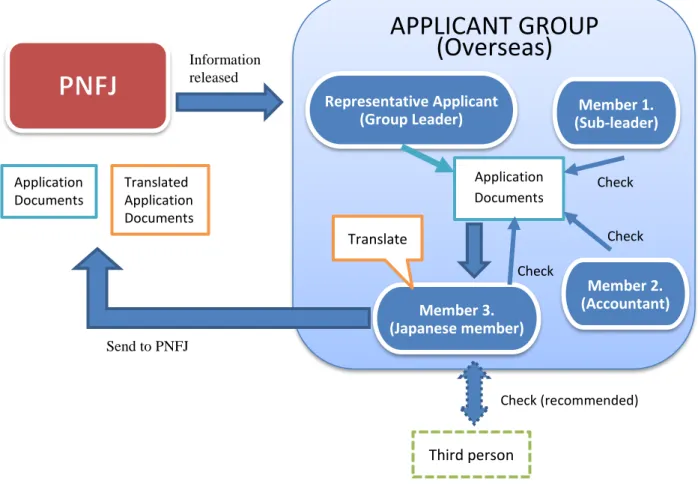
1) To translate an application form and send it to the secretariat of PNFJ.
2) To translate an interim report, to make comments on the report from the expert point of view, and to submit it to the secretariat of PNFJ.
3) To translate the summary of final report, and to submit it to the secretariat of PNFJ. 4) To make sure the final report and the account report to be made properly.
5) To check the contents of final report and to make a correction if necessary.
6) To attend the meeting for presentation of outcomes, which will be held in late November or early December 2018 in Tokyo.
5. TERM OF THE PROJECT AND THE MAXIMUM AMOUNT OF GRANT
Any project plan should be for a single year. The term is from October 2017 to September 2018. The maximum amount of the grant is 1,500,000 yen. It is important to note that the
6. SELECTION OF APPLICATIONS
All applications are to be reviewed fairly by the review committee. The judging criteria are as follows:
1) Importance and urgency:
Does the project deal with important objects and/or place in terms of nature conservation in the area? Is the project urgent to implement?
2) Validity of the plan:
Are the final goal, methods to achieve the goal, budget and term reasonable? 3) Efficacy of the outcome:
Will the data and outcomes gained in the project be useful for further research and/or activities for the conservation?
After the final decision made by the board of trustees, applicants will be notified the result by e-mail in September. The secretariat of PNFJ will not answer any questions regarding the process of selections.
7. SCHEDULE
Application start: 29 May 2017
Application close: 12:00pm, 14 July 2017 by email
In case of postal service, application must arrive on the day.
Announcement of the result: 30 September 2017
Funding term: 1 October 2017 - 31 September 2018 First remittance of the grant: Early in October 2017
Interim report: 31 March 2018
Second remittance of the grant: Early in April 2018 Submission of final report: 30 November 2018
Result presentation session: Late in November or early in December 2018
8.APPLICATION PROCEDURE
1) The applicant needs to download the application documents from the PNFJ website below:
http://www.pronaturajapan.com/foundation/pronaturafund/28pnfbosyu ;or
2) Applicants must complete Application Form and Expenditure Schedule sheet in English or Japanese. If written in English, the completed documents should be sent to the Japanese member, and the Japanese member needs to make a translated version. 3) The Japanese member is responsible to send all application documents to the
secretariat of PNFJ. The following documents must be included;
a) Application Form (A4×7 pages, written by applicant).
b) Expenditure Schedule (A4x7 pages, Excel sheet, written by applicant)
c) Japanese translation of the application form (A4×6 pages, written by Japanese member). d) Japanese translation of the expenditure schedule (A4x2 pages, Excel sheet, written by
Japanese member)
Please send all documents by PDF format.
Note:
(1) If you mention plant or animal species, please write its scientific name together. (2) Additional sheets or additional materials to the application form are not accepted.
9. RESTRICTION OF EXPENDITURE
The grant is to be used to carry out the projects and to make report(s) on the project concerned. The grant should NOT be used as salary for the applicants. Expenditure for food and beverages is not allowed. Please refer to the expenditure item list for further information.
The grant can be spent on the following travel expenses: Japanese resident member’s travel to the project field; Japanese member’s travel to attend the meeting for presentation of outcomes; and project leader’s short-term visit to Japan as a part of the project. A long- term stay for the purpose of studying in Japan is not applicable. If the project leader is visiting Japan when the meeting for presentation of outcomes is held, domestic travel expense for two people (the project leader and a Japanese member) is applicable. A project group may need to submit “Plan Change Request” when the expenditure plan needs to be changed.
10.APPLICATION FORMAT
The application should be written in black and white. Size of the frame can be changed in each page, but adding of pages is not allowed. The size of letters should be larger than 12 pt. Font type is free. The applicant may underline or boldface the important words in
11.QUESTIONNAIRE
The applicant must answer the questionnaire which is attached in the application form. The answers will be utilized to the improvement of application system in this grant program in the future. The answer of questionnaire would not affect the evaluation of application. However, if the questionnaire page is empty, PNFJ will not accept the application.
12.FAILURES IN APPLICATION DOCUMENTS
PNFJ will not accept the application if the application documents have any failures such as:
Non-response to the questionnaire
Adding pages in the application form
Changing the format significantly
PNFJ strongly recommends applicants to have a check by third person before sending application documents.
13.OBLIGATION OF THE GRANTEE:
1) To submit the receipt of grants immediately when the payment is confirmed.
2) To submit the interim report describing progress of the project by the end of March 2018 via Japanese member. The Japanese member needs to translate it and make some comments on it. 3) To submit the full report on both research/activity and account to the secretariat of PNFJ via
Japanese member by the end of October 2018. The grantee must attach all receipts (or copies of them) of expenses to the account reports.
If failed to fulfill the above responsibilities, the grantee may be asked to refund the subsidies.
14. REMITTANCE OF GRANTS
The funds will be remitted to grantees in two payments. The first portion will be remitted after the project fund contract is completed (in October 2017). The remaining portion will be remitted after PNFJ received the interim report (in April 2018).
The amount of funds will be stated in Japanese Yen. However, the remittance will be made in the currency specified by the applicant on the application form.
The currency exchange rate will be the rate on the remittance date; therefore the total amount of remittance may be subject to change depending on the exchange rate.
15. APPLICATION DEADLINE:
All the application documents should be sent via Japanese member and should arrive at the secretariat of PNFJ by no later than July 14, 2017. Delayed applications are not considered for the selection.
Pro Natura Foundation Japan
Shoto Annex 2F, 1-25-8 Shoto, Shibuya, Tokyo 150-0046 Japan
Phone: +81-3-54541789 Fax: +81-3-54542838 URL: http://www.pronaturajapan.com
E-mail : [email protected]
APPENDIX
ILLUSTRATION OF APPLICATION PROCESSES
Application Documents
APPLICANT GROUP
(Overseas)
Representative Applicant (Group Leader)
Member 1. (Sub-leader)
Member 2. (Accountant) Member 3.
(Japanese member) Application
Documents
Check
Check Check
Translated Application Documents
Information released
Send to PNFJ
Translate
Third person
Check (recommended)