X- Ray D
i f f r ac t i on St udy of CeT2Al 10 ( T = Ru,
O
s ) at Low
Tem
per at ur es and under Pr es s ur es
著者
KAW
AM
U
RA Yuki hi r o, H
AYASH
I J uni c hi , TAKED
A
Kei ki , SEKI N
E Chi hi r o, TAN
I D
A H
. , SERA M
. ,
N
AKAN
O
S. , TO
M
I TA T. , TAKAH
ASH
I H
. , N
I SH
I O
KA
T.
j our nal or
publ i c at i on t i t l e
Ac t a Phys i c a Pol oni c a A
vol um
e
131
num
ber
4
page r ange
988- 990
year
2017
U
RL
ht t p: / / hdl . handl e. net / 10258/ 00009541
Vol.131(2017) ACTA PHYSICA POLONICA A No. 4
Proceedings of the 16th Czech and Slovak Conference on Magnetism, Košice, Slovakia, June 13–17, 2016
X-Ray Diffraction Study of CeT
2
Al
10
(T = Ru, Os)
at Low Temperatures and under Pressures
Y. Kawamura
a,∗, J. Hayashi
a, K. Takeda
a, C. Sekine
a, H. Tanida
b, M. Sera
b,
S. Nakano
c, T. Tomita
d, H. Takahashi
eand T. Nishioka
faMuroran Institute of Technology, Muroran, Hokkaido 050-8585, Japan bHiroshima University, Higashi-Hiroshima, Hiroshima 739-8530, Japan cNational Institute for Materials Science, Tsukuba, Ibaraki 305-0044, Japan
dISSP, University of Tokyo, Kashiwa, Chiba 277-8581, Japan eNihon University, Sakurajosui, Setagaya, Tokyo 156-8550, Japan
fKochi University, Kochi, Kochi 780-8520, Japan
We have carried out a powder X-ray diffraction investigation on antiferromagnetic Kondo semiconductors CeRu2Al10 and CeOs2Al10 at low temperatures and under high pressures as well as the structural investigation
on single crystal of these compounds. The results of powder X-ray studies of CeRu2Al10 and CeOs2Al10indicate
that these compounds do not have structural transition at its antiferromagnetic ordering temperature. The results of single crystal structural refinement indicate that the b-axis of this crystal structure is insensitive not only to pressure but also to temperature and that the effect of cooling to Ce–Ce distance for CeRu2Al10 is the same as
that for CeOs2Al10.
DOI:10.12693/APhysPolA.131.988
PACS/topics: 61.50.Ks
1. Introduction
CeT2Al10 (T = Ru, Os) crystallizes in orthorhom-bic structure (space group Cmcm No. 63) [1]. These
compounds have been reported to exhibit antiferromag-netic (AFM) ordering at ordering temperatures (TN) of
CeRu2Al10 and CeOs2Al10 are 27.3 and 28.7 K, respec-tively [2, 3]. These compounds are also reported as a Kondo semiconductor, the gap of which is due to the strong c–f hybridization. Optical conductivity studies have confirmed thec–f hybridization gap in CeRu2Al10 and in CeOs2Al10are 35 and 45 meV, respectively [4, 5]. These compounds have been extensively studied be-cause of the coexistence of AFM ordering and c–f hy-bridization gap. Neutron scattering have confirmed the existence of antiferromagnetic ordering in both CeRu2Al10 and CeOs2Al10 [6–8]. These TN values are
about 100 times higher than that would be expected from the de Gennes law [3]. The electronic instability, which accompanies structural instability, is one possible drive force for the highTN of CeRu2Al10 and CeOs2Al10.
TheTN of CeRu2Al10and CeOs2Al10suddenly disap-pear at a critical pressure (PC)≈4 GPa and 2.5 GPa, respectively [3, 9]. This sudden disappearance, like a first-order transition, implies the possibility of a pressure-induced structural transition nearPC. This study focuses
onTN and onPCat room temperatures and the effect of
cooling to the structure.
∗corresponding author; e-mail: [email protected]
In this paper, we report the synchrotron X-ray stud-ies of CeRu2Al10 and CeOs2Al10 aroundTN and as well
as those under pressure. We also report the analysis of single crystal structure at 110 K and 300 K.
2. Experimental details
CeRu2Al10 and CeOs2Al10 were grown by Al self flux method. For the analysis of single crystal struc-ture, we use a piece of single crystal of CeRu2Al10 with 50 µm×40 µm×20 µm and that of CeOs2Al10 with 70 µm×50 µm×20 µm. The measurements of single crystal structure were performed on a Rigaku Saturn724 diffractometer using multi-layer mirror monochromated MoKα radiation.
For the experiment of synchrotron powder X-ray diffraction, the single crystals were grinded into a fine powder. The uniform grain was obtained by using sed-imentation method. The pressure was applied by dia-mond anvil pressure cell (DAC). The measurement down to 10 K was cooled with GM refrigerator. The sample was exposed by the beam with a size ofΦ100µm in
di-ameter and with a wave lengthλ≈0.62Å. Imaging plate was used as a detector. In order to eliminate remaining spots of the Debye ring, a stage of the DAC was oscil-lated during synchrotron X-ray exposure. The mixture of methanol and ethanol with 4:1 ratio was used as pres-sure transmission. The prespres-sure was evaluated by ruby fluorescence method.
3. Results and discussions 3.1. Powder X-ray diffraction
Figure 1 shows the X-ray diffraction pattern of CeRu2Al10 and CeOs2Al10aroundPC at room
tempera-ture. The diffraction pattern of CeRu2Al10at 4.2 GPa is
X-Ray Diffraction Study of CeT2Al10. . . 989
not changed from that at 3.1 GPa except a slight change of peaks position due to the contraction of lattice param-eters. Because the PC of CeRu2Al10 is from 3 GPa to 4 GPa, this result indicates the lack of structural change aroundPC at room temperature. In addition, the
inten-sity ratio of the peaks does not change from 3.1 GPa to 4.2 GPa, which implies the lack of structural deformation aroundPC at room temperature.
Fig. 1. X-ray diffraction pattern of (a) CeRu2Al10and
(b) CeOs2Al10at the pressure belowPC(top) and above PC (bottom).
Similar results can be seen in the X-ray diffraction pat-terns of CeOs2Al10. The diffraction pattern of CeOs2Al10 at 3.3 GPa is not changed from that at 1.3 GPa except a slight change of peaks position. In addition, the in-tensity ratio of the peaks does not change from 1.3 GPa to 3.3 GPa. Because thePC ≈2.5 GPa for CeOs2Al10, these results imply the lack of structural change and de-formation aroundPC at room temperature.
Although the angles of the peaks of CeRu2Al10are not so different from that of CeOs2Al10 due to the similar lattice constant, the relative peak intensity of each peaks is considerable different as can be seen in Fig. 1. This difference is due to the difference of the atomic position. Figure 2 shows the X-ray diffraction pattern aroundTN
belowPC. Neither peak disappearance nor peak splitting
are observed. Furthermore, the intensity of the peak does not change a lot at different temperatures. We note that the background of CeRu2Al10and CeOs2Al10is different, which is due to the change of Mylar sheet at the window of GM refrigerator.
We evaluated bulk modulus by the Birch equation of state [10]:
P = 3/2B0 h
(i/i0)− 7
−(i/i0)− 5i
× n
1 + 3/4 (B′
0−4) h
(i/i0)− 2
−1 io
,
where B0 is the bulk modulus, B0′ is its first pressure derivative, P is the pressure,i (i=a, b, c)denotes the
lattice parameters, i0 (i0 =a0, b0, c0) denotes the lat-tice parameters at ambient pressure. B0 of a, b, c for
Fig. 2. X-ray diffraction pattern of (a) CeRu2Al10and
(b) CeOs2Al10at 20 K (left), 30 K (middle), and 40 K
(right). The peaks are shifted for clarity as indicated in the parenthesis.
CeRu2Al10 is derived to 101, 128, 97 GPa, respectively. In addition,B0ofa,b, andcfor CeOs2Al10 is derived to 106, 144, and 108 GPa, respectively.
TheB0ofV assuming cubic approximation are among these values; 105 GPa for CeRu2Al10 and 120 GPa for CeOs2Al10[11]. The large value ofbindicates that lattice parameter is insensitive to pressure. The difference ofB0 forbparameter for CeOs2Al10from the other axis is more distinctive than that of CeRu2Al10.
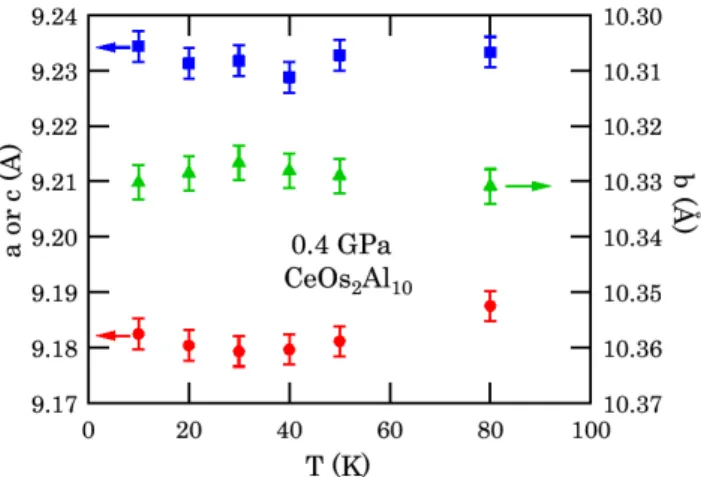
Fig. 3. Lattice parametera(circle, left axis),b (trian-gle, right axis), andc(square, left axis) at low temper-atures of CeOs2Al10belowPC.
Figure 3 shows the lattice parameters of CeOs2Al10at low temperatures below PC. There is no distinct
differ-ence aroundTN out of this experimental error attributed
990 Y. Kawamura et al.
3.2. Single crystal analysis
In order to evaluate the effect of cooling on lattice parameters for CeOs2Al10 and for CeRu2Al10, we per-formed single crystal X-ray structure refinement. The refinement parameters of CeRu2Al10 with R = 0.028, wR= 0.062, andS= 1.19are compatible to the previous
report withR= 0.043,wR= 0.123, andS= 1.10[13]. Table I shows the lattice parameter of CeRu2Al10 and CeOs2Al10 at 300 K and at 110 K. The aandc param-eters of CeOs2Al10 are longer than those of CeRu2Al10, while theb parameter of CeOs2Al10 is almost the same as that of CeRu2Al10. This small b parameter for CeOs2Al10 induces the large difference of B0 of b from that ofaand c. The differences of lattice parameters a, b, andcat 110 K from those at 300 K for CeRu2Al10are 0.23%, 0.12%, 0.21%, respectively. Those for CeOs2Al10 are 0.18%, 0.09%, 0.21%, respectively.
TABLE I Lattice parameters and Ce–Ce distance of CeRu2Al10
and that of CeOs2Al10. Estimated standard deviations
are given in parentheses.
CeRu2Al10 CeOs2Al10
300 K 110 K 300 K 110 K a[Å] 9.120(2) 9.099(3) 9.139(2) 9.123(3) b[Å] 10.268(2) 10.256(4) 10.267(3) 10.258(3) c[Å] 9.181(2) 9.162(3) 9.187(2) 9.168(3) Ce-Ce [Å] 5.247 5.237 5.271 5.261
Overall, the lattice parameters of CeRu2Al10are more sensitive to cooling than those of CeOs2Al10. This is the same tendency as the B0s of CeRu2Al10 are smaller than those of CeOs2Al10, where B0 means the hard-ness against pressure. The lattice parameters of b for CeRu2Al10 and CeOs2Al10 are insensitive to cooling. This tendency is consistent with the results that the lat-tice parameter ofbis insensitive to pressure compared to that ofaor c.
Next, we discuss the relation between lattice pa-rameters and physical properties. When CeRu2Al10 is compared to CeFe2Al10, the lattice parameter has an anisotropic contraction. We proposed that the shrinkage of lattice parameters aand c is related to the enhance-ment of the anisotropic c–f hybridization [11]. When CeRu2Al10 is compared to CeOs2Al10, the effect of c– f hybridization cannot be related to chemical pressure. Although thec–f hybridization of CeRu2Al10 is smaller than that of CeOs2Al10, the volume and the Ce–Ce dis-tance of CeRu2Al10are smaller than those of CeOs2Al10. On the other hand, the Ce–Ce distance decreases by 0.19% from 300 K to 110 K for both compounds, which indicates the effect of cooling is the same in these com-pounds. This study reveals that the comparison of tem-perature dependence of physical properties on CeRu2Al10 and that on CeOs2Al10is fruitful because Ce–Ce distance is essential factor for discussing c–f hybridization and magnetic ordering atTN.
4. Conclusions
We have investigated structure of CeRu2Al10 and CeOs2Al10 at low temperature and at high pressures. Powder X-ray diffraction does not show any hint of struc-tural change or modification atTN or PC at room
tem-perature. The structural analysis of the single crystal indicates that theb-axis of this crystal structure is insen-sitive not only to pressure but also to cooling and that the effect of cooling of Ce–Ce distance for CeRu2Al10 is the same as that for CeOs2Al10.
Acknowledgments
The synchrotron radiation experiments were carried out at BL-18C in KEK with the approval of the Photon Factory Program Advisory Committee (proposal Nos. 2013G501, 2015G512). This work was partially sup-ported by JSPS KAKENHI (grant Nos. 15K17687 and 23340092).
References
[1] V.M.T. Thiede, T. Ebel, W. Jeitschoko,
J. Mater. Chem. 8, 125 (1998).
[2] A.M. Strydom, Physica B404, 2981 (2009).
[3] T. Nishioka, Y. Kawamura, T. Takesaka, R. Kobayashi, H. Kato, M. Matsumura, K. Kodama, K. Matsubayashi, Y. Uwatoko, J. Phys. Soc. Jpn. 78, 123705 (2009).
[4] S. Kimura, T. Iizuka, H. Miyazaki, T. Hajiri, M. Mat-sunami, T. Mori, A. Irizawa, Y. Muro, J. Kajino, T. Takabatake, Phys. Rev. B84, 165125 (2011).
[5] S. Kimura, T. Iizuka, H. Miyazaki, A. Irizawa, Y. Muro, T. Takabatake, Phys. Rev. Lett. 106,
056404 (2011).
[6] J. Robert, J.M. Mignot, G. Andre, T. Nishioka, R. Kobayashi, M. Matsumura, H. Tanida, D. Tanaka, M. Sera, Phys. Rev. B82, 100404 (2010).
[7] D.D. Khalyavin, A.D. Hillier, D.T. Adroja, A.M. Strydom, P. Manuel, L.C. Chapon, P. Peratheepan, K. Knight, P. Deen, C. Ritter, Y. Muro, T. Takabatake, Phys. Rev. B 82, 100405
(2010).
[8] D.T. Adroja, A.D. Hillier, P.P. Deen, A.M. Stry-dom, Y. Muro, J. Kajino, W.A. Kockelmann, T. Tak-abatake, V.K. Anand, J.R. Stewart, J. Taylor,
Phys. Rev. B82, 104405 (2010).
[9] K. Umeo, T. Ohsuka, Y. Muro, J. Kajino, T. Taka-batake, J. Phys. Soc. Jpn. 80, 064709 (2011).
[10] F. Birch, Phys. Rev. 71, 809 (1947).
[11] Y. Kawamura, J. Hayashi, K. Takeda, C. Sekine, H. Tanida, M. Sera, T. Nishioka, J. Phys. Soc. Jpn. 85, 044601 (2016).
[12] D.T. Adroja, A.D. Hillier, Y. Muro, T. Takabatake, A.M. Strydom, A. Bhattacharyya, A.D. Aladin, J.W. Taylor, Phys. Scr. 88, 068505 (2013).