IN E NGLISH W ORD -I NTERNAL C LUSTERS
BY J APANESE L ISTENERS :
A C ASE FOR P HONETICALLY -D RIVEN L OANWORD
A DAPTATION
AKIKO TAKEMURA
ITSUEKAWAGOE
SHIGETOKAWAHARA
Kobe University, Graduate school of Humanities & Keio University Kyoto Sangyo University
Keio University
1 Background
1.1 Theoretical background
When a language borrows words from another language, these words usually undergo some changes;1 for example, the English word cat is borrowed as [kjatto] in Japanese. In this single example, we observe at least four changes: (1) the first consonant is borrowed as palatalized, (2) the low front vowel is converted to a back vowel, (3) the word-final [t] is borrowed as a geminate, and (4) an epenthetic vowel [o] is inserted at the end of the word. We will, following many previous studies, call this process “loanword adaptation”.
Accounting for why and how these changes occur in loanword adaptation has been a matter of extensive debate in phonological theorization. In this debate, there have been, to simplify a bit, three general types of theories: (i) a “phonological account” in which loanword adaptation occurs at an abstract phonological level, while abstracting away from non-contrastive phonetic details (LaCharité and Paradis, 2005, Paradis and LaCharité, 1997), (ii) a phonetic account in which changes observed in the process of adaptation are largely attributed to a matter of speech perception, or what we may call perceptual “phonetic approximation” (Peperkamp, 2005, Peperkamp and Dupoux, 2003, Takagi and Mann, 1994) and (iii) a mixed account in which both phonetic and phonological factors influence the pattens of loanword adaptation (Kenstowicz, 2007,
1We would like to thank the audience at ICPP 2011 at Kyoto and FAJL 7 at NINJAL/ICU, as well as the members of the Keio phonetics and phonology meeting group for their comments on this project. Our thanks to Natalie Dresher for proofreading this paper. Remaining errors are ours.
1
Kubozono, 2006, Silverman, 1992, Yip, 2006) (see Kang 2011 and Kang 2013 for recent overviews of these theories). This paper presents a novel case of the phonetically-driven adaptation, instantiating the case of (ii). Overall, the current study lends further support to the phonetic account of loanword adaption (ii), while also being compatible with the mixed account (iii). The empirical focus is on a gemination pattern (and lack thereof) that is observed when Japanese speakers borrow English words with word-internal consonant clusters.
1.2 Gemination in Japanese loanword adaptation
Among many changes that occur when Japanese speakers borrow English words, one prominent and often discussed phenomenon is the gemination of (word-final) consonants (Kubozono 2015 and many references cited therein). For example, the English word map is borrowed into Japanese as [map.pu], with gemination and concomitant epenthesis. (1) presents other examples of English word-final consonants being geminated in the process of loanword adaptation. (Here and throughout this paper, “.” indicates a syllable boundary.)
(1) Examples of word-final gemination in Japanese borrowed forms a. map → [map.pu]
b. set → [set.to] c. rack → [rak.ku]
When Japanese speakers borrow English words, gemination typically takes place word-finally, when a lax vowel is followed by a voiceless stop, as exemplified and schematized in (2). This gemination occurs very frequently, so long as the word-final consonants are voiceless stops.2 The gemination percentages reported in Shirai (2002) are almost 100% for voiceless stops at word-final position.
(2) map →[map.pu] CVC[-voice] →CVC.CV
Less well-studied is gemination pattern in word-internal position. At word-internal position, when a lax vowel is followed by a voiceless stop and another consonant, there are two possible outcomes, as illustrated in (3).
(3) Two possible outcomes regarding gemination in word-internal clusters a. chapter, accent → [cha.pu.taa], [a.ku.sen.to]
b. Chaplin, supplement → [chap.pu.rin], [sa.pu.ri.men.to]
The examples in (3a) and those in (3b) are almost identical string-wise, but the following consonants after the target voiceless stop differ. For chapter and accent, the word-medial stop consonants are followed by another stop or a fricative (i.e. an obstruent). In such cases, they are never adopted with gemination. On the other hand, as exemplified by Chaplin and supplement in (3b), when the word-medial stop consonants are followed by a liquid, they are borrowed either with gemination or without gemination; gemination is optional. (4) summarizes this observation.
2Voiced stops and fricatives geminate less often (Kubozono et al., 2008, Shirai, 2002). Our experiment focuses on voiceless stops only, but we will come back to this issue at the general discussion section.
We will henceforth refer to obstruent and obstruent strings like chapter and accent as “Obs-Obs type” and obstruent and liquid strings like Chaplin and supplement as “Obs-Liq type”.
(4) a. chapter, accent → Obstruent + Obstruent (Obs-Obs type) → No gemination
b. Chaplin, supplement → Obstruent + Liquid (Obs-Liq type) → Optional gemination More expanded lists are shown in (5) and (6). Our exhaustive search of loanwords in one of the Japanese accent dictionaries (Akinaga, 1981) shows that the observations reported above hold generally among the existing loanwords: when Obs-Obs words are borrowed into Japanese, no gemination occurs; while most of Obs-Liq type words are borrowed without gemination, some Obs-Liq type words are borrowed into Japanese with gemination.
(5) Examples of Obs-Obs type: No gemination
/pt/ chapter, captain, scripter, Baptist /kt/ doctor, tractor, victim, victory, factor /ps/ gypsy, rhapsody /ks/ accent, accident, boxer
/pk/ napkin /kS/ collection, attraction
/pS/ caption, reception /tk/ Atkinson (6) Examples of Obs-Liq type
a. No gemination b. With gemination
/pl/ supplement /pl/ Chaplin
/tl/ butler /tl/ settlement, cutlet, Hitler
/tr/ metronome, patriarch /tr/ mattress, buttress /kr/ lacrosse, secretary, nichrome, acrobat /kr/ buckram
/kl/ cyclamen /kl/ necklace, Jacklyn
Even though all the Obs-Liq type words in (6) share the same phonological environment (i.e. before a liquid), the outcome of loanword adaptation may differ from item to item. As far as we are aware, this is a new descriptive finding—there have been no previous studies on the geminability differences between word-internal pre-liquid stops and pre-obstruent stops (though see also Kubozono et al. 2013). Katayama (1998) analyzes Obs-Obs type of words in Optimality Theory (Prince and Smolensky, 2004), but does not discuss Obs-Liq type words. Kubozono et al. (2008) likewise present an Optimality-Thoretic analysis of consonant gemination in Japanese loanwords, but their analysis is limited to word-final consonants. Our paper is thus intended to explore the gemination pattern and the lack thereof in word-internal clusters.
To summarize the observation about the existing loanwords in Akinaga (1981) , there is a difference between the Obs-Obs type of words and the Obs-Liq type of words. The question addressed in this paper is where this difference comes from. Are these two types of sequences perceived differently by native Japanese listeners? Or do they differ structurally somehow, in such a way that a stop preceded by a liquid is phonologically more geminable? To address these questions, this paper: (i) first reports a perception experiment of nonce words to examine the productivity of the observed geminability difference (Experiment 1), (ii) reports another perception experiment with cross-spliced stimuli to examine the source of geminability differences (Experiment 2) and (iii) examines and describes the acoustic properties of the stimuli used in Experiment 1 (Section 4). Through these studies, we conclude that it is the phonetic quality of the first syllable in the Obs-Liq types of words that is responsible for the gemination percept.
2 Experiment 1
2.1 The question
The overall question that is addressed in this paper is, “Why is gemination inhibited before an obstruent, while gemination is possible before a liquid?” Building on the theoretical debate about loanword adaptation reviewed in section 1, we can entertain two possibilities: (i) the two types are perceptually different, as predicted by the phonetically-driven theory of loanword adaptation, or (ii) the two types are structurally different, as predicted by the phonology-driven theory. Before addressing these possibilities, the first experiment examined the productivity of the observed asymmetry by testing whether the asymmetry observed in the existing loanwords can be replicated with nonce English words.
2.2 Stimuli and procedure
To examine the productivity of the geminability difference between word-internal pre-obstruents stops and pre-liquid stops, beyond the patterns observed in the existing loanwords in Akinaga (1981), the experiment had two types of nonce words; e.g. /pepkin/ for the Obs-Obs type of stimuli and /peplin/ for the Obs-Liq type of stimuli. The stimuli used in Experiment 1 are shown in (7).
(7) Stimuli for Experiment 1
Obs-Obs type Obs-Liq type /pektin/, /pekter/ /peklin/, /pekler/ /pepkin/, /pepker/ /peplin/, /pepler/ /petkin/, /petker/ /petrin/, /petrer/
These stimuli were produced by a male native speaker of American English, and recorded in a soundproof room using Praat (Boersma and Weenink, 1999–2014). Japanese listeners listened to these two types of non-words, and chose the best written representation in Japanese of what they heard from four choices. (8) shows an example of the four responses, taking the set for /peplin/ as an example:
(8) Responses for a nonce word stimulus, /peplin/ a. pe.pu.rin (short-vowel)
b. pep.pu.rin (short-vowel with gemination) c. pee.pu.rin (long-vowel)
d. peep.pu.rin (long-vowel with gemination)
Forty native speakers of Japanese participated in this experiment. No explicit instructions were given about the purpose of the test. The stimuli were randomly presented to the participants and they heard each item three times.
2.3 Results
We obtained a total of 1440 responses (12 test words × 3 trials × 40 participants). The long-vowel responses occurred only 66 times, and therefore we eliminated them from our analysis.
The response (8d) with both gemination and vowel lengthening was particularly rare due to a phonotactic restriction against a super-heavy syllable in Japanese phonology (Kawagoe and Takemura, 2013, Kubozono, 1999, 2015).3 Also, there was one unanswered response, resulting in a total of 1373 short-vowel responses. We further removed the responses for the stimuli /pektin/ (n =118) since its transcription in Katakana competes with the established loanword [pe.ku.chin] (pectin).4 Therefore, the total number of data that entered into the final analysis was 1255.
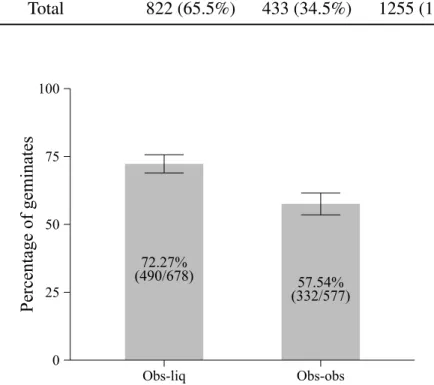
Table 1 and Figure 1 show the result of gemination percentages for the Obs-Obs type stimuli and the Obs-Liq type stimuli.
Table 1: Result of gemination responses in Experiment 1 Gemination No gemination Total Obs-Obs type (pepkin) 332 (57.5%) 245 (42.5%) 577 (100%)
Obs-Liq type (peplin) 490 (72.3%) 188 (27.7%) 678 (100%) Total 822 (65.5%) 433 (34.5%) 1255 (100%)
72.27%
57.54% (490/678)
(332/577)
0 25 50 75 100
Obs-liq Obs-obs
Percentage of geminates
Figure 1: Gemination percentages for the Obs-Obs stimuli versus the Obs-Liq stimuli in Experiment 1
The percentage of gemination on the Obs-Obs type stimuli is 57.5%, while for the Obs-Liq type stimuli, the percentage of gemination is 72.3%, and this difference is statistically significant (χ2(1) = 54.0, p < .001). In short, pre-liquid word-internal stops were perceived more as geminates than pre-obstruent stops.
3The occurrence of super-heavy syllables in Japanese is restricted to (1) morphologically complex native words such as [toot.ta] (the past tense form of [too.ru] ’pass’) and [koot.ta] (the past tense form of [koo.ru] ’freeze’) (Vance, 1987) and (2) loanwords such as [gu.raun.do] ’ground’ and compounds such as [ron.donk.ko] ’Londoners’ (Poser, 1990).
4Thanks to an anonymous FAJL abstract reviewer for pointing this out.
2.4 Discussion
Experiment 1 shows that more geminates are perceived in Obs-Liq type of words than in the Obs-Obs type of words. This result is compatible with the geminate occurrence tendency observed in the existing loanwords in Japanese, reviewed in section 1.
Although the overall patterns are as expected, there is nevertheless one complication: the result shows that even the Obs-Obs type of words observe more than 50% of geminate occurrence, which we would have not expected if the listeners purely followed the tendency observed in the established loanword data (no gemination occurs in obstruent-obstruent internal clusters in existing loanwords in Akinaga 1981). We unfortunately do not have a clear explanation of this difference between the experimental results and the existing loanword adaptation pattern. Nevertheless, the direction of the results is as expected: it is the Obs-Liq type of words that caused more geminate occurrence.
Setting aside this complication, the next question we address is where the perceptual difference between the two types of stimuli comes from. Does this difference come from the acoustic properties of the stimuli? Or are there phonological, structural differences between the two types of the stimuli?
3 Experiment 2
3.1 The question
Experiment 1 showed that the Obs-Liq type of nonce words were perceived with a geminate more than the Obs-Obs type of nonce words. This result replicates the same tendency observed in the existing loanwords but does not answer the question of whether gemination is perceived differently because of the acoustic differences or structural/phonological differences. Experiment 2 aims to tease apart these two possibilities.
3.2 Stimuli and procedure
Experiment 2 used the cross-spliced stimuli. The first syllables were cut off from /pepkin/ and /peplin/ and cross-spliced before /lin/ and /kin/, respectively. To illustrate this stimulus structure, we use the following notation, where the subscript shows the original phonetic context in which the first syllables occurred: /pepPreLiq-kin/ and /pepPreObs-lin/. In this design, /pepPreLiq-kin/ is phonologically Obs-Obs, but phonetically Obs-Liq at least in the first syllable containing the target consonant; /pepPreObs-lin/ is phonologically Obs-Liq, but phonetically Obs-Obs.
(9) The structure of cross-splicning
phonologically phonetically (the first syllable)
a. pepPreLiq-kin Obs-Obs Obs-Liq
b. pepPreObs-lin Obs-Liq Obs-Obs
As shown in (9), this cross-splicing design allows us to tease apart the phonetic and phonological accounts of loanword adaptation. The phonological account predicts more gemination in /pepPreObs-lin/ (the Obs-Liq stimuli), because it is the phonological sequence—a stop followed by a liquid—that triggers gemination, and the phonetic quality of the first syllable
should not matter. On the other hand, the phonetic account predicts that /pepPreLiq-kin/ (the Obs-Obs stimuli) would be perceived with gemination more often, because the phonetic quality of the pre-liquid syllable containing the target consonant—/pepPreLiq/—would be responsible for the perception of gemination.
The rest of the experimental procedure was identical to that of Experiment 1.
3.3 Results
We obtained a total of 1968 responses (12 stimuli × 4 repetitions × 41 participants = 1968). No long-vowel answers were observed in this experiment. We again eliminated the responses for the stimuli /pektin/ (41 participants × 4 repetitions = 164). As a result 1804 responses entered into our analysis.
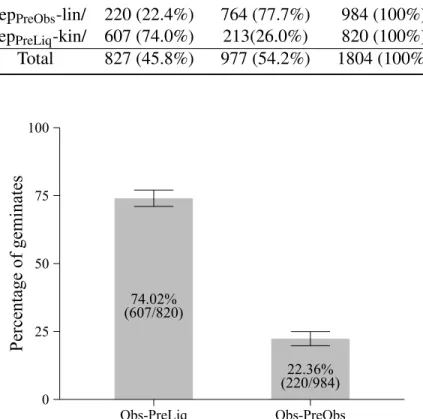
Table 2: Results of gemination responses for cross-spliced stimuli Gemination No gemination Total /pepPreObs-lin/ 220 (22.4%) 764 (77.7%) 984 (100%) /pepPreLiq-kin/ 607 (74.0%) 213(26.0%) 820 (100%) Total 827 (45.8%) 977 (54.2%) 1804 (100%)
74.02%
22.36% (607/820)
(220/984) 0
25 50 75 100
Obs-PreLiq Obs-PreObs
Percentage of geminates
Figure 2: Gemination percentages between the Obs-PreObs type versus the Obs-PreLiq type stimuli in Experiment 2
As Table 2 and Figure 2 show gemination is observed more in Obs-PreLiq stimuli, with a statistically significant difference (χ2(1) = 478.8, p < .001).
3.4 Discussion
Let us recall that the phonological account predicts that more gemination would be observed in /pepPreObs-lin/ (i.e. phonologically Obs-Liq stimuli) because under this account, the phonological
sequence of a stop followed by a liquid is a trigger for the stop to be perceived as geminate. On the other hand, the phonetic account predicts that /pepPreLiq-kin/ (phonologically Obs-Obs, but phonetically Obs-Liq) would be perceived with gemination more often, since the phonetic quality of /pepPreLiq/ is responsible for the perception of gemination. The results obtained in this experiment show that gemination is perceived more in /pepPreLiq-kin/, which thus supports the phonetic account.
4 Acoustic analysis
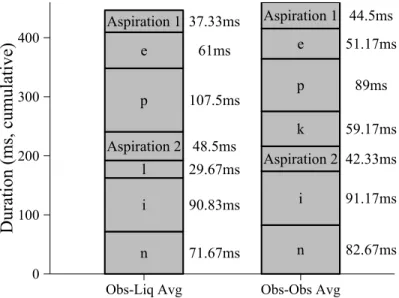
To summarize the results of both Experiments 1 and 2, the stimuli that contained a phonetic CVCPreLiqsyllable induced more geminate perception. The question that arises is what the crucial phonetic differences between CVCPreLiqand CVCPreObs are that cause these different gemination patterns. To address this question, we conducted an acoustic analysis. In order to explore what this phonetic property might be, we examined what phonetic differences exist in the initial CVC syllables between Obs-Obs type of words and Obs-Liq type of words. Figure 3 shows the average duration of the target consonant of gemination. Although the results are based on averages, example segments are written in Figure 3 to facilitate the understanding of the word structure. The left bar chart shows the average duration of each segment in Obs-Liq type words. The right bar chart indicates the average duration of each segment in Obs-Obs type words. “p” after “e” in Figure 3 indicates the target geminate consonant.
71.67ms 90.83ms 29.67ms 48.5ms 107.5ms
61ms 37.33ms
82.67ms 91.17ms 42.33ms 59.17ms 89ms 51.17ms
44.5ms
n i l Aspiration 2
p e Aspiration 1
n i Aspiration 2
k p e Aspiration 1
0 100 200 300 400
Obs-Liq Avg Obs-Obs Avg
Duration (ms, cumulative)
Figure 3: Duration of segmental intervals in the stimuli
The duration of target geminate consonants is longer before liquids (Avg=107.5ms, SD=12.65) than before stops (Avg=89ms, SD=22.89). Due to the small number of stimuli, these differences did not reach statistical significance (n.s., p= 0.10) (Mann–Whitney U test). Nevertheless we observe some interesting differences: the word-internal pre-liquid stops are longer with clear aspiration, whereas word-internal pre-obstruent stops are shorter without clear aspiration. Even though we cannot be conclusive because of the small number of stimuli, we suspect that the
longer duration of the target consonants in pre-liquid stops induced more gemination responses in both Experiments 1 and 2. The presence of aspiration may have promoted the percept of long consonants for pre-liquid stop, to the extent that the aspiration is parsed as belonging to the preceding consonant as well.5
5 Conclusions
This paper first identified a hitherto unnoticed difference in the gemination pattern of word-medial stops. Depending on the following context (i.e. obstruent or liquid), the outcome of gemination differed; gemination is more common when the target consonant is followed by a liquid than when followed by an obstruent. This difference was confirmed by the examination of existing loanword data. To account for this difference, we entertained two hypotheses: whether the occurrence of geminate is triggered by structural differences or phonetic differences.
Experiment 1 revealed that the consonant clusters in word-internal position patterned in ways that are expected from the patterns of existing loanwords: infrequent gemination in Obs-Obs type words and more frequent gemination in Obs-Liq type words. Experiment 2 directly addressed the question of whether the occurrence of geminate is triggered by its structure or its phonetic properties, using cross-spliced stimuli. It showed that the phonetic quality of the initial syllables dominates the pattern of geminate perception: infrequent gemination in Obs-Liq (CVCPreObs LVO) and more frequent gemination in Obs-Obs (CVCPreLiqOVO). Thus, this result supports the phonetic account of the gemination pattern.
To pin down the precise acoustic properties that caused geminate percept in Experiments 1 and 2, we analyzed the acoustic properties of stimuli (albeit in a preliminary way). The acoustic analysis reveals that the duration of the target consonants in Obs-Liq words are longer than those in Obs-Obs words. Also, the geminate perception may even be enhanced by the aspiration after the target consonant found in CVCLiq, although it is not clear whether aspiration indeed contributes to the percept of consonant gemination. It remains as our future work to see whether or not the presence of aspiration enhances the geminate perception. Also, more detailed acoustic analysis with large number of stimuli based on multiple speakers is warranted for a more robust statistical analysis.
Overall, taken together, it seems to be the case that sub-phonemic phonetic quality differences can affect the adaptation of loanwords, as predicted by the phonetically-driven theory of loanword adaptation (Peperkamp, 2005, Peperkamp and Dupoux, 2003, Takagi and Mann, 1994). It is not the case that consonant durations are contrastive in English, but sub-phonetic durational differences in different contexts can result in different adaptation strategies. This overall conclusion is in line with that of Kubozono et al. (2013) who explore the positional asymmetry of consonant gemination in Japanese loanwords and conclude that Japanese native listeners are sensitive to the phonetic differences between final and non-final coda consonants in the source words. Their results show that Japanese speakers are sensitive to fine phonetic details of the original English sounds, at least when it comes to loanword adaptation.
The current results do not exclude the phonologically-driven theory of loanword adaptation. In fact, when we look at the gemination pattern in loanword adaptation more broadly, some
5Japanese geminates do not show longer VOT than singletons (see Kawahara 2015 for a recent overview), and therefore, this may undermine the speculation here that aspiration would induce more geminate percepts. However, longer aspiration, we suspect, would not inhibit geminate percepts, either.
phonological factors—such as restrictions on certain types of geminates—are probably at play (Katayama, 1998, Kubozono, 2015, Kubozono et al., 2008, Shirai, 2002). Then, it may as well be after all that both phonetic and phonological factors influence loanword adaptation (Kenstowicz, 2007, Kubozono, 2006, Silverman, 1992, Yip, 2006). With this said, the phonological account may have trouble explaining the current finding, although we would like to remain non-conclusive, because it depends on many assumptions, some of which may be untenable. The reasoning goes as follows. CVOOVC and CVOLVC would be syllabified in English as CVO.OVC and CV.OLVC, respectively (modulo [tl]-sequence) (Selkirk, 1982).6 Katayama (1998) and Kitahara (1996) argue that loanword gemination in Japanese may occur to preserve “coda-ness” of the source language. This coda-ness preservation theory would predict more gemination in Obs-Obs types than in Obs-Liq types, given the syllabification patterns in English, contrary to what we found in our experiments. This argument against the phonological account of gemination is based on the assumption that Japanese speakers know how to syllabify word-internal clusters in English, the assumption that cannot be taken to be true without empirical evidence. This argument is also based on the coda-ness preservation theory, which is not the only phonological explanation of gemination (for an alternative, see e.g. Kubozono et al. 2008).
At any rate, at the very minimum, the current paper offers three new empirical findings: (i) in Japanese loanword adaptation patterns, there is a difference between geminablity of word-medial stops, depending on the quality of the following consonant, (ii) this difference is productive to the extent that it can be replicated using new nonce words (Experiment 1), and (iii) it is the phonetic quality of the first syllables that may be responsible for the geminability difference (Experiment 2). Overall, the results show that phonetic details should play some role in loanword adaptation, even if that may not be all there is to it in loanword adaptation pattern.
References
Akinaga, Kazue, ed. 1981. Meikai nihongo akusento jiten [Japanese accent dictionary], 2nd edition. Tokyo: Sanseido.
Boersma, Paul, and David Weenink. 1999–2014. Praat: Doing phonetics by computer. Software. Kang, Yoonjung. 2011. Loanword phonology. In The Blackwell companion to phonology, ed.
Marc van Oostendorp, Colin J. Ewen, Hume Elizabeth, and Keren Rice, 2258–2282. Oxford: Blackwell-Wiley.
Kang, Yoonjung. 2013. Loanwords. Oxford Bibliographies Online .
Katayama, Motoko. 1998. Optimality Theory and Japanese loanword phonology. Doctoral dissertation, University of California, Santa Cruz.
Kawagoe, Itsue, and Akiko Takemura. 2013. Geminate judgment of English-like words by Japanese native speakers: Differences in the borrowed forms of “stuff” and “tough”. Journal of East Asian Linguistics21:307–337.
Kawahara, Shigeto. 2015. The phonetics of sokuon, obstruent geminates. In The handbook of Japanese language and linguistics: Phonetics and phonology, ed. Haruo Kubozono. Mouton.
6The current experiment did not test internal [tl] clusters.
Kenstowicz, Michael. 2007. Salience and similarity in loanword adaptation: A case study from Fijian. Language Sciences 29:316–340.
Kitahara, Mafuyu. 1996. Consonant gemination and accent in Japanese loanwords. In Proceedings of Formal Approaches to Japanese Linguistics 2, ed. M. Koizumi, M. Oishi, and U. Sauerland. Cambridge: MITWPL.
Kubozono, Haruo. 1999. Mora and syllable. In The handbook of Japanese linguistics, ed. Natsuko Tsujimura, 31–61. Oxford: Blackwell.
Kubozono, Haruo. 2006. Where does loanword prosody come from?: A case study of Japanese loanword accent. Lingua 116:1140–1170.
Kubozono, Haruo. 2015. Loanword phonology. In The handbook of Japanese language and linguistics: Phonetics and phonology, ed. Haruo Kubozono. Mouton.
Kubozono, Haruo, Junko Ito, and Armin Mester. 2008. Consonant gemination in Japanese loanword phonology. In Current issues in unity and diversity of languages. Collection of papers selected from the 18th International Congress of Linguists, ed. The Linguistic Society of Korea, 953–973. Republic of Korea: Dongam Publishing Co.
Kubozono, Haruo, Hajime Takeyasu, and Mikio Giriko. 2013. On the positional aymmetry of consonant gemination in Japanese lownrods. Journal of East Asian Linguistics 21:339–371. LaCharité, Darlene, and Carole Paradis. 2005. Category preservation and proximity versus
phonetic approximation in loanword adaptation. Linguistic Inquiry 36:223–258.
Paradis, Carole, and Darlene LaCharité. 1997. Preservation and minimality in loanword adaptation. Journal of Linguistics33:379–430.
Peperkamp, Sharon. 2005. A psycholinguistic theory of loanword adaptation. In Proceedings of the 30th annual meeting of the Berkeley Linguistics Society, ed. M. Ettlinger, N. Fleischer, and M. Park-Doob, 341–352. Berkeley: Berkeley Linguistics Society.
Peperkamp, Sharon, and Emmanuel Dupoux. 2003. Reinterpreting loanword adaptation: The role of perception. Proceedings of ICPhS XV:367–370.
Poser, William. 1990. Evidence for foot structure in Japanese. Language 66:78–105.
Prince, Alan, and Paul Smolensky. 2004. Optimality Theory: Constraint interaction in generative grammar. Malden and Oxford: Blackwell.
Selkirk, Elisabeth. 1982. The syllable. In The structure of phonological representations, ed. Harry van der Hulst and Norval Smith, Vol. Part II. Dordrecht: Foris Publications.
Shirai, Setsuko. 2002. Gemination in loans from English to Japanese. MA thesis, University of Washington.
Silverman, Daniel. 1992. Multiple scansions in loanword phonology: Evidence from cantonese. Phonology9:289–328.
Takagi, Naoyuki, and Virginia Mann. 1994. A perceptual basis for the systematic phonological correspondences between Japanese loan words and their English source words. Journal of Phonetics22:343–356.
Vance, Timothy. 1987. An introduction to Japanese phonology. New York: SUNY Press.
Yip, Moira. 2006. The symbiosis between perception and grammar in loanword phonology. Lingua 116:950–975.