268 PART TWO International Trade Policy
Although high-technology industries probably produce extra social benefits because of the knowledge they generate, much of what goes on even in a high-technology industry has nothing to do with generating knowledge. There is no reason to subsidize the employment of capital or nontechnical workers in high-technology industries; on the other hand, innova tion and technological spillovers happen to some extent even in industries that are mostly not at all high-tech. A general principle is that trade and industrial policy should be targeted specifically on the activity in which the market failure occurs. Thus policy should seek to subsidize the generation 01 knowledge that firms cannot appropriate. A general subsidy for a set of industries in which this kind of knowledge generation is believed to go on is a pretty blunt instrument for the purpose.
Perhaps, instead, government should subsidize research and development wherever it occurs. The problem here is one of deinition. How do we know when a firm is engaged in creating knowledge? A loose definition could lend itself to abuse: Who is to say whether paper clips and company cars were really supporting the development of knowledge or were placed in the research department's budget to inflate the subsidy? A strict definition, on the other hand, would risk favoring large, bureaucratic forms of research where the allocation of funds can be strictly documented over the smaller, informal organizations that are widely believed to be the key to the most original thinking.
The United States does in efect subsidize research and development (R&D), at least as compared with other kinds of investment. Research and development can be claimed by firms as a current expense and thus counts as an immediate deduction against the corporate proit tax. By contrast, investment in plant and equipment cannot be claimed as an immedi ate expense and can be written of only through gradual depreciation. This efective favor able treatment for knowledge is an accident of tax history rather than an explicit policy, but we should note it before c�mcluding that the United States spends too little on R&D or that the high-technology sector needs further encouragement. To reach such a conclusion we would need to know how much subsidy is justified.
How Important Are Externalities? The question of the appropriate level of subsidy for high technology depends on the answer to a diicult empirical problem: How important, quantitatively, is the technological spillover argument for targeting high-technology industries? Is the optimal subsidy 10,20, or 100 percent? The honest answer is that no one has a good idea. It is in the nature of externalities, benefits that do not carry a market price, that they are hard to measure.
Further, even if the externalities generated by high-technology industries could be shown to be large, there may be only a limited incentive for any one country to support these industries. The reason is that many of the benefits of knowledge created in one country may in fact accrue to firms in other countries. Thus if, say, a Belgian m develops a new technique for making steel, most of the firms that can imitate this technique will be in other European countries, the United States, and Japan rather than in Belgium. A world government might find it worthwhile to subsidize this innovation; the Belgian govenment might not. Such problems of appropriability at the level of the nation (as opposed to the firm) are less severe but still important even for a nation as large as the United States.
Despite the criticism, the technological spillover argument is probably the best case one can make intellectually for an active industrial policy. In contrast to many simplistic criieria for choosing "desirable" industries, which can be strongly rejected, the case for or against targeting "knowledge-intensive" industries is ajudgment call.
Imperfect Competition and Strategic Trade Policy
During the 1980s a new argument for industrial targeting received substantial theoretical attention. Originally proposed by economists Barbara Spencer and James Brander of the
CHAPTER 1 1 Controversies in rade Policy 269
Don 'I poduce o
University of British Columbia, this argument locates the market failure that justiies goven ment intervention in the lack of perfect competition. In some industries, they point out, there are only a few irms in efective competition. Because of the small number of firms, the assumptions of perfect competition do not apply. In particular, there will typically be excess retuns; that is, firms will make proits above what equally risy investments elsewhere in the economy can eam. There will be an intenational competition over who gets these proits.
Spencer and Brander noticed that, in this case, it is possible in principle for a govenment to alter the rules of the game to shift these excess returns from foreign to domestic irms. In the simplest case, a subsidy to domestic irms, by deterring investment and production by foreign competitors, can raise the profits of domestic firms by more than the amount of the subsidy. Setting aside the effects on consumers-for example, when the firms are selling only in foreign markets-this capture of profits rom foreign competitors would mean the subsidy raises national income at other countries' expense.
The Brander-Spencer Analysis: An Example The Brander-Spencer analysis can be illustrated with a simple example in which there are only two firms competing, each from a diferent country. Bearing in mind that any resemblance to actual events may be coinci dental, let's call the firms Boeing and Airbus, and the countries the United States and Europe. Suppose there is a new product, 150-seat aircraft, that both [Ifms are capable of making. For simplicity, assume each firm can make only a yes/no decision: either to produce I50-seat aircraft or not.
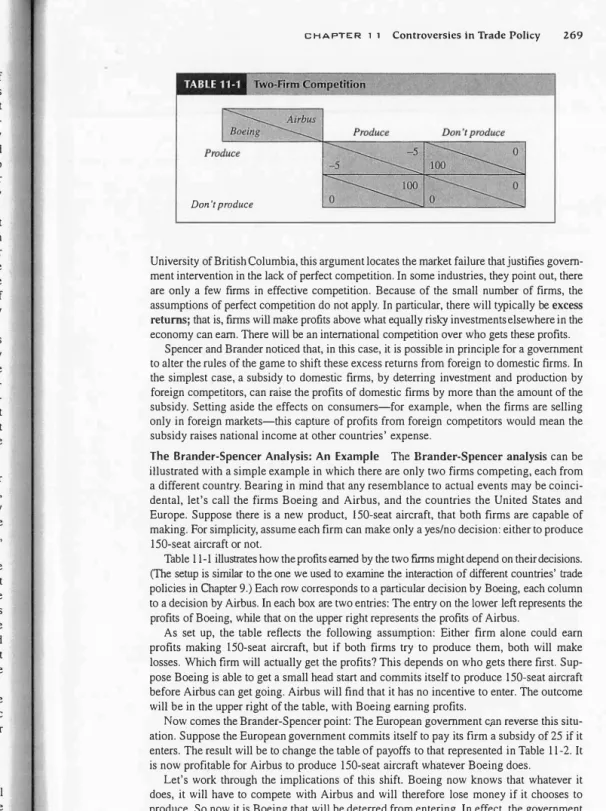
Table 11-1 illusrates how the proits nd by the two ms might depend on their decisions. (The setup is similar to the one we used to examine the interaction of diferent countries' rade policies in Chapter 9.) Each row corresponds to a particular decision by Boeing, each column to a decision by Airbus. In each box are two entries: The enry on the lower left represents the proits of Boeing, while that on the upper right represents the proits of Airbus.
As set up, the table reflects the following assumption: Either irm alone could earn proits making I50-seat aircraft, but if both firms try to produce them, both will make losses. Which [Ifm will actually get the profits? This depends on who gets there [St. Sup pose Boeing is able to get a small head start and commits itself to produce 150-seat aircraft before Airbus can get going. Airbus will ind that it has no incentive to enter. The outcome will be in the upper right of the table, with Boeing earning profits.
Now comes the Brander-Spencer point: The European govenment cln reverse this situ ation. Suppose the European government commits itself to pay its firm a subsidy of 25 if it enters. The result will be to change the table of payofs to that represented in Table 11-2. It is now profitable for Airbus to produce 150-seat aircraft whatever Boeing does.
Let's work through the implications of this shift. Boeing now knows that whatever it does, it will have to compete with Airbus and will therefore lose money if it chooses to produce. So now it is Boeing that will be deterred from entering. In efect, the government
270 PART TWO International Trade Policy
Don '( produce o
subsidy has removed the advantage of a head start that we assumed was Boeing's and has conferred it on Airbus instead.
The end result is that the equilibrium shifts from the upper right of Table 11-1 to the lower left of Table 11-2. Airbus ends up with profits of 125 instead of 0, proits that arise because of a govenment subsidy of only 25. That is, the subsidy raises profits by more than the amount of the subsidy itself, because of its deterrent efect on foreign competition. The subsidy has this efect because it creates an advantage for Airbus comparable with the strategic advantage it would have had if it, not Boeing, had had a head start in the industry. Problems with the Brander-Spencer Analysis This hypothetical example might seem to indicate that this strategic trade policy argument provides a compelling case for govern ment activism. A subsidy by the European govenment sharply raises profits of a European irm at the expense of its foreign rivals. Leaving aside the'interest of consumers, this seems clearly to raise European w�lfare (and reduce U.S. welfare). Shouldn't the U.S. goven ment put this argument into practice?
In fact, this strategic justiication for trade policy, while it has attracted much interest, has also received much criticism. Critics argue that to make practical use of the theory would require more information than is likely to be available, that such policies would risk foreign retaliation, and that in any case the domestic politics of trade and industrial policy would prevent use of such subtle analytical tools.
The problem of insuicient information has two aspects. The first is that even when looking at an industry in isolation, it may be diicult to fill in the entries in a table like Table 11-1 with any confidence. And if the government gets it wrong, a subsidy policy may turn out to be a costly misjudgment. To see this, suppose that instead of Table 11-1 the reality is represented by the seemingly similar payofs in Table 11-3. The numbers are
Don't produce
CHAPTER 1 1 Controversies in Trade Policy 271
Don't produce
not much diferent, but the diference is crucial. In Table 11-3, Boeing is assumed to have some underlying advantage-maybe a better technology-so that even if Airbus enters, Boeing will still find it proitable to produce. Airbus, however, cannot produce proitably if Boeing enters.
In the absence of a subsidy, the outcome in Table 11-3 will be in the upper right corner; Boeing produces and Airbus does not. Now suppose that, as in the previous case, the European govement provides a subsidy of 25, which is suicient to induce Airbus to produce. The new table of payofs is illustrated as Table 11-4. The result is that both frrms produce: The outcome is in the upper left. In this case Airbus, which receives a subsidy of 25, earns proits of only 5. That is, we have reversed the result above, in which a subsidy raised prof its by more than the amount of the subsidy. The reason for the diference in outcome is that this time the subsidy has failed to act as a deterrent to Boeing.
Initially the two cases look very similar, yet in one case a subsidy looks like a good idea, while in the other it looks like a terrible idea. It seems the desirability of strategic trade poli cies depends on an exact reading of the situation. This leads some economists to ask whether we are ever likely to have enough information to use the theory efectively.
The information requirement is complicated by the fact that we cannot consider indus tries in isolation. If one industry is subsidized, it will draw resources from other industries and lead to increases in their costs. Thus, even a policy that succeeds in giving U.S. irms a strategic advantage in one industry will tend to cause strategic disadvantage elsewhere. To ask whether the policy is justiied, the U.S. government needs to weigh these ofsetting efects. Even if the government has a precise understanding of one industry, this is not enough; it needs an equally precise understanding of those industries with which that industry competes for resources.
If a proposed strategic trade policy can overcome these criticisms, it still faces the prob lem of foreign retaliation, essentially the same problem faced when considering the use of a tarif to improve the terms of trade (Chapter 9). Strategic policies are beggar-thy-neighbor policies that increase our welfare at other countries' expense. These policies therefore risk a trade war that leaves everyone worse of. Few economists would advocate that the United States be the initiator of such policies. Instead, the most that is usually argued for is that the United States itself be prepared to retaliate when other countries appear to be using strate gic policies aggressively.
Finally, can theories like this ever be used in a political context? We discussed this issue in Chapter 9, where the reasons for skepticism were placed in the context of a political skeptic's case for free trade.
272 PART TWO International Trade Policy
•• ••
Case Study When the Chips Were UpDuring the years when arguments about the efectiveness of strategic trade policy were at their height, advocates of a more interventionist trade policy on the part of the United States often claimed that Japan had prospered by deliberately promoting key industries. By the early 1990s, one example in particular-that of semiconductor chips-had become Exhibit A in the case that promoting key industries "works." Indeed, when author James Fallows published a series of articles in 1994 attacking free trade ideology and alleging the superiority of Japanese-style interventionism, he began with a piece titled "The parable of the chips." By the end of the 1990s, however, the example of semi conductors had come to seem an object lesson in the pitfalls of activist trade policy.
A semiconductor chip is a small piece of silicon on which complex circuits have been etched. The industry began in the United States in 1971 when the U.S. m Intel intro duced the first microprocessor, the brains of a computer on a chip. Since then the indus try has experienced rapid yet peculiarly predictable technological change: Roughly every 18 months the number of circuits that can be etched on a chip doubles, a rule known as Moore's Law. This progress underlies much of the information technology revolution of the last three decades.
Japan broke into the semiconductor market in the late 1970s. The industry was dei nitely targeted by the Japanese government, which supported a research efort that helped build domestic technological capacity. The sums involved in this subsidy, however, were fairly small. The main component of Japan's activist trade policy, according to U.S. critics, was tacit protectionism. Although Japan had few formal tarifs or other barriers to imports, U.S. firms found that once Japan was able to manufacture a given type of semiconductor chip, few U.S. products were sold there. Critics alleged that there was a tacit understanding by Japanese firms in such industries as consumer electronics, in which Japan was already a leading producer, that they should buy domestic semiconduc tors, even if the price was higher or the quality lower than for competing U.S. products. Was this assertion true? The facts of the case are in dispute to this day.
Observers also alleged that the protected Japanese market-if that was what it was indirectly promoted Japan's ability to export semiconductors. The argument went like this: Semiconductor production is characterized by a steep learning curve (recall the dis cussion of dynamic scale economies in Chapter 6). Guaranteed a large domestic market, Japanese semiconductor producers were certain that they would be able to work their way down the leaming curve, which meant that they were willing to invest in new plants that could also produce for export.
It remains unclear to what extent these policies led to Japan's success in taking a large share of the semiconductor market. Some features of the Japanese industrial system may have given the country a "natural" comparative advantage in seiconductor produc tion, where quality control is a crucial concern. During the 1970s and 1980s Japanese factories developed a new approach to manufacturing based on, among other things, set ting acceptable levels of defects much lower than those that had been standard in the United States.
In any case, by the mid-1980s Japan had surpassed the United States in sales of one type of semiconductor, which was widely regarded as crucial to industry success: random access memories, or RAMs. The argument that RAM production was the key to dominating the whole semiconductor industry rested on the belief that it would
CHAPTER 1 1 Controversies in Trade Policy 273
yield both strong technological externalities and excess returns. RAMs were the largest-volume form of semiconductors; industry experts asserted that the know-how acquired in RAM production was essential to a nation's ability to keep up with advancing technology in other semiconductors, such as microprocessors. So it was widely predicted that Japan's dominance in RAMs would soon translate into domi nance in the production of semiconductors generally-and that this supremacy, in turn, would give Japan an advantage in the production of many other goods that used semiconductors.
It was also widely believed that although the manufacture of RAMs had not been a highly profitable business before 1990, it would eventually become an industry charac terized by excess retuns. The reason was that the number of fums producing RAMs had steadily fallen: In each successive generation of chips, some producers had exited the sector, with no new entrants. Eventually, many observers thought, there would be only two or three highly proitable RAM producers left. '
During the decade of the 1990s, however, both justifications for targeting RAMs technological externalities and excess returns-apparently failed to materialize. On one side, Japan's lead in RAMs ultimately did not translate into an advantage in other types of semiconductor: For example, American irms retained a secure lead in microprocessors. On the other side, instead of continuing to shrink, the number of RAM producers began to rise again, with the main new entrants from South Korea and other newly industrial izing economies. By the end of the 1990s, RAM production was regarded as a "com modity" business: Many people could make RAMs, and there was nothing especially strategic about the sector.
The important lesson seemed to be how hard it is to select industries to promote. The semiconductor industry appeared, on its face, to have all the attributes of a sector suitable for activist trade policy. But in the end it yielded neither strong externalities nor excess returns.
• •••
Globalization and Low-Wage Labor
It's a good bet that most of the clothing you are wearing as you read this came from a devel oping counry far poorer than the United States. The rise of manufactured exports from devel oping countries is one of the major shifts in the world economy over the last generation; even a desperately poor nation like Bangladesh, with a per-capita GDP less than 5 percent than that of the United States, now relies more on expots of manufactured goods than on exports of tra ditional agricultural or mineral products. (A government oficial in a developing country remarked to one of the authors, "We are not a banana republic-we are a pajama republic.") It should come as no surprise that the workers who produce manufactured goods for export in developing countries are paid very little by advanced-country standards-often less than $ 1 per hour, sometimes less than $0.50. After all, the workers have few good alter natives in such generally poor economies. Nor should it come as any surprise that the conditions of work are also very bad in many cases.
Should low wages and poor working conditions be a cause for concern? Many people think so. In the 1990s the anti-globalization movement attracted many adherents in advanced countries, especially on college campuses. Outrage over wages and working