Indirect reciprocity in three types of social dilemmas
1
Mitsuhiro Nakamura1,∗ and Hisashi Ohtsuki1
2
1Department of Evolutionary Studies of Biosystems,
3
The Graduate University for Advanced Studies (SOKENDAI),
4
Hayama, Kanagawa 240-0193, Japan
5
(Dated: March 19, 2014)
6
Abstract
Indirect reciprocity is a key mechanism for the evolution of human cooperation. Previous studies explored indirect reciprocity in the so-called donation game, a special class of Prisoner’s Dilemma (PD) with unilateral decision making. A more general class of social dilemma includes Snowdrift (SG), Stag Hunt (SH), and PD games, where two players perform actions simultaneously. In these simultaneous-move games, moral assessments need to be more complex; for example, how should we evaluate defection against an ill-reputed, but now cooperative, player? We examined indirect reciprocity in the three social dilemmas and identified twelve successful social norms for moral assessments. These successful norms have different principles in different dilemmas for suppressing cheaters. To suppress defectors, any defection against good players is prohibited in SG and PD, whereas defection against good players may be allowed in SH. To suppress unconditional cooper- ators, who help anyone and thereby indirectly contribute to jeopardizing indirect reciprocity, we found two mechanisms: indiscrimination between actions towards bad players (feasible in SG and PD) or punishment for cooperation with bad players (effective in any social dilemma). Moreover, we discovered that social norms that unfairly favour reciprocators enhance robustness of coopera- tion in SH, whereby reciprocators never lose their good reputation.
Keywords: evolutionary game theory; indirect reciprocity; Prisoner’s Dilemma game; Snowdrift game; Stag
7
Hunt game
8
∗ Author for correspondence: [email protected]
I. INTRODUCTION
9
In everyday life, your social image influences what you obtain. Helping someone raises
10
your reputation in your community and others help you later when required. This is called
11
indirect reciprocity, a key mechanism for explaining the evolution of cooperative behav-
12
ior among unrelated individuals [1–3]. Indirect reciprocity based on reputation has been
13
extensively investigated for decades through numerous theoretical studies [4–23] and exper-
14
imental tests [24–31]. The global success of humans in the past was partially dependent on
15
the establishment of indirect reciprocity, as it was used to explore for more suitable part-
16
ners for effective economic exchange instead of maintaining closed transactions in inefficient
17
relationships [4, 32].
18
One important feature of indirect reciprocity is that it endogenously provides an incentive
19
for actors to reward or punish other community members, which is achieved by controlling
20
the actors’ reputations that lead to the future rewards or punishments for the actors them-
21
selves. We can imagine numerous possibilities of rules to control the reputation of actors
22
that behave differently in various social contexts; such rules are called social norms [4, 10].
23
Some promising norms can stabilize cooperation in indirect reciprocity, but others cannot.
24
Previous studies have systematically obtained successful social norms in Prisoner’s Dilemma
25
scenarios when the reputation information is well-shared in a population [10, 11], when it
26
belongs to each individual [9], with the presence of costly punishment [13], with incom-
27
plete reputation information [19], with multiple reputation states [22], and with group-level
28
reputations [21].
29
Most of the previous studies have investigated social norms for the so-called donation
30
game, a variant of Prisoner’s Dilemma with unilateral decision making [33]. In the dona-
31
tion game, two individuals called donor and recipient participate in and only the donor
32
can decide whether or not to help the recipient, i.e., whether to benefit the recipient by
33
making an investment. Because the donation game focuses on the unilateral behavior of a
34
donor, it ignores many aspects that exist in reality. One such aspect is that the donation
35
game is merely an instance of various social dilemmas. Reputation systems would also play
36
an important role in various simultaneous-move games such as Snowdrift, Stag Hunt, and
37
general Prisoner’s Dilemma games. In these games, social norms may depend not only on
38
an actor’s choice but also on his/her co-player’s choice. For example, how should we define
39
goodness when an actor defects against a bad co-player that unexpectedly cooperates with
40
the actor? Should the actor’s defection be justified, even if the co-player shows reformation?
41
Moreover, individuals could infer that a focal player’s reputation should be bad when the
42
player received punishment from another player who had established a high reputaion. Can
43
such possibility be stable in evolutionry scenarios? To the best of our knowledge, although
44
two previous studies have investigated games other than the donation game, they have not
45
done so exhaustively and not clarified the general characteristics of social norms for the
46
simultaneous-move games [4, 18].
47
The present study is directed towards completely exploring reputation systems in
48
simultaneous-move games that comprise more extensive social situations than those in
49
the donation game. We discover that diverse social norms stabilize reciprocation and realize
50
cooperative and stable populations. These successful social norms vary for different types
51
of social dilemmas. To suppress cheating in Prisoner’s Dilemma and Snowdrift games, these
52
norms have a common characteristic such that defection against good players is regarded as
53
bad irrespective of the co-player’s action. However, in the Stag Hunt game, defection against
54
good players may be allowed, whereas social norms that unfairly favour reciprocators are
55
required to achieve robustness of reciprocation; under these norms, reciprocators never lose
56
their good reputation. It is also imperative to punish unconditional cooperators that help
57
anyone, because they blindly support cheaters [7,8]. There are two mechanisms to restrain
58
unconditional cooperation. One method is to avoid distinguishing between cooperation and
59
defection towards bad players, in which case unconditional cooperators pay an extra cost of
60
helping bad players while reciprocators do not. The other method is to regard cooperation
61
with a bad player as a bad deed, in which case unconditional cooperators are explicitly
62
punished. We discover that the former mechanism is feasible in Prisoner’s Dilemma and
63
Snowdrift games, whereas the latter works for all three social dilemmas.
64
II. MODEL
65
We consider a large, well-mixed population in which players from time to time play a
66
symmetric two-player simultaneous-move game. In a one-shot game, two players are sampled
67
from the population in a uniform random manner. Each player selects an action, which is
68
either cooperation (C) or defection (D). There are four possible outcomes of the game for
69
a player: both players select C (the outcome is called reward; R), the focal player selects C
70
and his/her co-player selects D (sucker; S), the focal player selects D and his/her co-player
71
selects C (temptation; T), and both players select D (punishment; P). The payoff matrix of
72
the game is given by
73
C D
C 1 S
D T 0
, (1)
where the payoff of the focal player is 1, S, T , or 0 when the outcome is R, S, T, or P,
74
respectively. Figure 1 illustrates the outcomes of competitions (e.g., replicator dynamics)
75
between cooperators and defectors for the three types of social dilemmas contained in the
76
payoff matrix (1) [33–35]. In a two-dimensional payoff space, the region defined by T > 1 >
77
S > 0 yields a Snowdrift game (SG) that has one stable internal equilibrium at which the
78
fraction S/(S + T − 1) of players are cooperators and the rest are defectors. The region
79
T > 1 > 0 > S yields a Prisoner’s Dilemma game (PD) that has a unique stable equilibrium
80
at which defectors dominate the population. It should be noted that the donation game,
81
where the sum of the payoffs of outcomes S (one-sidedly paying cost of helping) and T (one-
82
sidedly enjoying benefit of being helped) is always equal to the payoff of outcome R (both
83
paying cost and enjoying benefit), is projected onto a half-line S + T = 1 (T > 1) in the
84
payoff space (solid red line in Fig. 1); the PD game defined here is more general than the
85
donation game. The region 1 > T > 0 > S yields a Stag Hunt game (SH) that has two pure
86
stable equilibria at which cooperators and defectors each dominate the population. Because
87
there is no dilemma when 1 > T > 0 and 1 > S > 0, we do not study this trivial region.
88
We employ a binary reputation model in which reputation states are either good (G) or
89
bad (B) (e.g., Ref. [6]; see Refs. [33, 36, 37]). In a one-shot game, each of the two players
90
selects an action (i.e., C or D), which is a response to each co-player’s reputation (i.e., G or
91
B). A rule that specifies when to use which action is called an action rule, and it is denoted
92
by a. There are four possible action rules. A reciprocator cooperates with a good co-player
93
and defects against a bad co-player, i.e., a(G) = C and a(B) = D. An unconditional
94
cooperator always cooperates (a(G) = a(B) = C) while an unconditional defector always
95
defects (a(G) = a(B) = D). A ‘contrary’ player cooperates with a bad co-player and defects
96
against a good co-player (a(G) = D and a(B) = C). Hereafter, we denote reciprocators,
97
unconditional cooperators, unconditional defectors, and contrary players by CD, CC, DD,
98
and DC, respectively.
99
After a one-shot game, each participant of the game receives a new reputation that is
100
determined by a social norm according to the outcome of the game (R, S, T, or P) and each
101
co-player’s reputation (G or B). Note that in our model, every member in a population has
102
the same opinion about a player’s reputation, which is attained through public information
103
sharing [11,36,37]. TableIshows an example of a social norm under which a player receives
104
a bad reputation only when he/she plays with a good co-player and the outcome is T or
105
P, i.e., whenever the player selects defection against a good co-player. This social norm
106
was called simple standing in previous studies [12]. Because a social norm is specified by
107
inserting G or B into the eight placeholders in a 4 × 2 table, there are 24×2 = 256 possible
108
norms.
109
We introduce errors in assessments with which a player is assigned an opposite reputation;
110
if a player is assessed as good (bad), with a small probability µ, the player receives a
111
bad (good) reputation [9, 10]. The models of indirect reciprocity generally consider errors
112
not only in observers’ assessments but also in players’ taking actions [38]. Nevertheless,
113
because the difference between the two kinds of errors usually does not change the reuslts
114
qualitatively when assuming public information sharing (see, e.g., Refs. [13, 20]), we only
115
introduce errors in assessments.
116
III. METHODS
117
Our aim is to obtain desirable social norms that achieve cooperative and stable popula-
118
tions of reciprocators in different social dilemmas. To do so, we verify whether each candidate
119
of the 256 social norms satisfies the following criteria in each of three social dilemmas, SG,
120
PD, and SH.
121
Goodness: The population of reciprocators develops mutual cooperation except for defec-
122
tion caused by assessment errors.
123
Stability: The population of reciprocators is stable against any invasion by rare mutants
124
(either CC, DD, or DC players).
125
Because the population of unconditional cooperators is stable in SH (see Fig. 1), one might
126
wonder why we bother to need reciprocators and reputation systems to maintain cooperation.
127
One reason could be that reciprocators enhance robustness of cooperation. Therefore, for
128
SH, we additionally check the following criterion.
129
Usefulness: The population of reciprocators is more robust against an invasion by uncon-
130
ditional defectors than that of unconditional cooperators.
131
We extend the standard methods for indirect reciprocity in the donation game regime
132
(see, e.g., Refs. [10, 19, 21]) to consider the simultaneous-move games, and introduce the
133
above three criteria. Table II summarizes the definitions of symbols used in this section.
134
A. Goodness
135
Consider a population in which all players adopt a unique action rule denoted by a. After
136
repeating the random matching games sufficiently many times, the population reaches an
137
equilibrium in which the fraction of players that have good reputations, denoted by p(G),
138
satisfies
139
p(G) = X
rfocal∈{G,B}
X
rco∈{G,B}
p(rfocal)p(rco)φ(g(a(rco), a(rfocal)), rco). (2) The right-hand side of Eq. (2) averages the probability with which a player receives a good
140
reputation, φ(g(a(rco), a(rfocal)), rco), when the player and his/her co-player have reputations
141
rfocal and rco, respectively. In Eq. (2), g(a(rco), a(rfocal)) represents the outcome of the game
142
when the focal player and his/her co-player select actions a(rco) and a(rfocal), respectively.
143
Since the assessments involve errors that occur with probability µ, φ(·, ·) is either 1 − µ or
144
µ. p(B) (= 1 − p(G)) represents the fraction of bad players. By solving Eq. (2), we obtain
145
p(G) =
B −√B2− 4AC
2A (A 6= 0)
C
B (A = 0),
(3)
where
A = φ(g(a(G), a(G)), G) + φ(g(a(B), a(B)), B)
− φ(g(a(B), a(G)), B) − φ(g(a(G), a(B)), G), (4a) B = 1 + 2φ(g(a(B), a(B)), B)
− φ(g(a(B), a(G)), B) − φ(g(a(G), a(B)), G), (4b)
and
C = φ(g(a(B), a(B)), B). (4c)
We are interested in whether a homogeneous population of reciprocators achieves coop-
146
eration. In a population of reciprocators (i.e., CD players), the frequency of cooperation
147
clearly equals the fraction of good players. Therefore, under a social norm, we expand the
148
obtained p(G) by µ, and when
149
p(G) = 1 − O(µ), (5)
we regard the social norm as satisfying the criterion of goodness.
150
B. Stability
151
The expected payoff of a resident player in a homogeneous population of players adopting
152
an action rule a is given by
153
f (a|a) =X Xp(rfocal)p(rco)ψ(g(a(rco), a(rfocal))), (6) where ψ(g(a(rco), a(rfocal))) determines a player’s payoff for each outcome of the game, i.e.,
154
g(a(rco), a(rfocal)). Hereafter, we omit the ranges of the summations over rfocal and rco.
155
We next consider that an infinitesimal fraction of mutant players adopting another action
156
rule b (6= a) invade the population. The fraction of mutants that have good reputations
157
satisfies
158
q(G) =X Xq(rfocal)p(rco)φ(g(b(rco), a(rfocal)), rco). (7) Equation (7) yields
159
q(G) = δ − (δ − γ)p(G)
1 + δ − β − (α + δ − β − γ)p(G), (8)
where
α = φ(g(b(G), a(G)), G), (9a)
β = φ(g(b(B), a(G)), B), (9b)
γ = φ(g(b(G), a(B)), G), (9c)
and
δ = φ(g(b(B), a(B)), B). (9d)
The expected payoff of a mutant player is given by
160
f (b|a) =X Xq(rfocal)p(rco)ψ(g(b(rco), a(rfocal))). (10) We define that the population of players adopting an action rule a is stable in a region
161
of the payoff space (i.e., SG, PD, or SH) if it satisfies
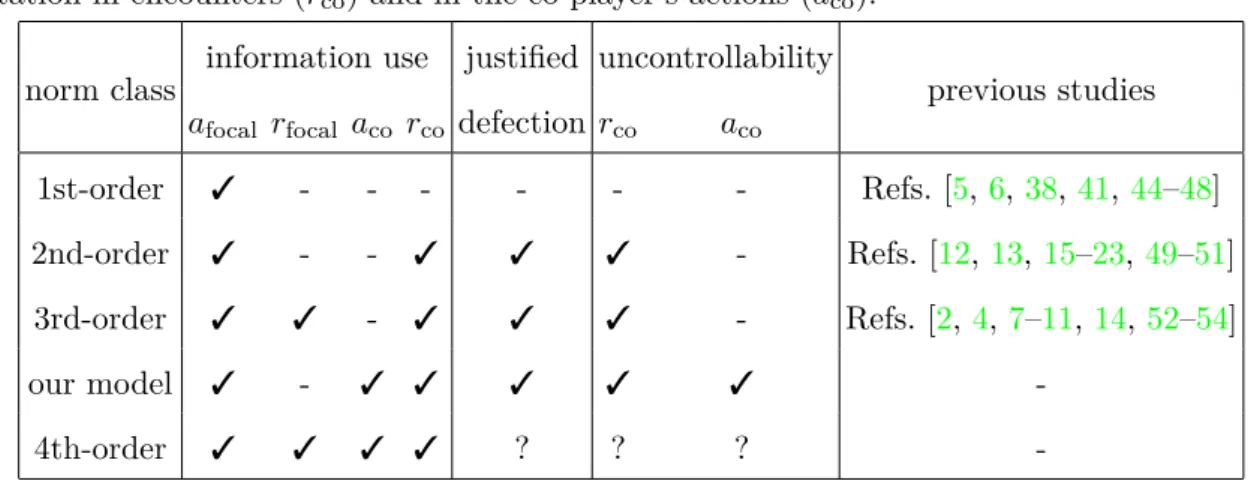
162
∆f ≡ f(b|a) − f(a|a) < 0 ∀b 6= a (11)
in all the area of the focused region. ∆f is a function of µ and thus, it can be expanded as
163
∆f = d0+ µd1 + O(µ2), (12)
where dk represents the series coefficient of k-th order when expanded by µ. Because ∆f is
164
indeed at most of O(µ) when the population satisfies the goodness criterion, we only need
165
to check at most d1. We consider that ∆f < 0 if
166
d0 < 0 (d0 6= 0)
d1 < 0 (d0 = 0 and d1 6= 0)
(13)
holds true.
167
C. Usefulness
168
Because a homogeneous population of unconditional cooperators (i.e., CC players) is
169
stable in SH, even when a social norm satisfies the stability criterion, it is worse to adopt
170
the CD action rule if the basin of attraction of CD players in competition with DD players
171
is narrower than that of CC players. To examine this point, after detecting the social
172
norms that satisfy the criteria of goodness and stability in SH, we numerically compare the
173
basins of attraction of CC and CD players when they compete with DD players under those
174
candidates. We select only the norms whereby CD players have larger basins of attraction
175
than that of CC players in all the area of SH.
176
Here we consider a population that consists of players adopting either two action rules denoted by a and b. We denote by x the fraction of a-players; the fraction 1 − x are b-players. We also denote by p(G) and q(G) the fractions of good players within a- and b- players, respectively. Note that the fraction of good players in the entire population equals
xp(G) + (1 − x)q(G). p(G) and q(G) are governed by the following time evolution:
˙p(G) = −p(G) + xX Xp(rfocal)p(rco)φ(g(a(rco), a(rfocal)), rco)
+ (1 − x)X Xp(rfocal)q(rco)φ(g(a(rco), b(rfocal)), rco), (14a) and
˙q(G) = −q(G) + xX Xq(rfocal)p(rco)φ(g(b(rco), a(rfocal)), rco)
+ (1 − x)X Xq(rfocal)q(rco)φ(g(b(rco), b(rfocal)), rco). (14b) We numerically solve ˙p(G) = ˙q(G) = 0 in Eq. (14) and obtain the equilibrium values of p(G) and q(G) that satisfy Tr J < 0 and det J > 0, where J is the Jacobian matrix of Eq. (14). Using them, the expected payoffs of a- and b-players, which depend on x, are given by
f (a|x) = xX Xp(rfocal)p(rco)ψ(g(a(rco), a(rfocal)))
+ (1 − x)X Xp(rfocal)q(rco)ψ(g(a(rco), b(rfocal))), (15a) and
f (b|x) = xX Xq(rfocal)p(rco)ψ(g(b(rco), a(rfocal)))
+ (1 − x)X Xq(rfocal)q(rco)ψ(g(b(rco), b(rfocal))), (15b) respectively.
177
When the competition between a- and b-players is bistable, the basin of attraction of
178
a-players is given by 1 − x∗a, where x∗a is the critical fraction of a-players at which f (a|x∗a) =
179
f (b|x∗a) holds true. Because the competitions between CC or CD players and DD players
180
are indeed bistable in SH, to compare the basins, we only need to compare x∗CC and x∗CD
181
under each social norm. In case of the competition between CC and DD players, we easily
182
obtain x∗CC = S/(S + T − 1). In case of the competition between CD and DD players, we
183
fix a(G) = C, a(B) = D, and b(G) = b(B) = D for Eqs. (14) and (15), set µ = 0.01 or 0.1,
184
and identify x∗CD using the bisection method [39]. For each social norm, we check whether
185
x∗CD < x∗CC holds true for all the payoff configurations (T, S) ∈ {ǫ, 2ǫ, . . . , 1 − ǫ} × {−(1 −
186
ǫ), −(1 − 2ǫ), . . . , −ǫ}, where we set ǫ = 0.05.
187
After the above numerical examination, in Appendix A, we analytically verified whether
188
the obtained norms (shown in Fig. 2(e)) satisfy the usefulness criterion.
189
IV. RESULTS
190
We found that, among the 256 candidates, twelve social norms shown in Fig. 2satisfy the
191
goodness, stability, and/or usefulness criteria for at least one of SG, PD, and SH. Among
192
these twelve norms, eight satisfy the two criteria defined for SG and PD (Fig. 2(a, b1, b2))
193
and six satisfy the three criteria defined for SH (Fig 2(b1, d1, d2)). The accurate conditions
194
for the stability of reciprocators are listed in Appendix B.
195
A. Snowdrift and Prisoner’s Dilemma games
196
The four social norms shown in Fig. 2(a) satisfy the two criteria for SG and PD. A
197
sufficient condition for the stability of reciprocators under these norms is given by T > 1.
198
In these four norms, the assessments of an action towards a good co-player do not depend
199
on the co-player’s action; cooperation with a good co-player is always regarded as good and
200
defection against a good co-player is always regarded as bad. When a player encounters
201
a bad co-player that selects cooperation (i.e., outcome R or T), any action performed by
202
the focal player is regarded as good. When a player encounters a bad co-player that selects
203
defection (i.e., outcome S or P), the assessment varies among the four norms.
204
The four social norms shown in Fig. 2(b1,2) also satisfy the two criteria for SG and
205
PD. The condition for the stability of reciprocators under these four norms is given by
206
S < T . These four norms are different from those shown in Fig.2(a) with regard to only the
207
assessment such that mutual cooperation (i.e., outcome R) with a bad co-player is regarded
208
as bad.
209
Figure2(c) extracts the common features of the eight norms in Fig.2(a, b1, b2) that are
210
successful in SG and PD. These norms claim that cooperation (i.e., outcomes R and S) and
211
defection (i.e., outcomes T and P) towards good players should be regarded as good and
212
bad, respectively, while one-sided defection (i.e., outcome T) against bad players should be
213
regarded as good.
214
B. Stag Hunt game
215
The four social norms shown in Fig.2(d1,2) as well as those shown in Fig.2(b1) satisfy the
216
three criteria for SH. It should be noted that in SH, the four norms shown in Fig. 2(b1,2)
217
satisfy the goodness and stability criteria; however, only those in Fig. 2(b1) satisfy the
218
usefulness criterion. A sufficient condition for the stability of reciprocators under the four
219
norms in Fig. 2(d1,2) is given by S < T < 3/2, whereas the corresponding condition under
220
the two norms in Fig.2(b1) is given by S < T . The four norms in Fig. 2(d1,2) are different
221
from those in Fig.2(b1) with respect to the assessments such that either one-sided or mutual
222
defection (i.e., outcome T or P) against a good co-player is regarded as good.
223
Figure2(e) extracts the common features of the six norms shown in Fig.2(b1, d1, d2) that
224
are successful in SH. These norms require that cooperation (i.e., outcomes R and S) with
225
a good player and defection (i.e., outcomes T and P) against a bad player are regarded as
226
good, i.e., reciprocation should always be regarded as good. In addition, mutual cooperation
227
(i.e., outcome R) with a bad player is regarded as bad.
228
V. INTUITIONS
229
From the twelve social norms obtained, we discovered that reputation systems are based
230
on different mechanisms to maintain indirect reciprocity. In this section, we provide ex-
231
planations for how a homogeneous population of reciprocators (i.e., CD players) prevents
232
invasions by mutants that adopt the DD or DC action rules (Sec. V A) and the CC action
233
rule (Sec. V B).
234
A. Universality and an exception for excluding unconditional defectors and con-
235
trary players
236
Let us consider an invasion event in an error-free limit (i.e., µ → 0) under any successful
237
social norm. Here, most players (residents) adopt the CD action rule and an infinitesimal
238
fraction of players (mutants) adopt the DD or DC action rule. Because the social norm
239
satisfies the goodness criterion, most residents have good reputations, whereas we assume
240
that mutants have good and bad reputations with probabilities q(G) and q(B), respectively.
241
In this population, a mutant is likely to play a game with a good CD resident. In the game,
242
the DD or DC mutant selects defection because the resident is of a good reputation, whereas
243
the CD resident selects cooperation or defection depending on the mutant’s reputation.
244
Therefore, the outcome for the mutant is T (one-sided defection) when his/her reputation
245
is good, and P (mutual defection) when his/her reputation is bad. The expected payoff of
246
the mutant is q(G) · T + q(B) · 0 = q(G)T , and that of the resident is clearly 1. The payoff
247
difference is thus ∆f = q(G)T − 1. The condition for stability against an invasion by the
248
mutants is ∆f < 0, which is rewritten as
249
q(G) < 1
T. (16)
From Eq. (16), we see that there are two cases in which the mutants are suppressed. In one
250
case, q(G) is sufficiently small, i.e., the reputation of mutants is effectively damaged. This
251
policy is employed by the social norms in Fig.2(c) that stabilize CD players in SG and PD.
252
They have a universal principle as per which, when a player plays with a good co-player,
253
cooperation (i.e., outcome R or S) and defection (i.e., outcome T or P) are regarded as good
254
and bad, respectively. Because of this principle, once a DD or DC mutant appears in the
255
population, he/she repeatedly encounters good players, selects defection, and receives bad
256
reputations. Intuitively, because the temptation of defection is considerably strong in SG
257
and PD (i.e., T > 1), defection against a good player should be accused.
258
In the other case, T is smaller than 1 and the inequality (16) is satisfied by any value of
259
q(G). This is naturally met in SH and some of the social norms shown in Fig.2(e) disregard
260
the reputation of defection against a good co-player (i.e., outcome T or P). Intuitively
261
speaking, because defection against cooperation is simply irrational (i.e., T < 1) in SH,
262
there is no requirement to damage the reputations of unconditional defectors or contrary
263
players as punishment. However, to satisfy the usefulness criterion in SH, the reputation of
264
these mutants should be slightly damaged (see Appendix C); thus, the norms in Fig. 2(e)
265
have at least one pivot that assigns a bad reputation to defection, either one-sided or mutual
266
(i.e., outcome T or P), against good players (see the ‘†’-ed pivots in Fig. 2(e)).
267
B. Diversity for excluding unconditional cooperators
268
In contrast, imagine that rare CC players invade a population of CD players. A CC mu-
269
tant is likely to encounter a good CD resident and always select cooperation. The expected
270
payoff of the mutant is q(G) · 1 + q(B) · S = q(G) + q(B)S, and that of the resident is 1. The
271
payoff difference is thus ∆f = [q(G) + q(B)S] − 1 = −q(B)(1 − S). Because S < 1 holds true
272
in all three social dilemmas, the condition for stability against an invasion by CC mutants,
273
∆f < 0, is
274
q(B) > 0 (17)
in the error-free limit (i.e., µ → 0). Equation (17) implies that a small yet non-erroneous re-
275
duction of reputation suffices to suppress unconditional cooperators. However, by observing
276
Fig. 2, it is evident that unconditional cooperators in most cases receive good reputations
277
because selecting cooperation (i.e., outcomes R and S) when one plays with a good co-player
278
is always regarded as good under those norms. Since both CD and CC players generally have
279
good reputations, the payoff difference between them is yielded by their different behaviors
280
when they encounter rare bad players, who have erroneously received bad reputations.
281
In the four social norms shown in Fig. 2(a), when a CD or a CC player (both have good
282
reputations) encounters a bad CD co-player, each selects defection and cooperation, while
283
the CD co-player selects cooperation. As a result, both the focal CD and CC players receive
284
good reputations. The payoff difference under these norms is, therefore, approximated by
285
∆f ∝ 1 − T, (18)
which yields the sufficient condition (shown before) for the stability of CD players against
286
an invasion by CC mutants, i.e., T > 1. During the above game sequence, the CD and
287
CC players experience outcomes T and R, respectively, whereas their resultant reputations
288
remain the same. Intuitively, if the temptation for defection is sufficiently large (i.e., if
289
T > 1) and an actor’s behavior towards a bad player does not influence his/her reputation,
290
defection is more rational than cooperation. This mechanism is feasible only in SG and PD.
291
In the eight social norms shown in Fig. 2(b1, b2, d1, d2), the adopted mechanism is
292
different. When a focal (good) CD player encounters a bad CD co-player, he/she selects
293
defection, whereas the co-player selects cooperation. As a result, the focal player maintains
294
a good reputation. In the next round, the focal CD player encounters another good CD
295
co-player, and mutual cooperation is achieved. The sum of payoffs in these two rounds is
296
T + 1. In contrast, when a focal (good) CC player encounters a bad CD co-player, both
297
select cooperation, and the focal CC player receives a bad reputation. In the next round, the
298
focal, bad CC player encounters a good CD co-player. The focal player selects cooperation,
299
whereas the co-player selects defection. As a result, the focal CC player retrieves a good
300
reputation. The sum of payoffs in these two rounds is 1 + S. Thus, the payoff difference
301
between the CC and the CD players is approximated by
302
∆f ∝ (1 + S) − (T + 1) = S − T, (19)
which yields the condition (shown before) for the stability of CD players against an inva-
303
sion by CC mutants, i.e., S < T . Intuitively, these eight norms enforce defection against
304
potentially harmful players, i.e., bad players. Unconditional cooperators do not obey this
305
enforcement and are punished for a moment. This mechanism is feasible in all three social
306
dilemmas.
307
VI. DISCUSSION
308
A. Summary
309
We analyzed an extended model of indirect reciprocity in symmetric two-player simultaneous-
310
move games that include three types of social dilemmas: Snowdrift (SG), Prisoner’s Dilemma
311
(PD), and Stag Hunt (SH) games. We showed that twelve social norms achieve cooperative
312
and stable populations of reciprocators that exclusively cooperate with good co-players
313
(Fig. 2). These norms possess different characteristics for providing the stability to re-
314
ciprocators in different payoff structures and in excluding mutants. In SG and PD, eight
315
norms stabilize the populations of reciprocators (Fig. 2(c)). In SH, six norms stabilize the
316
populations of reciprocators and also enable them to secure larger basins of attraction than
317
unconditional cooperators in competition with unconditional defectors (Fig. 2(e)). Among
318
them, only two norms are almighty such that they satisfy all the criteria in any type of social
319
dilemmas (Fig. 2(b1)). These two norms are the variants of the so-called Kandori social
320
norm, which is characterized as possessing enforcement of defection against bad players and
321
is known to exhibit strong stability in previous models [4, 14, 16].
322
The twelve social norms implement mechanisms in diverse manners for detecting and
323
punishing players that do not follow reciprocation. We confirmed a principle in SG and PD
324
for preventing an invasion by defectors; cooperation (i.e., outcomes R and S) and defection
325
(i.e., outcomes T and P) towards a good player should be regarded as good and bad,
326
respectively. This principle is identical to one of the fundamental properties in the so-called
327
‘leading eight’ social norms that have been known to stabilize indirect reciprocity in the
328
donation game regime [10, 11]. In the norms in Fig. 2(d1,2), either one-sided or mutual
329
defection (i.e., outcome T or P) against a good player is regarded as good, and the defectors
330
are not severely punished. This exception is only plausible in SH, because the temptation
331
for defection is weak in SH (i.e., T < 1).
332
An invasion by unconditional cooperators is a substantial risk because they indiscrim-
333
inatingly help defectors and allow their indirect invasion. We summarize mechanisms for
334
preventing invasion by unconditional cooperators as follows:
335
Rationality: Not discriminating between cooperation and defection towards bad players
336
when one-sided defection is individually rational, i.e., T > 1 (Fig.2(a); feasible in SG
337
and PD)
338
Enforcement: Unjustifying mutual cooperation with bad players (Fig. 2(b1, b2, d1, d2);
339
feasible in SG, PD, and SH).
340
In previous works, the variants of the norms called standing and shunning employed the
341
rationality mechanism, and those of the norm called Kandori employed the enforcement
342
mechanism (see, e.g., Refs. [10, 19]).
343
The social norms presented in Fig. 2(e) are successful in SH. They assign good reputa-
344
tions to players that select cooperation (defection) towards good (bad) co-players. In other
345
words, these norms possess an unfair bias for favouring reciprocators whereby they always
346
regard reciprocation as a good deed. This property maintains mutual cooperation among
347
reciprocators even when there is a non-negligible fraction of other strategists, and thus, it
348
succeeds in enlarging their basin of attraction. The other features of these norms are that
349
their punishments of defection against good players (i.e., outcomes T and P) can be milder
350
than those in case of SG and PD, and that they have the enforcement mechanism introduced
351
above.
352
B. Information use and emerging uncontrollability of reputation
353
For determining a focal player’s reputation, social norms in our model use three sources
354
of information, i.e., the focal player’s action, his/her co-player’s action, and the co-player’s
355
reputation (see Tab. III). The stability and efficiency of indirect reciprocity is generally sen-
356
sitive to which kinds of information are available. Early studies of indirect reciprocity in
357
evolutionary games focused on the so-called first-order assessment, which only takes into
358
account a focal player’s past action (afocal in Tab. III) for determining the player’s reputa-
359
tion [5, 6, 40]. However, the first-order assessment is not sufficient to stabilize reciprocation
360
except adopting special assumptions [7–9, 38, 41]. Reciprocation can be stable when the
361
assessment uses at least two sources of information: a focal player’s action and his/her
362
co-player’s reputations (afocal and rco in Tab. III). This is because they enable one to dis-
363
tinguish naïve defection (i.e., defection against a good player) and defection to be justified
364
(i.e., defection against a bad player). There are a couple of reviews that explain the issue
365
of justified defection [33, 36, 42]. It should be noted that the justified defection is not an
366
only way to stabilize indirect reciprocity; e.g., the ‘shunning’ social norm [12, 19, 43] and
367
the ‘tolerant scoring’ [22, 44].
368
The availability of information introduces not only the justified defection, but also a
369
‘gamble’. In our model, players face with a gamble in which the player’s new reputation
370
may depend on the co-player’s action (aco in Tab. III). This means that an actor in a game
371
cannot fully control his/her new reputation by taking an appropriate action. Such a sort of
372
uncontrollability has tacitly appeared in previous studies. For example, under the shunning
373
social norm, when an actor meets a bad recipient, the actor always receives a bad reputation
374
regardless of his/her behavior [36,43]. In the shunning norm, an actor faces with a gamble
375
on what kind of recipient he/she encounters. This is also true in the simple-standing norm,
376
in which an actor always receives a good reputation when he/she by chance encounters a
377
bad recipient [12]. In contrast to such uncontrollability in encounters, our model contains
378
another uncontrollability in the co-player’s actions. On the uncontrollability in the co-
379
player’s actions, our results have shown that successful social norms have the following
380
characteristics:
381
1. In PD and SG (see Fig.2(c)), the uncontrollability disappears when a player encounters
382
a good co-players; the player’s new reputation when the game outcome is R and S (T
383
and P) is consistently good (bad) regardless of the co-player’s action.
384
2. In SH (see Fig. 2(e)), the uncontrollability disappears when a player adopts recipro-
385
cation; selecting cooperation with a good co-player (outcomes R and S) or defection
386
against a bad co-player (outcomes T and P) is consistently assessed as good.
387
3. Otherwise (i.e., in cases when encountering a bad player in PD and SG, or when
388
selecting cooperation (defection) toward a bad (good) co-player in SH), the gamble
389
can emerge.
390
Under a population of reciprocators using one of the successful social norms, players typically
391
encounter good co-players and select cooperation. The uncontrollability in the co-player’s
392
actions disappears in such typical scenarios, while it remains in rare scenarios (i.e., encoun-
393
tering bad players, selecting defection against a good player, etc.). This is also true for the
394
uncontrollability in encounters in the previous studies.
395
In sum, our study revealed that indirect reciprocity is sometimes feasible even under social
396
norms that include the apparently unreasonable uncontrollability in which a player can not
397
necessarily anticipate his/her reputation by taking an appropriate action; the reputation
398
may depend on the co-player’s choice. However, in most cases under successful social norms
399
that enable stable reciprocation, such uncertain situations are rare.
400
C. Comparison with the leading eight
401
Indirect reciprocity is also stabilized when using information about the focal player’s
402
action, the focal player’s reputation, and the co-player’s reputation (see the ‘3rd-order’
403
column in Tab. III), under the so-called leading eight social norms in the donation game
404
regime [10, 11]. Because the information used in the classical model in Refs. [10, 11] and
405
that in the present model are different (see Tab. III), we cannot directly compare these two
406
models. However, if we regard the co-player’s actions C and D (aco in Tab.III) as the focal
407
player’s reputations G and B (rfocal in Tab. III), respectively, the information use in our
408
model corresponds with that in the classical model, and the social norms in Fig. 2(c) just
409
agree with the leading eight. Therefore, we want to compare these two models using the
410
above correspondence. The classical model, in contrast to ours, assumed more cognitively
411
powerful players that use their own reputation information for their action rule. To clarify
412
the difference between the two models, we extended our basic model to allow such intelligent
413
players, and we found that only six of the leading eight norms survived the equilibrium
414
selection (see Appendix D).
415
In Tab. IV, we show the two norms among the leading eight that failed to stabilize
416
reciprocation in our extended model. In the classical model, the two norms succeed in
417
stabilizing reciprocation when paired with the so-called OR strategy, with which a player
418
defects against a bad co-player only when the player has a good reputation. Consider a
419
game involving two bad players, both adopting OR strategy. In the game, a focal player
420
and his/her co-player both select cooperation, because each of them has a bad reputation.
421
However, since the co-player selects cooperation, the outcome of the game may be either
422
R or T, and the outcome T when playing with a bad co-player results in the focal player’s
423
good reputation. Therefore, in the two norms, the focal player can enjoy a better payoff
424
if he/she switches the action to defection when T > 1, which is satisfied in the donation
425
game. On the other hand, under the corresponding two norms in the classical model, when
426
both players have bad reputations, cooperation and defection are regarded as good and bad,
427
respectively (see Tab. IV). Thus, the OR strategy players have no incentive to switch their
428
actions in the same situation.
429
In sum, a slight difference in the manner to use information destabilizes OR strategy,
430
which is stable in the classical indirect reciprocity model and appears only when assuming
431
players to be more intelligent. Note that, we have only analyzed the stability of homogeneous
432
populations of the variants of reciprocator including OR strategy; it could be possible that
433
a mixture of OR strategists and some more defective strategists, e.g., normal reciprocators,
434
is evolutionarily stable.
435
D. Difference from two previous works that studied other than the donation game
436
Kandori was the first to study simultaneous-move games in community enforcement using
437
reputation information [4]. His model and ours are fundamentally different in the following
438
ways: 1) He investigated random matching games between two populations of players (e.g.,
439
games between lenders and borrowers), whereas we studied random matching games between
440
players in one population. 2) In his model, any equilibrium can be stabilized by long-term
441
punishment (called T -period punishment) or by damaging the group-level reputation of the
442
violator’s population (called contagious equilibrium; see also Ref. [21]). They are strong
443
devices for punishing defectors. In contrast, our model was not restricted to such strong
444
punishments. We found that milder devices for punishment, the two mechanisms introduced
445
above, are sufficient.
446
Uchida studied a Snowdrift-type donation game model [18]. He conducted a complete
447
search on the entire combinations of third-order social norms and action rules and found
448
that only two social norms, one, a variant of the Kandori norm and the other, called ‘L4’,
449
develop cooperative and stable populations of reciprocators. The ‘L4’ social norm damages
450
reputation of players that defect against good players or cooperate with bad players when
451
their own reputations are bad. If we regard a co-player’s cooperation and defection as the
452
proxy of a focal player’s good and bad reputations, respectively, then the ‘L4’ norm implies
453
that the outcomes T and P when a focal player plays with a good co-player or the outcome
454
S when a focal player plays with a bad co-player are regarded as bad. Thus, the ‘L4’ norm
455
is included in the norms shown in Fig.2(a), which indeed are successful in SG. However, in
456
the extended model that introduces more intelligent players, they are not successful in SG
457
(see Tab. VI(a)).
458
E. Limitations in the present study
459
In this study, we ignored the possibility that reputation is updated based on complete
460
information about a focal player’s and his/her co-player’s actions and reputations, i.e.,
461
fourth-order social norms (see Tab.III) [4,11]. We also assumed that reputation information
462
about a player is publicly shared among players, and ignored the possibility of nonpublic
463
sharing in which players do not necessarily share reputation information, as studied in several
464
previous works [9, 17,20, 23]. These open questions should be explored in the future.
465
ACKNOWLEDGMENTS
466
This work was supported by JSPS KAKENHI Grant No. 13J05595 to MN and JSPS
467
KAKENHI Grant No. 25118006 to HO.
468
Appendix A: Social norms in Fig. 2(e) satisfy the usefulness criterion in SH
469
We proof that CD players under the social norms shown in Fig. 2(e) have larger basins
470
of attraction than CC players in competition with DD players in all the area of SH in the
471
payoff space. Let ∆f (x) ≡ f(b|x) − f(a|x) denote the payoff difference between the players
472
adopting action rules b and a when the frequencies of a- and b-players are given by x and
473
1 − x, respectively. We assume that the action rules a and b are CD and DD, respectively.
474
By substituting a(G) = C and a(B) = b(G) = b(B) = D into Eq. (15), we obtain
475
∆f (x) = xh(q(G) − p(G))(S + T ) + p(G)2(S + T − 1)i− q(G)S. (A1) Let x∗CC = S/(S + T − 1) denote the critical fraction of CC players in competition with DD
476
players over which the CC players are advantageous than the DD players. If the basin of
477
attraction of CD players in competition with DD players is larger than that of CC players,
478
then ∆f (x∗CC) < 0 holds true. The social norms in Fig. 2(e) imply in common that φ(R, G) =
479
φ(S, G) = φ(T, B) = φ(P, B) = 1 − µ and φ(R, B) = µ. Substituting these φ values,
480
a(G) = C, and a(B) = b(G) = b(B) = D into Eq. (14), we solve ˙p(G) = ˙q(G) = 0, and
481
obtain
482
p(G) = 1 − µ,
q(G) = (1 − µ) [1 − x(1 − µ − φ(P, G))]
2 − µ − x(1 − µ) [1 − φ(P, G) + φ(T, G)] − (1 − x)φ(P, G).
(A2)
Substituting Eq. (A2) into Eq. (A1) at x = x∗CC, we see that in an error-free limit (i.e.,
483
µ → 0),
484
∆f (x∗CC) = −x∗CC (1 − T ) [1 − φ0(P, G)] − S [1 − φ0(T, G)]
(1 − T ) [2 − φ0(P, G)] − S [1 − φ0(T, G) + φ0(P, G)] (A3) holds true, where φ0(·, ·) ∈ {0, 1} represents φ(·, ·) ∈ {µ, 1 − µ} in the error-free limit. Since
485
1 > T > 0 > S holds true in SH, the denominator of the first term in the right-hand side
486
of Eq. (A3) is clearly positive. In order to let ∆f (x∗CC) be negative, the numerator, i.e.,
487
(1 − T ) [1 − φ0(P, G)] − S [1 − φ0(T, G)], needs to be positive. This is satisfied unless both
488
φ0(T, G) and φ0(P, G) are equal to 1, i.e., when at least one pivot is B in the assessments
489
of defection (outcomes T and P) against good players, which indeed is met in the six norms
490
in Fig. 2(e).
491
Appendix B: Accurate conditions for the stability of reciprocators
492
Table V lists the accurate conditions for the stability of CD players under the social
493
norms shown in Fig.2, which are derived from Eq. (13).
494
In Tab.V and hereafter, we denote a social norm in line as r11r21r31r41r12r22r32r42, where
495
rij is either G, B, or ‘*’ in row i and column j of the 4 × 2 table that represents a norm as
496
seen in Fig.2.
497
Appendix C: How to secure robustness of reciprocation in SH
498
To stabilize reciprocation in SH, in Sec. V A, we mentioned that there is no need to
499
damage the reputation of defectors, since T < 1 holds true in SH. To satisfy the usefulness
500
criterion, however, we need to do so.
501
Here we consider that in a population under the social norms in Fig. 2(e), the fraction x
502
of players are reciprocators (i.e., CD players) and the rest 1 − x are unconditional defectors
503
(i.e., DD players). A DD player, which has a good (bad) reputation with probability q(G)
504
(q(B)), encounters a CD player with probability x and achieves either of the outcomes T and
505
P with probabilities q(G) and q(B), respectively. On the other hand, he/she encounters a
506
DD player with probability 1 − x and here achieves the outcome P only. Thus, the expected
507
payoff of the DD player is x[q(G)·T +q(B)·0]+(1−x)·0 = xq(G)T . In a similar manner, the
508
expected payoff of a CD player is given by x·1+(1−x)[q(G)·S +q(B)·0] = x+(1−x)q(G)S,
509
where it should be noted that a pair of CD players always achieve mutual cooperation (i.e.,
510
outcome R) because their reputations are always good under those norms. Therefore, the
511
payoff difference between the DD and CD players is
512
∆f = xq(G)T − [x + (1 − x)q(G)S] = x[q(G)(S + T ) − 1] − q(G)S (C1) in an error-free limit (i.e., µ → 0). By solving ∆f = 0, we obtain the critical fraction of CD
513
players over which they are advantageous than DD players, given by
514
x∗CD= q(G)S
q(G)(S + T ) − 1. (C2)
On the other hand, the corresponding critical fraction of CC players is given by
515
x∗CC = S
S + T − 1. (C3)
If the basin of attraction of CD players is larger than that of CC players in competition with
516
DD players, x∗CD < x∗CC holds true. This yields the condition for satisfying the criterion of
517
usefulness,
518
q(B) > 0. (C4)
The condition (C4) implies that at least we need to slightly reduce the reputation of DD
519
players for securing better robustness of CD players than that of CC players. Indeed,
520
although defection against a good player (i.e., outcomes T and P) can be allowed in SH under
521
the norms in Fig. 2(e) (see Sec. V), these norms do not completely allow such defections.
522
Appendix D: Equilibrium selection when assuming more intelligent players
523
1. The extended model
524
Here we assume that players are more intelligent; a player performs an action based on
525
his/her own as well as his/her co-player’s reputation. In this case, an action rule is extended
526
as a(rfocal, rco), where rfocal is the focal player’s and rco is the co-player’s reputations. The
527
number of possible action rules is 22×2 = 16. We denote the extended action rule in line
528
by sGGsGBsBGsBB, where suv = a(u, v) ∈ {C, D}. For example, the action rule CDCD
529
represents a normal reciprocator that selects cooperation and defection when his/her co-
530
player’s reputation is good and bad, respectively, irrespective of his/her own reputation.
531
We are interested in identifying successful pairs of reciprocating action rules and social
532
norms that satisfy the criteria introduced in Sec. III. Among the 16 possible action rules,
533
we consider that four action rules, CDCC, CDCD, CDDC, and CDDD, are the variants of
534
reciprocator, because they perform reciprocation when they are of good reputation. There-
535
fore, the number of pairs to be examined is 4 × 256 = 1024. We replace all the action-rule
536
terms in Sec. III by the above extended ones, e.g., a(rco) → a(rfocal, rco), and perform the
537
same procedure except for the following three points.
538
Change in the goodness criterion: If players adopt action rules other than CDCD, the
539
fraction of good players does not necessarily agree with the frequency of cooperation; it is
540
given by
541
p(C) =X Xp(rfocal)p(rco)1C(a(rfocal, rco)), (D1) where 1C(·) is an indicator function by which 1C(C) = 1 and 1C(D) = 0. We redefine that a pair of an action rule and a social norm satisfies the criterion of goodness if
p(C) = 1 − O(µ) (D2a)
and
µ→0limp(G) > 1
2 (D2b)
holds true. Note that the condition (D2b) is necessary in order to rule out possible pairs
542
of the CDDC action rule and some social norms whereby a majority of players are of bad
543
reputation but cooperative. In such a population, the CDDC players achieve mutual coop-
544