Error Analysis of Statistical Machine Translation Output
David Vilar
∗, Jia Xu
∗, Luis Fernando D’Haro
†, Hermann Ney
∗∗Lehrstuhl f¨ur Informatik VI – Computer Science Department RWTH Aachen University
52056 Aachen, Germany
{vilar,xujia,ney}@cs.rwth-aachen.de
†Speech Technology Group – ETSI de Telecomunicaci´on Dpto. Ingenier´ıa Electr´onica
Universidad Polit´ecnica de Madrid 28040 Madrid, Spain
Abstract
Evaluation of automatic translation output is a difficult task. Several performance measures like Word Error Rate, Position Independent Word Error Rate and the BLEU and NIST scores are widely use and provide a useful tool for comparing different systems and to evaluate improvements within a system. However the interpretation of all of these measures is not at all clear, and the identification of the most prominent source of errors in a given system using these measures alone is not possible. Therefore some analysis of the generated translations is needed in order to identify the main problems and to focus the research efforts. This area is however mostly unexplored and few works have dealt with it until now. In this paper we will present a framework for classification of the errors of a machine translation system and we will carry out an error analysis of the system used by the RWTH in the first TC-STARevaluation.
1. Introduction
Evaluation of machine translation (MT) ouput is a con-troversial task in the MT community. Several automatic measures have been proposed the Word Error Rate (WER), the Position independent word Error Rate (PER), the BLEU (Papineni et al., 2002) and the NIST (Doddington, 2002) measures being the most widely used ones. A rela-tionship between these error measures and the actual errors found in the translations is however not easy to find. The identification of the most prominent problems of a transla-tion system is important in order to focus research efforts. The goal of this work is to present a framework for (human) error analysis of machine translation output and analyse the results obtained by our group in the first TC-STAR evalua-tion campaign.
The goal of the TC-STARproject1is to build a speech-to-speech translation system that can deal with real life data. We concentrate on three translation directions: Spanish to English, English to Spanish and Chinese to English. For the Spanish-English language pair we have collected data from speeches held in the European Parliament Ple-nary Sessions to build an open domain corpus. There are three different versions of the data, the official version of the speeches as available on the web page of the European Parliament, the actual exact transcription of the speeches produced by human transcribers and the output of an auto-matic speech recognition system. This provides an useful framework for testing various translation technologies. The first version of the data, called Final Text Edition (FTE), consists of written text and text-to-text translation methods can be used. Using the verbatim human produced tran-scription we can investigate the impact that spontaneous speech effects (ungrammaticality, false starts, hesitations, etc.) have on the translation quality. Lastly, in the third
1http://www.tc-star.org/
condition (ASR), the integration of speech recognition and translation systems is investigated.
For Chinese to English translation we do not have such ap-propriate data available. We use broadcast news as pro-vided by the Linguistic Data Consortium (LDC), but in this case the distinction between the FTE and verbatim data is somewhat artificial.
2. The RWTH Statistical Machine
Translation System
Our statistical machine translation system is based on a log-linear combination of seven different models, the most im-portant ones being phrase based models in both source-to-target and source-to-target-to-source directions and a source-to-target language model. Additionally we use IBM1 models at phrase level, also in source-to-target and target-to-source directions; and phrase and length penalties. We then proceed to generaten
-best lists and rescore them with IBM1 models at sentence level and additional clustered language models. A more de-tailed description of the system can be found in (Vilar et al., 2005).
3. Error Classification
In order to find the errors in a translation, it is useful to have one or more reference translations in order to contrast the output of the MT system with a correct text2. However, as it is well known in the machine translation community, there are several correct translations for a given source sentence, which poses a difficult problem for automatic evaluation and comparison of machine translation systems. There-fore the use of this reference translations must be done with care.
2And a tool for highlighting the differences also proved to be
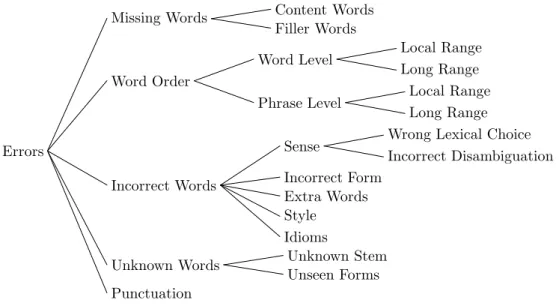
The classification of the errors of a machine translation system is by no means unambiguous. The classification scheme we propose in this work is an extension of the error typology presented in (Llitj´os et al., 2005). It has a hierar-chical structure as shown in Figure 1. In the first level we have split the errors in five big classes: “Missing Words”, “Word Order”, “Incorrect Words”, “Unknown Words” and “Punctuation” errors.
A “Missing Word” error is produced when some word in the generated sentence is missing. We can distinguish two types of errors, when the missing words is essential for ex-pressing the meaning of the sentence, and when the missing word is only necessary in order to form a grammatically correct sentence, but the meaning is preserved. Normally the first type of errors are caused by missing “main words” like nouns or verbs, but this not always the case, as for ex-ample a missing preposition can alter the meaning of the sentence significantly. This first type of errors is of course more important and should be addressed first. For each of these divisions one could further distinguish which lexical category (“Part of Speech”) is missing, as different word types may have different treatments. For simplicity these subclasses are not included in Figure 1.
The next category concerns the word order of the gener-ated sentence. Here we can distinguish between word or phrase based reorderings, and within each of these cate-gories between local or long range reorderings. In the case of word based reorderings, we can generate a correct sen-tence by moving individual words, independently of each other, whereas when a phrase based reordering is needed, blocks of consecutive words should be moved together to form a right translation out of the generated hypothesis. The distinction between local or long range is difficult to define in absolute terms, but it tries to express the difference between having to reorder the words only in a local context (within the same syntactic chunk) or having to move the words into another chunk. For the Chinese-English lan-guage pair, a more refined classification scheme, dependent on the sentence type has been carried out, see Section 5.3 for more details.
The widest category of error are the “Incorrect Words” er-rors. These are found when the system is unable to find the correct translation of a given word. Here we distinguish five subcategories. In the first one, the incorrect word disrupts the meaning of the sentence. Here we could further distin-guish two additional subclasses, when the system chooses an incorrect translation and when the system was not able to disambiguate the correct meaning of a source word in a given context, although the distinction between them is certainly fuzzy.
The next subcategory within the “Incorrect Words” errors is caused when the system was not able to produce the correct form of a word, although the translation of the base form was correct. This is specially important for inflected lan-guages, where the big variability of the open word classes poses a difficult problem for machine translation. How to further analyze the errors that fall into this category is very much dependent of the language pair we are considering. For example, for the Spanish language, being a highly in-flected language, it is useful to distinguish between bad
verb tenses and concordance problems between nouns and adjectives or articles.
Another class of errors is produced by extra words in the generated sentence. This kind of error was introduced mainly when investigating the translation of speech input, as artifacts of spoken language may produce additional words in the generated sentence.
The last two classes are less important. The first one (“Style Errors”) concerns a bad choice of words when translating a sentence, but the meaning is preserved, although it can not be considered completely correct. A typical example is the repetition of a word in a near context. In this case a human translator would choose a synonym and avoid word repeti-tion. The second one concerns idiomatic expressions3that the system does not know and tries to translate as normal text. Normally these expressions can not be translated in this way, which causes some additional errors in the trans-lation.
Unknown words are also a source of errors. Here we can further distinguish between truly unknown words (or stems) and unseen forms of known stems.
A variation of this category has a special importance for the Chinese-English language pair. For the majority of Eu-ropean languages, or even languages that share the same alphabet, unknown proper names can be “translated” sim-ply by copying the input word to the generated sentence, without further processing. Chinese characters, however, can not be translated into English by itself, and a conver-sion, sometimes guided by the pronunciation, is required. Therefore for this language pair we also distinguish be-tween unknown person, location, organization and other proper names.
Lastly there can also be punctuation errors, but, for the cur-rent machine translation output quality, these represent only minor disturbances for languages without fixed punctuation rules, and are not further considered in this work.
Of course, the error types so defined are not mutually ex-clusive. In fact it is not infrequent that one kind of error causes also another one to occur. So for example, a bad word translation can also cause a bad ordering of the words in the generated sentence.
4. Corpora
The corpora considered in this analysis are the corpora used in the TC-STARevaluation: the European Parliament Ple-nary Sessions (EPPS) corpora for the English-Spanish guage pair, and broadcast news for the Chinese-English lan-guage pair.
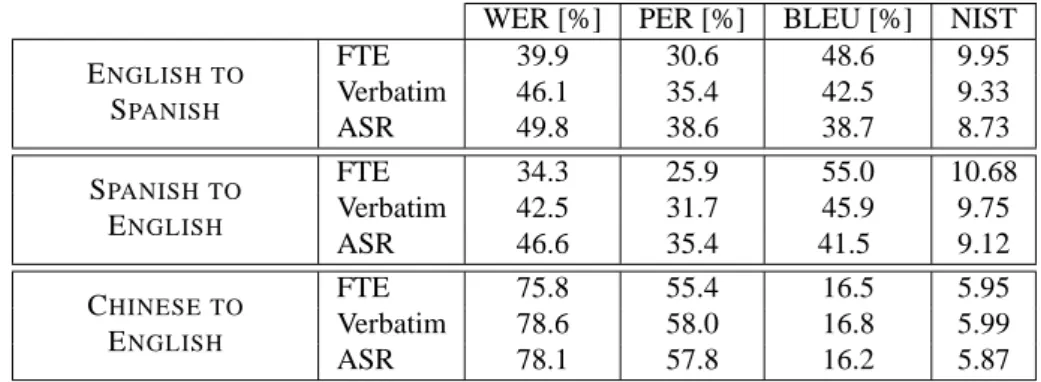
A description of the EPPS data can be found in (Vilar et al., 2005). The statistics of the corpora can be found in Table 1 and the results in Table 2. Note that for all the EPPS tasks the same training corpus was used, consisting of the Final Text Editions data, only the preprocessing of the corpus was different. This produces a slight mismatch between training and testing data, which contributes in increasing the error rates for the Verbatim and ASR conditions.
For the Chinese to English translation, the training corpora are provided by the Linguistic Data Consortium (LDC), the
3
Content Words Filler Words Missing Words
Local Range Long Range Word Level
Local Range Long Range Phrase Level
Word Order
Wrong Lexical Choice Incorrect Disambiguation Sense
Incorrect Form Extra Words Style
Idioms Incorrect Words
Unknown Stem Unseen Forms Unknown Words
Punctuation Errors
Figure 1: Classification of translation errors.
domain being news articles. A list of these corpora can be found at the LDC web pages (LDC, 2005) under the “Large Data Condition”. The evaluation data is selected from the manual transcription of the “Voice of America”.
As shown in Table 1, the whole training corpus contains more than seven million sentences after the filtering. Each of the evaluation data has 494 sentences. After preprocess-ing, such as Chinese word segmentation and the number-, hour- and date-categorization, we obtained nearly 200 mil-lion Chinese running words for training. The evaluation data were also preprocessed. Because of the large amount of training data, there were very few Chines unknown words. The translation results for the Chinese-English tasks are presented in Table 2.
5. Error Statistics
In this section we will analyze in more detail which are the most prominent source of errors in each of the tasks within the TC-STARproject.
5.1. English to Spanish 5.1.1. EPPS FTE data
As stated earlier, Spanish is a highly inflected language, havig for example 17 different verb tenses (not counting impersonal forms like gerundium). It is often the case that the correct verb gets chosen, but the tense is incorrect. This is epecially true for past tenses, as Spanish differentiates several tenses depending if the action was terminated or not, and the subjunctive tenses, which have no direct correspon-dence into English. The errors due to bad tense amount to 15.1%of the total. There are also cases where the tense is
correctly generated, but the person is not correct. This is mainly motivated by the relatively long sentences present in the corpus, as the verb and the corresponding subject in-formation necessary for generating the correct form of the verb are relatively far apart. Neither the translation nor the language models are able to handle so long range context information.
Incorrect lexical choice is also an important problem. Es-pecially there is an important disambiguation problem, namely the pair of Spanish verbs “ser” and “estar”. Both are translations of the English verb “to be”, the first one being used for permanent properties of objects or persons, and the second one is used for expressing temporary qual-ities or locations4. In many cases the system is not able to distinguish between these two verbs.
The next most frequent errors are caused by missing words, 7.9%of the total errors caused by missing content words.
Another important source of errors concerns the genera-tion of the correct order of the sentence. Although En-glish and Spanish have a very similar word order, there are some deviations. The most frequent ones are the adjective-noun pairs, English uses the form “adjective-adjective-noun” while in Spanish it is more common to use “noun-adjective”. In most cases this permutations are correctly handled by the phrase based translation model, as they occur only in a lo-cal context, but for some longer ranging reorderings or for unseen adjective noun pairs, the system is not able to han-dle them correctly.11.6%of the errors are caused by local
range word based reorderings.
There are also problems with the concordance between names, adjectives and articles. In contrast with English, Spanish articles and adjectives must match the gender and number of the noun. As was the case when handling re-ordering, in most of the cases this gets modelled by the phrase based translation model, but there are still some er-rors left. The complete error statistics for this task can be found in the column of the FTE Spanish-English in Table 3.
5.1.2. EPPS Verbatim data
The errors found for the verbatim data condition are quite similar to those found for the FTE condition. However, the input in this condition has some ungrammatical construc-tions which constitute an additional source of errors, as dis-cussed in Section 4. The statistics are shown in Table 3.
4This is a rough simplification and the exact use is more
EPPS BN
Spanish English Chinese English
TRAINING DATA
Sentence pairs 1 207 740 7 082 390
Running Words 34 851 423 33 335 048 198 867 499 212 674 144
Vocabulary 139 587 93 995 223 258 351 198
Singletons 48 631 33 891 99 937 162 240
FTE TEST DATA
Sentences 840 1094 494
Running Words 22 756 26 885 13 852
Vocabulary 3644 3744 2 585
OOVs (running words) 40 102 1
VERBATIM & ASR TESTDATA
Sentences 1073 792 494
Running Words 18 896 19 306 12 508
Vocabulary 3302 2772 2 586
OOVs (running words) 145 44 1
Input WER (ASR only) 10.1% 9.5% 13.7%
Number of Politicians* 36 11 —
*Unknown number of interpreters.
Table 1: Statistics of the TC-STARcorpora.
WER [%] PER [%] BLEU [%] NIST
ENGLISH TO SPANISH
FTE 39.9 30.6 48.6 9.95
Verbatim 46.1 35.4 42.5 9.33
ASR 49.8 38.6 38.7 8.73
SPANISH TO ENGLISH
FTE 34.3 25.9 55.0 10.68
Verbatim 42.5 31.7 45.9 9.75
ASR 46.6 35.4 41.5 9.12
CHINESE TO ENGLISH
FTE 75.8 55.4 16.5 5.95
Verbatim 78.6 58.0 16.8 5.99
ASR 78.1 57.8 16.2 5.87
Table 2: TC-STARevaluation results.
When comparing the error statistics with the FTE data, the most prominent difference is an increase in the number of missing words. This can be explained by the ungrammat-ical constructions of the input text. If we decompose this kind of errors into missing context words and missing filler words, the increase is mainly due to this last kind of errors. That means that the ungrammaticality of the input sentence is somewhat transfered to the generated sentence.
5.1.3. EPPS ASR data
The analysis carried out for the Verbatim data is also appli-cable to the ASR data. In this condition, however, we have an additional source of errors, namely the errors due to the speech recognizer. The input data has a9.5%word error
rate. If we decompose these errors into insertion, deletion and substitution errors we see that the most important er-rors are substitution erer-rors amounting to a total of 54.7%
of the errors (deletions amount to25.0%and insertions to
20.3%). This trend gets transfered to the translations. If
we compare the output of the verbatim system with the out-put of the ASR system, we find that 62.8%of the
differ-ences correspond to substitutions. This increase is easily explained if we consider that a change in a word (a substitu-tion) also changes the surrounding words in the translation, as the context changes and another phrase gets selected in
the translation process. The deletion and substitution er-rors are not so important, as they affect normally articles or prepositions that are not essential for the translation pro-cess.
5.2. Spanish to English
For the reverse direction, namely translating from Spanish to English, we have observed similar problems. However, as English is a language with nearly no inflections, the error rates achieved by the systems are better than for Spanish. The main problem in this direction for each of the condi-tions are presented in this subsection.
5.2.1. EPPS FTE data
When generating English, the most prominent source of errors is a bad lexical choice. The amount of errors due to incorrect translations and bad disambiguation together amount to28.2%of the total errors. However, more than an
increase in the absolute number of errors when comparing to the opposite direction, the higher percentage is motivated by the decrease in the number of other errors.
Missing words are the second most important source of er-rors. However, most missing words are simply filler words, 18.8%of the total errors, that is, the meaning of the
Type Sub-type E-S [%] S-E [%]
FTE Verbatim FTE Verbatim
Missing Words 19.9 26.4 26.0 19.6
Content Words 7.9 9.9 7.2 4.4
Filler Word 12.0 16.5 18.8 15.2
Word Order 15.4 11.5 20.4 21.1
Local Word Order 11.6 4.8 12.7 13.2
Local Phrase Order 2.1 5.5 6.0 6.9
Long Range Word Order 1.7 1.1 0.6 1.0
Long Range Phrase Order 0.0 0.0 1.1 0.0
Incorrect Words 64.4 61.0 50.8 57.3
Sense 21.9 24.6 28.2 36.8
Wrong Lexical Choice 13.0 15.4 15.5 21.1
Disambiguation 8.9 9.2 12.7 15.7
Incorrect Form 33.9 30.2 9.9 11.7
Verbs
Incorrect Tense 15.1 13.2 7.7 7.8
Incorrect Person 8.2 8.5 2.2 3.9
Concordance
Incorrect Gender 7.5 4.8 0.0 0.0
Incorrect Number 3.1 3.7 0.0 3.9
Extra Words 0.0 2.9 1.1 3.9
Style 7.9 3.3 9.9 3.9
Idioms 0.7 0.0 1.7 0.0
Unknown Words 0.3 1.1 2.8 2.0
Unknown Words 0.3 1.1 1.1 1.5
Unseen Forms 0.0 0.0 1.6 0.5
Table 3: Error statistic for the English–Spanish EPPS FTE Task.
that the “to” particle of English infinitives is missing. Only in7.2%of the cases, a content word, essential for the
mean-ing of the sentence is missmean-ing. The complete statistics can be found in the column of FTE S-E in Table 3.
5.2.2. EPPS Verbatim data
As was the case for the English to Spanish direction, if we switch to verbatim data, the input looses in grammatical correctness. In this translation direction this is even more important, as the number of interpreters increases. This produces a distorted input and the system is not always able to produce suitable translations. We can observe this effect in the increased number of bad lexical choice errors with respect to the final text editions. We also encounter an in-crease in the number of extra words, which originate from the spontaneous speech effects of the input text. The other errors are quite similar to the FTE condition. The statistics can be found in the column of the Verbatim S-E in Table 3.
5.2.3. EPPS ASR data
As was the case for the reverse direction, the most impor-tant source of errors of the speech recognizer are substi-tution errors, amounting to a total of 58.3% of the total
errors (with 25.5%deletions and16.2%insertions). This
also has the effect that the most significant differences be-tween the output of the Verbatim and the ASR conditions are substitution errors, amounting to57.9%of the
differ-ences. In this case however, most of the substitution errors of the recognizer are due to changes in the morphology of
the words, but the base form remains the same. It is not unusual that plural and singular or masculine and feminine forms of the words are exchanged. In these cases the con-textual information is not lost in the same way as for the English to Spanish direction and the proportion of errors remains nearly the same.
5.3. Chinese to English
For the Chinese to English direction, we introduce new types of reordering errors. The main difference between the two languages is the position of the modifiers, and so we distinguish three major categories related to the sentence construction. In Chinese declarative sentences, the modi-fiers are usually located before the predicates, and the mod-ifier of the place/time can also be at the beginning of a sen-tence. In interrogative sentences the word order is generally the same as in declarative sentences, but in the Is-Question sentence, a Chinese key word “Ma” is appended to show the tone, and in the Wh-Question sentence, the question part is substituted by a word “Shenme”. Lastly subordi-nate/infinitive sentences are placed after the main sentence in English but before the main sentence in Chinese.
5.3.1. CE FTE data
Type Sub-Type FTE [%] Verb [%]
Missing Words 27.5 20.9
Content Words 22.1 14.2
Filler Words 5.4 6.7
Word Order 17.8 17.3
Declare 10.1 10.3
Question 0.2 0
Sub-ordinate 0.7 0
Infinitive 6.8 5.9
Long Range 10.6 11.1
Local Range 7.3 6.2
Incorrect Words 27.9 32.0
Wrong Lexical Choice 18.5 25
Incorrect Form 9.4 7.0
Named Entity 8.9 10.1
Person 5.4 7.0
Location 2.6 2.1
Organization 0.7 0.8
Others 0.2 0.3
Extra Words 17.8 19.8
Content Words 5.4 10.3
Filler Words 12.4 9.5
Unknown Words 0 0
Table 4: Error statistics for the Chinese–English Tasks.
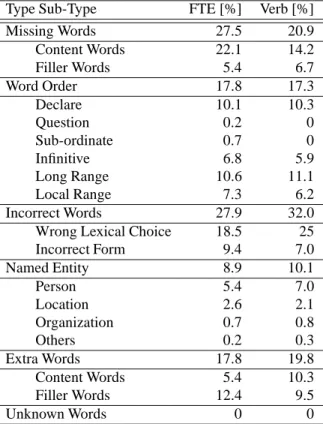
are the “Extra Words” and the “Word Order”, which con-tribute 17.8% of the errors respectively. At last the “Named Entity Words” amount to 8.9% of the total errors. Because of the very low OOV rate as shown in Table 1, no “Un-known Words” were found in the analysis.
Unlike the EPPS translation systems, the CE translation system produces numerous “Extra Words”, most of them filler words like prepositions. One reason could be that the translations are in fact very short because of the missing words, and then the system inserts filler words to make the sentence longer. Therefore we expect a reduction of “Extra Words” as the “Missing Words” problem is suitably han-dled.
The next error class are the errors caused by the reordering. If we calculate the translation mistakes both at the word and phrase levels, in the FTE translation 17.8% of the total errors are caused by bad reorderings, and if we only count at the word level, 20.4% words are taken as incorrect because of the wrong positions in the sentence. This is related to the difference between the WER and PER in Table 2.
We categorize the reordering types with respect to three cri-teria: the sentence type, the local/long range reordering and the reordering at the word/phrase level. In the statistics of Table 4, 10.6% reorderings take place in long ranges, i.e. across more than two positions, and 7.3% reorderings are in short ranges. From the statistics and the linguistic view as presented in the beginning of Section 5.3, we see that the CE translation system requires a phrase based reordering and the reordering may have different lengths of ranges. As described in Section 3, for the Chinese-English transla-tion we distinguish the named entity words with four cat-egories: the person name, the location name, e.g. the city,
country, the organization name and other names. Here the person name is the biggest problem, which contains 5.4% of the total errors. The translation of the location names is also an error source.
5.3.2. CE Verbatim & ASR data
In the Chinese English translation task, the verbatim data is the same as the FTE data without punctuation marks. As shown in Table 4, the order of the error classes according to their number of the errors has not changed, but in the trans-lation of the verbatim data, the percentage of the “Missing Words” decreases from 27.5% to 20.9% and the number of the “Incorrect Words” and “Extra Words” increase. The conclusions for the analysis of the CE ASR data are similar to the conclusions presented for the EPPS task.
6. Conclusion
In this paper we presented a framework for the analysis of errors for the output of machine translation systems, and carried out a detailed analysis of the results presented by our group in the first TC-STARevaluation. The most impor-tant class of errors is language-pair dependent, e.g. the verb tense generation for translation from English into Spanish or the word order for translation from Chinese to English. Future work will study in more detail the relationship be-tween the automatic evaluation measures (maybe on the level of word classes) and the error classes used in this work.
7. Acknowledgments
This work has been partly funded by the integrated project TC-STAR – Technology and Corpora for Speech-to-Speech Translation – (IST-2002-FP6-506738) and partly sponsored by the National Office of Universities and Research - Re-gional Education Ministry - Community of Madrid, Spain.
8. References
George Doddington. 2002. Automatic evaluation of ma-chine translation quality using n-gram co-occurrence statistics. In Proc. ARPA Workshop on Human Language
Technology.
LDC. 2005. Linguistic data consortium chinese training data resources. http://www.ldc.upenn.edu/Projects/ TIDES/mt2005cn.htm.
Ariadna Font Llitj´os, Jaime G. Carbonell, and Alon Lavie. 2005. A framework for interactive and automatic refine-ment of transfer-based machine translation. In Proc. of
the 10th Annual Conf. of the European Association for Machine Translation (EAMT), Budapest, Hungary, May.
Kishore Papineni, Salim Roukos, Todd Ward, and Wei-Jing Zhu. 2002. Bleu: a method for automatic evaluation of machine translation. In Proc. of the 40th Annual Meeting
of the Association for Computational Linguistics (ACL),
pages 311–318, Philadelphia, PA, July.
David Vilar, Evgeny Matusov, Saˇsa Hasan, Richard Zens, and Hermann Ney. 2005. Statistical Machine Transla-tion of European Parliamentary Speeches. In
Proceed-ings of MT Summit X, pages 259–266, Phuket, Thailand,