- 平01 -
Annual Report of Pro Natura Fund Vol.20 (2011
Conservation of Snow leopard Uncia uncia in Mustang district of
Annapurna Conservation Area ACA of Nepal
The Biodiversity Research and Training Forum BRTF - Nepal
Achyut Aryal
n c n
The snow leopard Uncia uncia is a flagship carnivore of the high mountains of central Asia. It is a highly threatened animal and is placed in appendix I of CITES, "Endangered" category of IUCN Red list status WWF 2006 and under strict protection schedule 1 of Protected Animals DNPWC, 2007 .
The snow leopard Uncia uncia is a moderately large cat native to the mountain ranges of South Asia and Central Asia. The classification of this species has been subject to change and its exact taxonomic position will not be resolved until further studies are conducted.
The populations of snow leopards are declining; the main threats in its conservation are lack of information about its status, retaliatory killing for livestock depredation, poaching, and loss of habitat because of high density of livestock in grazing area.
The snow leopard-human conflict is one of the main threats to its survival because it is known to kill sheep, goats, horses and yak calves DNPWC 2005 . Every year hundreds of livestock are predated by snow leopards and local people kill Snow leopard as retaliation Chetri 2005 .
Degradation of snow leopards habitat continues due to year-round grazing pressure. Large numbers of livestock compete with free ranging ungulates like the blue sheep, himalayan tahr and musk deer. They often kill livestock because of high encounter rates and ineffective guarding by headers WWF 2006 .
Poaching and inadequate protection and management are another issue in Nepal, as government of Nepal lack the financial and human resources to adequate protection and management of the Snow leopard, its prey and its habitat. Additional constraints include its extremely remote and rugged range, harsh climatic and environmental conditions that prevail in many areas and a severe lack of trained staff to conduct surveys and develop management plans. To know the status of snow leopard is a big challenge to biologists due to its cryptic coloration, sedentary behavior, sparse distribution in far flung and harsh climatic conditions in which it inhabits Fox 1994 .
Snow leopards are found in Mugu Dolpa Jackson and Ahlborn, 1989 , Manang Oli 1991, Thapa 2004 , and Myagdi Bhajimaya et al. 1990 districts. A habitat suitability index model suggests an estimated population of snow leopard is 350-500 in eight mountain-protected areas of Nepal DNPWC 2005 , but this figure needs to be confirmed by field survey Chetri 2005 .
Therefore the project has launched to find out present status of snow leopards and raised conservation education in local level.
c c :
1. To find out status and distribution of Snow leopard and map out distribution and potential poaching area 2. To find out habitat preference of snow leopard in ACA.
3. To investigate the diet condition of snow leopard through the scats analysis. 4. Launch the community base snow leopards conservation activities
: a a
Study was conducted at Upper Mustang region of Annapurna Conservation Area and outside the ACA of Nepal. Upper Mustang is located in between N 28° 47' 39" to 29° 19' 54" and E 83° 28' 55" to 84° 15' 16", north from the Annapurna and Dhaulagiri massif. Lomangthang is a main village of the Upper Mustang, it is also known to the world as the walled city since the settlement is surrounded by wall.
The climate of the area can be characterized as cold desert, desiccated by strong winds and high solar radiation. The climate is sub-alpine, and has a maximum and minimum temperature of 26.8°C and 9.9°C in July and 10.7°C and -5.8 °C in November of 2005. The most of the area remains under snow for 4 - 5 months from November to March. Total annual rainfall is less than 200 mm and more than half of the total precipitation occurs as snow during the winter months. The region falls under the Dhaulagiri-Annapurna mountain rain-shadow zone.
Agricultural production in the area is very limited due to scarcity of water, lack of proper irrigation, low temperature for longer periods and low rainfall. Only 1.7% land is cultivable and average landholding is 0.35 ha per person. Majority of the land is uncultivated and barren. Local production of food meets only 55% of subsistence needs and that only 8% of the 5700 inhabitants of Upper Mustang are self sufficient in terms of grain Thakali 1994 . Animal husbandry is the main source of income for the local people. The average number of animals reared in 2002 in Upper Mustang is 36, 503 MIS 2002 . Cattle, yaks, dzos, sheep, goats, horses, mules and donkey are reared. Goat and sheep trading from China is also a common practice among the local population.
The rangelands not only provide grazing lands for livestock but also support large number of rare and endangered plants, animals and birds. The vegetation of the area represents high altitude grasslands that are Tibetan in characters Stainton 1972 . Plant species such as Caragana spp., Lonicera spp., Stipa spp., Carex spp., Kobresia sp, Kobresia felicina, Lagotis spp Chetri and Gurung 2004 . The rangelands also support unique assemblage of rare and endangered species -Tibetan Argali Ovis ammon hodgsonii , Tibetan Gazelle Procapra picticaudata , Kiang Equus kiang , Blue sheep Pseudois nayaur and their predators - Snow Leopard Uncia uncia , Lynx Lynx lynx isabellinus , Red Fox
Vulpes vulpes , Brown Bear Ursus arctos and Grey Wolf Canis lupus Chetri and Gurung 2004, Chetri 2008 . As animal husbandry is the main source of income, rangelands of Upper Mustang have socio-economic relationship with the lives of local people Pokharel 2006 .
- 平0年 - Fig1 Study Area
Study on climate change and impact on snow leopards, its prey species as well as local livelihood has been written in separate paper.
n a an a a
Sign scats, pugmarks, scraping, and scent spray survey were also carried out in study area. Snow leopards signs were identified on basis of their size, colour, pugmarks and other features and compared with other predators sign Table1 . Confusion with dogs, wolf scats were avoided because herders and livestock were in downhill and we did not find wolf, wild dog in our study area. I used the techniques of the Snow Leopard Information Management System SLIMS for snow leopard survey and design transects line accordingly Jackson and Hunter 1996 . Additional transect were laid out in snow leopards potential area, such as ridgeline, stream beds, and accessible cliffs. Different habitat parameters were taken as described in SLIMS guidelines to understand the habitat use of snow leopards.
Table1 Distinguish characters of different predators used for confirmation of their scats.
- 平05 - ca c n an Ana
Standard micro-histological method was used to identify prey through comparison betweenthe scats hair sample and hair samples of each potential preys. Snow leopards scats were collected following the SLIMS guidelines and searching the scats along the transects line and random walking trails also. Scats of different predators were identified on the basis of size, colour, location, local knowledge and microscopic structure of medulla and cuticular structure of hairs. Scats were prepared according to Johnson and Aldred 1982 , and Korschgen 1980 for identification of prey items, it was done by comparing surface scale patterns of guard hairs with those of a reference hair collection comprising potential prey species from area Weingart 1973 .
The hair sample from the scats was first washed in hot water. Subsequently, it was thoroughly air dried and cleared in ether for 1 hour to remove the wax deposition and races of the moisture. Finally the hairs were passed through xylol for 24 hour and mounted with DPX for permanent slides to see to medulla structure of the hair. Gelatin solution was used to prepare slides for seeing the cuticular structure of hairs and cuticular scales were observed by the impression techniques. The slides were observed under a light microscope 100x and 400x and digital photos were taken to see the cuticular and medulla pattern. At least 20 hair samples were taken from the each sample scats for analysis and detect multiple prey species Mukherjee et al. 1994 . The prey residue composition of the predator scats were extrapolated in term of the prey frequency of occurrence in scats Fi calculated by equation-I Karanth and Sunquist 1995, Mizutani 1999, Pikunov and Korkishko 1992, Ramakrishan et. al. 1999 .
= n % a n
Where ni is the number of scats where a given i-th prey species residues occur and N is the number of all scats samples.
n a n ca n ac :
Workshops were conducted in participatory way with the involvement of local people to gather information on snow leopard and provide them how to monitoring the snow leopard in future.
Eco-club formation in different schools and other conservation activities carried out through the participatory way, detail describe in below.
R an c n:
a an n n a n an n A A
n:
Snow leopards survey has conducted in 6 VDCs of Upper Mustang region such as in Lomanthnag VDC, Chhunup VDC, Chhoser VDC, Tsrang VDC, Ghami VDC and Surkhang VDC of Upper Mustang fig2 . Snow leopard has distributed in 1883km2 area of Upper Mustang. Snow leopards sign were found from 2900 meters to 6000 meters of the area. Surkhang VDC provides biggest area compared to other VDC for snow leopards. It is because the VDC has good number of prey species as well as good habitat for snow leopards. They are using specific area in those VDCs.
Table2 Snow leopards distribution area in Upper Mustang Region
- 平0ウ -
Fig2 Snow leopards distribution in Upper Mustang Region of Nepal
a an an c :
Transect lines were laid out in the potential habitat of snow leopards such as ridgeline, river bank, gully etc. we surveyed Upper Mustang region's five VDCs. The transect lines lengths varied from 100meter to 1000 meters. We were laid out 85 transect lines in Upper Mustang region for snow leopard survey which covered 49.6km. Altogether, 292 signs were recorded in the transect line. Scrapes were most common sign type 62% in the survey area followed by feces
35% , pugmarks 1% and urine spray 1% Table3 .
Chhoser and Surkhang VDCs provided more snow leopards signs, 34% and 33%, respectively followed by the Ghami, Lomanthang Tsrang and Chunup VDCs fig4 . However there is no significant difference in sign distribution/density throughout the study area χ2=22.25, p>0.05 .
We concluded that Chhoser and Surkhang VDCs provided prime habitat for snow leopard and maximum number of snow leopards were living in this area compared to others VDCs of Upper Mustang region.
On the basis of sign survey, we can estimate the population density of snow leopards guided by SLIMS Hunter and Jackson 1996, Bajimaya 2001 . According to this SLIMS guidelines, snow leopard density will be high if the signs densityis more than 20 items per kilometer, medium if the signs density is 5-20 per kilometer and indicate low if the sign density is <5 per kilometers. Therefore there were 2-5 snow leopards per 100 km2 .
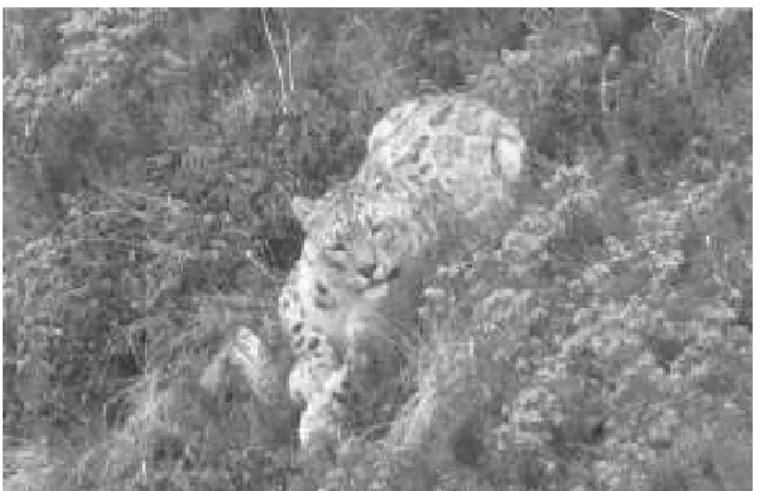
Fig3 Snow leopards in SNP
Table3 Sign density of Snow leopards
- 平09 - Fig4 Snow leopard sign density
Fig5 Snow leopard sign density throughout the different area of Upper Mustang
Fig6 Total and mean sign density of snow leopard in different area of Upper Mustang
Fig7 Transect lines in study area
Photo1 Snow leopard signs
- 平11 -
a a nc
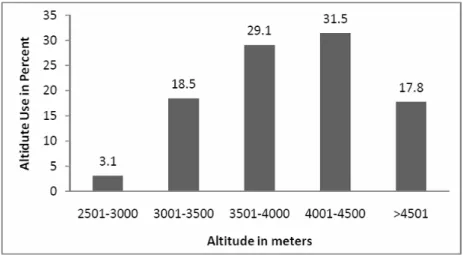
Snow leopard mostly used the area between 3500 and 4500 meter in altitude. Thirty two percent was found in the area from 4001 to 4500 meter and 29% from 3501 to 4000 meter. This elevation was most used by snow leopards. There was significant difference in use of habitat, snow leopard prefered to use often 3500 and 4500 altitude x2-0.001, p>0.05 fig9 . Snow leopard mainly used slopes more than 40 degree 46% . Snow leopard used slopeareas more of tey than plain area x2-0.034, p>0.5 fig10 . Snow leopard often used cliff area 34% , ridgeline 20% and steam bed
18% . x2-0.004, p> 0.05 fig11 .
Fig8 Altitude used by snow leopards
Fig9 Slope used by snow leopard
Fig10 Habitat used by snow leopards
n n a Uncia uncia
Altogether we used 69 sample of scats for diet analysis of snow leopards. The frequencies of occurrence of each prey species in scats of snow leopard Table4 , were not significantly different χ2= 0.032, p > 0.05; R2- 0.81 . On average, blue sheep was the most frequent 39.3% , and marmot 19.5% was second position in diet of snow leopards' diet. Beside these snow leopards also consumed wild ass, pika. More important result is that 23% of snow leopards diet was covered by livestock yak, goat, horse . Therefore, it also showed that there are high level of livestock depredation by snow leopards, conflict between human and snow leopards are increasing, and snow leopard conservation become more challenge.
Table4 Occurrences of prey species in scats n= 69 of Snow leopards
- 平1年 -
c a n a a an n a ac n ac n
Local people in the Upper Mustang Region are primarily pastoralists and agriculturalists.Although predators e.g. snow leopard, brown bear, lynx, wolf, and fox have historically preyed on livestock in the area, local interviews from 2009 suggest that depredations are increasing. Local people stated that the culprits for a majority of these losses >538 depredations were snow leopards. They believe that because grasses and shrubs are no longer found in abundance at high elevation due to increased temperatures, blue sheep must forage on natural foods as well as agriculture found at lower elevations. As a result, blue sheep compete with local livestock and raid croplands near villages. This shift in blue sheep foraging ecology has also resulted in an increase in the number of livestock depredations. Evidence suggests snow leopards have expanded their ranges to lower elevations to feed on their primary food source, blue sheep. As a result of occupying lower elevations, snow leopards commonly prey on livestock. Currently, there is no alternative to the retaliatory killing of snow leopards in order to reduce future livestock losses. Therefore we should conduct conservation awareness program and livelihood support program to local people for conservation of snow leopard in wild.
Photo2 A goat attacked by snow leopards.
n a n ca n n a a a a n c n a n n a
Conservation education tour was organized for R.N School, Lomanthang, Upper Mustang students and local youth teacher for two days. Local students and teacher have vital role to society so to encourage conservation of snow leopards in local area, we organized the conservation education tour to motivate leading youth local teachers and student towards the conservation snow leopards. Altogether 51 students and teachers participated in the conservation tour. We arranged the program and support for their all expenses partly supported by ACAP. We visited them to Chitwan National Park with them and provide information how they were conserving wildlife and biodiversity of the region. They were interacted with local Eco-club and know how they are involving in local environment and wildlife conservation. We went to Chitwan National Park to see park management system, how they are managing tourism in the area. They learned lots of things and made their vision clear. They can use what they learned there in their local area for conservation of snow leopards and other animals.
n ac n ca n a a n a
To implement any conservation tools, first we should understand local people attitude, their feelings, local norms and values, so we started our activities to interact with local people from Chhoser VDC. We discussed with the group about their problem, their feelings towards the snow leopards. Local people are very upset with the snow leopards because of killing their livestock, so they are demanding supportto protect their livestock with solar electric fencing. We talked with them on livestock insurance policy. They liked this idea and they wanted to implement the such program in local level. It would be effective for conservationof snow leopard. Local people even didn't know the legal status of the snow leopards and its importance in the ecosystem, so we were able to give insight about its value in maintaining high altitude ecosystem. They were also demanding high tech training for preparing yak milk processing and production of different product from milk and hair of livestock.
Fig11 R.N. Schools of Lo-manthangs during visit in Chitwan National Park
- 平15 -
n a n n W
The workshop was conducted in Lo-Managthang ACAP office. It was jointly organized by ACAP/Lomanathang, SLC and BRTF Nepal. We gathered local participants from all snow leopards distribution VDCs, especially herders who were directly affected by snow leopards. The main objectives of the workshop was as follows; snow leopard distribution and its impact to livestock, how to solve the conflict between snow leopards and local people, analysis of current situation and problem of snow leopard and livestock depredations. Finally local participant prepared their own action plan to implement the conservation of snow leopard and protection of their livestock from snow leopards.
Observation and Feedback from the workshop:
1 It is hardly possible to keep livestock and provide fodder to them without taking them to the pastures for further grazing, so, snow leopard kills their livestock.
2 There is scarcity of grass in the pasture.
3 The number of blue sheep seems increased because they often come down to the villages and destroy the crops. 4 The locals neither can protect their livestock and fields because they have no preventives.
5 Snow leopards often come to the corrals and kill huge number of sheep and goats; they seem to have no fear against the herders.
6 The related organizations like ACAP, SLC or the government level should address their problems.
7 The farmers or the herders should be provided with the financial and technical support to overcome the crisis. 8 The herders must be provided with insurance against their lost livestock.
9 Dhey in Surkhang VDC and Samjung in Chhoser area seem to be most affected by snow leopards and blue sheep. 10 Repair of previously constructed corrals and waterholes in many hotspots are needed.
n a n ca n a an a c n a n ca n
Snow leopards conservation essay and art competition were conducted in Lomanthang and altogether 4 schools Divya Deep Secondary School, Chhosher; Rastriya Lower Secondary School, Lomanthang; Tsarang Lower Secondary School, Tsarang; Lo- Kunphen Aurbedic Medical School, Lomanthang; Mahakaruna Sakyapa Vidhyalaya, Lomanthang . One day conservation education classes were conducted in for RN school of lomangthang, altogether 36 students were participated in the activities. The topic was given by the BRTF for essay and art competition. The topic was importance of snow leopards and your possible way of contribution to conservation in your area.
ca n:
Poster has published with the coordination of several snow leopard working organizations in Nepal. Altogether the 2000 pieces were printed and distributed to local level and international level to raise awareness for conservation of snow leopard in natural habitat. The poster size was 15 inches by 20 inches fig 14 .
Ac n n
We thank National Trust for Nature Conservation/Annapurna Conservation Area Project for providing permission to conduct research.
I would like to express my special thanks to Prof. Shiro Kohshima Kyoto University, Japan for his support for this project in various ways.
We thank Mr. Narendra Lama, Officer-Incharge of ACAP , Mr. Lal Bahadur Gurung ACAP Director for their support and encouragement.
We thank to Pro-Natura Fund, Japan for providing financial support for the project.
We would like to thank to Mr.Basu Dev Neupane NRCA, NTNC for plant identification, to Mr.Funjok Gurung, Mr.Shambhu Paudel and Mr.Bikash Adhikari for their support in field and lab work.
Fig13 Participants in the workshops
- 平1ウ -
Photo3 Awarding Ceremony of the eassey and art competition and conservation game organized in Lomanathang
Photo4 Conservation education activities in RN School
Fig14 Poster published during the project period
R nc
Ahlborn, G. and Jackson, R.M. 1988. Marking in free-ranging snow leopards in west Nepal: a preliminary assessment. In: Proceedings 5th International Snow Leopard Symposium, ed. H. Freeman. International Snow Leopard Trust, Seattle and wildlife Institute of India. Dehradun, India: pp. 25-49.
Chundawat, R.S. 1990. Habitat selection by a snow leopard in Hemis National Park. India. Int. Ped. Book of Snow leopards, 6: 85-92.
Fox, J.L. 1994. Snow leopard conservation in the wild - a comprehensive perspective on a low density and highly fragmented population. In: Proceedings of the Seventh International Snow Leopard Symposium, eds. J.L. Fox and D. Jizeng: pp. 3-1.
Fox, J.L. 1994. Snow leopard conservation in the wild - a comprehensive perspective on a low density and highly fragmented population. In: Proceedings of the Seventh International Snow Leopard Symposium, eds. J.L. Fox and D. Jizeng. Seattle, USA: pp. 3-15.
Fox, J.L., Sinah, S.P., Chundawat, R.S. and Das, P.K. 1991. Status of the snow leopard in northern India. Biol. Conserv, 55: 283-298.
Green, M.J.B. 1993. Nature reserves of the Himalaya and the mountains of Central Asia. IUCN, Cambridge and Gland.
Grigione, M.M., Burman, P., Bleich, V.C. and Pierce, B.M. 1999. Identifying individual mountain lions Felis concolor by their tracks: refinement of an innovative technique. Biol. Conserv., 88: 25-32.
Hussain, S. 2003. The status of the snow leopard in Pakistan and its conflict with local farmers. Oryx 37: 26-33. Jackson, R. and Ahlborn, G. 1984. A preliminary habitat suitability model for the snow leopard, Panthera uncia, in West Nepal. Int. Ped. Book of Snow leopards, 4: 43-52.
Jackson, R. and Hunter, D.O. 1996. Snow Leopard Survey and Conservation Handbook. International Snow Leopard Trust, Seattle, USA.
Jackson, R. 1996. Home range, movements and habitat use of snow leopard in Nepal, PhD Thesis.Univ. London, London.
Mallon, D. 1984. The snow leopard in Ladakh. Int. Ped. Book of Snow leopards 4: 23-37.Mallon, D. 1991. Status and conservation of large mammals in Ladakh. Biol. Conserv., 56: 101-119.
McCarthy, T.M. 2000. Ecology and conservation of snow leopards, Gobi brown bears, and wild Bacterian camels in Mongolia. PhD Thesis. The University of Massachusetts, USA.
Schaller, G. B. 1977. Mountain Monarchs: Wild Sheep and Goats of the Himalaya. The University of Chicago Press. Chicago.
Schaller, G.B. 1998. Wildlife of the Tibetan Steppe. The University of Chicago Press. Chicago.
Schaller, G.B., Junrang, R. and Mingjiang, Q. 1988. Status of the snow leopard in Qinghai and Gansu provinces, China. Biol. Conserv., 45: 179-194.
- 平19 - Photo5 Snow leopards habitat in Chhoser area
Photo6 Washing scats of snow leopard in lab Photo7 Preparing slides of hairs
Photo8 Looking hairs structures through photo microscope fig. Cuticular structure of blue sheep
ハュンヂダゝヴメンネ゙ンチ第20期 助成成果報告書 2011
要約
ネドヴャ ゚ンヂハャヂ保護区ムケタン地区 ける
マゥナミゞ Uncia uncia 保護活動
京都大学 生動物研究センタヴ
幸島 司郎
゚ グ ゚ 高 山 域 代 表 的 肉 食 動 物 あ る マ ゥ ナ ミ
ゞ Uncia uncia 絶滅 危機 瀕 いる絶滅
危惧種 あり 厳格 保護 策 対象 れ いる
ネドヴャ 代表的生息地 ある゚ンヂハャヂ保
護区 ムケタン地区 保護 必要 情報 如
家畜被害 対 る報復的捕殺 密猟 過 牧 よ
る生息地破壊 よ 個体数 減少 いる
考えられる そ マゥナミゞ 個体数 分布
生息地選好 地域 けるマゥナミゞ 個
体群保全 必要 情報を得る を目的 自動撮
影や糞分析 環境分析を行 う 密猟 危
険 あ る 地 点 ブ セ ヌ ン エ や 家 畜 被 害 関 る 調 査を行
途上 ある 糞分析 結果 地域 マゥ
ナ ミ ゞ 最 多 く 利 用 れ い る 餌 生 物 ノ ャ ヴ
クヴハ ナブメヤブヴモセダ あり い ナゼグ
ヤウ ヤェ 家畜 ある 明ら
家畜被害 マゥナミゞ 人間
軋轢を生 出 要 原因 一 ある
わ マゥナミゞ 最 要 餌生物 ある
ノャヴクヴハ 個体群密度調査を行 ろ 上
部ムケタン地 区 計839頭 確認 れ そ 個体
群密度 0.43~0.99個体/Km
2
推定 れ れ
ネ ド ヴ ャ 国 内 ノ ャ ヴ ク ヴ ハ 分 布 域 中 最 い
個体群密度 あ 一方 標高 いヤェカャカ
地区 計98頭 確認 れ そ 個体群密度 2.09
個体/Km
2
推定 れ 上部ムケタン地区 近
毎 均0.14℃ 均最高気温 上昇 り
Samjung村 標高4100m Dye村 標高3900m
水不足 村 移転 る 気候変動 よる
環境変化 影響 見られる ノャヴクヴハ 標高
高 い 地 域 乾 燥 化 よ 食 物 る 草 曓
減少 いる 標高 い地域 移動 いる
考えられる それ 伴 マゥナミ
ゞ 地 移動 る 家畜被害 人間
軋轢 増加 いる可能性 ある
れら 調査 同時 地域 民 マゥナミゞ
関 る正 い理解や保護 必要性 理解を深 地
域 根 民 参 加 型 保 護 活 動 を 醸 成 る
地域 民や学生をマゥナミゞ 調査 参加
将来 民 よる個体群モッタモンエ調査を可
能 る ダヤヴッンエを行 地
域 学校 マゥナミゞ保護 エコンェメノ
を作り 保護教育 必要 フケタヴや冊子を作成ン
配布 る 活動を行 れら 調査 活動
よ 地域 マゥナミゞ個体群 保全 必
要 生態情報を得る 民 保全意識を向
上 る れ 地域 根 曒長い保
護活動 基盤 る 期待 る