A uthor(s )
A mbe, Y uichi; A oi, S hinya; Nachstedt, T imo; Manoonpong,
Poramate; W ö
rgö
tter, F lorentin; Matsuno, F umitoshi
C itation
PL OS ONE (2018), 13(2)
Is s ue D ate
2018-02-28
UR L
http://hdl.handle.net/2433/230573
R ig ht
©
2018 A mbe et al. T his is an open access article distributed
under the terms of the C reative C ommons A ttribution L icense,
which permits unrestricted use, distribution, and reproduction
in any medium, provided the original author and source are
credited.
T ype
J ournal A rticle
Simple analytical model reveals the functional
role of embodied sensorimotor interaction in
hexapod gaits
Yuichi Ambe1*, Shinya Aoi2, Timo Nachstedt3, Poramate Manoonpong4,5, Florentin Wo¨rgo¨tter3, Fumitoshi Matsuno6
1Department of Applied Information Sciences, Graduate School of Information Sciences, Tohoku University, Sendai, Japan,2Department of Aeronautics and Astronautics, Graduate School of Engineering, Kyoto University, Kyoto, Japan,3Bernstein Center for Computational Neuroscience, Third Institute of Physics, Georg-August-Universita¨t Go¨ttingen, Go¨ttingen, Germany,4Embodied AI and Neurorobotics Lab, Centre for Biorobotics, The Mærsk Mc-Kinney Møller Institute, University of Southern Denmark, Odense M, Denmark, 5Bio-inspired Robotics and Neural Engineering Lab, School of Information Science and Technology, Vidyasirimedhi Institute of Science and Technology, Rayong, Thailand,6Department of Mechanical Engineering and Science, Graduate School of Engineering, Kyoto University, Kyoto, Japan
Abstract
Insects have various gaits with specific characteristics and can change their gaits smoothly in accordance with their speed. These gaits emerge from the embodied sensorimotor interac-tions that occur between the insect’s neural control and body dynamic systems through sen-sory feedback. Sensen-sory feedback plays a critical role in coordinated movements such as locomotion, particularly in stick insects. While many previously developed insect models can generate different insect gaits, the functional role of embodied sensorimotor interactions in the interlimb coordination of insects remains unclear because of their complexity. In this study, we propose a simple physical model that is amenable to mathematical analysis to explain the functional role of these interactions clearly. We focus on a foot contact sensory feedback called phase resetting, which regulates leg retraction timing based on touchdown information. First, we used a hexapod robot to determine whether the distributed decoupled oscillators used for legs with the sensory feedback generate insect-like gaits through embod-ied sensorimotor interactions. The robot generated two different gaits and one had similar characteristics to insect gaits. Next, we proposed the simple model as a minimal model that allowed us to analyze and explain the gait mechanism through the embodied sensorimotor interactions. The simple model consists of a rigid body with massless springs acting as legs, where the legs are controlled using oscillator phases with phase resetting, and the governed equations are reduced such that they can be explained using only the oscillator phases with some approximations. This simplicity leads to analytical solutions for the hexapod gaits via perturbation analysis, despite the complexity of the embodied sensorimotor interactions. This is the first study to provide an analytical model for insect gaits under these interaction condi-tions. Our results clarified how this specific foot contact sensory feedback contributes to gen-eration of insect-like ipsilateral interlimb coordination during hexapod locomotion.
a1111111111 a1111111111 a1111111111 a1111111111 a1111111111
OPEN ACCESS
Citation:Ambe Y, Aoi S, Nachstedt T, Manoonpong P, Wo¨rgo¨tter F, Matsuno F (2018) Simple analytical model reveals the functional role of embodied sensorimotor interaction in hexapod gaits. PLoS ONE 13(2): e0192469.https://doi.org/ 10.1371/journal.pone.0192469
Editor:Gennady Cymbalyuk, Georgia State University, UNITED STATES
Received:April 8, 2017
Accepted:January 24, 2018
Published:February 28, 2018
Copyright:©2018 Ambe et al. This is an open access article distributed under the terms of the
Creative Commons Attribution License, which permits unrestricted use, distribution, and reproduction in any medium, provided the original author and source are credited.
Data Availability Statement:All relevant data are within the paper and its Supporting Information files.
Funding:YA is supported by the JSPS Institutional Program for Young Researcher Overseas Visits,
http://www.jsps.go.jp/english/e-daikokai/. SA is supported by the JSPS Grant-in-Aid for Young Scientists (A) (grant no. 17H04914),https://www. jsps.go.jp/english/e-grants/. PM and FW are supported by the Bernstein Center for
Introduction
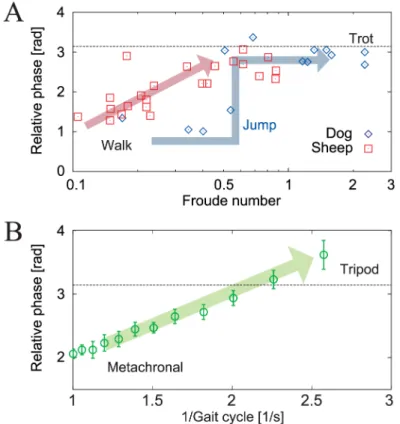
Legged animals prefer specific gaits and change these gaits in accordance with their locomo-tion speeds. For example, quadruped animals use a walking gait at lower speeds but use a trot-ting gait at higher speeds. These gaits are characterized by the relative phases between the limbs (called interlimb phase relationship) [1,2]. In the walking gait, the swinging movements of the legs propagate from back to front, while in the trotting gait, the diagonal legs move in phase. During the transition between these gaits, some quadrupeds, such as dogs, change their ipsilateral phase relationships instantly in a manner similar to the human walk–run transition, whereas other quadrupeds, such as sheep, change their phase relationship with a smooth tran-sition depending on their locomotion speed, as shown inFig 1A[3].
Insects also change their gaits, e.g., between metachronal and tripod gaits, depending on their locomotion speeds, as observed in stick insects [4–7], cockroaches [8–10], and flies [11]. Like quadrupeds, the gaits of insects are also characterized by the relative phases between their limbs. In the metachronal gait, the swinging movements of the legs propagate from posterior to anterior in a manner similar to the quadrupedal walking gait (we call this gait the direct wave gait), while in the tripod gait, the diagonal legs move in phase, like the quadrupedal trot-ting gait. There is a near-antiphase relationship between the left and right limbs, irrespective of
Fig 1. Interlimb phase relationships for locomotion speed. A: Ipsilateral relative phases (fore leg–hind leg) for dogs and sheep versus Froude number (where the locomotion speed increases as the Froude number increases) [3]. Dogs change their phase relationship suddenly at a Froude number of approximately 0.5, while sheep change their phase relationship smoothly based on locomotion speed.B: Ipsilateral relative phases ((fore leg–hind leg)/2) of stick insects for gait cycle (where the locomotion speed decreases as the gait cycle increases) [4]. Data points and error bars show the average values and the errors of the mean values of the measured results, respectively. Stick insects change their phase relationships smoothly based on locomotion speed in a manner similar to sheep.
https://doi.org/10.1371/journal.pone.0192469.g001
grant 01GQ1005A, project D1), http://www.bccn-goettingen.de/. PM is supported by the Human Frontier Science Program (grant no. RGP0002/ 2017),http://www.hfsp.org/fundingand the Centre for BioRobotics (CBR) at University of Southern Denmark (SDU, Denmark),https://www.sdu.dk/en/ om_sdu/institutter_centre/mmmi_maersk_ mckinney_moeller/forskning/forskningsprojekter. FW and FM are supported by the HeKKSaGOn network,http://www.hekksagon.net/61.php. The funders had no role in study design, data collection and analysis, decision to publish, or preparation of the manuscript.
the locomotion speed. While insects can choose gaits in which the swinging movements of the legs propagate from anterior to posterior (we call this gait the retrograde wave gait), as observed in some centipedes [12], they do not use the retrograde wave gait and prefer to use the direct wave gait like quadrupeds. Furthermore, similar to sheep, insects change their ipsi-lateral relative phases smoothly based on their locomotion speed, as shown inFig 1B.
Locomotion is a complex process that requires various components with real-time interac-tion between motor control funcinterac-tions and body dynamics through sensory feedback (embodied sensorimotor interaction) [13]. For example, it is known that stick insects do not generate coor-dinated motor outputs without sensory feedback [14,15], which indicates that sensory feedback plays a critical role in shaping these motor patterns. To attempt to understand the locomotion mechanisms of insects, many researchers have developed bio-inspired control models that use sensory feedback. It is important to clarify the functional role of sensory feedback, because sen-sory feedback has been shown to be an important factor in adaptive and coordinated leg move-ments in many studies [16–21]. Cruse and colleagues [22–25] identified six rules required to establish interlimb coordination based on behavioral studies, and proposed a bio-inspired con-troller using an artificial neural network, called Walknet. This network creates various move-ments for hexapod models and robots, including gait transitions, curve walking and searching behavior, as observed in stick insects. Daun-Gruhn [26] developed an oscillator network model of stick insect walking based on use of central pattern generators (CPGs) for each leg joint along with sensory feedback, which generated the insect like gaits by introducing excitatory and inhib-itory synaptic connections among the oscillators for the ipsilateral front to rear legs. Neurome-chanical models of the insect were also proposed based on physiological findings to
demonstrate adaptive walking using sensory feedback [27–29].
While these models can replicate insect gaits, the functional role of sensory feedback in interlimb coordination is still not fully understood. It is not clear when and how sensory feed-back affects the insect gaits, which is an important factor in the design of the robotic controller. This is largely because these models are too complex (i.e., they have multiple sensory feedback channels, neurons, and muscles). In particular, the effects of embodied sensorimotor interac-tions are too complex to be analyzed using these models. Owaki et al. [30] proposed minimal model to describe the hexapedal interlimb coordination solely by using the local and neighbor-ing leg loadneighbor-ing information. However, they investigated them experimentally with the robot. To the best of our knowledge, no study to date has investigated this effect analytically (i.e., by representing the effects of sensory motor interaction with an analytical solution for the sys-tem). An analytical understanding of this effect would be helpful in providing a deeper under-standing of the gait generation mechanism and for the design of the robotic controller.
In this paper, we designed a minimal control model for hexapod locomotion. A single oscil-lator is used to control the movement of each leg. While the contralateral osciloscil-lators are con-strained to be antiphase, there is no connection between the ipsilateral oscillators. The
ipsilateral coordination is formed by the local sensory feedback (i.e., foot contact information). The local sensory feedback, in the form of phase resetting, modulates the oscillator rhythm based on local tactile information. We investigated the effects of sensory feedback on hexapod gaits using a hexapod robot and found that the robot generated two gaits through the sensory feedback; one of these gaits had the following major characteristic properties of insect gaits [5].
P1 The swing movement propagates from posterior to anterior (i.e., a direct wave gait).
The other gait satisfied P2 but the swing movement propagated from anterior to posterior (i.e., a retrograde wave gait). Next, we propose a simple physical model that is amenable to mathematical analysis to explain the above gait mechanisms analytically. This simple model consists of a rigid body that uses massless springs as legs; the legs are controlled using oscillator phases with phase resetting and its governing equations are reduced such that they can be explained using only the oscillator phases with some approximations. This simplicity allows us to reach analytical solutions for the hexapod gaits via perturbation analysis, despite the com-plex nature of the embodied sensorimotor interactions.
The main contribution of this work is the elucidation of the functional role of specific foot contact sensory feedback on hexapod gaits using both the real physical robot and the simple model. In particular, we demonstrated that the direct and retrograde wave gaits were produced through local sensory feedback using touchdown information, and these gaits changed smoothly depending on the locomotion speed. These results suggest that the local sensory feedback contributes to generation of insect-like ipsilateral interlimb coordination. Further-more, we explained these mechanisms analytically using the simple model, which then allowed us to discuss the differences between the direct and retrograde wave gaits, and the reason for the smooth gait transition. In addition, the simple model shows when and how the sensory feedback affects the gaits. Because the simple model proposed here was able to extract the essence of the gait generation mechanism, this simple model analysis can also be applied to future investigations of other sensory feedback mechanisms and legged locomotion systems.
Results
Hexapod robot and its controller with sensory feedback
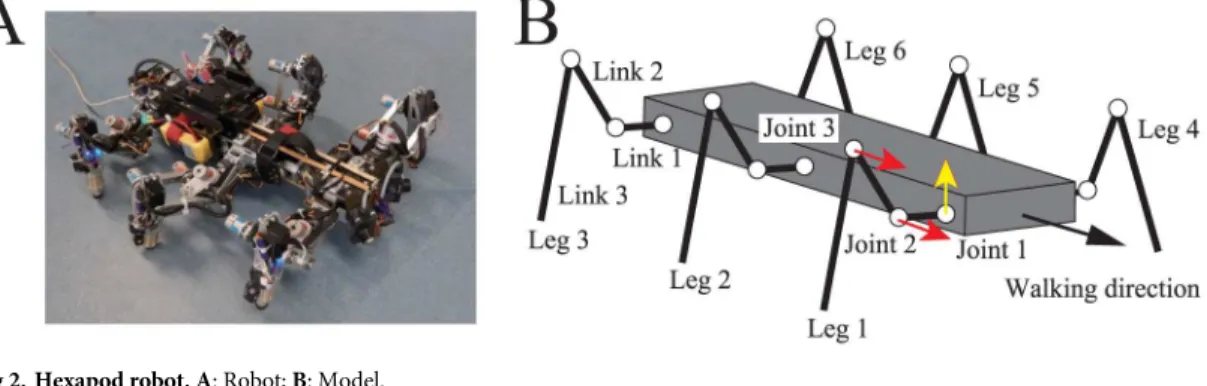
We used a hexapod robot (AMOS II [17]; seeFig 2A) consisting of one body with six legs (Legs 1–6).Fig 2Bshows the physical model of the robot that was used for the computer simu-lations. Joint 1 is a yaw joint that moves the leg from back to front, while joints 2 and 3 are pitch joints that lift the leg up and down. A touch sensor is installed on the tip of each leg.
We developed the control system for this robot using phase oscillators that were inspired by the physiological concepts of CPGs and sensory feedback described in [31–33] (Fig 3). Here, an overview of the system is given. We used six phase oscillators (designated Oscillators 1–6) with phases ofϕi(0ϕi<2π,i= 1,. . ., 6), and designed the trajectory of the tip of each Legi
relative to the body usingϕi(Fig 4). The trajectory is composed of a line segment with lengths
for the stance phase (0ϕi<2βπ) and a simple ellipsoid curve with heightdfor the swing
phase (2βπϕi<2π), whereβis the duty factor (i.e., the ratio between the stance phase and
Fig 2. Hexapod robot. A: Robot;B: Model.
step cycle durations). We set the duration of the swing phase to beTsw= const., as is often observed in insects [4,5]. The walking speedvcan then be given asv= (1−β)s/βTsw. Each joint was controlled using a proportional-derivative (PD) feedback controller to generate the desired joint angle, which was calculated using inverse kinematics.
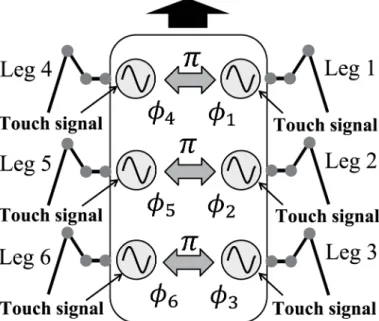
The phase oscillators have a basic frequency and the phases of these oscillators are modu-lated based on the interactions among them and the local sensory feedback. In insect gaits, changes in the ipsilateral phase relationships are dependent on speed, while the contralateral phase relationships are almost in antiphase [5]. To ensure that the system is simple, we mod-eled the interactions such that contralateral oscillators remain in antiphase. However, there are no direct relationships among the ipsilateral oscillators.
Fig 3. Locomotion control system using phase oscillators.Each oscillator controls the movement of a single leg. Contralateral oscillators are set to have alternate phases. Each oscillator is affected by the touch sensor signal.
https://doi.org/10.1371/journal.pone.0192469.g003
Fig 4. Leg movement based on oscillator phase. A: Oscillator phase.B: Desired leg movement. AEP and PEP represent the anterior extreme position and the posterior extreme position, respectively.
Physiological evidence has shown that detection of an increasing load on a leg promotes the retraction of that leg [34,35], and there are also some interneurons that cause a reset of the rhythmicity in motoneuron activities [36]. Based on these findings, we incorporated the phase resetting mechanism with foot contact signal as the local sensory feedback mechanism [31–
33]. More specifically, when Legitouches the ground during the swing phase (2βπϕi<2π)
as indicated by point R inFig 4A, the phaseϕiis reset to zero (see theMaterials and Methods
section).
Because the leg movements of our robot are determined by these oscillation phases, the rel-ative phases between the oscillators (ψ1(=ϕ2−ϕ1) andψ2(=ϕ3−ϕ2)) thus explain the gait, which is produced by interactions among the oscillators and the sensory feedback. In this study, we varied the locomotion speedvusing the duty factorβto determine whether our robot produced gaits that satisfy insect gait properties P1 and P2 through the embodied senso-rimotor interactions using computer simulations and robot experiments; however, these prop-erties were neither predesigned nor predetermined.
Simulation results
We performed computer simulations using the robot model (Fig 2B) and various locomotion
speeds by changingβfrom 0.5 to 0.65 in even steps (where the oscillator frequency changed from 0.05 to 0.0035 Hz, and the locomotion speed changed from 0.015 to 0.008 body lengths per second). At each locomotion speed, stable gaits were found by changing the various initial values of the relative phases (ψ1,ψ2).
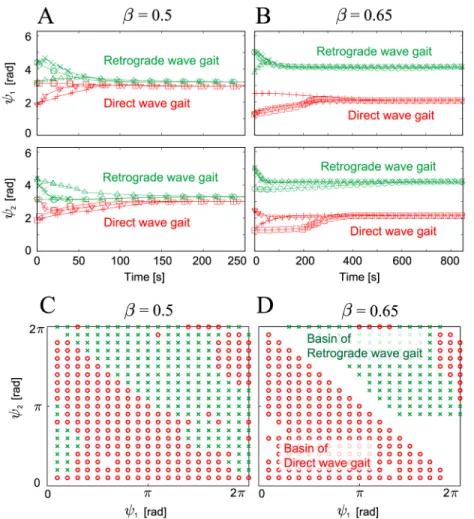
Fig 5A and 5Bshow the time profiles of the relative phases (ψ1,ψ2) for the six initial condi-tions for duty factors ofβ= 0.5 and 0.65, respectively. Data points are plotted when Leg 2 touches the ground (we use this condition for the Poincare´ section). Depending on their initial relative phases, the phases converge to one of two different sets, irrespective ofβ. This means that there are two stable gaits: the direct and retrograde wave gaits.Fig 5C and 5Dshow the basins of attraction for the relative phases (ψ1,ψ2) forβ= 0.5 and 0.65, where the red circles converge to the direct wave gait and the green x points converge to the retrograde wave gait. To calculate the basins, 400 lattice points are given on the relative phase plane as initial values and their convergence after 200 Poincare´ mapping steps is examined. The direct wave gait has larger size of basins than the retrograde wave gait.
Fig 6A and 6Bshow the relative phases (ψ1,ψ2) of the converged gaits that were plotted
when Leg 2 contacted the ground.Fig 6Cshows the maximum absolute eigenvalue that was
calculated based on a linear stability analysis of these gaits. These results show that our robot has two stable gaits (i.e., the direct and retrograde wave gaits), and that the relative phases of the two gaits change smoothly with locomotion speed, as per insect gaits (P2). We also note that the horizontal axis ofFig 1(“1/Gait cycle”) is proportional to (1−β) (see theMaterials and Methodssection).
One of the gaits obtained in the simulations is the direct wave gait, which satisfies the fol-lowing phase relationship:
c1c22ð1 bÞp: ð1Þ
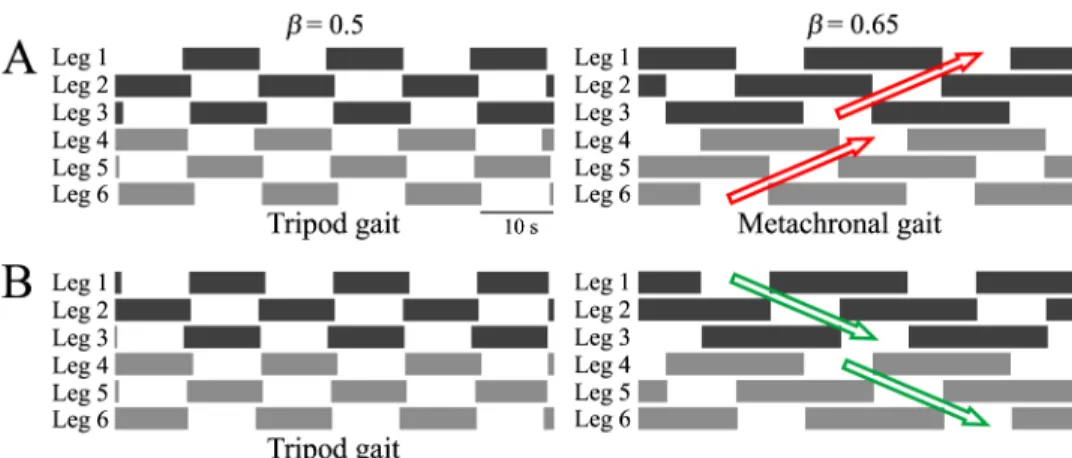
0.65, at least four legs are always in contact with the ground, but the leg movements are not in phase. Because the swing movement of these legs propagates from posterior to anterior, this is a metachronal gait.
The other gait is the retrograde wave gait, which satisfies the following phase relationship:
c1 c22bp: ð2Þ
This relationship is derived fromFig 6A and 6B. The green x points in these figures are close to the lineψ= 2βπ. In this gait, the swing movement of the legs propagates from anterior to posterior and the middle leg (the hind leg) lifts off just after the fore leg (the middle leg) touches the ground, as shown inFig 7B. This gait does not fulfil insect gait property P1. When
β= 0.5, this corresponds to a tripod gait because at least three legs are always in contact with the ground and the movements of the three legs are in phase. However, whenβ= 0.65, while at Fig 5. Relative phases (ψ1,ψ2) of the robot simulation plotted at the foot contact of Leg 2 and the basins of
attraction.Relative phases are plotted for six initial conditions with (A)β= 0.5 and (B)β= 0.65. Six different markers represent the results for the six initial conditions. Irrespective ofβ, the robot established two different gaits (i.e., direct and retrograde wave gaits) that were dependent on the initial conditions. The basins of attraction for the two different gaits are plotted for (C)β= 0.5 and (D)β= 0.65. The red circles and green x points in (C) and (D) converge to the direct wave gaits and the retrograde wave gaits, respectively. The direct wave gaits have larger size of basins than the retrograde wave gait.
Fig 6. Relative phases and maximum eigenvalue of gaits obtained for duty factorβin computer simulations. A: Relative phaseψ1.B: Relative phaseψ2.C: Maximum eigenvalue. Two stable gaits were found for each duty factor
(which were direct and retrograde wave gaits). The relative phases of each of the gaits changed smoothly with changing locomotion speed (duty factorβ).
https://doi.org/10.1371/journal.pone.0192469.g006
Fig 7. Footprint diagrams of the gaits obtained at duty factors ofβ= 0.5 and 0.65 in computer simulations. A: Direct wave gait.B: Retrograde wave gait.
least four legs are always in contact with the ground, the swing movement of the legs propa-gates from anterior to posterior, which differs from the metachronal gait.
In addition, the retrograde wave gait has smaller size of basins than the direct wave gait (Fig 5C and 5D). Furthermore, the retrograde wave gait has higher maximum eigenvalues than the direct wave gait in the Jacobian matrix of the Poincare´ map (Fig 6C). This means that the retrograde wave gait tolerates smaller disturbances than the direct wave gait and that it takes more time for disturbances to vanish from the retrograde wave gait than for the direct wave gait.
Robot experimental results
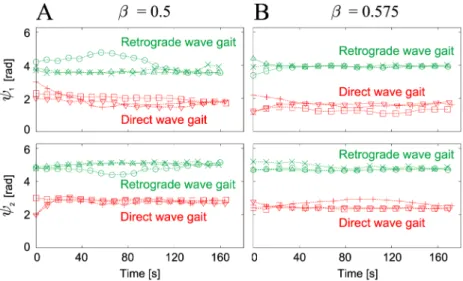
To validate the simulation results above, we performed experiments using the hexapod robot (Fig 2A). We used various values for the duty factorβin the range from 0.5 to 0.65, and used six initial values for the relative phases (ψ1,ψ2) for eachβ.Fig 8A and 8Bshow the time profiles of the relative phases (ψ1,ψ2) that were plotted when Leg 2 touched the ground for duty factors ofβ= 0.5 and 0.575, respectively. Irrespective of the value ofβ, the relative phases converged to one of two different sets, which again means that there are two stable gaits. These two gaits cor-respond to the direct and retrograde wave gaits from the simulation results.
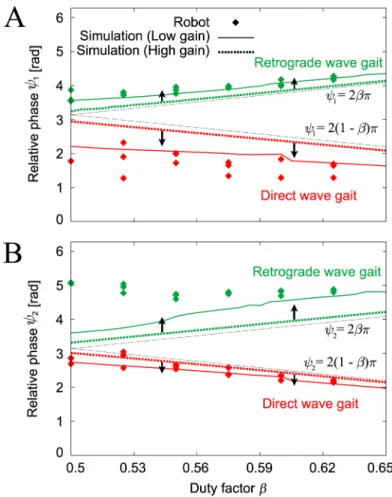
Fig 9shows the relative phases (ψ1,ψ2) of the converged gaits forβwhere the data points of the robot experiments are the average values from three gait cycles after the robot walked for over two minutes for each trial. There are two different gaits (the direct and retrograde wave gaits) and the relative phases changed smoothly with changes in the locomotion speed, as shown in the simulation results inFig 6A and 6B. The results forψ1for the direct wave gait andψ2for the retrograde wave gait differ slightly from the simulation results (dotted lines in
Fig 9). To clarify the reasons for these differences, we performed computer simulations that involved reduction of the PD feedback gains of the joint controller. The feedback gain of the motor controller in our robot is low because of hardware limitations. The simulation results that corresponded to low gain feedback (indicated by the solid lines inFig 9) were closer to the
Fig 8. Relative phases (ψ1,ψ2) of the robot experiments plotted at foot contacts of Leg 2.Relative phases are plotted for six initial conditions with (A)β= 0.5 and (B)β= 0.575. The six different markers represent the results for the six initial conditions. Irrespective of the value ofβ, the robot established two different gaits that were dependent on the initial conditions.
robot experimental results. While small differences still exist because of the limitations of the hardware, the robot experimental results are consistent with these simulation results. The direct and retrograde wave gaits of the robot for a duty factor ofβ= 0.6 are shown in the Sup-porting Information inS1andS2Movies, respectively.
Analysis using the simple physical model
Our hexapod robot produced characteristic interlimb coordination based on the phase rela-tionships among the ipsilateral oscillators that were dependent on the locomotion speed, despite the lack of direct interaction among the ipsilateral oscillators. This result emerged from the local sensory feedback, which was composed of phase resetting. To clarify the contribution of this embodied sensorimotor interaction to the determination of the phase relationship, we used a simple physical model of our hexapod robot and investigated its gait mechanism from a stability viewpoint. Here, we briefly explain the simple physical model. Full details are pre-sented in theMaterials and Methodssection.
The simple physical model (Fig 10) is reduced from our hexapod robot model and the oscil-lator-based controller on the basis of certain physical assumptions. The model consists of a Fig 9. Relative phases (A)ψ1and (B)ψ2of the gaits obtained for duty factorβin the robot experiments and the
computer simulations.Two stable gaits were obtained in the robot experiments: direct and retrograde wave gaits. The computer simulations used high and low feedback gains. When the feedback gain was reduced, the simulation results became much closer to the robot experimental results.
rigid body (mass:M; length: 2a; width: 2b) and six massless spring legs. The spring legs, which each have a spring constant ofK, are vertically attached at the bottom of the body at intervals ofaand represent the physical influence of the feedback controllers for the leg joints on the body (see assumption A1 in theMaterials and Methodssection). Based on the leg trajectory that was designed based on the oscillator phaseϕi(Fig 4), we determine the root positionΔxi
and the neutral lengthLiof the spring usingϕi. Because our robot walked with a long gait cycle
(i.e., at low speed), we investigated this simple model using its static equilibrium. We then obtained approximate solutions and determined the stability of these solutions.
Simple model analysis results
We derived periodic solutions for the two different gaits (the direct and retrograde wave gaits). The fixed points in the Poincare´ section, which corresponds to the touchdown points of Leg 2 without loss of generality, for these solutions are given by
cDw1 ¼ 2ð1 bÞp 2ð1 bÞ 1
dKþ
2 5
1 b b
1 dK
s
aþOððK Þ 2
Þ;
cDw2 ¼ 2ð1 bÞp 9
10ð1 bÞ 1 dKþ
1 25
11 b 30
ð1 bÞ 1
dK s
aþOððK Þ 2
Þ;
ð3Þ
and
cRw1 ¼ 2bpþ 9
10ð1 bÞ 1 dKþ
1 25
11 b 30
ð1 bÞ 1
dK s
aþOððK Þ 2
Þ;
cRw
2 ¼ 2bpþ2ð1 bÞ 1 dKþ
2 5
1 b b
1 dK
s
aþOððK Þ 2
Þ;
ð4Þ
whereðcDw1 ;cDw2 ÞandðcRw1 ;cRw2 Þare the fixed points of the direct and retrograde wave gaits, respectively. ()indicates a dimensionless parameter (see theMaterials and Methodssection),
andsanddare the dimensionless length and height shown inFig 4B, respectively.Fig 11
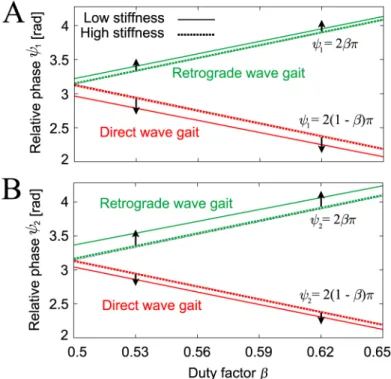
shows these fixed points, which are consistent with the corresponding points in our robot Fig 10. Simple physical model with rigid body and six massless spring legs.The body is represented by a flat plate here to show the geometric relationships between the model and the variables more clearly.
simulations (Fig 6);ψ1=ψ2= 2βπ+O((K)−1) for the direct wave gait andψ1=ψ2=
2(1−β)π+O((K)−1) for the retrograde wave gait. In addition, these fixed points have similar dependences on the feedback gain (seeFig 9).
Additionally, we obtained the maximum eigenvalues of the Jacobian matrix of the Poincare´ map of (ψ1,ψ2) for these two gaits:
lDw ¼ 5
6 4 45b
s a
2
;
lRw ¼ 5
6þ 4 45b
s a
2
;
ð5Þ
whereλDwandλRwrepresent the eigenvalues for the direct and retrograde wave gaits, respec-tively. The gait stability is dependent ons/aand these gaits are asymptotically stable for small
values ofs/a. While the two gaits have the same stability (λDw=λRw) fors/a= 0, the direct
wave gait is more stable than the retrograde wave gait (λDw<λRw) fors/a>0, as determined
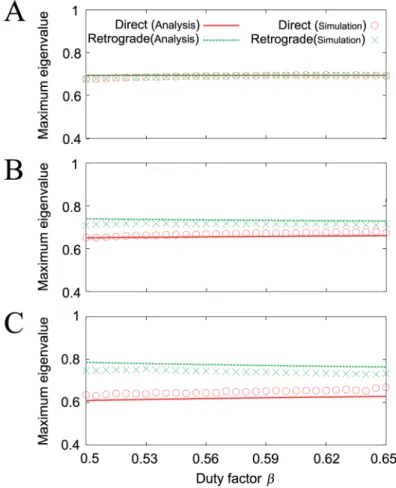
in the simulation results (Fig 6C).Fig 12compares the maximum eigenvalues from the simple model with those from the robot simulation. The results of the simple model analysis and the robot simulation are clearly similar. Details of the derivation of these solutions and their stabil-ity are presented in theMaterials and Methodssection.
Fig 11. Relative phases A (ψ1) and B (ψ2) of the direct and retrograde wave gaits from the simple model.The relative phases are derived with both high stiffness (dK= 50)(solid line) and low stiffness (dK= 5)(dashed line) for s/a= 0.3. When the stiffness decreases, the relative phasesψ
1andψ2move away from 2βπand 2(1−β)πin a similar
manner to the robot model inFig 9. In addition, the relative phases of each gait change smoothly with changes in locomotion speed (duty factorβ), as per the simulation.
Discussion
Interlimb coordination generated by local sensory feedback
In this study, we have investigated the effects of local sensory feedback, in the form of phase resetting, on the interlimb coordination during hexapod locomotion using a minimalistic modeling approach. In contrast to similar previous approaches [31,37–39], the ipsilateral oscillators in our model had no direct interactions. Our results show that our robot simulation model and the robot using the local sensory feedback generate two different gaits: direct and retrograde wave gaits. The direct wave gait is similar to an insect gait. In addition, the inter-limb coordination of the two generated gaits changed smoothly, as observed in insect gaits (Fig 1B) [4,5,8,11]. These gaits are not designed; instead, they emerge as a result of the embodied sensorimotor interaction. In addition, the simple model analysis replicates the results of both the robot simulations and experiments well, and the analysis also reveals the essence of the stability mechanism through analytical solutions. The model shows that these phenomena can happen when the walking speed is slow and the legs are elastic, as per physical assumptions A1-7 in theMaterials and Methodssection. These results indicate that local Fig 12. Maximum absolute eigenvalues of the direct and retrograde wave gaits of the simple model (Analysis) and the robot simulation (Simulation) for duty factorβ. A:s/a= 0,B: 0.15, andC: 0.3.
sensory feedback with phase resetting contributes to generation of ipsilateral interlimb coordi-nation during hexapod locomotion, which is consistent with physiological indications [40,41].
Some works have been performed to understand the interlimb coordination mechanism. For example, Cruse and colleagues [22–25] identified six rules to establish interlimb coordina-tion based on behavioral studies, and proposed a bio-inspired controller using an artificial neural network called Walknet. This network created various movements for hexapod robots, including gait transitions, curve walking and searching behavior, as observed in stick insects. Daun-Gruhn [26] developed an oscillator network model of stick insect walking based on the use of CPGs for each leg joint and sensory feedback. This model had both excitatory and inhib-itory synaptic connections for the oscillators for the ipsilateral front to rear legs. While these works achieved insect-like walking behavior, their models were complicated to allow clarifica-tion of the interlimb coordinaclarifica-tion mechanism. Our analytical expression gives a better under-standing of the functional effects of foot contact sensory feedback for interlimb coordination.
Similar studies using quadruped robots proposed a simple local sensory feedback mecha-nism that used leg loading information [42–44], and showed that interlimb coordination of the type observed in quadruped animals emerges through embodied sensorimotor interac-tions. Owaki et al. [30] showed that the hexapod robot can generate insect like interlimb coor-dination solely by using the local and neighboring leg loading information designed by the Tegotae based approach. Their minimal model reproduced various insects’ gait pattern includ-ing the adaptation to leg amputation. Although the Tegotae approach and our approach use foot contact sensory feedback as local sensory information to achieve insect-like ipsilateral interlimb coordination, our approach relies only on the regulation of leg retraction timing while the Tegotae approach is based on a function that quantitatively measures a perceived reaction (i.e., sensor feedback) and an expectation (intention) of a controller which can be considered as an internal model. In addition, because of the simplicity of phase resetting, our simple model allows us to give an analytical explanation as to why the local sensory feedback determines the gaits in hexapods, which have not been explained in above studies (see the
Materials and Methodssection).
Direct and retrograde wave gaits
Our robot simulation model and our robot generate both the direct and retrograde wave gaits using the local sensory feedback. In addition, the direct wave gait has a larger basin and a lower maximum eigenvalue than the retrograde wave gait. This means that perturbations in the direct wave gait disappear more rapidly than those in the retrograde wave gait and the direct wave gait can tolerate larger disturbances. Hughes [8] stated that at the liftoff of the fore legs, the center of mass (COM) in the retrograde wave gait within the supporting polygon is less than that in the direct wave gait. Our results suggest that the direct wave gait is better for robust walking, as proposed by Hughes.
In addition, the main reason why the stabilities of the two gaits are different is determined via the simple model analysis, as shown in theMaterials and Methodssection. The analysis results indicate that the retrograde wave gait is more stable than the direct wave gait when the model walks in the backward direction, which shows that the position of the COM relative to the supporting polygon affects the stability of the gait through embodied sensorimotor interaction.
Smooth and discontinuous gait transitions
certain insects, such as stick insects, change their gaits smoothly, as shown inFig 1B. Scho¨ner et al. [45] suggested that these gaits are the result of self-organization in a complex dynamic system. From this perspective, the differences between smooth and discontinuous gait transi-tions can be explained in terms of the gait stability structures.
Discontinuous gait transitions indicate that only some parts of the interlimb coordination can exist stably, and that these parts are separated. The appearance of hysteresis within the gait transition reflects this stability structure [33,46]. In previous work [32], we used a simple quadruped model and an oscillator network with phase resetting to show that saddle-node bifurcations induce discontinuous gait transitions and hysteresis using a dynamic stability analysis.
In contrast, smooth gait transitions indicate that all interlimb coordination within a specific range can exist stably. In this study, we show that the change in the gait of our robot simulation model occurs smoothly and is dependent on the locomotion speed (Fig 6A and 6B), as
observed in stick insects (Fig 1B). In the case of the direct wave gait, the model generates a metachronal gait at slow speeds (β= 0.65), and this gait transits smoothly to a tripod gait (β= 0.5) as the speed increases. This dependence of the gait on the locomotion speed can be explained via an analysis of the static stability of the body dynamics using our simple model, as shown inFig 11. These results indicate that the discontinuous gait transition mechanism arises from dynamic stability, while the smooth gait transition mechanism can be explained based on static stability.
Role of sensory feedback in fast and slow locomotion
It has previously been suggested that sensory feedback does not play a primary role in high– speed locomotion [47]. For example, the high–speed walking motions of cockroaches were analyzed using a simple planar model that was composed of a rigid body with massless spring legs [48,49], and the results showed that self-stabilization based on intrinsic musculoskeletal properties makes a greater contribution to the generation of locomotion than the sensory feedback.
Conversely, it has also been suggested that sensory feedback plays a critical role in low– speed locomotion, as observed in stick insects [47,50]. For example, a neuromechanical model of a stick insect leg showed that the three leg joints were all controlled by independent bistable neural circuits with sensory feedback [51]. In addition, computer simulations and robot exper-iments involving low–speed movement demonstrated that coordinated leg joint movements are generated by neuromechanical interactions through sensory feedback [52]. Some studies proposed use of positive feedback of the angular velocity for joint control [24,53], which con-tributes to the adjustment of the leg trajectory and thus reduces mechanical stress [28]. Our model focuses on the embodied sensorimotor interactions produced by local sensory feedback to clarify the mechanisms of low–speed insect gaits.
Limitations and future work
interlimb coordination through regulation of the leg retraction timings, which can vary according to changes in the body posture. While we did succeed in clarifying the effects of sen-sory feedback on ipsilateral interlimb coordination, the above properties cannot be explained based on the focused sensory feedback alone. We would therefore like to analyze these proper-ties in future by considering other types of sensory feedback, e.g., joint angle feedback.
Physically, the mass and size of the robot are unlike the corresponding properties of insects. In addition, the robot’s joints are controlled by high–gain servo motors, while insects use mus-cles to control their joints. In the neural model, we used a simple CPG-based controller and a sensory feedback model. However, our simple model and the associated analysis can provide meaningful insights into both the biological sciences and engineering, as many studies have shown [57–60]. In particular, because our simple model extracted the essential components that are required for hexapod static walking, it can provide a basis for further analysis of insect gaits and offer hints for adaptive walking design. For example, the constraint that has been imposed between the left and right oscillators can easily be removed from our simple model for the purposes of further analysis. Additionally, other gait types that we did not analyze in this work, such as the tetrapod gait [54], can also be investigated more easily using our simple model than through use of a complex insect model. Sensory feedback with leg loading infor-mation can also be applied to our simple model. This simple model will also be helpful in the design of a distributed control method for legged robots that can adapt to leg amputation, because the model is simple to formulate. In addition, our analysis can be extended to multi-legged and quadruped models. The direct wave gait has also been observed in quadrupeds and millipedes. Conversely, the retrograde wave gait has also been observed in some centipedes. It will also be possible to analyze the effects of sensory feedback on these gaits by simply extend-ing our analysis. In the future, we will test on uneven ground as well as investigate mechanisms underlying continuous and discontinuous gait transitions.
Materials and methods
Hexapod robot
The hexapod robot (AMOS II [17] inFig 2) is composed of a single body and six legs (Legs 1–6). Each leg consists of three links (Links 1–3), which are connected using joints that are controlled by servo motors (Joints 1–3). Joint 1 is a yaw joint that moves the leg from back to front. Joints 2 and 3 are the pitch joints that lift the leg up and down. A touch sensor has been installed on the tip of each leg.Table 1lists the physical parameters of the robot in the case where all six legs are identical.
Table 1. Physical parameters of the robot.
Link Parameter Value
Body Mass [kg] 4.6
Width [mm] 100
Length [mm] 400
Leg link 1 Mass [kg] 0.27
Length [mm] 65
Leg link 2 Mass [kg] 0.27
Length [mm] 65
Leg link 3 Mass [kg] 0.27
Length [mm] 115
The robot is battery-powered and is controlled using an external host computer (central processing unit (CPU): Intel Core i5 2.5 GHz; memory: 8 GB) with commands sent at 1/30 s intervals. Communications between the robot and the computer are conducted via the serial interface. The serial cable remains slack so that it does not affect the locomotion of the robot. For computer simulation of our hexapod robot model, we used the LPZROBOTS computer simulator, which is based on the Open Dynamics Engine (ODE) [61].
Controller
Phase oscillator and motor controlThe phase oscillators follow these dynamics:
_
i ¼ oþgiþyi; ð6Þ
ty_i ¼ kif yi; ð7Þ
whereωis the basic locomotion frequency andgiis the interaction between the oscillators (see
the section below entitled Hexapod gait in the phase oscillator model).ki
frepresents the sen-sory feedback, which is incorporated in a first-order lag system usingyiand the time factorτ
(= 1 s) (see the section below entitled Sensory feedback).
For motor control, the tip of Legifollows a trajectory relative to the body that is based onϕi
(Fig 4). During the stance phase (0ϕi<2βπ), the leg tip moves along a line segment that
runs between the anterior extreme position (AEP) and the posterior extreme position (PEP), which lies parallel to the body. During the swing phase (2βπϕi<2π), the leg tip moves
along a simple ellipsoid curve that includes both the AEP and the PEP.βis the duty factor (i.e., the ratio of the stan phase and step cycle durations). We used the distance between the AEP and PEP, denoted bys= 6 cm, and the height of the ellipsoid, denoted byd= 6 cm. Each joint was controlled using a PD feedback controller to generate the desired joint angle that was cal-culated using inverse kinematics.
We set the duration of the swing phase to beTsw= const., as is often observed in insects [4,
5]. The step cycle durationTp, the basic frequencyωin (6), the stride lengthSland the locomotion speedvare then given byTp=Tsw/(1−β),ω= 2(1−β)π/Tsw,S=s/β, andv= (1−β)s/βTsw, respectively, i.e., they are all determined based onβ. We setTsw= 5 s in the experiments and 10 s in the simulations.
Hexapod gait in the phase oscillator modelBecause the leg movements of our robot are determined by the oscillation phases, the relative phases between the oscillators must explain the gait, which are produced by interactions among the contralateral oscillators and the sen-sory feedback.
In insect gaits, the ipsilateral phase relationships change depending on the speed of motion, while the contralateral phase relationships are almost in antiphase [5]. To ensure a simple sys-tem, we assume that the contralateral legs alternate in phase. Therefore, the interactions between the oscillatorsgiin (6) are described as follows (Fig 3):
gi ¼
X
6
j¼1 kij
csinði j pÞ; ð8Þ
where
kij
c ¼
(k
c ði; jÞ 2 fð1;4Þ;ð2;5Þ;ð3;6Þ;ð4;1Þ;ð5;2Þ;ð6;3Þg
0 otherwise:
oscillators are constrained to values ofπ. There is no direct interaction that could produce another relationship among the oscillators (ipsilateral coordination).
Because the relative phases between the left and right legs are set in antiphase, the gait in our phase oscillator model can be explained using the two relative phasesψ1(=ϕ2−ϕ1) and
ψ2(=ϕ3−ϕ2), which are determined based on locomotion dynamics.
Sensory feedbackSensory feedback plays an important role in determining the coordinated motor outputs of the CPGs during locomotion [14,50,62–65]. Physiological evidence has shown that detection of an increasing load on the leg promotes leg retraction [34,35], and some interneurons can cause a reset of the rhythmicity during motoneuron activities [36]. The motor outputs of the CPGs are thus modulated by phase shifting and rhythm resetting based on foot contact information (phase resetting).
Based on these findings, we incorporated the phase resetting mechanism from our previous work [31] and thus determinedki
fin (7) by
ki f¼
(0 0
iðtoiÞ<2bp
f2p iðti
oÞgdðt toiÞ 2bpiðtoiÞ<2p;
ð9Þ
whereti
ois the time when Legitouches the ground andδ() is the Dirac delta function. When Legitouches the ground during the swing phase (2βπϕi<2π), as indicated by point R in
Fig 4A, the phaseϕiis then reset to zero. We denoteiðtoiÞhere as td
i (i.e., the touchdown phase). In this paper, we used a first-order lag system with time factorτto vary the phase value continuously [66] for the robot simulation model. Because of this phase resetting process, leg load detection triggers retraction of the leg. This can be regarded as a simplified description of the sensory feedback process in insects that was described above [34,35].
Simple physical model
Physical assumptionsTo clarify the underlying mechanisms that allow our hexapod robot to produce two different gaits and to change the phase relationship between the tripod and meta-chronal gaits smoothly with changes in the locomotion speed, we develop a simple physical model (Fig 10) based on the following assumptions:
A1 Because the legs of the robot are much lighter than its body, we neglect the mass of its legs. We also replace the physical influence of the PD feedback controllers of the leg joints on the body through use of spring legs. The angular displacements from the commanded angles in the joints yield forces that are proportional to these displacements because of the PD feedback controllers in the robot simulation model and in the robot. We therefore model this effect simply using the springy leg in the simple model. Specifically, we use six massless springs (with spring constantK) that are vertically attached (spaced at intervala) to the bottom of the body (mass:M; length: 2a; width: 2b). Touchdown and liftoff both occur at the neutral length and the springs only work during the stance phase.
A2 Because the gait cycle of our robot was more than 20 s, which ensures that the robot’s gait is static, we investigated the static equilibrium while neglecting the horizontal friction that occurs between the leg tips and the ground.
A4 Based on the leg trajectory that was designed based on the oscillator phaseϕi, we
deter-mine the root positionΔxiand the neutral lengthLiof the spring usingϕi(Δxi=Δxi(ϕi), Li=Li(ϕi)). We also assume that the toe position can be changed without any dynamics.
A5 Because the feedback gains of our robot are large enough to follow the desired leg trajec-tory, particularly in the computer simulations, we used a large value for the spring con-stantKand use this constant as an order parameter in the stability analysis.
A6 Because the relative phases of the left and right oscillators are constrained to a value ofπ
in (6), we useϕi+3=ϕi+π(i= 1, 2, 3).
A7 Because the time constantτin (7) is much shorter than the gait cycle, we neglect the delay in the sensory feedback process (τ= 0).
In the simple model, we use the inertial frameSG(xG,yG,zG), which is fixed on the ground, and the robot coordinate frameSR(xR,yR,zR), which is fixed on the body, with an origin that is located at the COM.qGandqRare the vectors onSGandSR, respectively.xRis the walking direction of the model andzGis the vertical direction. The robot posture is represented by the pitch angleΔθpand the roll angleΔθr. We denote the position of the COM byrGRonSGand the position of the tip of LegibyxR
tionSR. The length of Legiis represented byLi−Δli, where
Δliis the compression. The displacement of the root of Legiin thexRdirection is represented byΔxi.
The positions of each of the leg tipsxR
tiði¼1; . . .;6ÞonSRare given by
xR
t1 ¼ ½aþDx1; b; ðL1 Dl1Þ
T
xR
t2 ¼ ½Dx2; b; ðL2 Dl2Þ
T
xR
t3 ¼ ½ aþDx3; b; ðL3 Dl3Þ
T
xR
t4 ¼ ½aþDx4; b; ðL4 Dl4Þ
T
xR
t5 ¼ ½Dx5; b; ðL5 Dl5Þ
T
xR
t6 ¼ ½ aþDx6; b; ðL6 Dl6Þ
T : ð10Þ 8 > > > > > > > > > > > > > > > > < > > > > > > > > > > > > > > > > :
Based on the leg tip trajectory of our robot shown inFig 4B, the neutral length of the leg spring
Liand the displacement of the associated rootΔxiare given as functions of the oscillator phase ϕi, as follows:
Li ¼
(L 0
i<2bp
L dsini 2bp
2ð1 bÞ 2bpi <2p;
ð11Þ
Dxi ¼
s 1 2
i 2bp
0i<2bp
s 1
2þ
i 2bp 2ð1 bÞp
2bpi<2p;
ð12Þ 8 > > > > < > > > > :
whereLis the neutral spring length during the stance phase.
To clarify the parameter dependence of the gait stability, we normalized the physical parameters. Specifically, we normalized the length parameterpwith respect toLasp=p/L
dimensionless parameter. We assume the orders of the dimensionless parameters used for the stability analysis as follows:
a; b; d’Oð1Þ; ð13Þ
s ≲O ðKÞ 23
; ð14Þ
Dl
i;Dyp; Dyr’OððK
Þ 1
Þ; ð15Þ
We neglectO((K)−2) here. However, the inequality of (14) means that we do not neglect the dimensionless parameters {Δp,s, (s)2,sΔp} forΔp’O((K)−1).
Phase description of the model position and posture based on equilibrium of force and momentWhen the vertical distance from the leg root to the ground is less than the neutral lengthL
i, and the compression of the leg springDl
i 0, the leg is in contact with the ground. Otherwise, the leg must be in the air. LetS= {ijLegion the ground} be the set of stance legs. When Legiis in contact with the ground, the following constraint applies:
ðxG
ti Þz¼ ðR G Rx
R
ti Þz¼0 i2S; ð16Þ
where ()zindicates thezelement and the matrixRGRis the approximate rotation matrix from SRtoSGgiven by
RG R¼
1 0 Dyp
0 1 Dyr
Dyp Dyr 1
2 6 6 6 4 3 7 7 7 5 :
The constraint of (16) is approximated here using the dimensionless heighth(¼ ðrG
R Þz) as
Dl
1 ¼ ða
þ
Dx
1ÞDypþb
DyrþL
1 h
Dl
2 ¼Dx
2Dypþb
Dy
rþL
2 h
Dl
3 ¼ ð a
þDx
3ÞDypþb
Dy
rþL
3 h
Dl
4 ¼ ða
þDx
4ÞDyp bDyrþL4 h
Dl
5 ¼Dx
5Dyp bDyrþL5 h
Dl
6 ¼ ð a
þDx
6ÞDyp bDyrþL6 h
; ð17Þ 8 > > > > > > > > > > > > > > < > > > > > > > > > > > > > > :
where the equation forDl
i is only applicable wheni2S. Based on this constraint,Dl
i can be determined usingΔθr,Δθp,h, andϕi.
The ground reaction force is given by the sum of the spring compression forces of the stance legs, which is equivalent to the gravitational force, and thus yields the following equa-tion:
X
i2S
K
Dl
In addition, the equilibria of the moments around the COM in the pitch and roll directions are approximated as follows:
X
i2S
K
Dl
iðR G Rx
R
ti Þx ¼0; ð19Þ
X
i2S
KDliðR G Rx
R
ti Þy¼0; ð20Þ
where ()xand ()yindicate thexandyelements, respectively. From (18), (19), and (20),Δθr,
Δθp, andhcan be determined using the oscillator phaseϕiwith the dimensionless parameters a,b,d,s, andK.
Phase dynamicsBased on assumptions A6 and A7, the phase dynamics of (6) can be reduced to
_
i ¼oþ
1 2k i fþ 1 2k
iþ3
f i¼1;2;3; ð21Þ
wherekiþ3
f indicates the sensory feedback from the leg on the opposite side and the coefficient 1/2 for bothki
fandk iþ3
f comes from assumption A6 (a detailed explanation is presented in
S1 Appendixin the supplementary file). The sensory feedbackki
fonly works at the foot contact. Because the model positionh
and
the posture (Δθr,Δθp) are represented byϕi,kifin (9) is explained usingϕi. The state variables
in this system are therefore summarized byϕ1,ϕ2, andϕ3, and the gait is then represented by the relative phasesψ1(=ϕ2−ϕ1) andψ2(=ϕ3−ϕ2).
Single constraint on the phase relationship immediately before a touchdown eventIn this model, when the leg touches the ground, the vertical distance from the leg root to the ground is equal to the neutral length (Dl
i ¼0). Because the model position and posture are described usingϕi, this equality gives only a single constraint forϕi.
Derivation of periodic solutions and their stabilities
In this section, we derive periodic solutions for the direct and retrograde wave gaits and inves-tigate the stability of these solutions through linear stability analysis. First, we deal with the direct wave gait, and then deal with the retrograde wave gait based on the symmetry properties of these gaits.
In one gait cycle, each leg experiences the swing and stance phases once. Because the rela-tive phases between the oscillators change only at the moment of foot contact by phase reset-ting, as in (21), the reset value must be identical for all the oscillators for the periodic solution. This means that the phase value immediately before foot contact must be identical for all the oscillators (i.e.,td
1 ¼
td
2 ¼
td
3).
Direct wave gaitFig 13shows the sequence of the touchdown and liftoff events for the legs with the direct wave gait in the range around 1/2<β<2/3. The touchdown event of Legiis denoted by event Ti. Events T2, T6, T1, T5, T3, and T4 thus occur in that order for a single gait cycle. Because of the right and left symmetries of the simple model and the antiphase rela-tionship between the left and right oscillators, our model thus has axial symmetry. Because the amount of phase resetting is determined by the geometric conditions at each event (Dl
equivalent to events T1, T2, and T3, respectively. Therefore, we investigate the sequence T2, T3, T1, T2, T3, and T1 for a single gait cycle, which means that we only need to examine half of the repeating events: T2, T3, and T1.
We denote the sets of stance legs immediately before event Ti(i= 1, 2, 3) bySTi, which is based on the relative phasesψ1*ψ2*2(1−β)πas
ST1¼ f2;4;6g; ST2¼ f1;3;4;5g; ST3¼ f1;2;5;6g: ð22Þ
The details of these sets are presented inS2 Appendixof the supplementary file.
We use the timing immediately before event T2 for the Poincare´ section and find the fixed point for the relative phasesðc^T2
1 ; c^
T2
2 Þto produce the periodic solution; here, we denote the
value immediately before event TibyðÞTiand the value of the periodic solution immediately before event TibyðÞ^Ti. Phases (ϕ
1,ϕ2,ϕ3) evolve over time, and the relative phases (ψ1,ψ2) evolve as events occur.Fig 14shows how the phases (ϕ1,ϕ2,ϕ3) and the relative phases (ψ1,ψ2) at each event evolve as a result of the sensory feedback, where event T2’ indicates event T2 after half a gait cycle, and the value next to “Sensory feedback” indicates the amount of change in the oscillator phase caused by phase resetting (21). Immediately before event T2 (the Poin-care´ section),T2
2 is equal to
td
2, and the relative phases are represented byðc
T2
1 ;c
T2
2 Þ, as per
Fig 14. Immediately after event T2, the phaseϕ2is changed topþtd2=2by the sensory
feed-back. The relative phases immediately after event T2 are also changed as shown inFig 14
because of the sensory feedback. Next, event T3 occurs. Immediately before event T3,T3
3 is
equal totd
3. Because no leg touchdown event occurs between events T2 and T3, the relative
phases immediately before event T3 are the same as those immediately after event T2, which is indicated by the equals sign inFig 14. While we omit further explanation ofFig 14here, we can see that the state variablesðTi
1;
Ti
2;
Ti
3Þimmediately before each event Tiare represented
by the relative phases on the Poincare´ sectionðcT21 ; cT22 Þandðtd
1;
td
2;
td
3Þ. To find the
peri-odic solution, we then solve for^td
2ð¼^
td
1 ¼^
td
3Þ,c^
T2
1 , andc^
T2
2 , which can be determined from
the phase relationshipDl
1¼0,Dl
2 ¼0, andDl
3 ¼0immediately before events T1, T2, and
T3, respectively. As a result,c^T2
1 andc^
T2
2 are given byc
Dw
1 andc
Dw
2 , respectively (see (3)). A
detailed explanation of this derivation is presented inS3 Appendix.
Fig 13. Touchdown and liftoff events for the direct wave gait.Black and grey legs represent the stance and swing legs, respectively. Events Tiand T(i+ 3) (i= 1, 2, 3) have axial symmetry.
We investigate the stability of this direct wave gait by analyzing how the small perturbations
Δψ1andΔψ2for the relative phasesc^T21 andc^
T2
2 immediately before event T2 evolve after a
sin-gle gait cycle, where we assume that these perturbations do not change the sets of stance legs
ST1,ST2, andST3. We obtain the perturbations after they have evolved over one gait cycle
ðDc01; Dc
0
2Þfrom the amount of phase resetting that occurs at each event using
Dc01
Dc02
2
4 3
5 ¼
ffiffiffiffiffiffiffi
lDw1
q
0
ffiffiffiffiffiffiffi
lDw2
q
ð1
ffiffiffiffiffiffiffi
lDw1
q
Þ ffiffiffiffiffiffiffilDw2
q 2
6 6 4
3
7 7 5
2
Dc1
Dc2
" #
; ð23Þ
where
lDw
1 ¼
5 6
4 45b
s a
2
;
lDw2 ¼ 13 18þ
4 81b
s a
2
:
ð24Þ
A detailed explanation of how we obtain this solution is presented inS4 Appendix.lDw1 and
lDw2 correspond to the eigenvalues of the evolution matrix of the perturbations. Becauses
is
small (O ðKÞ 23
),lDw
1 ð¼l
DwÞis the maximum eigenvalue and thus determines the stability
of this gait.
Fig 14. Evolution of the oscillator phases as a result of sensory feedback at each event.The sensory feedback provided at each event changes the relative phases.
Retrograde wave gaitNext, we derive the periodic solution for the retrograde wave gait and investigate its stability by considering the conditions of symmetry between the direct and retrograde wave gaits. We denote the flow of the oscillator phases by the stride parameters
and the initial valuesT2
1 ;
T2
2 , and
T2
3 immediately before event T2 byΦsðt; T2 1 ; T2 2 ; T2 3 Þ.
Because the model movements for the direct wave gait withs>0 and for the retrograde wave
gait with−s<0 are identical except for the walking direction, we can then write
Φsðt;T2
1 ;
T2
2 ;
T2
3 Þ ¼Φ sðt; T2
3 ;
T2
2 ;
T2
1 Þ ð25Þ
Based on this symmetry condition,c^T2
1 andc^
T2
2 for the retrograde wave gait are given byc
Rw
1
andcRw2 , respectively (see (4)). Additionally, the eigenvalues of the evolution matrixðlRw1 ; lRw2 Þ become
lRw1 ¼ 5
6þ 4 45b s a 2 ;
lRw2 ¼ 13
18 4 81b s a 2 : ð26Þ
The maximum eigenvaluelRw1 ð¼lRwÞthus determines the stability of this gait.
Stability mechanismIn this section, the mechanism by which the perturbations evolve in this stability analysis is explained briefly by focusing on a specific leg. The perturbations in the relative phases change the body inclination through the elasticity of the leg and thus change the timing of the leg touchdown, which induces changes in the relative phases through phase resetting, as shown inS3andS4Appendixes. As a result, the perturbations change after the leg touchdown event. This process reduces the perturbations after a single gait cycle through six leg touchdown events, as shown in (24) and (26).
In addition, because the legs propel the body (s6¼0), the relative foot positions between
the legs at the leg touchdown point are different for the two gaits (direct and retrograde wave gaits), as characterized by (25). Therefore, the body inclination angles induced by the perturba-tion are different for the two gaits. This changes the phase resetting intensity, and the stability then differs between the two gaits, as characterized by the lengths/ain (24) and (26).
Supporting information
S1 Movie. Direct wave gait in the robot experiments.This movie shows the direct wave gaits of the robot at a duty factor ofβ= 0.6. The swing movement propagates from back to front. Additionally, this is the metachronal gait because all four legs are almost always in contact with the ground.
(MP4)
S2 Movie. Retrograde wave gait in the robot experiments.This movie shows the retrograde wave gaits of the robot at a duty factor ofβ= 0.6. While all four legs are almost always in con-tact with the ground, the swing movement propagates from front to back.
(MP4)
S1 Appendix. Effect of the phase interaction between left and right on phase resetting.This appendix explains how assumptions A6 and A7 reduce the original phase dynamics of (6) to the reduced phase dynamics of (21).
S2 Appendix. Set of stance legs immediately before each event for the direct wave gait.This appendix explains how the set of stance legs immediately before each event is determined for the direct wave gait.
(PDF)
S3 Appendix. Derivation of periodic solution for the direct wave gait.This appendix explains how the periodic solution for the direct wave gait in (3) is obtained.
(PDF)
S4 Appendix. Stability analysis of the direct wave gait.This appendix explains how the evo-lution matrix of the perturbations in (23) is derived.
(PDF)
Acknowledgments
This work was partly supported by the JSPS Institutional Program for Young Researcher Over-seas Visits, the HeKKSaGOn network, the JSPS Grant-in-Aid for Young Scientists (A) (grant no. 17H04914), the Bernstein Center for Computational Neuroscience II Goettingen (BCCN grant no. 01GQ1005A, project D1), the Centre for BioRobotics (CBR) at University of South-ern Denmark (SDU, Denmark) and the Human Frontier Science Program (grant no. RGP0002/2017).
Author Contributions
Conceptualization:Yuichi Ambe, Shinya Aoi, Timo Nachstedt, Poramate Manoonpong, Flor-entin Wo¨rgo¨tter, Fumitoshi Matsuno.
Data curation:Yuichi Ambe, Timo Nachstedt.
Formal analysis:Yuichi Ambe, Shinya Aoi.
Funding acquisition:Yuichi Ambe, Shinya Aoi, Poramate Manoonpong, Florentin Wo¨rgo¨t-ter, Fumitoshi Matsuno.
Investigation:Yuichi Ambe, Timo Nachstedt.
Methodology:Yuichi Ambe.
Project administration:Florentin Wo¨rgo¨tter, Fumitoshi Matsuno.
Resources:Poramate Manoonpong, Florentin Wo¨rgo¨tter.
Software:Yuichi Ambe.
Supervision:Shinya Aoi, Poramate Manoonpong, Florentin Wo¨rgo¨tter, Fumitoshi Matsuno.
Visualization:Yuichi Ambe.
Writing – original draft:Yuichi Ambe, Shinya Aoi.
Writing – review & editing:Poramate Manoonpong, Florentin Wo¨rgo¨tter, Fumitoshi Matsuno.
References
1. Alexander RM. Principles of animal locomotion. Princeton: Princeton University Press; 2006.
3. Jayes AS, Alexander RM. Mechanics of locomotion of dogs (Canis familiaris) and sheep (Ovis aries). Journal of Zoology. 1978; 185(3):289–308.https://doi.org/10.1111/j.1469-7998.1978.tb03334.xPMID:
700246
4. Graham D. A behavioural analysis of the temporal organisation of walking movements in the 1st instar and adult stick insect (Carausius morosus). Journal of Comparative Physiology. 1972; 81(1):23–52.
https://doi.org/10.1007/BF00693548
5. Wilson DM. Insect walking. Annual Review of Entomology. 1966; 11:103–122.https://doi.org/10.1146/ annurev.en.11.010166.000535PMID:5321575
6. Cruse H. What mechanisms coordinate leg movement in walking arthropods? Trends in Neurosciences. 1990; 13(1):15–21.https://doi.org/10.1016/0166-2236(90)90057-HPMID:1688670
7. Grabowska M, Godlewska E, Schmidt J, Daun-Gruhn S. Quadrupedal gaits in hexapod animals—Inter-leg coordination in free-walking adult stick insects. Jounal of Experimental Biology. 2012; 215:4255– 4266.https://doi.org/10.1242/jeb.073643
8. Hughes GM. The Co-Ordination of insect movements: I The walking movements of insects. Journal of Experimental Biology. 1952; 29:267–285.
9. Delcomyn F. The locomotion of the cockroachPeriplaneta americana. Journal of Experimental Biology. 1971; 54:443–452.
10. Bender JA, Simpson EM, Tietz BR, Daltorio KA, Quinn RD, Ritzmann RE. Kinematic and behavioral evi-dence for a distinction between trotting and ambling gaits in the cockroachBlaberus discoidalis. Journal of Experimental Biology. 2011; 214:2057–2064.https://doi.org/10.1242/jeb.056481PMID:21613522
11. Wosnitza A, Bockemu¨hl T, Du¨bbert M, Scholz H, Bu¨schges A. Inter-leg coordination in the control of walking speed inDrosophila. Jounal of Experimental Biology. 2013; 216:480–491.https://doi.org/10. 1242/jeb.078139
12. Full RJ. The handbook of comparative physiology. Oxford: Oxford University Press; 1997.
13. Aoi S, Manoonpong P, Ambe Y, Matsuno F, Wo¨rgo¨tter F. Adaptive Control Strategies for Interlimb Coordination in Legged Robots: A Review. Frontiers in Neurorobotics. 2017; 11:39.https://doi.org/10. 3389/fnbot.2017.00039PMID:28878645
14. Bu¨schges A, Schmitz J, Ba¨ssler U. Rhythmic patterns in the thoracic nerve cord of the stick insect induced by pilocarpine. Journal of Experimental Biology. 1995; 198:435–456.
15. Buschmann T, Ewald A, von Twickel A, Bu¨schges A. Controlling legs for locomotion-insights from robot-ics and neurobiology. Bioinspiration & biomimetrobot-ics. 2015; 10(4):041001. https://doi.org/10.1088/1748-3190/10/4/041001
16. Steingrube S, Timme M, Wo¨rgo¨tter F, Manoonpong P. Self-organized adaptation of a simple neural cir-cuit enables complex robot behaviour. Nature Physics. 2010; 6:224–230.https://doi.org/10.1038/ nphys1508
17. Manoonpong P, Parlitz U, Wo¨rgo¨tter F. Neural control and adaptive neural forward models for insect-like, energy-efficient, and adaptable locomotion of walking machines. Frontiers in Neural Circuits. 2013; 7(12):12.https://doi.org/10.3389/fncir.2013.00012PMID:23408775
18. Xiong X, Wo¨rgo¨tter F, Manoonpong P. Neuromechanical control for hexapedal robot walking on chal-lenging surfaces and surface classification. Robotics and Autonomous Systems. 2014; 62:1777–1789.
https://doi.org/10.1016/j.robot.2014.07.008
19. Xiong X, Worgotter F, Manoonpong P. Adaptive and energy efficient walking in a hexapod robot under neuromechanical control and sensorimotor learning. Cybernetics, IEEE Transactions on. 2015; PP (99):1–1.
20. Arena P, Fortuna L, Frasca M, Sicurella G. An adaptive, self-organizing dynamical system for hierarchi-cal control of bio-inspired locomotion. Systems, Man, and Cybernetics, Part B: Cybernetics, IEEE Transactions on. 2004; 34(4):1823–1837.https://doi.org/10.1109/TSMCB.2004.828593
21. Pearson K, Ekeberg O, Bu¨schges A. Assessing sensory function in locomotor systems using neuro-mechanical simulations. Trends in Neurosciences. 2006; 29(11):625–631.https://doi.org/10.1016/j.tins. 2006.08.007PMID:16956675
22. Cruse H, Du¨rr V, Schmitz J. Insect walking is based on a decentralized architecture revealing a simple and robust controller. Philosophical Transactions of the Royal Society A. 2007; 365(1850):221–250.
https://doi.org/10.1098/rsta.2006.1913
23. Cruse H, Kindermann T, Schumm M, Dean J, Schmitz J. Walknet–a biologically inspired network to control six-legged walking. Neural Networks. 1998; 11(7-8):1435–1447. https://doi.org/10.1016/S0893-6080(98)00067-7PMID:12662760