Review
Evolution of Toilets Worldwide through the Millennia
Georgios P. Antoniou1,*, Giovanni De Feo2, Franz Fardin3, Aldo Tamburrino4, Saifullah Khan5, Fang Tie6, Ieva Reklaityte7, Eleni Kanetaki8, Xiao Yun Zheng9, Larry W. Mays10and
Andreas N. Angelakis11,12
1 Department of Architecture Engineering, National Technical University of Athens, Athens 10682, Greece 2 Department of Industrial Engineering, University of Salerno, via Ponte don Melillo II, Fisciano (SA) 84084,
Italy; [email protected]
3 Social Sciences Department, Ladyss (UMR 7533-CNRS) and French Institute of Pondicherry
(Umifre 21-CNRS/MAEE), University of Paris, 8, Saint-Denis 93200, France; [email protected] 4 Department of Civil Engineering, University of Chile, Santiago 8370449, Chile; [email protected] 5 Institutes of Social Sciences and Directorate of Distance Education, Bahaudin Zakariya Universit, Multan,
Punjab 60800, Pakistan; [email protected]
6 Nationality Studies School, University of Yunnan, Kunming 650092, China; [email protected]
7 Department of Antiquity Studies, Faculty of Philosophy and Letters, University of Saragossa, P. Cerbuna 12,
Saragossa 50006, Spain; [email protected]
8 Department of Architecture Engineering, Democritus University of Thrace, Xanthi 67100, Greece; [email protected]
9 Yunnan Academy of Social Sciences, Kunming 650000, China; [email protected]
10 School of Sustainable Engineering and the Built Environment, Arizona State University, Tempe, AZ 85287-5306, USA; [email protected]
11 Institute of Iraklion, National Foundation for Agricultural Research (N.AG.RE.F.), Iraklion 71307, Greece;
12 Hellenic Union of Municipal Enterprises for water Supply and Sewerage, Larissa 41222, Greece
* Correspondence: [email protected]; Tel.: +30-210-729298; Fax: +30-210-7299296
Academic Editor: Marc A. Rosen
Received: 18 March 2016; Accepted: 15 June 2016; Published: 13 August 2016
Abstract:Throughout history, various civilizations developed methodologies for the collection and
disposal of human waste. The methodologies throughout the centuries have been characterized by technological peaks on the one hand, and by the disappearance of the technologies and their reappearance on the other. The purpose of this article is to trace the development of sewage collection and transport with an emphasis on toilets in ancient civilizations. Evolution of the major achievements in the scientific fields of sanitation with emphasis on the lavatory (or toilets) technologies through the centuries up to the present are presented. Valuable insights into ancient wastewater technologies and management with their apparent characteristics of durability, adaptability to the environment, and sustainability are provided. Gradual steps improved the engineering results until the establishment of the contemporary toilet system, which provides a combined solution for flushing, odor control, and the sanitation of sewerage. Even though the lack of proper toilet facilities for a great percentage of the present day global population is an embarrassing fact, the worldwide efforts through millennia for the acquisition of a well-engineered toilet were connected to the cultural level of each period.
Keywords: latrine; lavatory; wastewater; S-trap; Mesopotamian; Minoan; Greek; Roman; Indus
Valley Civilizations; Egyptians; Byzantines; Pre-Columbians
1. Introduction
A large amount of research and literature has focused on the historical development of water supply systems and the related hydraulic infrastructure in ancient civilizations; however, there is a lack
of corresponding information on sanitation and particularly on toilets (or lavatories). This is somewhat surprising since the lack of sanitation affects human development to the same or even greater extent as the lack of clean water [1].
Relevant studies have enabled researchers to understand what facilities were available in different time periods, how design changed over time, how common such sanitation facilities were, and social attitudes to private and communal latrine use. The resulting body of evidence helps us to place into context the efforts made by those in the past to deal with human waste. Besides, it should be emphasized that most of the existing archaeological and written resources throughout history have been focused on urban and elite examples. There is a lack of information on rural practices, despite the probable similarities. On the other hand, the rural examples generally were more impromptu and therefore fewer examples have survived.
The earliest known multiple flushing lavatories attached to a sophisticated sewage system that have so far been identified were located in the ancient cities of Harappa and Mohenjo-Daro in Indus Valley, dating from the mid-3rd millennium BC [2]. Almost every house unit at Harappa, Mohenjo-Daro and Lothal was equipped with a private bath-toilet area with drains to take the dirty water out into a larger drain that emptied into the sewage and drainage system [3,4]. Similar technologies were developed in Minoan Crete and other Greek islands at that time.
In ancient Egypt there were cesspool lavatories located indoors in wealthy houses and temples, and outdoors for other dwellings. Excavations have revealed that underneath a wooden or stone slab seat was a hole leading to a cesspool, which was either filled with sand or emptied every few days onto nearby fields using the human waste as fertilizer [5]. At Abusir, a brass drainpipe running from the upper temple was found along the connecting masonry causeway to the outer temple on the river. At the temple of King Suhura at Abusir stone basins in niches on the walls were used as lavatories, and pipes of beaten copper were used to empty the waste. In addition to these lavatories, a portable lavatory consisting of a wooden stool with a large slot in the middle for use with a pottery vessel beneath was discovered in the tomb of Kha [5]. A recent study has demonstrated human intestinal parasites among the Essene sect at Qumran, near the Dead Sea [6,7]. About 2000 years ago, the Essenes seem to have used a hatchet to bury their feces just below the surface soil. However, a stone lavatory seat with keyhole-shaped defecation opening was recovered from a house in Jerusalem dating to c. 500–700 BC, confirming the presence of such technology by that date [8].
The presence or absence of lavatory sewerage with flushing technology is that which distinguishes the majority of the earlier simple lavatory structures from the more innovative constructions of later antiquity [9,10]. Despite advances in engineering, the application of simpler lavatory constructions continued throughout most of antiquity. From the early Minoan era (ca. 3200–2300 BC) issues related to water supply were considered of great importance and were accordingly developed [10]. In the classical antiquity, Greeks and later Romans formed a type of lavatory which survived with limited modifications for more than 1500 years. Besides the flushing flow under the multi seat bench of the lavatory, the common use by several persons was the main feature of that latrine.
to each other, and separated through partitions for privacy. The squat toilets are still found mostly in the eastern world possibly due to anatomically better defecation position and/or possibly related to the Islamic defecation hygiene jurisprudence. Such toilets exist in North Africa, some areas of Europe and South America, due to the Arabic, or generally eastern, influences related also to the Islamic presence in Europe.
The Arab conquest in the 8th c. brought together in the Iberian Peninsula different hygienic manners regarding baths, sewers, and plumbing. The irrigation systems were widely adapted in the rural areas and have persisted until nowadays. The toilet became an indispensable element in an urban house of the Islamic state ofAl-Andalus. This circumstance should be considered as a unique one when compared with the hygienic situation in the coetaneous European towns.
At the dawn of the industrial revolution, in the late 18th c., the S-trap pipe provided the most effective means of odor control. In addition, one of the most revolutionary inventions in the sanitary field appeared for the first time, the water closet, and a vision of a new physical urban sanitation system to address concerns about disease transmission from exposure to waste began.
In the 19th c., there were diffuse outbreaks of cholera. Despite the generally accepted concept about cholera which was themiasma theory, in 1854, the British physician John Snow demonstrated that cholera epidemics were waterborne rather than airborne. From the beginning of that century the water closetgained tremendous popularity due to its ability to remove human waste from the house immediately, thus making cesspools no longer necessary. The twentieth century was characterized by the incorporation of several ergonomic features in the toilet technology adjoined by the use of modern material and automation devices. In addition, very often the toilet became one of the main elements where prosperity was presented through luxurious constructions.
In this study, a timeline of historical development of toilets worldwide over the last 5000 years of the human history is discussed. Paradigms of the major civilizations, such as Mesopotamia, Minoan, Indus Valley, Chinese, Egyptian, Pre-Columbian, Classical, Hellenistic, Roman, Medieval Christian and Islamic (the case of Al-Andalus), Ottoman, and modern civilizations are referred to which justify the significance of that technology with respect to world history. A chronological order is followed where possible and convenient for the aim of the study. Emphasis is given to the systems adapted to urban regions and to the places and periods of great achievements. Rapid technological progress in the 20th c. created a disregard for past water technologies that were considered to be far behind the present ones. Even so, there are still a great number of unresolved problems related to sanitation principles and of course to the toilet. In the developing world, such problems have been intensified to an unprecedented degree.
2. Prehistoric Times
2.1. Ancient Mesopotamia (from the Fourth to the Second Millennium BC)
Mesopotamia is the land between the Euphrates and Tigris rivers and the region bordering them. Roughly, for the purposes of this article, Mesopotamia includes the area of influence of the different cultures developed in that region, thus extending the name to include western Iran, eastern Syria, and southeastern Turkey, area which sometimes is called “Greater Mesopotamia”. In this region, agriculture flourished, the first settlements took place, and many key inventions were produced, like the wheel and writing. In Mesopotamian literature, there are scripts about the existence of sewers in their cities [11] (p. 107).
like the “main sewer of the royal zone” in the city of Ugarit in northern Syria (Figure2). Thus, sewage disposal could be achieved in three ways: directly to the gutter or canalization of a street; towards pits located in the city if the house was close to one of them; and for the houses being next to the city walls, directly out of the city by means of canalizations regularly spaced along the ramparts ([14,15]). Many cities (like Emar in Syria) did not use pipes or canals to conduit the wastewater, they did, however, have the streets built over a layer of permeable soil that could serve this function. Streets of some cities utilized a more elaborated design of permeable roads, which included a layer of soil with high contain of clay in contact with the walls of buildings (examples can be found in the city of Mari in western Syria or Tell Arqa in northern Lebanon) [16]. Certainly, there are cities with both permeable streets and pipe canalizations to transport rain and waste water (e.g., Ugarit and Habuba Kabira).
(a) (b)
Figure 1. Pipes from baked clay from the fourth and third millennium BC in: (a) Chogha Mish [12], Figure 1.Pipes from baked clay from the fourth and third millennium BC in: (a) Chogha Mish [12], (Plate 13A) and (b) Eshnunna [13], (Plate 73B). Courtesy of the Oriental Institute of the University of Chicago.
(a) (b)
Recently, Margueron [16,18] has questioned the idea held for over a century by many archeologists regarding the existence of large sewage collectors in ancient Mesopotamian cities. Margueron argues that transport of solid waste requires conduit slopes and water discharges larger than those usually available in Mesopotamia, and that the net of water conduits uncovered in Mesopotamian cities were built exclusively to manage rainwater. Thus, solid wastes were managed by means of cesspits, which have been found profusely across Mesopotamia. The layout of one of the excavated areas of Ugarit, showing the location of cesspits (black triangles) and water wells (black circles) in a residential area is shown in Figure3a. Note the proximity of both kinds of facilities, which could lead to contamination of the clean water. Usually, rainwater and wastewater were not mixed and they were transported through separated conduits (except in cities where wastewater was delivered to permeable streets). In several story buildings, rainwater from the terrace was carried by means of pipes or canalizations to the water well, whereas that wastewater was transported from the upper stories to the cesspit. A sketch of these parallel canalizations of a several story house in Ugarit is shown in Figure3b.
Figure 3.Residential area of Ugarit: (a) Plant area showing the position of cesspits (black triangles) and wells (black circles) in the houses (from [17], Figure 54 courtesy of Eisenbrauns Inc.) and (b) disposal of rainwater and wastewater in several story buildings (adapted from [16] Figure 97b with permission from Éditions Geuthner).
Bathrooms tend to be found in private houses which are larger than average size, and relatively few built toilets have been securely identified and they usually are located in the least accessible part of the house, as viewed from its main entrance [19] (p. 73). They were also located under the stairs when the building has more than one story [16] (p. 547).
connects to the toilet. The pipes have small orifices to facilitate drainage and frequently broken pottery is found around them, enhancing permeability of the surrounding soil. The sections of pipes were about 60 cm long and 48 cm in diameter with very thin walls (Figure4). According to Banks [20] (p. 345), at Adab they reached a depth of 12 to 15 m, and “whatever their length, they reached to the desert sand, and served every purpose of the modem sewer”. Other examples of cesspits from the third and second millennium BC presented in the literature are sketched in Figure5One of them is from the Sumerian city of Eshnunna (current Tell Asmar, near Bagdad) and it is formed by four pipes with a diameter of about 0.57 m and 0.32 m height (Figure5a). The cesspit of the palace of Mari receives the wastes of three different sources (Figure5b): (a) from the discharge located directly on the top of the pit and (b) from other two nearby sources, conducted by means of clay pipes, joining the cesspit at about 2 and 3 m below the surface, respectively. The pit is more than 9 m deep, and each cylindrical pipe has a diameter of about 1.15 m and 0.62 m long [16].
Figure 4.Clay baked pipes of a vertical pit at the city of Adab (second half of third millennium BC) (adapted from [20], p. 346).
Two kinds of toilets have been described in ancient Mesopotamia:toilette à la turque, i.e., a squat toilet, in which the person adopts a squat position, and the seat type toilet. The formation of the squat one has remained almost unchanged for 6000 years. It is the most common type used currently in the Middle East and in many other countries around the world. Besides the human position, there was a different formation for the disposal of the waste. The squat type (Figure6) usually had a deep pit constructed by cylindrical ceramic drain rings ([21], Figure 3.2). There were also seat type toilets as well as the squat type with foot-stands. The other method for the disposal had a sloped drain leading outside the building most, commonly at the street ([21], Figure 3.3).
Figure 5. Sketches of cesspits for disposal of wastewater: (a) Eshunna (Tell Asmar), located at the north-east of Bagdad, third millennium BC (adapted from [13] courtesy of the Oriental Institute of the University of Chicago) and (b) Palace of Mari (south-east of Syria, by the Euphrates river), beginning of second millennium BC (adapted from [16], Figure 461, with permission of Éditions Geuthner). It collected wastewater from three different sources.
Figure 6. Bathroom with a toilet à la turque, at the palace of Mari, located between the throne room and the kitchen with recipients for water. (adapted from [16], Figure 460, with permission of Éditions Geuthner).
They were built with baked bricks and coated with bitumen, and installed in a room with paved floor. As an example, a toilet from Tell Asmar is shown in Figure7with a sketch from Delougaz et al. [13]. The toilet is about 40 cm high, formed by five courses of 37.5×37.5×7.5 cm3bricks, with a slot of 10 cm wide through the middle. The slot connects to the opening of a bell shaped clay pipe (with a mouth of 12 cm in diameter), and the junction was smoothly calked with bitumen. From a survey made by Margueron [18], it was found that the heights of the toilets reported as seat type in the literature are in the range of 0.2 to 0.6 m, with 0.5 m the value for about the 50% of the facilities. Recently, Margueron [16,18] has questioned the commonly accepted view that facilities like that of Figure 7 correspond to toilets. When this type of toilet is not directly over the cesspit, the conduit carrying the waste has a relatively low slope, which is not enough to transport solid wastes. Furthermore, according to Margueron, it is hard to justify two different designs of sanitary facilities coexisting in the same area, because when concerned to the satisfaction of natural needs, a society applies always the same practices, and “the juxtaposition of two different practices for the same society is inconceivable (except in the particular case of colonization)”. Finally, on the floor of the rooms where these facilities are located, remainders of tools and artisanal products have been found [16] (p. 551). Thus, Margueron concludes that these set-ups should be considered as devices that were part of the wastewater system of the artisanal industry of the city.
(a) (b)
Figure 7. Seat type toilets at Eshuna (Tell Asmar): (a) Photo and (b) Sketch (adapted from [13], Plates Figure 7.Seat type toilets at Eshuna (Tell Asmar): (a) Photo and (b) Sketch (adapted from [13], Plates 76 and 42) Courtesy of the Oriental Institute of the University of Chicago.
2.2. Minoan Civilization (ca. 3200–1100 BC)
dence of the Minoan engineering. On top a channel for regular water, underneath was a
Figure 8.Evidence of the Minoan engineering. On top a channel for regular water, underneath was a channel for toilets waste water (not visible in the photo, A. Angelakis).
No public toilets were known in Minoan Crete, while in a number of houses the lavatory was located in the private living rooms (e.g., Knossos, Phaistos, Tylissos, Malia, and Gournia). In most cases the evidence for the identification of a toilet was from the existence of a sewer at the floor level passing through the exterior wall and connecting with the outside central sewerage and drainage system. However, in some homes there are also traces of some sort of provision for a stone or wooden seat [24].
One of the most interesting rooms in the ground floor in the residential quarter of the Knossos palace was identified as a toilet. Remains of a clay tube were found just outside the door of the room. It is thought that water was poured through a hole in the floor immediately outside the toilet door, while an under-floor channel linked the hole with the vertical clay pipe under the lavatory seat [25]. The toilet consisted of a wooden seat about 57 cm from the ground with an earthenware “pan” and a rooftop reservoir as a source of water [26]. The toilet could thus be flushed even during a rainless summer, either by an attendant outside the lavatory or by the user. The toilet in the residential quarter of the Palace of Minos in Knossos [22] is probably the earliest flush lavatory in history (Figure9).
At certain times of the year the drains in the palace of Minos may have been adequately flushed through by the rainfall that fell into the light-wells, but in general it was supposed that water was poured into the toilets to flush them. It was also observed that there was sufficient space at the end of the seat at Queen’s Hall lavatory in Knossos for a large pitcher [27]. The toilet is similar in function to that of the so-called Queen’s Hall, those found in the Phaistos and Malia palaces as well as in some of Minoans cities and houses [24].
Figure 9. Section and plan of ground-floor toilet in the residential quarter of palace of Minos (top Figure 9.Section and plan of ground-floor toilet in the residential quarter of palace of Minos (top) (adapted from [22]) and general view (bottom) [28].
Another toilet was discovered in one of the houses near the palace at Malia, known as Da. It contained a seat in nearly perfect condition, since it was made out of stone, not of wood like the seat at the palace of Minos in Knossos [29]. This stone seat was 68.50 cm long by 45.50 cm wide front to back, and its surface was 34–38 cm above the floor (Figure10a,b). It was built directly against an outside wall through which a large sewer passed like that in Knossos, the structure was evidently intended for use as a seat rather than a stand [24]. Thus, it resembles the “Egyptian” toilet mostly than the so-called “Turkish” type found in the palaces at Mari in Syria and Alalakh in Turkey [22]. However, there is a substantial difference between those toilets and the Minoan, due to their flushing processes and their connections to the sewers. The toilet at the palace in Knossos mentioned before [22], may well be the earliest flush toilet world widely identified to date. A similar toilet has been discovered in the west side of the so-called Queen’s Apartment at Phaistos. It was also connected to the sewage and drainage system of the palace. Another toilet connected to a sewer was discovered in House C at Tylissos [30]. In addition, most Minoan toilets were located near or next to the bathrooms.
(a) (b)
In addition to the toilets with flushing systems operated by pouring water into a conduit which discovered in Minoan Crete [22], a toilet of such an installation was found in the island of Thera (Santorini) in the Cyclades [31]. This is the best-preserved example belonging to ca. 1550 BC, in the Bronze Age settlement of Akrotiri, which shares the same cultural context with that of Crete [32].
2.3. Indus Valley Civilization (ca. 3200–1900 BC)
Indus valley civilization had a proper town planning with well laid out streets, separate living quarters, flat-roofed brick houses, efficient drainage system, ventilation and toilet system. Harappa town planning has stunned the archaeologists worldwide [33] (Figure11), [4]. It has become a landmark for the contemporary civilization when technological advancements have been made which is helping to achieve great heights. It has inspired the contemporary generation. The concept of bathing pools and granaries gives a glimpse of the modern day swimming pools and storehouses where grains can be stored. It was a proper furnished city. This facilitated the Harappa dwellers to live a luxurious life with proper sanitation and regulation [34,35].
(a) (b) (c)
Figure 11. Town planning of Indus valley civilization at: (a) Harappa; (b) Mohenjo-Daro; and (c) Figure 11.Town planning of Indus valley civilization at: (a) Harappa; (b) Mohenjo-Daro; and (c) Lothal (adapted by [4]).
Indus civilizations during the Bronze Age (ca. 3300–1300 BC (with mature period of ca. 2600–1900 BC) developed in the northwestern region (e.g., Mohenjo-Daro, Harappa, and Lothal) of the Indian subcontinent. According to De Feo et al. [1], Mohenjo-Daro, considered as one of the capitals of the Indus valley culture, can be considered as the most sophisticated ancient places with wastewater management. Indeed, almost every habitation of this urban site had its own bathroom including a lavatory and was connected to the sewerage and drainage system [35]. The three main aspects of domestic wastewater management included the bathroom, the lavatories, and the sewage and drainage system.
In each society from time to time the administration felt the need to provide public toilet facilities to those who could not afford to have individual toilets. The public toilets have a long history in a number of countries and most of these were constructed and managed by municipalities. There was, however, all around disgust with their poor maintenance, vandalism and lack of basic facilities [27]. In the absence of proper toilet facilities, people had to defecate and urinate wherever they could. Defecating on roads, open spaces, or in rivers was very common
The toilets at Mohenjo-Daro were only used by the affluent classes. Most people would have squatted over old pots set into the ground or used open pits (Figure12). The people of the Indus valley civilization in Pakistan and north-western India had primitive water-cleaning toilets that used flowing water in each house that were linked with drains covered with burnt clay bricks. The flowing water removed the human wastes [36].
Figure 12.Public toilets, Open toilet and house hold toilet in Indus valley civilization (adapted from [4]).
The Indus valley civilizations used flushing toilets similar to that of Minoan civilization. The cities of Harappa and Mohenjo-Daro had a flush toilet in almost every house, attached to a sophisticated sewage system very similar to those reported in Knossos and Akrotiri of the ancient Minoan civilization from the 2nd millennium BC [33].
Toilets would have been an essential feature in Mohenjo-Daro, but the early excavators identified most toilets as post-cremation burial urns or sump pots. This brick structure had a hole in the top that was connected to a small drain leading out of the base into a rectangular basin (not reconstructed). Early excavators suggested that structure with a hole and drain located are thought to have been toilets (Figure12). For human urination, they may have used a hole in the ground at open places that connected to nearby drain. The toilets of Indus valley civilization were different than the Roman and Greek Civilizations. This difference is the main evidence of the cultural difference between them [36]. The Indus valley civilization in Pakistan has the concept of toilet and latrine and a well-established waste system at that time, as shown in (Figure13).
Finally, by about 1700 BC, the Indus valley civilization was on the verge of decline. Town planning is one of the most outstanding and remarkable features of the civilization. They have well planned drainage and sanitation systems, dockyards, and hydraulic engineering. The houses had their own wells, bathroom, and household toilet. They also have the concept of providing public toilet facilities to those who could not afford to have individual toilets. Almost every house had a bathroom and toilet, usually a fine sawn burnt brick pavement, often with a surrounding curb. The house drains start from the bathrooms and toilets of the houses and join up to the main sewer in the street.
2.4. Mycenaean Kingdoms (ca. 1900–1100 BC)
Mycenaean represents the first advanced civilization in mainland Greece, with its palatial states, urban organization, works of art and writing system. Mycenaean and Minoan civilizations shared several similarities in terms of water and waste water technologies. Due to the inability for a precise dating of the finds of these periods it is not easy to determine if these technologies emerged simultaneously or the Mycenaeans influenced by Minoas after their invasion in Crete. Nevertheless, both had baths that fitted the human body quite ergonomically, but most traces testify that they did not have individual bathtubs like the Minoans [24]. Sewer ducts and drainpipes for vertical water transfer also existed in Mycenean buildings. However, it seems that in Mycenaean culture there was no running water in lavatories [24]. On the other hand, in Tyrins, a characteristic Mycenaean fortified settlement, there were ducts leading out of enclosures which are considered either as toilet duct or sewers [24].
3. Pre-Columbian America (ca. 2000 BC–1500 AD)
In spite of the highly developed civilizations that flourished in pre-Columbian America, there is no record or evidence of the use of toilets. However, the recent discovering and description of a pressurized conduit by French and Duffy [37] in Palenque, from the Classic Maya period (ca. 250–600 AD), does not rule out the technical knowledge of the Mayans and their ability to build toilets. The Maya had to deal mostly with seasonal lack of water and they needed to build storage reservoirs, but the people of Palenque had to cope with an excess of water on a limited terrain with steep slopes. Several technical solutions were applied, i.e., expanding the size of their plazas by 23% [37]. They had the ability to design and construct structures as pressurised conduits (aqueducts) and fountains. French [38] indicates that there were what appear to be two indoor toilets in the Palenque palace building, suggested by the shape of the features and their drain system, but there is no direct evidence of such use and more studies and analysis are needed. He also states that he is “not aware of any other toilet at any pre-Columbian site”.
4. The Far East Technologies
4.1. Early Chinese Dynasties and Empires (ca. 770 BC–220AD)
Figure 14.Figure 14. Pigsty toilet model, Eastern Han dynasty 25–220 AD, China National MusePigsty toilet model, Eastern Han dynasty 25–220 AD, China National Museum, Beijing, China (with permission of Xiao Yun Zheng).
4.2. Japanese Examples
Examples from the Japanese antiquity that were found in archaeological excavations present a variety of lavatory types. Simple and more articulated technical solutions combine very often a continuous flow as a flushing device. The simplest types recorded are those of a simple open pit providing an impromptu squat formation ([42], Figure15a). As it can be traced from the existing examples, the squat type of toilet was rather predominant in Japan. The continuing flow toilet at Heijo-Kyo as it is represented [43] uses a water duct bypass to provide a kind of relevant flushing. The waste ended at the main duct afterwards. It seems that this formation was a kind of reuse of wastewater flow for the uses of the toilet. Similar formations have been identified during 4th c. BC in Amorgos, Greece [44], pp. 82–83).
(a) (b)
Figure 15. (a) Fujiwara palace toilet and (b) Heijo-Kyo open air toilet (G. Antoniou, inspired by [43]). Figure 15.(a) Fujiwara palace toilet and (b) Heijo-Kyo open air toilet (G. Antoniou, inspired by [43]).
Figure 16.Toilet complex at Akita Castle (G. Antoniou, inspired by [43]).
5. Antiquity of the Mediterranean Region
5.1. The Classical Greek and Hellenistic Periods (5th c.–1st c. BC)
Because of the extremely limited remains from the Geometric and Archaic periods (relatively 10th c.–8th c. and 7th–6th c. BC), the sanitation techniques is unknown. Possibly some built examples resembling the preexisting Mycenaean era formations [45] were continued. Also, clay pots and vessels—such as theamidesandskoramides—would have been common features during that era, as it can be concluded from some 6th c. finds (Figure17) and earlier surviving examples of the 5th c. BC.
Even though latrines were mentioned in many literal references no public or private lavatories dated in the Classical period (4th–5th c. BC) have been found. Despite the absence of flushing toilets in excavations from this time period, cesspits (κoπρών—kopron) have been found during the excavations
by the American School of Classical Studies in houses of this period in Athens (specifically north of Areios Pagos). Similarly, on Rhodes, small rectangular constructions under the streets, just outside the houses are believed to bekoprons[46].
The comedies of Aristophanes are the main ancient sources about the terminology of the sanitary structures in ancient Greece. Except for the containers of clay for defecation such as theκoπρoδóχoι
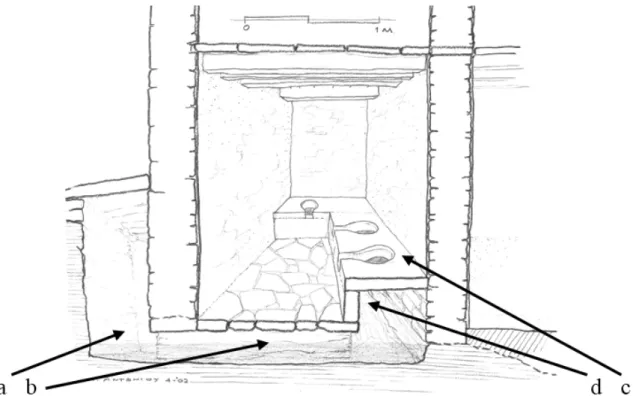
(koprodochoi) (amidesorskoramidesfrom Athens, see also [47]), well known from written sources, the archaeological finds of small cesspits and sewage ducts dated in the ca. 5th c. BC could be related to traces of sanitary and purgatory structures found in Olynthus [48], a city destroyed by King Philipp II in 348 BC. Not only have small sewage ducts made of clay or lead been found, but also well-formed sanitary clay vessels. All these clay utensils can be easily dated to the ca. 5th c. BC and are characterized by the efforts for achievement of anatomical shapes. In these seats, the absence of a base combined with the form of the lower edge (see Figure18) suggests that they were either used over cesspits or along with some other mechanism for the collection and drainage of excrement. It is evident that at that time the lavatory still had a private use (apochorisis, apopatos, afedron). The ancient terms mostly refer to a private type of use and the main term derives from theapochorisis(withdrawal) [9]. The typical ancient Greek lavatory on the other hand is characterized by the use of more than one person at the same time (see Figure19). The design of a typical lavatory in ancient Greece had been completed by the ca. 4th c. BC, and had incorporated all the preexisting design features of that type. Some documentation for similar installations in the Minoan and the Mycenaean period has already been discussed above.
ώ
ό
Figure 18. Axonometric sketches of clay defecation and toilet seat vessels, Olynthos (G. Antoniou sketched inspired by [48]).
Figure 19.Restored view of the lavatory at Ithidiki’s residence on Amorgos: (a) input water conduit; (b) flushing duct below the floor level; (c) bench-type seats with the keyhole-shaped defecation openings; (d) front covers of the bench-type seats; and (e) sewage duct. Notice (e) is located at the back and it is not visible (courtesy of G. Antoniou).
Beside these, there were also other secondary constructions as the central shallow tank for cleaning the sponghia (out of sponge) the toilet paper of that period, the urine sewage conduit, small sedimentation tanks, etc. The seats’ supporting presents interesting differentiation and typology. Four types can be distinguished. All of them are cantilevered, mostly covered except the later type in Philippoi [49] and Efessos (see Figure20c). More specifically, these are:
(a) Cantilevered stone slab protruding out of the wall.
(b) Freely supported slab over stone beams, cantilevered or not.
(c) Similar to the previous type where the stone joists protrude out the vertical plates and have been formed as neck moldings of benches and exedras.
(d) Type where the freely supported seat slab is also supported by stone cantilever beams which were shorter and less wide than the seat.
(a) (b)
(c) (d)
Figure 20. Formation and types of lavatory’s seats supporting (G. Antoniou). Figure 20.Formation and types of lavatory’s seats supporting (G. Antoniou).
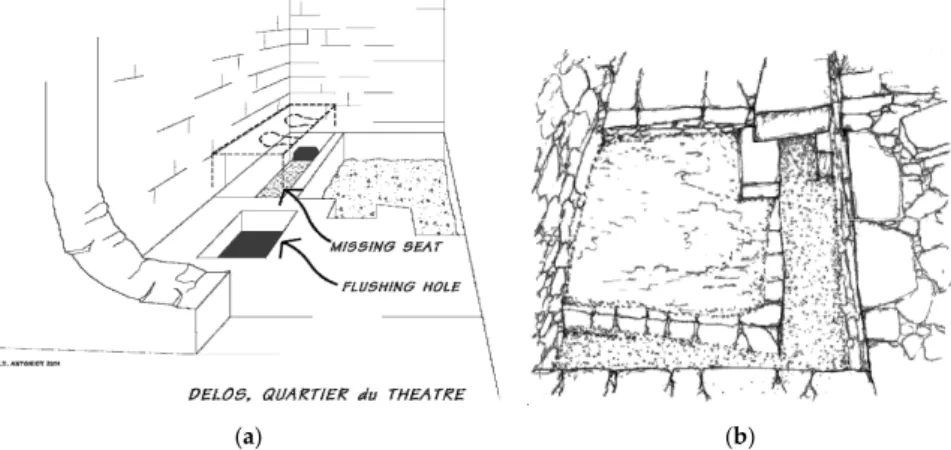
The element of the keyhole-shaped opening became a feature of the lavatory with some ornamental forms. Despite that, it is obvious that the functionality was always very important. There is also some evidence that the covers for the openings were made out of clay. The seats in small domestic lavatories were just wooden benches, probably with similarly shaped openings. The main difference between private and public toilets was their size and the number of users. On the other hand, the method for the water supply differs sometimes, since the domestic lavatories require less water for the flushing. The public ones were usually supplied with running water, reused or not [43] (pp. 82–83). The sewage ducts of the city usually ran along the streets or beside the buildings. Sometimes in small residences, there were no sewage lines and the waste was placed outside the house (i.e., in Dystos [50]). Many latrines dated to the ca. 2nd c. BC have been preserved in residences (Delos, Thira, Amorgos, Dystos, Kassopi, and Erythrai) and in public buildings (especiallyGymnasiums andPalestrae). The significance of Delos (see Figure21) for the evolution of the typical layout of the ancient Greek lavatory is important [9], and the need for a more detailed historical investigation and presentation was recently examined [51]. Lavatory capacity can be classified according to the number of the toilet seats, which correspond to the maximal number of users at any one time:
(a) The very small domestic lavatories used by two or three people of the house (e.g., in ancient Dystos, Greece, [9], Figure21).
(b) Moderate-sized domestic lavatories with more than four defecation seats.
(c) Small public lavatories with evidence for at least four users at a time (e.g.,Gymnasiumof Minoa, [9] and inPalestraeon Delos [52]) and
(d) Large public lavatories used by more than 10 to 20 people. These were generally constructed during the Roman period (Figure22).
(a) (b)
α ό
Figure 22. The lavatories of the Asklipeion in Pergamon. The older multi seat elongated one was adjoined in Roman era with a large square latrine (G. Antoniou, drawn after [53]).
Most of the ancient names for toilet mentioned at the beginning of this section refer to a private place (the part—απó—apo). Despite this, the excavation of many private lavatories clearly demonstrates
evidence for their simultaneous use by more than one person. Even in residences where the inhabitants numbered 5–10 people, there were lavatories with two up to four defecation openings. In these cases, it is unclear whether there was a simultaneous usage by residents of different sexes. Public latrines were used by dozens of people simultaneously, and often more than 50 (Athenian Agora, [54]); Pergamon, Asklepeion(Figure22). This was a practice which expanded during the Roman era and survived in many Byzantine and medieval lavatories of the Eastern Mediterranean area and western Europe as well, including monasteries [55], baths [56] and castles such as Acre in Israel (Figure 36) and even at Mytilene’s (at the 16th c. semi-subterranean refuge). These examples are discussed more in Sections6.1and6.2.
5.2. The Roman Period (ca. 1st c. BC–4th c. AD)
Figure23. The protruding stonework around the edges of the latrine would have had wooden seats resting on them. Beneath the seats, a flow of water flushed away waste toward the drain [1]. Usually, shops and bars had toilets in Pompeii. Moreover, as reported in Hobson [59], in some areas of the archeological site, there are a number of single rooms opening directly onto the street that have been identified as latrines.
Figure 23.Remains of the multi-seat latrine in theForumof Pompeii (photo courtesy of Giovanni De Feo).
In the town of Herculaneum, that is only a few kilometers from Pompeii, the number of cesspits and the distribution of toilets is significantly different from Pompeii [59,64]. First of all, in Herculaneum there was a limited presence of cesspits mainly due to the fact that the ground is too rocky for draining away urine and feces [66]. Secondarily, toilets are less frequently seen in residences and more frequently visible in association with commercial or public uses. In Herculaneum, toilets occurred in public baths and commercial spaces such as workshops and taverns (taberna). Toilets were located in domestic, as well as commercial, buildings [61]. The only multi-seat latrine, whose remains are shown in Figure24, supplied the men’s baths (thermae) [59].
The remains of what is commonly considered the most famous multi-seat Roman latrine are in the archeological site of Ostia, near the Forum (Figure25). The official placard describing the remains reads:This public latrine (forica) was installed in what had previously been two shops, near the Forum Baths, perhaps when the Baths themselves were repaired in the Late Empire (4th c. AD). The stone seating is still preserved around the walls, and there is a small basin next to the pillar which separates the two doorways into the room.
Figure 25.Figure 25. Remains of the most famous multi-seat Roman latrine in the archeological site of ORemains of the most famous multi-seat Roman latrine in the archeological site of Ostia, near theForum(photo courtesy of Giovanni De Feo).
Due to their intrinsic nature as well as general and specific (namely in terms of hygienic conditions) knowledge limitations, Roman toilets were clearly far from hygienic [67] (p. 162). Moreover, Romans must have contracted many (for them deadly) diseases from using these toilets, resulting in a high mortality rate [67] (p. 162).
6. Post Antiquity and Medieval Times
6.1. The Byzantine Practices (4th–14th c. AD)
Wastewater and lavatory technical practices and the relevant applications during the Byzantine period present interesting characteristics related mostly to a combination of various historical aspects, as the partial continuation of the ancient tradition and practices, the barbaric raids and their results, the social reformation due also to the Christianity, the power of the Church within the state, and so on. The Byzantine state, which originally preserved the Roman name, continued in many ways and somehow ‘inherited’ the Greco-Roman civilization of the antiquity. Thus, the new state adapted at its beginning not only administrative institutions, but also the constructional and technical achievements of the pre-existing empire. The Greco-Roman civilization survived mostly in the eastern part, since after the 5th c. AD, the western part was lost due to the barbaric invasions. Therefore, the medieval characteristics of the west remained away from the east for quite long time. Several typical ancient Greek and Roman formations can be traced in the applied wastewater and storm water technologies, as well as in the lavatories built until the 8th c.
sources regarding life in the Byzantine era, which states that the users in the baths were visiting the toilet after undressing and before entering the bath, for obvious hygienic reasons. Moreover, it can most certainly be concluded from the surviving remains that lavatories were used by many people simultaneously, despite their use almost two centuries after the official end of the ancient religion and the prevalence of Christianity which promoted privacy. During that period not only single seat toilets are constructed in old buildings [70], promoting privacy, but also single bathing chambers are incorporated in preexisting Roman baths, which originally had only common bathing pools, as in Epidauros [71]. Construction wise these toilets were supplied by water through pipes or the ditch system of the bath, possibly reusing water out of the main use of the bath as well. In Marea, an entry chamber (Figure26) resembles similar plans found during theveryend of the Hellenistic period, i.e., in Athens [54] and references in [72]. Their placement at the outer zone of the building served as well for the sewage, like the way it was usually applied at the ancient lavatories, that is, in Delos, Dystos, Kos, etc. (see Section5.1; [9]). It seems that the collective use, the connection or attachment to bathing facilities, and the semi-perimetric ditch, supplied by the bath water or separate stream water (as in Aksaray Sultan Han, and Incir Han), are characteristics that survived up to the 12th to 13th c. and are found at Selcuk—or Rum Selcuk according to Prof. Kiel—Hans-Caravansarais in Anatolia [73].
vatory at Marea baths Egypt. Water-wastewater (underfloor) ditche
Figure 26.Lavatory at Marea baths Egypt. Water-wastewater (underfloor) ditches in gray (G. Antoniou, inspired after [68]).
Monastic lavatories with a collective character are not rare in the greater region of the eastern Mediterranean during the first Byzantine centuries. The row of the collective latrines at St. Symeon monastery in Assuan, Egypt (Figure27a, number 44) and their placement leads to the existence of a kind of sewage. On the other hand, a similar row at the great eastern tower (ca. 6th to 7th c. AD) of St. Catherine’s monastery at Sinai (Figure27b; [55]) had undoubtedly a collective use, but the waste was drained exactly outside the walls, via pipes through the thickness of the towers’ wall. Similarly, the lavatories of the Zygos monastery in Mt. Athos, in Greece—dated ca. 10th c. AD—have a similar layout, but placed outside the walls, attached to them [74]. On the other hand, it is not certain if it was operating as a collective toilet or not, forming just a row of toilets. The waste was also drained directly outside via inclined pipes (as also in Figure28).
Hospital ofMega Meteoronmonastery—where a separating wall is absent, there was probably a wooden partition [77]. Doors resembled a kind of curtain, the so-calledvelothyron[78]. In many cases, there are pipes draining out the waste, inclined as in Vrontiani monastery in Samos (Figure28), or vertical as at the lavatory of theMega MeteoronHospital (Figure30). On the other hand, there are monastic literal references about cleaning or removing the waste ( . . . σαρώσατω τα λύµατα. . . ) [77]. This leads to the conclusion that there was not a sewage system in every case.
α ώ α ω α ύ α α
(a) (b)
Figure 27. Late antiquity lavatories: (a) Collective lavatories (#44) St. Symeon Monastery, Egypt [78] Figure 27.Late antiquity lavatories: (a) Collective lavatories (#44) St. Symeon Monastery, Egypt [78] and (b) St Catherine’s Monastery, the outlets of the lavatory in row in the SE Justinian tower (G. Antoniou inspired by photograph of Panoramio K. Haraburda [79–83]).
α ώ α ω α ύ α α
(a) (b)
Figure 29.Figure 29. Toilet at Toilet atEstiaEstia (fireplace) of Helandarion monastery Greece (adapted from [72(fireplace) of Helandarion monastery Greece (adapted from [72]).
Figure 30. The protruding two seat lavatory (in 5 cm) at the hospital ofMega Meteoronmonastery, Greece, had possibly a light separating wall or curtain (adapted from [72]).
chamber oftriclinion, found often in each floor. Their usual semicircular edge, rather than their vaulted ceiling, was the reason of the term exedra, one of the names that had been given to the toilets by that time [84]. Traces testifying domestic twin or triple toilets are very limited, and in Salonika coexist with a typical single toilet [85].
(a) (b)
Figure 31. Two mansion house chambers with toilet in Mystras, Greece. (a) Toilet placed at the Figure 31.Two mansion house chambers with toilet in Mystras, Greece. (a) Toilet placed at the corner of the chamber and (b) placed in the middle of the long side: [84].
(a) (b)
Figure 32. Chambers with single toilets in small protruding niches, in Mystras. Greece: (a) oridinary Figure 32.Chambers with single toilets in small protruding niches, in Mystras. Greece: (a) oridinary house and (b) Mansion house (adapted from [84]).
Similar protruding residential-type toilets—with or without a sewage pipe—dated in the mid- and late-Byzantine period survive in some monasteries of Mt. Athos [86]. Illumination was provided by oil lamps inside small niches on the walls. Written sources about 24 h burning oil lamps in monasteries’ typikonrefer also to the toilet oil lamps [77].
Concerning the toilets’ drainage, from the majority of the archaeological findings, it seems that the wastewater and storm water networks were inferior to the relevant Hellenistic and Roman ones. Later, information about mature Byzantine settlements as Mystras, refer to both piping networks [84] (Figure31a,b) and individual residential water-tight cesspits [87].
6.2. The Venetian Period (11th c.–17c. AD)
the eastern Mediterranean where the technologies of the antiquity survived more than at the other western parts. It seems that these influences were combined with the practices of the rest of the European knowhow.
The Byzantine state was weakened from crusades and Ottoman invasion and was unable to retain sovereignty over several provinces in Eastern Mediterranean. The Venetian Republic became dominant and ruled the trade in that region. Many cities flourished during the Venetian period. Under the rule of Venetians, many fortresses, which were later improved by the Ottomans, were built. Also, rain water cisterns, aqueducts, irrigation windmills and other water infrastructures were constructed. However, during this period water availability, quality, and sanitation were at a low level. Several cities suffered from the lack of water and wastewater management.
Venetians, however, built advanced wastewater and drainage systems in several castles and fortresses, usually located in coastal areas. Such castles and fortresses can be found all over the Eastern Mediterranean, such as in Corfu, Lefkas, Methoni, and Koroni and many others in the Ionian region at Chanea, Rethymnon (Fortetsa), Iraklion, etc., in Crete but also in Keryneia, Lemessos, etc., in Cyprus and many others in that region. Beside other well articulated constructions in the castles, the Venetians constructed water supply and drainage systems for protection from stormwater, as well as lavatories. These constructions were quite sophisticated for that time. In several cases, the rainwater and the sewage from the lavatories were directly discharged to the moat or the sea. In addition, during the Venetian period, just like during the late Byzantine times, the construction of lavatories reflected the need for privacy, which was imposed by social and religious factors. Moreover, they reflected the lack of spacious housing within fortresses. The result was small spaces for the defecation (the absolute necessary), similar in most cases to the examples of the Byzantine era, presented above. The examples in the castles are mostly typical Europeangarderobes(see below in Section6.3). Even in countryside houses (like in Chromonastiri in Crete, Figure33) and other spacious buildings, the size of the lavatories was limited, following the practice ofgarderobes. On the other hand, their location was next to the most private sectors of the residences, such as bedrooms, in contrast to the ancient houses, in which they were placed closer to the entrance or commonly accessed areas. However, in both cases their position was at the perimeter of the building.
Figure 33.Figure 33.Protruding privy-garderobe Protruding privy-garderobeat the second floor of a rural residential complex in Chromonastiri at the second floor of a rural residential on Crete (courtesy of G. Antoniou).
accommodating many monks. Examples may be found in Scotland, such as in the Saint Andrew Cathedral Priory, the Dumferline and the Inchcolm Benedictian and Augustinian Abbeys [88]; they will be presented more in Section6.3.
Small protruding niches on the higher floors of the buildings, with free open air drainage, were quite common practice for the toilets in the late Byzantine and Venetian periods, and several lavatories of that type are preserved at the monasteries of Mountain Athos [89]. This is in contrast to typical Byzantine buildings which had a built-in drainage conduit [72,86]. Despite that, there are cases, especially in fortresses, such as in Lemessos, where a closed vertical pipe conveyed the wastes to a cesspit located on the ground level, (Figure34) which also happens in severalgarderobes(see below and [90]).
(a) (b)
Figure 34. Lavatories (garderobes) at: (a) 40 Colones Castle Cyprus (sketch by G. Antoniou) and ( Figure 34. Lavatories (garderobes) at: (a) 40 Colones Castle Cyprus (sketch by G. Antoniou) and (b) Castle of Lemessos, Cyprus (with permission by G. Antoniou).
6.3. The Medieval European Practices (8th c.–15th c. AD)
The intact surviving examples of the European medieval lavatories are not much. They are mostly constructions—or mostly their remains—of monastic communal lavatories thenecessariaorreredorters’ as it was briefly mentioned above. On the other hand, small toilets, privies andgarderobesremained or are restored at the various castles, towers and fortifications. Their concept seems to also have been adopted also for residential cases as it can be concluded by their existence in proverbs of that era (Wikipedia, Netherlandish Proverbs). The most common feature for most of the mentioned types is the usual free disposal of the waste, either at a moat or just outside the enclosure (i.e., at the sea in Portchester Castle) or generally the building. During the High Medieval times, inner drainage networks start to appear [90] but can be considered as exceptions.
The application of that type of lavatory was predominat for the European practices, presenting a variety of forms, disposal networks and material combinations. It seems that this predominance remained until the establishment of the water closet.
6.3.1. Lavatories Installations in Central and Northern Europe (8th–15th c. AD)
but adjusted to the ethics of the era, by using separating screens [91]. That continuation most possibly occurred through the early Byzantine examples from the Holy Lands region (Palestine, Sinai and Egypt) monasteries which pilgrims had visited. The crusades’ lavatory at Acre Castle in Israel (Figure36) closely resembles the multi seat Roman lavatories and could be considered as an example derived by originals, even though mostly the height of the seat refers more to a squat formation rather than to a typical sitting ancient one. This example incorporates the usual (St. Andrews Abbey, Inchcolm Abbey, etc.) single longitudinal sewer duct under the floor. Relevant to those early eastern paradigms, it can be found also in the north of Europe, as the embodied in the fortification walls or towers common lavatories like the case of the Portchester Castle–Benedictine Priory in England (ca. 11th c. Figure37). The resemblance of the chutes with the outflows of the lavatory at the Justinian tower at Sinai monastery (Figure27b; [55]) is obvious but the main body of the building behind the wall is missing nowadays.
Figure 35.The remains of the elongated Reredorter of St. Andrews Abbey in Scotland. The deep drain is visible along the side towards the enclosure (Google Earth, street view, 2015).
Figure 36. Crusades Lavatory in Acre Castle Israel [92].
Figure 37.The latrine chutes on the enclosure walls at the Portchester Castle–Benedictine Priory ca. 11th c. [79–83]. The resemblance to the lavatory at the tower of Sinai monastery dated in the 6th c. (Figure 27b) is obvious.
Thereredorteswere situated usually in the vicinity of the dormitories (dorters) or chambers but originally not attached to them. A corner tower as in Southwell palace was a typical case. A relevant formation of not attached to main chambers toilets were found also in castles as the Langley Castle in England (Figure38). Semi-detached towers, as in Incholm Abbey, Scotland, or even highly detached ones as in the Kwidzyn Castle (actually an Ordensburgen in Poland (Figure39) was accessed by covered passageways ensuring a safe distance against odors! In most cases of tower lavatories, the disposal of waste was to cesspits, rather to the moat or to an open ditch.
Figure 39. Kwidzyn Castle Poland. On the right the high detached lavatory tower. On the left, behi Figure 39.Kwidzyn Castle Poland. On the right the high detached lavatory tower. On the left, behind the trees, the short detached lavatory tower (Panoramio, Knapczyk, 2015) [79–83].
Garderobeswere the most common toilets for both military and residential (see Figure40) uses in the Middle Ages. They were simple constructions, protruding out of the wall, usually covered or semi covered (Figures40c,d,41and42). The waste was usually discarded freely outside to the moat or even to the street. Inclined ducts in the walls discarded waste in to the moats (Figures37and40b). In some cases, there were cesspits incorporated in the structure (Figure40a) or type of midden pits accessible from the inner side (Figure40d). Rarely they were deployed in multiple levels as in Langley Castle (Figure38).
(
a
)
(
b
)
(
c
)
(
d
)
(a) (b)
Figure 41. Exterior of garderobes: (a) Elaborated stone and brick construction at Burg Campen Figure 41.Exterior ofgarderobes: (a) Elaborated stone and brick construction at Burg Campen (Benutzer A., Wikipedia commons) and (b) Simple wooden structure at Kunta Hora Prague (G. Antoniou).
(a) (b)
Figure 42. (a) Twin restored garderobe in Chillon Castle Switzerland (Eldar Kadymov Panoram Figure 42.(a) Twin restoredgarderobein Chillon Castle Switzerland (Eldar Kadymov Panoramio, [79–83] accessed November 2015) and (b) One of thegarderobesat Bodiam Castle England (restored) (V. Tzekov, Panoramio, accessed November 2015) [79–83].
Garderobeshad both stone (Figure 34a) and wooden seats (Figure42). Most of the wooden restorations present a circular opening. On the other hand, there are surviving stone examples where the hole is not circular (Figure34a,b, Peveril Castle, Drum Castle in UK as well) but a more anatomical shape for male users.
The location of a latrine as a sort of a cage fastened to the wall was a common practice in the military architecture, the typicalgarderobeas was discussed earlier. In the domestic cases this construction was simple and comfortable, especially in the dwellings located on a hill and surrounded by water, as the filth thus fell outside the enclosure or on its wall, providing an unpleasant sight but avoiding the accumulation of waste within the fortification walls. The privy box was constructed of brick, wood or of both materials. This type of latrine was common throughout Europe, and because of its prominence in the wall often served for defensive purposes, i.e., to observe the enemy’s approach.
Apart from the latrines they also had cesspools. Within the medieval and post medieval towns there were latrines, from where waste was evacuated directly to the street. Citizens tried to build latrines at the greatest height possible, which, according to our reasoning is quite paradoxical [96] (pp. 264–265). For example, the parliament of Normandy in 1519 ordered the placement of the privies at the top of the buildings [97] (p. 38). This same construction, that is, the latrine located at the height of the second floor of the house, was usual in other cities too. Similar constructions survive even nowadays but are equipped with drain type sewers.
In the engravings of Albrecht Dürer we can observe the reality of the German and Italian cities of the late fifteenth and early sixteenth centuries—the walls of houses and city walls were littered with small boxes, fulfilling the role of latrines, where all filth fell to the street, or in the best case, outside the city walls. The latrine-boxes protruding from the houses were equipped with seats with a hole, from which the filth fell into a ditch or a channel expressly filled with ash [98] (p. 14). The same situation was common in the cities of England [99] (p. 26).
Stone built seat toilets related to that era survive in many other Castles as the twin lavatory, at the Aragonese Ischia Castle in Italy (Figure43a). On the other hand it seems that in the east, where the Muslim tradition related to religious rules about defecation (anal) hygiene was—and somehow still is—strong, the squat toilet was predominant, as the one in a—possibly—later example in Sanaa, Yemen (Figure43b). The squat type has been incorporated also in non Muslim constructions as the crusades toilet of Figure36. These medievalsemi squatformations could be relevant not only to the Seljuk examples—as in Aksaray Han, discussed in 6.4—but also to a mid 15th c. multiple toilet at a refuge in the Castle of Mytelene, Greece.
(a) (b)
Figure 43. (a) Twin built lavatory, Aragonese Ischia Castle, Italy [100] and (b) Bathroom with squat Figure 43.(a) Twin built lavatory, Aragonese Ischia Castle, Italy [100] and (b) Bathroom with squat toilet and bath in Sanaa Yemen [101].
6.3.2. Latrine in Medieval Muslim Spain: Al-Andalus (8th–15th c.)
disappearance of theAndalusidominion at the end of the 15th c. For an illustration we can take the case of Cordoba in the Modern times. If the major residences maintained in some cases the latrine, most possibly as a directAndalusiheritage, the houses of common citizens lacked any sanitation equipment. Therefore, a register shows that from 300 houses in the late 15th c. only three of them had a latrine [102] (pp. 151–152).
Normally, within rural settlements, the major part of the houses had no latrines and only some of the houses had their latrines connected to cesspools. Nevertheless, such vastly excavated Andalusi urban settlements as Siyasa (Cieza, Murcia) and Saltes (Huelva) or the suburbs of Caliphal Cordoba among others make evident a most common solution of medieval sanitation consisting in latrines connected to cesspools. It must be noted that in the towns where latrines connected to cesspools were employed, a separate channel evacuated rain water from the courtyard, which often fell over the streets. The inexistence of the connection between a cesspit and a drain water channel is therefore obvious since cesspools would have overflowed during the torrential rains [103].
Cesspits were usually located in public streets or cul-de-sacs. The location of cesspools outside the house was naturally intended to prevent the spread of bad odors and to preserve the cleanliness of the house. From time to time cesspools had to be cleaned, although this labor must have been quite unpleasant not only for those who carried it out, but also because it caused bad smells and pollution around the work place, normally a public street or a cul-de-sac. Cesspools were normally attached to the façade of the house in order to have the shortest distance between the latrine and the cesspool. Such settlements as the Caliphal suburbs of Cordoba are the clearest example of abundant cesspools located in the streets. The latrine and the pit were connected by means of small channels made of ceramics, stone slabs or bricks. Pits were sometimes paved with stones, covered with a stone lid or possibly with a wooden cover and leveled with earth [104].
The objective was to shorten the distance between the cesspit or a sewer and a latrine forced to place it near the entrance to the house, as close to the street as possible. Access to the latrine was usually located from the patio or the hallway (zaguán). At times the small size of the houses forced the owners to search for more ingenious solutions, such as placing the latrine under the vault of the staircase.
As it can be observed through the archaeological data, in an Andalusi house the privacy and the intimacy were key aspects while the latrine was being used. Apart from curtains and doors, the privy was often concealed by a low wall that created a curved entrance (entrada en recodo) and impeded viewing the person that was using the toilet by anyone who would have approached the entrance of the room.
Normally, a latrine was an extremely reduced space. Only several of the documented latrines were quite spacious. The major part of the Andalusi latrines can be considered as rather uncomfortable because their size was only 60–75 cm in width and 1 m in length.
A small rectangular platform of very distinct dimensions made of brick or stone, or marble, with a narrow opening in the middle was placed in the latrine room. A person would have had to squat in order to relieve himself. Sometimes the platform of the latrine was raised with respect to the floor level, a feature that may have contributed to keeping the room better ventilated. Nevertheless, latrines in various settlements present no podium such as in the case of the Siyasa settlement [104].
A small latrine room needed to be somehow ventilated. Most likely, slim apertures in the upper part of the wall were used to ventilate the room. Due to the orifice in the wall, the air would circulate freely from the patio to the street as the entrance to the latrine was normally from the patio.
Figure 44. Muslim Medieval latrine from Madinat al-Zahra settlement, Cordoba, 10th c. (courtesy of I. Reklaityte).
Finally, it should be mentioned that apart from the more extensive use of cesspools, a sewerage network was present in some medieval Muslim cities of Spain; the presence of sewers is documented through archaeological excavations and written sources. In an overcrowded town, a sewer system implied a notable hygienic improvement.
As a result of the archaeological excavations, the town of Murcia offers an excellent example of a sewer network assembled in order to evacuate rain and waste water. Other Medieval Spanish towns, such as, Lerida, Denia, Malaga, Cordoba, Almeria and Algeciras also had sewerage networks of greater or lesser importance [106] (pp. 401–412); [107] (pp. 231–246).
6.4. The Ottoman Practices Regarding Lavatory Installations
(a) (b)
Figure 45. (a) Nevşehirli Ibrahim Paşa Darül-hadis, Istanbul and (b) Sűleymaniye complex, Istanbul
ş ş
ű
ű
Figure 45.(a) Nev¸sehirli Ibrahim Pa¸sa Darül-hadis, Istanbul and (b) S˝uleymaniye complex, Istanbul (both adapted by [110], (a) p. 370, (b) p. 217.
As new urban centers were founded, but also in cases of formerly established cities that were conquered by the Muslims, many new buildings were constructed to fulfill the needs of the Islamic societies, and therefore religious buildings, as well as secular ones, but also mansions of domestic use, appeared. Most of these constructions were financed with the help of the Vakif institutions that also enabled their maintenance [111]. Sanitary installations (toilets) can still be found in Ottoman secular buildings (as represented through the architectural types of mosques, medreses (i.e., Nev¸sehirli Ibrahim Pa¸sa Darül-hadis, Figure45a), hammams, thermal baths (kaplıca), or külliyes—complexes of mixed uses, etc.), and two layout composition plans are traced. In the first case, as a mosque formed part of a whole complex (such as the S˝uleymaniye complex in Istanbul, Figure45b), lavatories were located in a rather remote part of the court.
Additionally, in cases where the mosque had no exterior courtyard, public toilets were inserted in the structure as an independent unit. Also in cases of smaller mosques (i.e., H˝udavendigar cami, Bursa, Figure46a) or other types of buildings (such as the Çinili kiosk, Istanbul, Figure46b), lavatories were incorporated in the general ground floor plan of the building [112].
Squat toilets were used, and placed adjacent to each other. Partitions were constructed, in order to offer some kind of privacy. This characteristic feature was lacking in relevant examples (sanitary installations) of the ancient Greek and Roman lavatories’ scheme, as well as centuries later, they had a layout similar to those of the Seljuk Hans.
The 13th c. Seljuk Caravanserais in Anatolia were equipped with lavatories for public communal use, which were sometimes attached to the bath. An exception was that of the Aksaray Sultan Han on the Konya-Aksaray Road (Figure47) [73], where the water installations run along the west exterior wall of the courtyard and the collective lavatories are situated at the southwest corner. The channel that facilitates the sewage is still evident. Single toilets are also traced as private small cells in the baths (hammams) of the caravanserais.
(a) (b)
Figure 46.Figure 46. ((aa) H) H˝udavendigar cami, Bursa (adapted by [113] p. 260) and (űdavendigar cami, Bursa (adapted by [113] p. 260) and (bb) Cinili Kiosk, Istanbul ) Cinili Kiosk, Istanbul (adapted from [114] p. 136).
ű
(a) (b)
Figure 48. Hamams: (a) Haseki Hürrem Hamam, Istanbul (adapted by [111] p. 249) and (b) Cerrah
ş
Figure 48.Hamams: (a) Haseki Hürrem Hamam, Istanbul (adapted by [111] p. 249) and (b) Cerrah Mehmed Pa¸sa Hamam, Istanbul (adapted from [115] p. 253).
The floor of the latrines was usually paved with marble slabs. A key-shaped hole was opened in the centrally placed slab (elaborated with an inclining surface) for the human waste. The specially curved slab was set at a distance from the wall, as the user’s body should not come in contact with the human waste, while the wall’s vertical surface formed a convex profile, in order to avoid splashing.
Several marble slabs used for the squat toilets were often well elaborated, as it can be noticed in many examples. The toilet slabs exhibited in archaeological sites such as the Bodrum castle in southern-west Turkey are a good example, (Figure49). Also in situ Ottoman squat toilets slabs were located on the lower row, e.g., at the Castle of Mytelene, Greece illustrated in Figure49, lower row.
ş
Figure 49. Ottoman squat toilet slabs. Upper row: exhibited at the Castle of Bodrum, Turkey and at Figure 49.Ottoman squat toilet slabs. Upper row: exhibited at the Castle of Bodrum, Turkey and at the lower row: in situ at the Castle of Mytelene, Greece (courtesy of G. Antoniou). The dashed line indicates the outline of the wall.
This was a special duty of the employee responsible for cleaning the lavatory (Figure50). Human waste was removed from the toilet through ceramic pipes, and placed under the key-hole shaped slab. In the 18th and 19th c. these slabs were formed in an elaborated manner (Figure49). Latrines were illuminated by small openings set on the roof, which also enabled the necessary ventilation of the cell.
Figure 50.Figure 50. Lavatory at the Harem, Topkapi, Istanbul (courtesy of Lavatory at the Harem, Topkapi, Istanbul (courtesy of E. Kanetaki).Ε
Lavatories (toilets) were also one of the necessary installations to be found in domestic architecture: they were situated outside of the buildings and as they were usually made of poor materials, almost no traces have been surveyed in houses dating from these times. The lack of hygiene conditions in domestic architecture was one of the main reasons for which the ritual of the hammam (public steam bath) became so popular [116].
![Figure 1. Pipes from baked clay from the fourth and third millennium BC in: (a) Chogha Mish [12],](https://thumb-ap.123doks.com/thumbv2/123deta/6874776.247251/4.892.167.723.356.724/figure-pipes-baked-clay-fourth-millennium-chogha-mish.webp)

![Figure 12. Public toilets, Open toilet and house hold toilet in Indus valley civilization (adapted from [ 4 ])](https://thumb-ap.123doks.com/thumbv2/123deta/6874776.247251/12.892.150.743.253.545/figure-public-toilets-toilet-toilet-indus-civilization-adapted.webp)
![Figure 15. (a) Fujiwara palace toilet and (b) Heijo-Kyo open air toilet (G. Antoniou, inspired by [43])](https://thumb-ap.123doks.com/thumbv2/123deta/6874776.247251/14.892.121.785.756.1042/figure-fujiwara-palace-toilet-heijo-toilet-antoniou-inspired.webp)