social networks among preschoolers
Keiko K. Fujisawa1,4), Nobuyuki Kutsukake2)& Toshikazu Hasegawa3)
(1Department of Humanities & Social Science, Faculty of Letters, Keio University, Mita 2-15-45, Minato-ku, Tokyo 108-8345, Japan;2Department of Evolutionary Studies of
Biosystems, The Graduate University for Advanced Studies, Kanagawa, Japan;
3Department of Cognitive and Behavioral Science, Graduate School of Arts and Sciences, The University of Tokyo, Tokyo, Japan)
(Accepted: 16 May 2008)
Summary
In general, aggression is believed to destabilize social integration. The question of who plays a central role in stabilizing and facilitating social integration is important in studies of conflict management and resolution. We investigated that question by applying social network analy- sis to behavioral data of preschool children (3- and 4-year-olds) in four classes. We identified two kinds of social network structures in each class: ‘affiliative network structure’ (ANS) consisting of socially positive behavior (affiliation and prosocial behavior) and ‘disruptive network structure’ (DNS) consisting of socially negative behavior (aggressive or disruptive behavior). Next, we tested how the exclusion of each child, having different degrees of cen- trality within the ANS or DNS, influenced the ‘density’, or cohesiveness, of the DNS or ANS among the same children. We found that excluding the children with higher centrality in the ANS did not affect the density of the DNS. In contrast, excluding the children with higher centrality in the DNS reduced the density of the ANS to a greater extent. This suggests that aggressive children play not only a dispersive role but also a cohesive role in their networks. This counterintuitive result highlights the adaptive and dual roles of aggressive children in their social groups.
Keywords: aggression, conflict management, network, preschool children, social network analysis.
4)Corresponding author’s e-mail address: [email protected]
© Koninklijke Brill NV, Leiden, 2008 Behaviour 145, 1577-1600
Also available online - www.brill.nl/beh
Introduction
To maintain social integration and regulate relationships within a group, both human children and nonhuman animals need to deal with conflict situations accompanying incompatible goals, interests, or actions. Therefore, conflict management and resolution are critical components of social life (Aureli & de Waal, 2000). Reconciliation, the post-conflict friendly reunion of former opponents, is perhaps the best example of such behavior, as it restores rela- tionships damaged by aggression (Aureli & de Waal, 2000). Reconciliation is widespread among nonhuman animals (Arnold & Aureli, 2006; see Kut- sukake & Clutton-Brock, 2008, for species with no reconciliation practices). Similarly, conflict resolution including reconciliation has been reported in human children (Hartup et al., 1988; Laursen & Hartup, 1989; Killen & Turiel, 1991; Shantz & Hartup, 1992; Vespo & Caplan, 1993; Iskandar et al., 1995; Butovskaya & Kozintsev, 1999; Ljungberg et al., 1999; Butovskaya et al., 2000; Verbeek et al., 2000; Butovskaya, 2001; Verbeek & de Waal, 2001; Fujisawa et al., 2005, 2006). The experiences of conflict management and resolution are essential for children’s social development (Shantz, 1987; Shantz & Hartup, 1992).
One important lesson from previous studies of conflict resolution and management is that understanding the effects of aggression should not be re- stricted to a local scale (i.e., specifically between the opponents) but should be understood at a more global level (i.e., with third parties and within a so- cial network). Animals live in complex social networks (Flack et al., 2005, 2006; Krause et al., 2007); thus, a single aggressive interaction between indi- viduals affects the social behaviors of other individuals in their social group as well as that of the opponents. Among nonhuman primates, for exam- ple, third parties who were not involved in the aggression interact with the opponents in post-aggression behaviors (e.g., consolation, redirection, ap- peasement, solicited consolation, successive aggression; Watts et al., 2000; Das, 2000; Wittig & Boesch, 2003; Kutsukake & Castles, 2004; Koski et al., 2007), although few studies have examined the functions of these behaviors (see Palagi et al., 2006; Koski & Sterck, 2007). The third-party individu- als also interact with each other after aggression (Cheney & Seyfarth, 1986, 1989; Aureli et al., 1992; Judge & Mullen, 2005). Dominant individuals in- tervene in ongoing aggression, terminating the aggression (Petit & Thierry, 2000). For example, Flack et al. (2005) reported that in a captive group of
pigtailed macaques the absence of individuals with higher rank, who were responsible for conflict control, destabilized the social organization. That is, the experimental removal of high-ranking male pigtailed macaques increased the mean level of conflict and aggression and decreased socio-positive inter- actions. Furthermore, the effects of the absence of these conflict controllers were represented in the networks of socio-positive interactions (e.g., groom- ing, play, proximity and contact-sitting) among group members (Flack et al., 2006). These studies emphasize the importance of a group-level or network- level perspective for comprehensive understanding of conflict management.
Human children are also embedded in social networks that are composed of multiple dyadic social relationships (Hinde & Stevenson-Hinde, 1987; Strayer, 1992; Strayer & Santos, 1996; Snyder et al., 1996). Children’s social development is promoted by their being embedded in networks and by the so- cializing experiences given not only by friends but also by non-friends in the classroom (Strayer, 1992). Therefore, conflict management among children should also be understood from a network perspective. To date, however, few studies have investigated the social networks of preschool children (e.g., Strayer, 1992; Farver, 1996; Strayer & Santos, 1996; Vermande et al., 2000; Fujisawa et al., in press), and none has dealt with conflict management.
Multiple dyadic relationships, each shaped by repeated interactions be- tween two individuals, make up social networks (Hinde, 1976a, b). There- fore, the characteristics of social networks are ultimately determined by the nature of social interactions, which can be broadly classified into two types. The first type of social interactions includes exchanges of affiliative and prosocial behaviors. The relationships shaped by these interactions have a cohesive or affiliative function (i.e., attracting individuals to one another and maintaining them in a tied social unit; Strayer, 1992). We call this type of dyadic relationships as affiliative relationships. In contrast, the second type of social interactions includes exchanges of aggressive behaviors. The re- lationships shaped by aggressive interactions are believed to have a disper- sive or disruptive function (McGrew, 1972; Strayer, 1980, 1992). This type of dyadic relationship leads to dispersed social units by reducing unneces- sary conflicts among group members (Strayer, 1992). We call this type of dyadic relationships as disruptive relationships. Based on these arguments, groups of children can be characterized by two different network structures:
’affiliative network structure’ (hereafter, ANS), which is composed of af- filiative relationships; and ‘disruptive network structure’ (hereafter, DNS),
which is composed of disruptive relationships (i.e., ‘positive network’ and
‘negative network’, respectively, in our prior study: see Fujisawa et al., in press). Most previous studies have examined these two types of network structure separately, without comparing them quantitatively (Strayer & San- tos, 1996; Vermande et al., 2000; exception: Strayer, 1992). Therefore, it is not known how the social network structures comprised of affiliative and dis- ruptive relationships are represented simultaneously within the same class- room.
Based on this background, we investigated the social network structures among children from the standpoint of conflict management. The essence of the indirect aspect of conflict management is that the cohesiveness or robust- ness of affiliative relationships is maintained even if conflict occurs. There- fore, it is important to reveal who plays roles of cohesion and stabilization in children’s social network structures. We challenged two simplified views of social network structures. First, it seems likely and has been generally thought that socially positive children play central social roles (e.g., Coie & Cillessen, 1993; Newcomb et al., 1993; see also Farmer & Rodkin, 1996), but this may not necessarily be true for children of preschool age (LaFreniere & Charlesworth, 1983; Strayer & Trudel, 1984; Hawley, 1999). Second, affilia- tive and aggressive behaviors are regarded as contrasting characteristics, but this view may misleadingly over-simplify the nature of social relationships (see Hawley, 1999). For example, it is generally believed that aggressive children are socially rejected and have no effects on social integration (e.g., Coie et al., 1990). However, this is not necessarily true for preschool children (Hawley, 1999). Also, aggressive children are believed to play a disruptive role by destabilizing the social network but this may not be the case. Aggres- sive children of preschool age are socially dominant, are paid much atten- tion, are more imitated by peers, and are often regarded as attractive social partners (Abramovitch & Grusec, 1978; Vaughn & Waters, 1981; LaFreniere
& Charlesworth, 1983; Strayer & Trudel, 1984; Hawley & Little, 1999). It has been reported that preschool children access attractive toys in coercive as well as affiliative ways (Charlesworth & LaFreniere, 1983; LaFreniere & Charlesworth, 1987). This bistrategic control (Hawley, 1999; Hawley et al., 2002) is likely to influence social network structures. From these studies, it can be said that the view contrasting affiliative and disruptive interactions is too simplistic for understanding social relationships among preschool chil-
dren. Rather, an integrated view that considers both affiliative and disruptive interactions within a dyad is necessary when investigating conflict manage- ment of preschoolers. We used a framework in which the ANS and DNS are linked with regard to the constructive management of disruptive inter- actions (i.e., conflict management) in preschoolers. Based on this integrative approach, we investigated the following hypotheses concerning the ANS and DNS.
Affiliative network structure (ANS)
If the cohesiveness of the ANS depends on the absence of disruptive interac- tions, then the cohesiveness of the ANS should increase if disruptively cen- tral children (i.e., aggressive children) are removed from the ANS (Hypothe- sis 1). This hypothesis is consistent with the view that disruptive interactions are incompatible with affiliative interactions. If, on the other hand, the cohe- siveness of the ANS depends on the presence of constructive management of disruptive interactions, then the cohesiveness of the ANS should decrease if disruptively central children are removed from the ANS (Hypothesis 2). This hypothesis is consistent with the view that, within a social group, disruptive interactions are not necessarily dispersive, but are actually well integrated with affiliation through constructive conflict management.
Disruptive network structure (DNS)
If the cohesiveness of the DNS depends on the absence of affiliative interac- tions, then the cohesiveness of the DNS should increase if affiliatively central children (i.e., affiliative children) are removed from the DNS (Hypothesis 3). This hypothesis is consistent with the view that being affiliatively central is associated with lower levels of disruptive social interactions. If, on the other hand, the cohesiveness of the DNS depends on the presence of affiliative interactions, then the cohesiveness of the DNS should decrease if affilia- tively central children are removed from the DNS (Hypothesis 4). This hy- pothesis is consistent with the view that disruptive interactions occur more frequently among individuals who affiliate more frequently (for example, conflicts occur more frequently between friends than between nonfriends; Hartup, 1992).
We tested these hypotheses by quantifying and using two proxies: (i) de- gree centrality, a proxy of how central a child is within the network structure,
and (ii) density, a proxy of the integration or cohesiveness of the network structure (see Methods for details of these proxies). In addition, we tested the effects of age and sex of children on the degree centralities and densities. This is because the densities of network structures are associated with the age of members in the group (Fujisawa et al., in press) and because boys are gen- erally more aggressive than girls (reviewed in Coie & Dodge, 1998), making it likely that boys tend to have higher centralities in DNSs compared with girls. Removing a child from a network structure means that the sex com- position of the group is changed. Thus, the possibility arises that the effect of removing a boy from the DNS on the cohesiveness of the ANS would be greater than the effect of removing a girl from the DNS. In contrast, findings of sex differences with regard to prosocial behaviors are equivocal (reviewed in Eisenberg & Fabes, 1998). Thus, it is unlikely that the centralities in the ANS would be different between boys and girls, and the effect of removing a child from the ANS on the cohesiveness of the DNS would differ according to the sex of the child.
Further, we investigated the extent to which affiliative and disruptive rela- tionships overlap within a given dyad. This focus allows the examination of the possibility that the removal of central children affects only part of the net- work structure because affiliative (or disruptive) children and non-affiliative (or non-disruptive) children are segregated within the network structure. In other words, it is possible that the removal of affiliatively central children from the DNS affects only the local cohesiveness of the DNS if (1) these children have social interactions with particular peers who are similarly af- filiative or prosocial; and (2) these children do not have social interactions with non-affiliative peers. Similarly, it is possible that the removal of disrup- tively central children from the ANS affects only the local cohesiveness of the ANS if (1) these children have social interactions with particular peers who are similarly disruptive or aggressive; and (2) these children do not have social interactions with non-aggressive peers. In addition, if affiliative and disruptive relationships overlap to some extent within a given dyad, then it suggests that the relationships of children are maintained by both disruptive and affiliative interactions and it further suggests that the constructive con- flict management occurs within such dyads.
Methods Participants
The study was conducted at a public nursery school in Tokyo as part of a project investigating social development in Japanese preschool children (Fu- jisawa et al., 2008; in press). Two classes of 3-year-olds (Class 3A: nine boys and five girls; mean age = 44.1 months, SD = 3.0; Class 3B: eight boys and eight girls; mean age = 43.4 months, SD = 3.4), and two classes of 4-year-olds (Class 4A: nine boys and three girls; mean age = 55.1 months, SD = 2.5; Class 4B: seven boys and nine girls; mean age = 54.8 months, SD = 3.3) participated in this study. All children received parental consent to participate. Class 3A and class 4A consisted of entirely different children, while class 3B and class 4B consisted almost entirely of the same children. This was because the ‘B’ classes had participated in our two-year longitu- dinal project. One boy had left Class 3B and one girl had joined Class 4B when observation of the 4B group began. All of the children were Japanese and spoke Japanese as their first language.
Procedure
Observational data were collected during morning free-play time during the school year (not including summer and winter holidays). All observations were conducted inside a classroom. During the study period, one or two teachers were present throughout classroom observation. Twenty sessions of 5-min focal observations of each child (i.e., 100 min/child in total) were videotaped. Focal observations of each child in each class were conducted in a random order in each session. Each session usually took about two weeks. If a child scheduled to be filmed was absent on the observation day, he or she was filmed as soon as possible afterwards so that the intervals between each session would be as similar as possible for each child. Observations were not made when a focal child was engaging in teacher-structured activities. Chil- dren and teachers were accustomed to having their activities filmed before this study commenced. One observer, who had established a good rapport with the children and teachers before starting this study, moved around freely in the classroom and filmed all the children with a portable video camera.
Coding
Frequencies of affiliative, prosocial, and aggressive behaviors that occurred between a focal child and peers were coded. The initiator and the recipient of the social behavior were also identified.
Affiliative behavior
We coded the frequencies of the following affiliative behaviors: hand-to- body, body-to-body, talking, showing, approaching, and looking. These be- haviors were mostly based on Strayer’s (1980) coding, but ‘talking’ and
‘showing’ were added because of the differences in affiliative acts between Japanese and Western children’s behaviors. This slight modification was nec- essary because Japanese preschool children talk to each other significantly more often than do American children (Stevenson, 1991).
Hand-to-body: A child spontaneously and gently touched his/her partner’s body, including the partner’s hands, and then released the partner.
Body-to-body: A child spontaneously and gently clung to his/her partner’s body and then let go of the partner’s body.
Talking: A child spontaneously talked to his/her partner, excluding verbal aggression (e.g., insults, derogatory comments). An instance of a child’s talking was considered to end when the child stopped talking and started doing something else.
Showing: A child spontaneously showed an object or his/her actions (e.g., a toy, a book, or his/her own dancing) to his/her partner.
Approaching: A child spontaneously and purposefully approached within 1 m of a partner, excluding cases in which the child accidentally approached his/her partner.
Looking: A child looked at his/her partner, excluding staring in an un- friendly or angry manner.
Prosocial behavior
We coded the frequencies of the following prosocial behaviors: object of- fering and helping. These behaviors were chosen for this study because of their relatively frequent occurrence during the preschool period (Eisenberg
& Fabes, 1998).
Object offering: A child spontaneously gave objects (e.g., a toy) to his/her partner.
Helping: A child spontaneously assisted his/her partner to accomplish the partner’s goal (e.g., doing up buttons or pulling the partner into a big box while playing a driving game).
We did not code prosocial behaviors that appeared to benefit the initiator as well as the recipient, such as behaviors that occurred as part of a play ritual or as cooperation. Also, we did not code the behaviors if their initiator acted forcefully or aggressively toward the recipient, or if these behaviors were not welcomed by the recipient (e.g., an initiator helped to place a puzzle piece, but the recipient wanted to complete the puzzle by him- or herself without help).
Aggressive behavior
We coded the frequencies of the following aggressive behaviors (Strayer, 1980): hitting, kicking, pushing or pulling, wrestling, threatening gestures, and verbal aggression.
Hitting: A child forcefully touched his/her partner’s body with his/her hand.
Kicking: A child forcefully touched his/her partner’s body with his/her leg.
Pushing or pulling: Using his/her hand, chest, or shoulder, a child force- fully made his/her partner move away or closer.
Wrestling: A child forced his/her partner to the ground.
Threatening gestures: A child showed displays of hitting or kicking but did not actually hit or kick. A child made threatening faces such as staring or putting his/her tongue out.
Verbal aggression: A child made verbal threats, insults, or derogatory comments to his/her partner.
We did not code aggressive behavior when it occurred in play contexts. For example, play fighting was not coded as aggressive behavior.
Reliability
After extensive training, the first author and one research assistant indepen- dently coded 75 randomly selected sessions (i.e., 75×5 min) to assess coding reliability. Kappa coefficients were as follows: hand-to-body 0.71; body-to- body 0.70; talking 0.81; showing 0.75; approaching 0.78; looking 0.73; ob- ject offering 0.84; helping 0.75; hitting 0.65; kicking 0.74; pushing or pulling 0.84; wrestling 0.66; threatening gestures 0.66; verbal aggression 0.79.
Data analysis
Identifying affiliative and disruptive relationships at the dyadic level
We first calculated the total frequency of each affiliative, prosocial, and ag- gressive behavior for all possible dyads by summing up the frequencies of each behavior. We then conducted a factor analysis with varimax rotation on the behavioral data to identify affiliative and disruptive relationships. The first factor analysis yielded three factors with eigenvalues greater than 1.00. We excluded the variables of threatening gestures and verbal aggression and then conducted factor analysis again. This was because those variables had factor loadings of less than 0.35 for all three factors (Matsuo & Naka- mura, 2002). The final factor analysis yielded two factors with eigenvalues greater than 1.00. The first factor accounted for 31.2% of the total variance (eigenvalue = 3.75, α = 0.76) and was loaded highly on talking, look- ing, showing, hand-to-body, body-to-body, offering, and helping (all factor loadings were more than 0.35). The second factor accounted for 14.1% of the total variance (eigenvalue = 1.69, α = 0.60) and was loaded highly on hitting, kicking, pushing or pulling, and wrestling (all factor loadings were more than 0.35). We labeled the first factor as ‘affiliative relationship’ and the second factor as ‘disruptive relationship’.
Identifying affiliative and disruptive network structures
We used the social network analysis method, based on mathematical ideas of graph theory. This method allows for the investigation of the structures of a social network (Wasserman & Faust, 1994; Scott, 2000). That is, a graph (i.e., network) is simply a set of lines (i.e., representing the dyadic relationship between classmates) and connecting points (i.e., representing social entities such as classmates), and social network analysis calculates the properties of the patterns formed by the lines (Scott, 2000). Social network analysis has recently been applied to investigate the dynamics of the social relationships of children (e.g., Vermande et al., 2000; Fujisawa et al., in press).
We calculated the standardized factor scores of both factors (i.e., affiliative and disruptive relationships) for all possible dyads, using weights derived from the factor loadings. For the factors of affiliative and disruptive rela- tionships, respectively, we constructed matrices in which cells represented factor scores. We then converted cell values greater than 0 to ‘+1’ and cell
values of 0 or less than 0 to ‘0’. Let xij represent the value of a cell in the ithcolumn and the jthrow in a matrix. When xij is equal to ‘+1’ in a matrix based on the factor scores of ‘affiliative relationships’, it indicates that there was an affiliative relationship between childi and childj. When xij is equal to ‘0’ in the matrix, it indicates that there was not an affiliative relationship between them. This method was applied in the same way to matrices based on factor scores of ‘disruptive relationships’. We labeled the matrices de- rived from factor scores of ‘affiliative relationships’ as ‘affiliative network structures (ANSs)’ (‘positive networks’ in Fujisawa et al., in press) and the matrices derived from factor scores of ‘disruptive relationships’ as ‘disrup- tive network structures (DNSs)’ (‘negative networks’ in Fujisawa et al., in press).
As stated above, we dichotomized the strength of the relationships in dyads (0 = absence of tie, 1 = presence of tie) based on factor scores instead of using the actual factor scores. Although it is possible to analyze networks in which the relative strength of each tie is considered, such analy- ses would have been problematic for the following reasons. First, the stan- dardized factor scores included scores below zero, which cannot be used in social network analysis (Wasserman & Faust, 1994; Scott, 2000). Second, although it is possible to analyze networks in which the ties are weighted based on factor scores, allocating weights to ties cannot avoid arbitrariness (Scott, 2000). Also, a network with multiplex ties is extremely complicated to interpret (Scott, 2000).
Network properties: degree centrality
Degree centrality is based on the assumption that the individuals who play central roles in their social networks must be the most active in the sense that they have the most ties to other individuals in the network (Freeman, 1979; Wasserman & Faust, 1994; Scott, 2000; Hanneman & Riddle, 2005). We used this proxy to identify the extent to which each child played a central role in aggressive interactions in the DNS and in affiliative interactions in the ANS, respectively. The degree centrality is simply the number of other individuals to which an individual is adjacent; a high degree indicates that an individual is central (Freeman, 1979; Wasserman & Faust, 1994; Scott, 2000; Hanneman & Riddle, 2005). We used normalized degrees of individuals so that we could compare across networks of different sizes because the degree of an individual depends on the group size and, thus, measures of
centrality cannot be compared directly when group sizes differ significantly (Wasserman & Faust, 1994; Scott, 2000).
Network properties: density
The measure of density represents the cohesiveness of the social network: the extent to which all possible relations are actually present (Wasserman
& Faust, 1994; Scott, 2000; Hanneman & Riddle, 2005). The density of a network is defined as the number of ties within that network, expressed as the total number of ties divided by the total number of possible ties (Scott, 2000; Hanneman & Riddle, 2005).
To examine the influences of each child on the network structure, we cal- culated the density of the network when each child was removed from the network and estimated the magnitude of the network dispersion (i.e., desta- bilization) due to the absence of a given child. We conducted this procedure for each child in each class and for the ANS and DNS, respectively.
Statistical analyses
For descriptive statistics, the means and standard deviations of normalized degree centralities of individuals in the ANS and DNS in each class were calculated. In the following analysis, we used a general or generalized lin- ear mixed model. Mixed models allow both fixed and random terms to be fitted to the model. Identities of individuals and groups were set as random terms. Random terms are used to represent subject-specific (i.e., a child in the present study) random variation and take into consideration repeated sam- pling of the same individuals or groups (Crawley, 2007).
First, we examined whether the degree centrality of a child in the ANS and in the DNS was associated, in order to investigate the differential influence between the degree centralities in ANS and those in DNS, that is, to examine the possibility that if there were children who were affiliative as well as disruptive then they, by definition, had higher degree centralities both in the ANS and DNS. In the general linear mixed model, we set the degree centrality of a child in an ANS as a dependent term and the degree centrality in a DNS as an independent term.
Next, we investigated whether the age and sex of children affected their own degree centralities in the ANS and the DNS, respectively. The age and sex of a child were set as independent terms. We analyzed the ANS and the
DNS separately. The degree centrality of a child in the network in a class was set as a dependent term in a general linear mixed model.
To investigate the effect of a child’s absence on the structure of networks in a classroom, the density of a DNS (or an ANS) that did not include the child was set as a dependent term in a generalized linear mixed model. The degree centrality of the child in an ANS (or a DNS) in a class and the sex of the child were set as independent terms. We also investigated the two- way interactions between sex and the degree centrality of the child excluded from the network structure. However, the interactions were never statistically significant and, therefore, are not shown in our results.
We examined the extent to which affiliative and disruptive relationship overlapped within the same dyads. This analysis tested the possibility that affiliative (or disruptive) children and non-affiliative (or non-disruptive) chil- dren are segregated within the network structures and, therefore, that the removal of central children affects only part of the network structure. We calculated the proportions of the number of peers with whom a child had ties in both the ANS and DNS divided by the total number of peers with whom the child had ties in the ANS (or DNS).
We used the following software for the analyses: Ucinet 6 (Borgatti et al., 2002) to calculate the network properties (i.e., densities and degree central- ities) and R 2.5.0 (R Development Core Team, 2007) for all statistics. All tests were two-tailed, and the significance level was set at 5%.
Results
The effects of age and sex on degree centrality
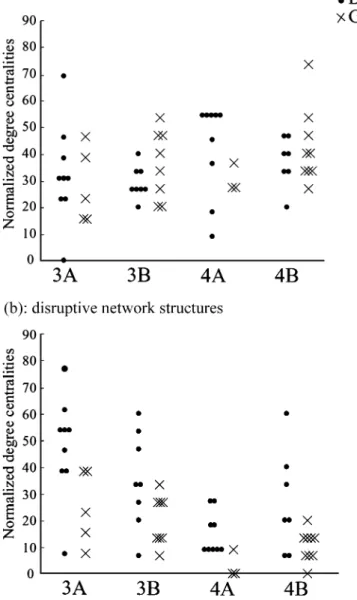
Means and standard deviations of normalized degree centralities of individ- uals in affiliative network structures (ANSs) and in disruptive network struc- tures (DNSs) in each class are shown in Table 1. The children who had higher degree centrality in the DNS did not necessarily have higher degree centrality in the ANS: a higher degree centrality in the DNS of children did not predict a higher degree centrality of those children in the ANS (the degree centrality in the DNS; β = 0.001, SE = 0.11, df = 53, t = 0.05, ns). Neither the age nor the sex of children affected the normalized degree centralities of the ANS (sex: β = 0.50, SE = 3.64, df = 53, t = −0.14, ns; age: β = 8.05, SE = 3.61, df = 2, t = −2.23, ns; Figure 1a).
Table 1. Means of normalized degree centralities (SD in parentheses) of individuals in affiliative network structures (ANS) and disruptive network
structures (DNS) in each class.
3A 3B 4A 4B
ANS 30.77 (16.19) 32.50 (9.97) 39.39 (15.45) 40.00 (11.79)
DNS 39.56 (19.69) 27.50 (15.25) 12.12 (8.57) 17.50 (14.88)
Boys occupied more central places in the DNS, relative to girls. The normalized degree centralities of boys were significantly higher than those of girls in the DNS (β = −16.63, SE = 3.68, df = 8, t = −4.52, p < 0.001; Figure 1b). There were no statistical differences in the normalized degree centralities of the DNS according to age (β = −18.82, SE = 7.19, df = 2, t = −2.62, ns; Figure 1b).
The influence of children with higher centrality in a disruptive/affiliative network structure on the density of the affiliative/disruptive network structure
Means and standard deviations of densities of the ANS and DNS from which one child was excluded are shown in Table 2. The densities of those network structures did not differ by age (ANS: β = 0.02, SE = 0.10, df = 2, t =0.23, ns; DNS: β = −0.98, SE = 0.36, df = 2, t = −2.72, ns).
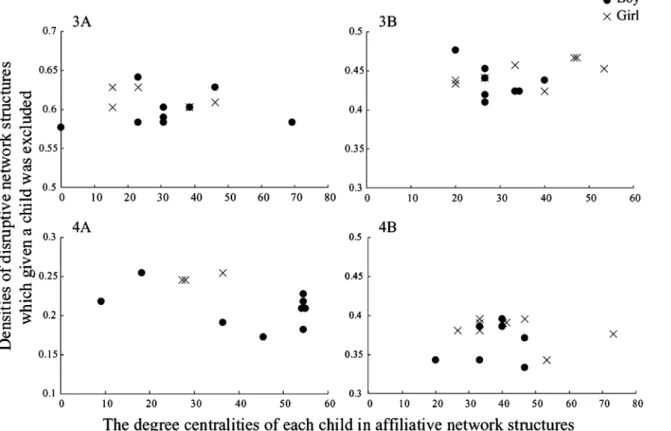
The absence of children with higher centralities in the ANS did not affect the magnitude of the cohesiveness in the DNS. The extent to which the densities of the DNS changed was not associated with the degree centrality in the ANS of the child excluded from the DNS (β = −0.001, SE = 0.001, df = 51, t = −1.04, ns; Figure 2). The sex of children who were excluded from the DNS did not affect the densities of the DNS (β = 0.06, SE = 0.07, df = 51, t = 0.80, ns; Figure 2).
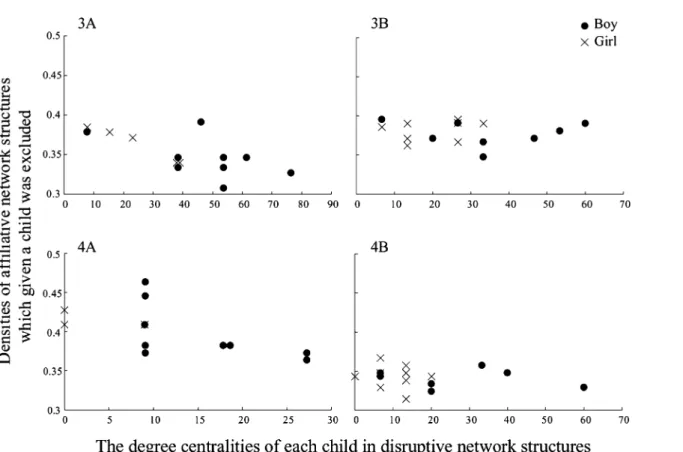
On the other hand, the extent to which the densities of the ANS decreased was positively associated with the degree centrality in the DNS of the child excluded from the ANS. This result suggests that the cohesiveness of the ANS was lessened if children with higher centralities in the DNS were absent from the ANS as compared to when children with lower centralities in the DNS were absent from the ANS (β = −0.002, SE = 0.001, df = 51, t = −2.49, p < 0.05; Figure 3). The sex of children who were excluded
Figure 1. The effects of children sex on the normalized degree centralities of children in each class. Black circles represent the normalized degree centralities of boys and X marks
represent those of girls.
from the ANS did not affect the densities of the DNS (β = 0.01, SE = 0.04, df = 51, t = 0.19, ns; Figure 3).
Table 2. Means of densities of affiliative network structures (ANS) and dis- ruptive network structures (DNS) in which one child was excluded from each
class (SD in parentheses).
3A 3B 4A 4B
ANS 0.35 (0.02) 0.38 (0.01) 0.40 (0.03) 0.34 (0.01)
DNS 0.60 (0.02) 0.44 (0.02) 0.22 (0.03) 0.38 (0.02)
Children had ties with the same peers in both the ANS and DNS to some extent (average proportion of the number of peers with whom a child had ties in both the ANS and DNS divided by the total number of peers that the child had ties with in the ANS: 3A: 53%; 3B: 35%; 4A: 34%; 4B: 27%; average proportion of the number of peers with whom a child had ties in both the ANS and DNS divided by the total number of peers that the child had ties with in the DNS: 3A: 52%; 3B: 46%; 4A: 83%; 4B: 53%). This result suggests that the relationships in the ANS and in DNS moderately overlapped.
Discussion
In studies of conflict resolution and management, determining who plays the role of stabilizing social integration is an important issue. Using social net- work analysis methods, we investigated four hypotheses concerning the ANS and the DNS: Hypothesis 1: the cohesiveness of the ANS should increase if disruptively central children (i.e., aggressive or disruptive children) are re- moved from the ANS; Hypothesis 2: the cohesiveness of the ANS should decrease if disruptively central children are removed from the ANS; Hypoth- esis 3: the cohesiveness of the DNS should increase if affiliatively central children (i.e., affiliative children) are removed from the DNS; Hypothesis 4: the cohesiveness of the DNS should decrease if affiliatively central children are removed from the DNS.
We found that the cohesiveness of the ANS decreased if disruptively cen- tral children, who had central positions in the DNS, were removed from the ANS. This result supports Hypothesis 2 but not Hypothesis 1. This result further suggests that the cohesiveness of the ANS depends on the presence of constructive management of disruptive interactions and that disruptive in- teractions are not necessarily independent of affiliative interactions and rela-
stabilizingroleofaggressivechildren1593
Figure 2. The relation between the degree centralities of each child in affiliative network structures and the densities of disruptive network structures in which the same child was excluded.
Fujisawa,Kutsukake&Hasegawa
Figure 3. The relation between the degree centralities of each child in disruptive network structures and the densities of affiliative network structures in which the same child was excluded.
tionships. Given that there were no relations between the centralities in the ANS and those in the DNS, this result was not the by-product of children being active in both affiliative and disruptive behaviors. Boys played rela- tively central roles in the DNS which was consistent with the general notion that boys are more aggressive or disruptive than are girls (Coie & Dodge, 1998). However, the result of this study was not due to the sex composition within the class because the sex of a child who was excluded from the net- work structure did not affect the cohesiveness of either the ANS or DNS. The fact that affiliative and disruptive relationships moderately overlapped rejected the possibility that prosocial or affiliative children were segregated from non-affiliative children in the DNS and that aggressive children were segregated from non-aggressive children in the ANS. Rather, these overlaps suggest that their relationships were maintained by both affiliative and dis- ruptive interactions, and that constructive conflict management was present within these dyads.
In contrast, children who held central positions in the ANS did not affect the density of the DNS, which supports neither Hypothesis 3 nor Hypoth- esis 4. This result indicates that the cohesiveness of the DNS did not de- pend on the existence of affiliative interactions. Furthermore, it suggests that the presence of affiliative relationships was not associated with decreases in disruptive interactions (i.e., conflict). This may be consistent with previ- ous findings concerning conflict management in children. These showed that children can resolve conflicts by themselves without interventions by third parties (Killen & Turiel, 1991; Fujisawa et al., 2006), whereas preschool chil- dren cannot necessarily intervene effectively as third parties for promoting peers’ conflicts resolution (Butovskaya et al., 2000; Fujisawa et al., 2006). Thus, it may be the case that children of preschool age are not motivated to actively reduce disruptive interactions by intervening peers’ conflicts; how- ever, this interpretation requires empirical testing in various types of sample (e.g., older age group).
From the simplified viewpoint that affiliative and disruptive social behav- iors have contrasting characteristics, the support for Hypothesis 2 but not for the other hypotheses seems counterintuitive. Therefore, this result suggests the complex nature of social relationships among children. Findings in sup- porting of Hypothesis 2 indicate that the DNS plays an important role in the ANS and that the former is associated with the increased cohesiveness of
the latter. This conclusion is consistent with the view that conflict manage- ment links disruptive relationship structures with increased affiliative rela- tionships. It is possible that children who have many disruptive relationships with group members promote affiliative relationships around them in order to mitigate the damage to social relationships with others caused by conflicts and to prevent peer aversion (Coie et al., 1982, 1991; Asher & Rose, 1997). It is also possible that, by stabilizing the ANS, children who are disruptive or who easily cause conflicts with peers may create a social environment in which conflicts are easily ended in reconciliation (Flack et al., 2006). Given that the presence of disruptive children increased the cohesiveness of the ANS, aggressive children may not necessarily be harmful in preschool so- cieties (Hawley, 1999). This result challenges the simplified view in which aggressive or disruptive behavior is merely crude and problematic, suggest- ing instead that aggressive children are integrated within social networks. From the applied perspective, to reduce conflict among preschoolers it may be necessary to consider who occupies the influential roles in their social networks.
In sum, to the best of our knowledge, this is the first study of its kind to in- vestigate conflict management or conflict resolution among children through the application of concepts regarding the structure of social networks. The findings reported herein demonstrate that disruptively central children play stabilizing roles in the ANS. This result is not consistent with the traditional view that aggression necessarily promotes dispersion, but is consistent with the view that conflict management can link disruptive relationship structures with increasing affiliation. The network analyses enabled us to quantify the geometric structure of social integration among children, which provides a new perspective for understanding conflict management among children and their social relationships in two ways. First, for young children, the social experiences of conflict management are considered necessary for social de- velopment (Shantz, 1987; Shantz & Hartup, 1992). The results of this study have not previously been obtained from studies focusing on dyadic relation- ships or interactions between opponents after aggression (e.g., Fujisawa et al., 2005, 2006). Research using social network analysis has great promise for future investigations of the social relationships and network structures of children. Second, this study indicates the adaptive aspect of aggressive behavior in that aggressive children may promote general harmony within a
class. This result may sound paradoxical in that aggressive behaviors func- tion to maintain group members in a dispersed social unit (Strayer, 1992), but provides a new insight for understanding social relationships among young children.
Acknowledgements
We would like to thank R. Kohata, Y. Usui and the teachers who participated in this study for their extensive cooperation. This study was supported by JSPS Research Fellowship and by Keio University Global COE Program: Centre for Advanced Research on Logic and Sensibility.
References
Abramovitch, R. & Grusec, J.E. (1978). Peer imitation in a natural setting. — Child. Dev. 49: 60-65.
Arnold, K. & Aureli, F. (2006). Postconflict reconciliation. — In: Primates in perspective (Campbell, C.J., Fuentes, A., MacKinnon, K.C., Panger, M. & Bearder, S.K., eds). Oxford University Press, New York, NY, p. 592-608.
Asher, S.R. & Rose, A.J. (1997). Promoting children’s social-emotional adjustment with peers. — In: Emotional development and emotional intelligence: educational implica- tions (Salovey, P. & Sluyter, D.J., eds). Basic Books, New York, NY, p. 196-230. Aureli, F., Cozzolino, R., Cordischi, C. & Scucchi, S. (1992). Kin-oriented redirection among
Japanese macaques: an expression of a revenge system? — Anim. Behav. 44: 283-291. Aureli, F. & de Waal, F.B.M. (2000). Natural conflict resolution. — University of California
Press, Berkeley, CA.
Borgatti, S.P., Everett, M.G. & Freeman, L.C. (2002). Ucinet for Windows: software for social network analysis. — Analytic Technologies, Cambridge, MA.
Butovskaya, M.L. (2001). Reconciliation after conflicts: ethological analysis of post-conflict interactions in Kalmyk children. — In: Cross-cultural approaches to aggression and reconciliation (Ramirez, J.M. & Richardson, D.S., eds). Nova Science, Huntington, NY, p. 167-190.
Butovskaya, M.L. & Kozintsev, A. (1999). Aggression, friendship, and reconciliation in Russian primary schoolchildren. — Aggress. Behav. 25: 125-139.
Butovskaya, M.L., Verbeek, P., Ljungberg, T. & Lunardini, A. (2000). A multicultural view of peacemaking among young children. — In: Natural conflict resolution (Aureli, F. & de Waal, F.B.M., eds). University of California Press, Berkeley, CA, p. 243-258. Charlesworth, W.R. & LaFreniere, P. (1983). Dominance, friendship, and resource utilization
in preschool children’s groups. — Ethol. Sociobiol. 4: 175-186.
Cheney, D.L. & Seyfarth, R.M. (1986). The recognition of social alliances by vervet mon- keys. — Anim. Behav. 34: 1722-1731.
Cheney, D.L. & Seyfarth, R.M. (1989). Redirected aggression and reconciliation among vervet monkeys, Cercopithecus aethiops. — Behaviour 110: 258-275.
Coie, J.D. & Cillessen, A.H. (1993). Peer rejection: origins and effects on children’s devel- opment. — Curr. Dir. Psychol. Sci. 2: 89-92.
Coie, J.D. & Dodge, K.A. (1998). Aggression and antisocial behavior. — In: Handbook of child psychology: Vol. 3. Social, emotional, and personality development, 5th edn. (Darmon, W. & Eisenberg, N., eds). Wiley, New York, NY, p. 779-862.
Coie, J.D., Dodge, K.A. & Coppotelli, H. (1982). Dimensions and types of social status: across-age perspective. — Dev. Psychol. 18: 557-570.
Coie, J.D., Dodge, K.A. & Kuperschmidt, J. (1990). Peer group behavior and social status. — In: Peer rejection in childhood (Asher, S.R. & Coie, J.D., eds). Cambridge University Press, New York, NY, p. 17-59.
Coie, J.D., Dodge, K.A., Terry, R. & Wright, V. (1991). The role of aggression in peer relations: an analysis of aggression episodes in boys’ play groups. — Child. Dev. 62: 812-826.
Crawley, M.J. (2007). The R book. — Wiley, New York, NY.
Das, M. (2000). Conflict management via third parties: post-conflict affiliation of the aggres- sor. — In: Natural conflict resolution (Aureli, F. & de Waal, F.B.M., eds). University of California Press, Berkeley, CA, p. 263-280.
Eisenberg, N. & Fabes, R.A. (1998). Prosocial development. — In: Handbook of child psy- chology: Vol. 3. Social, emotional, and personality development, 5th edn. (Darmon, W.
& Eisenberg, N., eds). Wiley, New York, NY, p. 701-778.
Farmer, T.W. & Rodkin, P.C. (1996). Antisocial and prosocial correlates of classroom social positions: the social network centrality perspective. — Soc. Dev. 5: 174-188.
Farver, J.A.M. (1996). Aggressive behavior in preschoolers’ social networks: do birds of a feather flock together? — Early Child. Res. Q. 11: 333-350.
Flack, J.C., Girvan, M., de Waal, F.B.M. & Krakauer, D.C. (2006). Policing stabilizes con- struction of social niches in primates. — Nature 439: 426-429.
Flack, J.C., Krakauer, D.C. & de Waal, F.B.M. (2005). Robustness mechanisms in primate societies; a perturbation study. — Proc. Roy. Soc. London, Series B Biol. 272: 1091- 1099.
Freeman, L.C. (1979). Centrality in social networks conceptual clarification. — Soc. Net- works 1: 215-239.
Fujisawa, K.K., Kutsukake, N. & Hasegawa, T. (2005). Reconciliation pattern after aggres- sion among Japanese preschool children. — Aggress. Behav. 31: 138-152.
Fujisawa, K.K., Kutsukake, N. & Hasegawa, T. (2006). Peacemaking and consolation in Japanese preschoolers witnessing peer aggression. — J. Comp. Psychol. 120: 48-57. Fujisawa, K.K., Kutsukake, N. & Hasegawa, T. (2008). Reciprocity of prosocial behavior in
Japanese preschool children. — Int. J. Behav. Dev. 32: 89-97.
Fujisawa, K.K., Kutsukake, N. & Hasegawa, T. (in press). Social network analyses of positive and negative relationships among Japanese preschool classmates. — Int. J. Behav. Dev. Hanneman, R.A. & Riddle, M. (2005). Introduction to social network methods. — University
of California Press, Riverside, CA.
Hartup, W.W. (1992). Conflict and friendship relations. — In: Conflict in child and adoles- cent development (Shantz, C.U. & Hartup, W.W., eds). Cambridge University Press, Cambridge, p. 186-215.
Hartup, W.W., Laursen, B., Stewart, M.I. & Eastenson, A. (1988). Conflict and the friendship relations of young children. — Child. Dev. 59: 1590-1600.
Hawley, P.H. (1999). The ontogenesis of social dominance: a strategy-based evolutionary perspective. — Dev. Rev. 19: 97-132.
Hawley, P.H. & Little, T.D. (1999). Winning some and losing some: a social relations ap- proach to social dominance in toddlers. — Merrill-Palmer Q. 45: 185-214.
Hawley, P.H., Little, T.D. & Pasupathi, M. (2002). Winning friends and influencing peers: strategies of peer influence in late childhood. — Int. J. Behav. Dev. 26: 466-474. Hinde, R.A. (1976a). Interactions, relationships and social structure. — Man. 11: 1-17. Hinde, R.A. (1976b). On describing relationships. — J. Child Psychol. Psychiatr. 17: 1-19. Hinde, R.A. & Stevenson-Hinde, J. (1987). Interpersonal relationships and child develop-
ment. — Dev. Rev. 7: 1-21.
Iskandar, N., Laursen, B., Finkelstein, B. & Fredrickson, L. (1995). Conflict resolution among preschool children: the appeal of negotiation in hypothetical disputes. — Early Educ. Dev. 6: 359-376.
Judge, P.G. & Mullen, S.H. (2005). Quadratic postconflict affiliation among bystanders in a hamadryas baboon group. — Anim. Behav. 69: 1345-1355.
Killen, M. & Turiel, E. (1991). Conflict resolution in preschool social interactions. — Early Educ. Dev. 2: 240-255.
Koski, S.E., de Vries, H., van den Tweel, S.W. & Sterck, E.H.M. (2007). What to do after a fight? The determinants and inter-dependency of post-conflict interactions in chim- panzees. — Behaviour 144: 529-555.
Koski, S.E. & Sterck, E.H.M. (2007). Triadic postconflict affiliation in captive chimpanzees: does consolation console? — Anim. Behav. 73: 133-142.
Krause, J., Croft, D.P. & James, R. (2007). Social network theory in the behavioural sciences: potential applications. — Behav. Ecol. Sociobiol. 62: 15-27.
Kutsukake, N. & Castles, D.L. (2004). Reconciliation and post-conflict third-party affiliation among wild chimpanzees at the Mahale Mountains, Tanzania. — Primates 45: 157-165. Kutsukake, N. & Clutton-Brock, T.H. (2008). Do meerkats engage in conflict management following aggression? Reconciliation, submission, and avoidance. — Anim. Behav. 75: 1441-1453.
LaFreniere, P. & Charlesworth, W.R. (1983). Dominance, attention, and affiliation in a preschool group: a nine-month longitudinal study. — Ethol. Sociobiol. 4: 55-67. LaFreniere, P. & Charlesworth, W.R. (1987). Effects of friendship and dominance status
on preschoolers’ resource utilization in a cooperative/competitive situation. — Int. J. Behav. Dev. 10: 345-358.
Laursen, B. & Hartup, W.W. (1989). The dynamics of preschool children’s conflicts. — Merrill-Palmer Q. 35: 281-297.
Ljungberg, T., Westlund, K. & Forsberg, A.J. (1999). Conflict resolution in 5-year-old boys: does postconflict affiliative behaviour have a reconciliatory role? — Anim. Behav. 58: 1007-1016.
Matsuo, T. & Nakamura, T. (2002). Daremo osiete kurenakatta inshi bunseki [Introduction for factor analysis]. — Kitaoji syobo, Kyoto.
McGrew, W.C. (1972). An ethological study of children’s behavior. — Academic Press, New York, NY.
Newcomb, A.F., Bukowski, W.M. & Pattee, L. (1993). Children’s peer relations: a meta- analytic review of popular, rejected, neglected, controversial and average sociometric status. — Psychol. Bull. 113: 99-128.
Palagi, E., Cordoni, G. & Tarli, S.B. (2006). Possible roles of consolation in captive chim- panzees (Pan troglodytes). — Am. J. Phys. Anthropol. 129: 105-111.
Petit, O. & Thierry, B. (2000). Do impartial interventions in conflicts occur in monkeys and apes. — In: Natural conflict resolution (Aureli, F. & de Waal, F.B.M., eds). University of California Press, Berkeley, CA, p. 267-269.
R Development Core Team (2007). R: a language and environment for statistical comput- ing. — R Foundation for Statistical Computing, Vienna.
Scott, J. (2000). Social network analysis: a handbook, 2nd edn. — Sage, London. Shantz, C.U. (1987). Conflicts between children. — Child. Dev. 58: 283-305.
Shantz, C.U. & Hartup, W.W. (1992). Conflict in child and adolescent development. — Cambridge University Press, Cambridge.
Snyder, J., West, L., Stockermer, V., Gibbons, S. & Almquist-Parks, L. (1996). A social learning model of peer choice in the natural environment. — J. Appl. Dev. Psychol. 17: 215-237.
Stevenson, H.W. (1991). The development of prosocial behavior in large-scale collective societies: China & Japan. — In: Cooperation and prosocial behaviour (Hinde, R.A.
& Groebel, J., eds). Cambridge University Press, Cambridge, p. 89-105.
Strayer, F.F. (1980). Child ethology and the study of preschool social relations. — In: Friend- ship and social relations in children (Foot, H.C., Chapman, A.J. & Smith, J.R., eds). Wiley, New York, NY, p. 235-265.
Strayer, F.F. (1992). The development of agonistic and affiliative structures in preschool play groups. — In: Aggression and peacefulness in humans and other primates (Silverberg, J. & Gray, J.P., eds). Oxford University Press, New York, NY, p. 150-171.
Strayer, F.F. & Santos, A.J. (1996). Affiliative structures in preschool peer groups. — Soc. Dev. 5: 117-129.
Strayer, F.F. & Trudel, M. (1984). Developmental changes in the nature and function of social dominance among young children. — Ethol. Sociobiol. 5: 279-295.
Vaughn, B.E. & Waters, E. (1981). Attention structure, sociometric status, and dominance: interrelations, behavioral correlates, and relationships to social competence. — Dev. Psychol. 17: 275-288.
Verbeek, P. & de Waal, F.B.M. (2001). Peacemaking among preschool children. — J. Peace Psychol. 7: 5-28.
Verbeek, P., Hartup, W.W. & Collins, W.A. (2000). Conflict management in children and adolescents. — In: Natural conflict resolution (Aureli, F. & de Waal, F.B.M., eds). University of California Press, Berkeley, CA, p. 34-53.
Vermande, M.M., van den Oord, E.J.C.G., Goudena, P.P. & Rispens, J. (2000). Structural characteristics of aggressor-victim relationships in Dutch school classes of 4- to 5-year- olds. — Aggress. Behav. 26: 11-31.
Vespo, J.E. & Caplan, M.Z. (1993). Preschoolers’ differential conflict behavior with friends and acquaintances. — Early Educ. Dev. 4: 45-53.
Wasserman, S. & Faust, K. (1994). Social network analysis: methods and applications. — Cambridge University Press, New York, NY.
Watts, D.P., Colmenares, F. & Arnold, K. (2000). Redirection, consolation, and male policing: how targets of aggression interact with bystanders. — In: Natural conflict resolution (Aureli, F. & de Waal, F.B.M., eds). University of California Press, Berkeley, CA, p. 281-301.
Wittig, R.M. & Boesch, C. (2003). The choice of post-conflict interactions in wild chim- panzees (Pan troglodytes). — Behaviour 140: 1257-1559.