Information Acquisition, Decision Making, and
Implementation in Organizations ∗
Hideshi Itoh
†Kimiyuki Morita
‡July 28, 2017
We study a decision process of a two-agent organization that consists of a decision- maker who selects a project and an implementer who implements and executes the selected project. Each of the decision-maker and the implementer has intrinsic and possibly divergent preferences over projects. Key features of the model are that (i) there is the separation of decision and implementation, and the performance of the selected project depends on the implementer’s costly effort; and (ii) the implementer engages in both acquiring additional information and implementing the project. We show that the implementer’s incentives to gather information and to implement the selected project interact with each other in a non-trivial way. We in particular show how this interaction affects the optimality of diversity of preferences in organizations as well as the implementer’s strategic communication.
JEL Classification Number: D23, D82, D83, M11.
Keyword: Decision Process, Preference Heterogeneity, Information Acquisition, Communication, Biased Agent, Complementarities.
∗The authors are grateful to Yasuyuki Miyahara, Hiroaki Niihara, and seminar participants at ESWC2015 (Montreal), EARIE2015 (Munich), Kobe University, and University of Tokyo for helpful comments. Financial support from JSPS KAKENHI Grant Number 25245031 (Itoh) and Grant-in-Aid for JSPS Fellows Grant Number 26·5608 (Morita) is greatly appreciated.
†Waseda Business School, Waseda University, Tokyo 169-8050, Japan (e-mail: [email protected])
‡Faculty of Business Administration, Osaka University of Economics, Osaka 533-8533, Japan (e-mail: [email protected])
1 Introduction
It is now well known that at the time of making movie The Godfather, director Francis Ford Coppola and Paramount Pictures had a lot of disagreements, particularly about casting choices. Although Coppola thought Marlon Brando was the right actor for Don Vito Corleone,1 Coppola was told by the Paramount president who had the decision right, “As long as I’m president of Paramount, Marlon Brando will not be in the picture.” Despite this refusal, Coppola continued to persuade the president and the executives, and finally succeeded in turning around their opinions by performing screen test and listing reasons why Brando was necessary for The Godfather.
The executives of Paramount also disagreed with Coppola about the casting of Michael Cor- leone. While the studio wanted to cast a young blond star as Michael, Coppola wanted the image of an Italian-American found in then unknown Al Pacino.2 Although Coppola tried to persuade the vice president in charge of the production of the movie, he did not accept Cop- pola’s opinion. Furthermore, the producer of the movie got upset about Coppola’s taking a lot of test films of Al Pacino. However, these test films helped the studio to alter the opinion.3 While The Godfather without Marlon Brando and Al Pacino might have been a good film, we could not watch the classic film without Coppola’s effort.
How did the initial divergence in preferences between Coppola and Paramount executives affect the outcome? Coppola probably worked hard to gather additional information about actors, exactly because of the disagreements, in order to convince the executives to follow his opinion. Paramount executives probably thought that it was Coppola who directed the film anyway,4 and he probably knew more about what he was doing to make the film succeed, and hence they were probably more inclined to respond to his claim in order to motivate him to direct the film enthusiastically than when they had similar preferences.
More generally, two key features of this story apply naturally to decision processes in orga- nizations, such as a new product development process. First, there is division of labor between decision and implementation: The studio made final decisions and Coppola implemented them as a director. As is summarized by Gibbons et al. (2012), a decision process of an organization is often described as moving from choice to execution (Mintzberg, 1979) or from ratification to implementation (Fama and Jensen, 1983). The development of a new car model is executed by a team of engineers often led by a product manager (Clark and Fujimoto, 1991), only after it is ratified by top management. A decision is rarely implemented by the same person, and the authority of the decision maker is often ineffective and the subordinate implementer has some
1According to Lebo (2005, p.48), Coppola said “I listed the reasons (...), one of them being that he had an aura about him when he was surrounded by other actors, similar to that of Don Corleone with the people.”
2According to Lebo (2005, p.63), Coppola said “I always saw this face of Al Pacino in this Sicily section.”
3Marlon Brando also saw the test films and recognized the ability of Al Pacino. The studio chief eventually allowed Al Pacino to be cast after talking to Brando (Lebo, 2005).
4It is said that he was almost replaced not once but several times. We do not consider such a possibility in this paper based on the fact that several directors were offered the position to direct the film by Paramount and all declined before Coppola finally accepted.
freedom to choose whether or not to obey the decisions (Arrow, 1974; Barnard, 1938; Simon, 1947). Takahashi (1997) argues, based on surveys of white-collar workers of Japanese firms, that they commonly avoid completing their tasks so long that they sometimes become unnecessary. Second, the person who implements the decision is very often the one who is in a better posi- tion to access to information valuable for decision making by exerting effort. Coppola engaged in both gathering additional information related to the success of the film and expending effort to direct the film following the approval by the studio. This feature is also commonly found in organizations. As emphasized by Hayek (1945) and Jensen and Meckling (1992), informa- tion relevant to decision making is dispersed, and important part of information is specific to
“the particular circumstances of time and place.” Furthermore, as Arrow (1974) emphasizes, the acquisition of information is costly and there is “a complementarity between a productive activity and some kinds of information. (p.42)” In the example of a new product development in the automobile industry, the product manager who is typically an engineer exerts consider- able efforts before the project is ratified, such as recruiting project members from functional departments, spending off-duty hours for acquiring new knowledge, developing the prototype products, and so on (Niihara, 2010).
To study a decision process with these two features, we consider a two-agent organization the principal of which hires a decision maker and an implementer.5 The decision maker selects one of two relevant projects and the implementer exerts implementation effort for the selected project after observing the cost of implementation. A project succeeds if and only if it “fits” the true state of nature and high implementation effort is exerted. Furthermore, before project choice, the implementer chooses an information-gathering effort to obtain a signal about the state of nature. The probability that an informative signal is observed is increasing in his effort. The informative signal indicates which project is more likely to succeed.
We analyze two cases separately, the case of symmetric information in which the signal gath- ered by the implementer is observable to the decision maker as well, and the case of asymmetric information where the signal is the implementer’s private and soft information and hence there is a strategic communication problem.6
We are in particular interested in diversity in values or preferences between the decision maker and the implementer. The Coppola-Paramount example suggests that their initial diver- gent preferences have incentive effects that eventually lead to good outcomes. It is frequently emphasized in business press and by business people that diversity in the workplace pays. For example, the Stanford GSB lecturer and chairman of JetBlue Airways Joel Peterson writes as follows.7
More important, building a homogeneous organization is just bad business. You
5Throughout the paper we assume the decision maker is female and the implementer is male, for the purpose of identification only.
6If the signal is the implementer’s private and hard information, all the results under symmetric information continue to hold.
7http://www.gsb.stanford.edu/insights/joel-peterson-what-are-most-common-hiring-mistakes
won’t have the variety of perspectives, backgrounds, and skills that are invaluable when you’re up against big problems, or facing big opportunities. You want to work with a group of people who challenge each others’ perspectives, and push each other beyond perceived limitations. The value of a great hire becomes clear when people on your team are forced out of their comfort zone by an infusion of new ideas. That’s when the world begins to look a little different.
Research on diversity or heterogeneity in organizations has also been proliferating in manage- ment literature, although its effects on performance are mixed, partly due to the vague meaning of diversity (see, for example, Harrison and Klein, 2007, for a recent overview of the literature from the standpoint of defining diversity). There is also literature showing evidence of the bright side of intragroup conflict in organizations, in particular, task-related diversity such as dissimi- larity in expertise, education, organizational tenure, and so on (see, for example, Horwitz and Horwitz, 2007, for a recent review of the literature).
To capture preference diversity between the decision maker and the implementer, we assume that each of them prefers one of two projects to be implemented than the other, ceteris paribus, and enjoys a higher private benefit from the success of the former, favorite project than that of the latter. We call the organization homogeneous if their favorite projects coincide, and call it heterogeneous if their favorite projects differ. The unbiased principal chooses either homogeneous or heterogeneous organization to maximize her expected profit. Our paper is thus similar in spirit to Prendergast (2008), who shows that “firms partially solve agency problems by hiring agents with particular preferences (p.201)” and the agents’ biases rise as contracting distortions become larger, although we assume away contracting issues in the main analysis. An example that fits this setting with no contract is a relationship between a doctoral student (implementer) and his academic adviser (decision maker). However, we later (in Section 4) extend the analysis by introducing contracting with the decision maker and the implementer, and show that the main results of the paper continue to hold with some modifications.
Under the assumption of symmetric information, we find three reasons why preference het- erogeneity between the decision maker and the implementer becomes optimal for the principal. First, the decision maker is more likely to “react” to the signal and to select her unfavorite project when the signal indicates it is more likely to succeed (Paramount probably reacted to Coppola in order to motivate him to direct the film enthusiastically). The decision maker is more likely to react under the heterogeneous organization because her unfavorite project is the implementer’s favorite one, and hence the implementer is more motivated to exert effort to implement the project.
Second, the implementer is more motivated to exert effort to gather additional information under the heterogeneous organization since “ignorance” is more costly (Coppola was probably more motivated to gather additional information in order to avoid status quo casting). Suppose that the signal is so informative that, whether preferences are homogeneous or heterogeneous, the decision maker reacts to the signal and implements the project with a higher probability
of success. If no informative signal is observed, the decision maker simply chooses her favorite project, which is the unfavorite one for the implementer under the heterogeneous organization. The implementer with the conflicting preference thus has a stronger incentive to exert effort to avoid ending up with no additional information and implementing his unfavorite project. We call it the ignorance-avoiding effect.
The third reason why the principal prefers diversity comes from interaction between the decision maker’s reactivity and his incentive to gather additional information (Coppola was probably more motivated to gather additional information, in order to induce Paramount to react). Suppose that the informativeness of the signal is intermediate and the decision maker reacts to it only under the heterogeneous organization. Then the only case in which the imple- menter can implement his favorite project is that the signal favoring that project is observed under the heterogeneous organization. This incentive to implement the favorite project in turn reinforces his incentive to gather information if the signal is sufficiently important.
Of course, diversity of preferences has its own cost. The decision maker chooses her favorite project when the signal favors it or when no additional information is available. It is however the implementer’s unfavorite project and hence his motivation to implement the project is lower under the heterogeneous organization. We in fact show that the principal strictly prefers the homogeneous organization if the signal is little informative, or if it is reasonably informative but the implementer’s marginal cost of information-gathering effort is sufficiently high. However, we show that the heterogeneous organization is optimal for the principal if both the signal is sufficiently informative and the implementer’s marginal cost is sufficiently low.
We then extend the analysis to the case in which the signal is the implementer’s private and soft information and the implementer can send any “cheap talk” message to the decision maker. The implementer has no incentive to manipulate information under the homogeneous organization. Under the heterogeneous organization, however, the implementer has incentives to induce the decision maker to choose his favorite project by deviating from truth-telling, and in general there is no equilibrium in which the signal observed by the implementer is perfectly communicated to the decision maker.
This lack of information does not always reduce the performance of the heterogenous or- ganization because the implementer’s favorite project is more likely to be selected and thus his motivation to implement it increases. The principal of the heterogenous organization thus benefits from asymmetric information when the implementer’s marginal cost of information ac- quisition is sufficiently high. Otherwise, however, the heterogeneous organization is less likely to be optimal for the principal, and in particular, the ignorance-avoiding effect, on which the second reason why the principal prefers diversity is based, no longer exists (while the other two effects are still at work). We argue that the vulnerability of heterogenous organization to the manipulation of soft information points to a critical importance of information sharing among members when they have conflicting preferences.
The separation of decision and implementation has recently been formalized and analyzed by
Blanes i Vidal and M¨oller (2007), Marino et al. (2010), Van den Steen (2010b), and Z´abojn´ık (2002). These papers study issues different from us, such as leadership, interpersonal authority, labor market conditions, and delegation of authority. Landier et al. (2009) is most closely related to ours. They show that preference heterogeneity between the decision maker and the implementer may be optimal for the principal. In their model, it is the decision maker who observes an informative signal. Furthermore, the decision maker always observes an informative signal without cost, and hence the incentive to acquire information is not an issue. Borrowing from their modeling approach, we study a complementary situation in which the implementer, exactly because he is the one who executes a project, can access to information valuable to decision making, only by exerting costly effort.8
Since the seminal work Dessein (2002), literature on strategic communication problems in organizations have been growing fast. We study how the implementer’s incentive to acquire information is affected by differences of preferences, and in this respect, our paper is related to Che and Kartik (2009), Dur and Swank (2005), Gerardi and Yariv (2008), Hori (2008), ?, and Van den Steen (2010a). Che and Kartik (2009) and Van den Steen (2010a) show that an agent who has “opinion” different from the decision maker (modeled as different priors) has more incentive to acquire information to persuade the decision maker. Dur and Swank (2005), Gerardi and Yariv (2008), Hori (2008), and ? point out that biased preferences can have positive effects on the agent’s incentive to acquire information, which are similar to our ignorance-avoiding effect. In contrast to our model, however, the privately informed agent in these papers is an “adviser” who does not engage in implementation of a project.
The bottom line is that our paper is an attempt to study the benefits and costs of prefer- ence diversity in organizations by unifying two issues previously analyzed separately, that is, (a) the separation of choice and implementation and (b) information acquisition and strategic communication.
Our theoretical analysis offer some interesting implications for complementarities in organi- zations. Our results imply that organizational practices such as information technology usage, investment in human capital, and information sharing exhibit complementarities, that is consis- tent with much of the existing empirical evidence (Ennen and Richter, 2010; Brynjolfsson and Milgrom, 2012). However, we show that such complementarities exist only in the heterogenous organization. We are currently unaware of any empirical research studying complementarities among organizational elements including preference diversity.
The rest of the paper is structured as follows. In Section 2, we introduce the model, and in Section 3 we report the main results under the assumption of symmetric information. In Section 4 we analyze alternative settings such as the decision maker exerting effort to gather information, the principal offering incentive contracts to the decision maker and the implementer, and so on, in order to discuss how our results change. In Section 5, we assume that additional signal is the implementer’s private information and analyze strategic communication issues. In section
8? is also related though in their model the decision maker both chooses and implements a project. The other agent in their model is an adviser who observes a signal privately and communicates it to the decision maker.
6, the concluding section, we discuss empirical implications.
2 The Model
A principal hires two agents, decision maker (hereafter DM, female) and implementer (IM, male), to select and execute a project. The principal first chooses either a homogeneous or heterogeneous organization (whose meanings are to be explained below). We assume that the principal cannot design contingent payment schemes except Subsection 4.3, where the principal can design incentive contracts in addition to the choice of organization.
DM chooses a project. There are potentially many projects, of which only two, called projects 1 and 2, are relevant: there are two possible states of nature θ ∈ {1, 2}, and project d ∈ {1, 2} is efficient if and only if the true state is θ = d. We assume Pr[θ = 1] = Pr[θ = 2] = 1/2.
IM then exerts effort e ∈ {0, 1} to implement and execute the selected project. Effort e = 1 costs ˜c to IM, which is random and distributed according to a cumulative distribution function F (·) with f (·) as the corresponding density function. We assume F (0) = 0 and F (·) is strictly increasing. IM chooses effort after observing the realization of ˜c.
Project efficiency and IM’s effort are perfect complements: The implemented project d suc- ceeds if and only if it is efficient (θ = d) and IM chooses e = 1. If the project succeeds, the principal obtains profit which we normalize to 1, and DM and IM enjoy private benefits B > 0 and b > 0, respectively. The payoffs to all three parties are zero, otherwise. We can interpret private benefits as intrinsic motivation, perks on the jobs, acquisition of human capital, benefits from other ongoing projects, the possibility of signaling abilities, and so on.
Furthermore, private benefits to DM and IM depend on whether or not their favorite projects are implemented. Without loss of generality, we assume DM prefers project 1, ceteris paribus, and obtains B = BH if project 1 is implemented and succeeds, while her private benefit is B = BL < BH if project 2 is implemented and succeeds. Similarly, IM enjoys bH (bL) if his favorite (respectively, unfavorite) project is implemented and succeeds, where bH > bL holds.
When IM prefers project 1, DM and IM agree about the favorite project and we call such an organization homogeneous. The organization where IM prefers project 2 is called heterogeneous. We denote DM’s bias toward her favorite project as Γ ≡ BH/BL > 1 and IM’s bias as γ ≡ bH/bL > 1. The principal, in contrast, has no bias toward a particular project, and hence chooses an organization to maximize the probability of success.
In addition to execution of a project, IM can engage in information acquisition and generate signal σ ∈ {φ, 1, 2}. Before DM chooses a project, IM chooses information-gathering effort π ∈ [0, 1]. The cost of information-gathering effort π is denoted by η(π; k), where k ∈ (0, +∞) is a parameter representing, for example, investment in information technology, the extent of IM’s discretion over his time allocation between information acquisition and other tasks, the magnitude of organizational support for his activities, and so on, that reduces the marginal cost of effort. For simplicity, we assume it is quadratic in π, that is, η(π; k) = π2/(2k).
When IM chooses π ∈ [0, 1], each value of the signal realizes with the following probabilities: For d, d′∈ {1, 2} and d′̸= d,
Pr[σ = d | θ = d] = πα Pr[σ = d′| θ = d] = π(1 − α)
Pr[σ = φ | θ = d] = 1 − π
where α ∈ (1/2, 1] is the informativeness of the signal: IM succeeds in gathering additional information σ ∈ {1, 2} with probability π, while with probability 1−π no additional information is available (σ = φ realizes). The posterior probability is hence Pr[θ = d | σ = d] = α > 1/2 and Pr[θ = d | σ = d′] = 1 − α < 1/2. Parameter α can be interpreted, for example, as IM’s knowledge about technological environments relevant to the projects, the importance of information acquisition for decision making, and so on. Given that information gathering is successful, the probability of observing σ = 1 and that of observing σ = 2 are equal to 1/2.
The timing of decisions and information structure are summarized as follows.
1. The principal selects either a homogeneous or heterogeneous organization. The principal chooses the homogeneous organization if indifferent. Whether the organization is homo- geneous or heterogeneous, as well as private benefits, are observable to DM and IM. 2. IM chooses information-gathering effort π ∈ [0, 1] that is unobservable to DM.
3. Signal σ ∈ {φ, 1, 2} realizes. We assume σ is observable to DM and IM before Section 5, where we alternatively assume σ is IM’s private information and IM sends a message to DM.
4. DM chooses a project d ∈ {1, 2}, which is observable to IM. DM chooses her favorite project 1 if indifferent.
5. The cost of implementation ˜c is realized and observed only by IM. 6. IM chooses the effort of implementation e ∈ {0, 1}.
7. The outcome of the project is realized.
3 Analysis
We solve the subgame perfect equilibrium of the model by moving backwards, analyzing in order (i) IM’s implementation decision, (ii) DM’s project choice, (iii) IM’s information-gathering effort, and (iv) the principal’s choice of an organization. The proofs not in the main text are found in Appendix.
3.1 Project Implementation
IM’s choice of implementation effort depends on which project DM has chosen as well as whether IM has additional information about the state of nature. Suppose throughout this subsection DM has chosen project d ∈ {1, 2} with IM’s private benefit b ∈ {bL, bH}. We denote the probability that IM chooses e = 1 (high implementation effort) given signal σ by q(b, d, σ) ≡ Pr[e = 1 | b, d, σ].
First, suppose IM has no additional information, so that he only knows the project selected by DM succeeds with probability 1/2. IM then chooses high implementation effort if and only if (b/2) − ˜c ≥ 0. DM then expects IM to exert high implementation effort with probability q(b, d, φ) = F (b/2).
Next, suppose IM obtains additional information. If σ = d ∈ {1, 2}, IM provides high implementation effort for project d if and only if αb − ˜c ≥ 0. If σ ̸= d,9 IM chooses e = 1 to implement project d if and only if (1 − α)b − ˜c ≥ 0. The probabilities that IM chooses e = 1 are thus given as q(b, d, d) = F (αb) and q(b, d, d′) = F ((1 − α)b), respectively. Note that these probabilities are strictly increasing in b: IM is more likely to choose high implementation effort if it is his favorite one. To guarantee that they are less than one for all α, we assume F (bH) ≤ 1 throughout the paper.
3.2 Project Choice
Moving backwards, we next analyze DM’s project choice. We denote the probability of the project being successful by p(b, d, σ) given IM’s private benefit b, project d, and signal σ. For each signal σ, DM chooses a project that maximizes her expected benefit, which we denote by d∗hom(σ) and d∗het(σ) under the homogeneous organization and the heterogeneous organization, respectively.
No Additional Information
First suppose σ = φ. Then IM chooses e = 1 with probability q(b, d, φ), and then the project succeeds with probability 1/2. Hence
p(b, d, φ) = 1
2q(b, d, φ) = 1 2F
( b 2
) . DM’s expected benefit given her private benefit B is then
p(b, d, φ)B = 1 2F
( b 2
) B.
Under the homogeneous organization in which project 1 is the favorite project for both DM and IM, it is obvious that DM chooses project 1 because it’s success probability as well as her
9By σ ̸= d, we always mean σ = d′∈ {1, 2} and d′̸= d.
private benefit is higher under d = 1 than d = 2: p(bH, 1, φ)BH > p(bL, 2, φ)BL.
Under the heterogeneous organization in which DM (IM) prefers project 1 (2, respectively), there is a tradeoff. If DM chooses her favorite project 1, her private benefit under success will be higher while IM is less likely to choose high implementation effort. DM’s expected benefits under d = 1 and d = 2 are, respectively, given as follows:
p(bL, 1, φ)BH = 1 2F
( bL
2 )
BH p(bH, 2, φ)BL= 1
2F ( bH
2 )
BL
DM chooses her favorite project 1 if p(bL, 1, φ)BH ≥ p(bH, 2, φ)BL, which is equivalent to Γ = BH
BL ≥
F (bH/2)
F (bL/2). (1)
In order to focus on a natural and interesting case where DM prefers her favorite project without further information (d∗hom(φ) = d∗het(φ) = 1), from now on we assume (1).10
Assumption 1. Γ ≥ F (bH/2)/F (bL/2).
In addition, we sometimes make the following assumption that directly compares the bias of DM and that of IM.
Assumption 2. Γ ≥ γ.
Assumptions 1 and 2 are equivalent if ˜c is uniformly distributed over [0, 1]. If F (·) is convex, Assumption 2 is implied by Assumption 1. We think it represents a realistic situation in which an important decision is made at a higher hierarchical rank and those who make the decision are more experienced and confident than those who implement the decision at lower ranks. If Assumption 1 does not hold, DM chooses her unfavorite project even though there is no additional information, in order to raise IM’s implementation probability. In the discussion section (Section 4) we explain how the results change under this alternative assumption. Additional Information
Next suppose σ ∈ {1, 2}. The success probabilities are given as follows. p(b, d, d) = αq(b, d, d) = αF (αb)
p(b, d, d′) = (1 − α)q(b, d, d′) = (1 − α)F ((1 − α)b)
First, consider the homogeneous organization. If σ = 1, the optimal project for DM is again project 1 since (i) project 1 is more likely to succeed than project 2, (ii) IM is more likely
10The corresponding assumption is also made in Landier et al. (2009).
to implement project 1, and (iii) success yields higher private benefit BH. We thus obtain d∗hom(1) = 1.
On the other hand, if σ = 2, DM’s expected benefit from her favorite project 1 is p(bH, 1, 2)BH = (1 − α)F ((1 − α)bH)BH. DM’s expected benefit from project 2 is p(bL, 2, 2)BL= αF (αbL)BL. Then d∗hom(2) = 2 if and only if
αF (αbL)BL> (1 − α)F ((1 − α)bH)BH holds. Define αhom ∈ (1/2, 1) as the solution to
αF (αbL) = (1 − α)F ((1 − α)bH)Γ. (2) Then d∗hom(2) = 2 if and only if α > αhom.
We say DM is reactive to signal σ if for each signal DM chooses a project with higher probability of success: d∗hom(σ) = σ for σ ∈ {1, 2}. Under the homogeneous organization, DM is reactive if α > αhom. Otherwise, she always chooses her favorite project 1 irrespective of the informative signal, in which case DM is called non-reactive.
Next consider the heterogeneous organization. If σ = 1 is received, DM’s expected benefit from her favorite project 1 is p(bL, 1, 1)BH = αF (αbL)BH. Similarly, her expected benefit from project 2 is given as p(bH, 2, 1)BL= (1 − α)F ((1 − α)bH)BL. Using α > 1/2 and Assumption 1 yield
αF (αbL)BH > 1 2F
( bL
2 )
BH ≥ 1 2F
( bH
2 )
BL> (1 − α)F ((1 − α)bH)BL,
and hence d∗het(1) = 1: Under Assumption 1, there is no difference between homogeneous and heterogeneous organizations if the signal indicates that project 1 is more likely to succeed.
If σ = 2, on the other hand, DM’s expected benefits from projects 1 and 2 are, respectively, given as p(bL, 1, 2)BH = (1 − α)F ((1 − α)bL)BH and p(bH, 2, 2)BL = αF (αbH)BL. DM is reactive if
αF (αbH)BL> (1 − α)F ((1 − α)bL)BH. Define αhet∈ [1/2, 1) as the solution to
αF (αbH) = (1 − α)F ((1 − α)bL)Γ. (3) Then d∗het(2) = 2 if and only if α > αhetholds.
From (2) and (3) one can easily show 1/2 ≤ αhet < αhom < 1: DM is more likely to be reactive under the heterogeneous organization than under the homogeneous organization. We have solved for DM’s optimal project choice as summarized in the following lemma,11 which is
11If Assumption 1 holds with equality, (3) yields αhet= 1/2 and hence Case 1 in the proposition does not arise. Similar remarks apply to other results as well.
a direct extension of Landier et al. (2009, Proposition 1)
Lemma 1. Under Assumption 1, there exist thresholds αhom and αhet satisfying 1/2 ≤ αhet< αhom < 1, such that DM’s optimal project choice is d∗hom(φ) = d∗het(φ) = 1 for all α ∈ (1/2, 1], and for informative signals, it is given as follows:
Case 1: If α ∈ (1/2, αhet], then DM is non-reactive under both organizations: d∗hom(σ) = d∗het(σ) = 1 for σ ∈ {1, 2};
Case 2: If α ∈ (αhet, αhom], then DM is non-reactive under the homogeneous organization but is reactive under the heterogeneous organization: d∗hom(σ) = 1 and d∗het(σ) = σ hold for σ ∈ {1, 2};
Case 3: If α ∈ (αhom, 1], DM is reactive under both organizations: d∗hom(σ) = d∗het(σ) = σ for σ ∈ {1, 2}.
As Lemma 1 and Table 1 given below make clear, there is no difference in project choice between homogeneous organization and heterogeneous organization if the signal is uninformative or a good news for DM’s favorite project 1. DM possibly makes a different choice if the signal favors her unfavorite project 2. In either organization, DM is reactive if the signal is sufficiently informative. DM’s incentive to be reactive is stronger under the heterogeneous organization because IM derives a higher private benefit from project 2 and is hence more likely to implement it.
Table 1: DM’s optimal project choice Homogeneous Heterogeneous α ≤ αhom α > αhom α ≤ αhet α > αhet
σ = φ project 1 project 1
σ = 1 project 1 project 1
σ = 2 project 1 project 2 project 1 project 2
3.3 IM’s Incentive to Gather Additional Information
Moving backwards further, we now analyze IM’s optimal information-gathering effort. Let K(b, d, σ) be IM’s expected net benefit given private benefit b, project d, and signal σ when he chooses e = 1:
K(b, d, σ) = p(b, d, σ)b − E[˜c | b, d, σ]
where IM’s expected cost of implementation effort E[˜c | b, d, σ] is given by
E[˜c | b, d, σ] =
∫ Pr[θ=d|σ]b
0
cf (c)dc.
Then for each signal σ, IM’s expected net benefit is calculated as follows:
K(b, d, φ) = 1 2F
( b 2
) b −
∫ b/2 0
cf (c)dc =
∫ b/2 0
F (c)dc K(b, d, d) = αF (αb)b −
∫ αb 0
cf (c)dc =
∫ αb 0
F (c)dc K(b, d, d′) = (1 − α)F ((1 − α)b)b −
∫ (1−α)b
0
cf (c)dc =
∫ (1−α)b
0
F (c)dc
Hence we simply write these as K(b/2), K(αb), and K((1−α)b), respectively. K(x) =∫0xF (c)dc satisfies ∂K(x)/∂x > 0 and ∂2K(x)/∂2x > 0 for all x > 0.
Homogeneous Organization
Consider the homogeneous organization and suppose first α ≤ αhom so that DM is non- reactive. IM’s expected payoff is equal to the expected benefit minus the cost of information acquisition:
π
2[K(αbH) + K((1 − α)bH)] + (1 − π)K( bH 2
)
− η(π; k). The first-order condition with respect to π yields the optimal effort as follows:
πhomN (α, k) = min {
k( 1
2K(αbH) + 1
2K((1 − α)bH) − K ( bH
2 ))
, 1 }
.
Note that πNhom(α, k) is strictly increasing in α and k if πhomN (α, k) < 1. Furthermore, πhomN (α, k) > 0 holds for all α ∈ (1/2, 1] and k > 0 by the strict convexity of K(·): Although DM is non-reactive, IM still has an incentive to gather additional information. This is because additional information enables him to decide whether or not to implement project 1 contingent on the informative signal. With additional information, IM chooses to implement project 1 if c ≤ αbH under signal σ = 1 and c ≤ (1 − α)bH under signal σ = 2. With no additional information, his decision can depend only on whether c ≤ (1/2)bH holds or not.
Suppose next α > αhom so that DM is reactive. IM’s expected payoff is given by π
2[K(αbH) + K(αbL)] + (1 − π)K( bH 2
)
− η(π; k).
By taking the first-order condition with respect to π, we obtain the optimal effort as follows: πhomR (α, k) = min
{ k( 1
2K(αbH) + 1
2K(αbL) − K ( bH
2 ))
, 1 }
,
which is strictly increasing in α unless πhomR (α, k) = 1. The following lemma proves that πhomR (α, k) > 0 holds for all α ∈ (αhom, 1] and k > 0 under Assumptions 1 and 2. By this lemma, πRhom(α, k) is strictly increasing in k if πhomR (α, k) < 1.
Lemma 2. Under Assumptions 1 and 2, πhomR (α, k) > 0 holds for all α ∈ (αhom, 1] and k > 0. Denote the optimal level of the information-gathering effort under the homogeneous organi- zation by πhom(α, k):
πhom(α, k) =
πNhom(α, k) if α ≤ αhom πRhom(α, k) if α > αhom
Suppose πNhom(α, k) < 1. Then πhom(α, k) discontinuously jumps up at α = αhom if and only if Γ > γ. To see this, first note πNhom(α, k) = πhomR (α, k) holds when αbL= (1 − α)bH, or
α = αγ ≡ γ
1 + γ, (4)
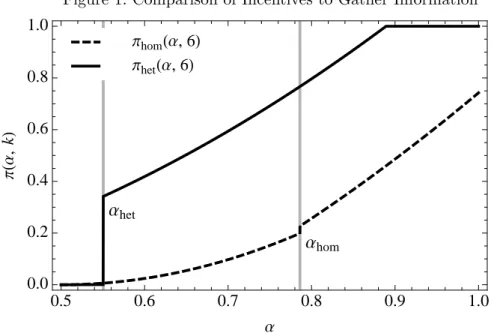
which satisfies αγ ≤ αhom if and only if Assumption 2 holds, with strict inequality if Γ > γ. Then when α is in the interval (αγ, αhom], IM would have stronger incentives to gather additional information if DM were reactive. However, the precision of the signal is not high enough for DM to react to it. Hence IM’s incentives rise discontinuously at αhom beyond which DM becomes reactive.12 In Figure 1 given below, πhom(α, k) is depicted as the dashed curve under the assumption of uniform distribution.
Define also khom(α) > 0 as the minimum k satisfying πhom(α, k) = 1: khom(α) = kNhom(α) for α ≤ αhom; and khom(α) = kRhom(α) for α > αhom, where
kNhom(α) =( 1
2K(αbH) + 1
2K((1 − α)bH) − K ( bH
2 ))−1
kRhom(α) =( 1
2K(αbH) + 1
2K(αbL) − K ( bH
2 ))−1
.
It is easy to see khom(α) is strictly decreasing in α, and discontinuously drops at α = αhom if Γ > γ.
Heterogenous Organization
Consider next the heterogeneous organization. We can obtain IM’s optimal information- gathering effort πhet(α, k) in a way similar to πhom(α, k):
πhet(α, k) =
πNhet(α, k) if α ≤ αhet πRhet(α, k) if α > αhet
12If Assumption 2 is not satisfied and hence Γ < γ, then αγ> αhomholds and πhom(α, k) drops discontinuously at α = αhom, possibly to zero. Our main results are valid without Assumption 2 since the homogeneous organization then becomes even less desirable than when Assumption 2 is satisfied. See Subsection 4.1 for the analysis of the case where DM is less biased than IM.
where πNhet(α, k) and πhetR (α, k) are defined as follows.
πhetN (α, k) = min {
k( 1
2K(αbL) + 1
2K((1 − α)bL) − K ( bL
2 ))
, 1 }
; πhetR (α, k) = min
{ k( 1
2K(αbL) + 1
2K(αbH) − K ( bL
2 ))
, 1 }
Both of them are strictly increasing in α and k (unless they are equal to one) and positive for all α > 1/2 and k > 0. It is easy to show that for all α ∈ (1/2, 1], πhetR (α, k) ≥ πhetN (α, k) holds with strict inequality if πhetN (α, k) < 1: IM would have more incentives to gather information if DM were reactive. In Figure 1, πhet(α, k) is depicted as the solid curve: πhet(α, k) jumps up at α = αhet.
We also define khet(α) as the minimum k satisfying πhet(α, k) = 1: khet(α) = kNhet(α) for α ≤ αhet and khet(α) = kRhet(α) for α > αhet where
kNhet(α) =( 1
2K(αbL) + 1
2K((1 − α)bL) − K ( bL
2 ))−1
kRhet(α) =( 1
2K(αbL) + 1
2K(αbH) − K ( bL
2 ))−1
khet(α) is strictly decreasing in α, and discontinuous at α = αhet. Comparison
We examine how IM’s incentive to gather additional information differs between two organi- zations. We sometimes adopt the following assumption.
Assumption 3. xf (x) is (weakly) increasing in x > 0.
This assumption means that F (·) is not “very concave.” It is satisfied if F (·) is convex. In particular, it holds if ˜c is uniformly distributed.
The following proposition summarizes the result.
Proposition 1. Under Assumptions 1 and 2, IM’s incentive to gather additional information differs between homogeneous and heterogeneous organizations as follows.
Case 1: Suppose α ∈ (1/2, αhet]. If Assumption 3 is also satisfied, πhom(α, k) ≥ πhet(α, k) for all k > 0. The inequality is strict if k < khet(α): IM is more likely to obtain information under the homogeneous organization than under the heterogeneous organization.
Case 2: Suppose α ∈ (αhet, 1]. Then πhom(α, k) ≤ πhet(α, k) holds for all k > 0. The inequality is strict if k < khom(α): IM is more likely to obtain information under the heterogeneous organization than under the homogeneous organization.
Figure 1: Comparison of Incentives to Gather Information
0.5 0.6 0.7 0.8 0.9 1.0
0.0 0.2 0.4 0.6 0.8 1.0
Α
ΠHΑ,kL
ΠhetHΑ, 6L ΠhomHΑ, 6L
Αhet
Αhom
In the figure, we assume ˜c is uniformly distributed over [0, 1], bL= BL= 0.3, bH = 0.9, and BH = 1.35. Then αhet ≈ 0.55, αhom≈ 0.78, and αγ = 0.75. The cost parameter is set to k = 6.
Figure 1 illustrates Proposition 1 by depicting IM’s optimal levels of the information-gathering efforts under two organizations. If the informativeness of the signal is so low that DM is non- reactive under either organization (Case 1), IM is more likely to gather additional information when the project selected by DM is his favorite one. This is because additional information is more valuable to IM when he decides whether or not to implement his favorite project 1 than his unfavorite project 2. Assumption 3 is not necessary. The strict relationship πhom(α, k) > πhet(α, k) can hold if F (·) is not “very concave.” The conclusion may not hold if F (·) is so concave that gathering information is “much more risky” under IM’s favorite project than under his unfavorite one.
Next suppose the signal is sufficiently informative (Case 2). There are two sub-cases. If α > αhom, then DM is reactive under either organization. The difference in IM’s incentive to gather information is then solely due to the difference in his expected benefit under no additional information. Without additional information, DM chooses project 1, which is IM’s favorite (unfavorite) project under the homogeneous (respectively, heterogeneous) organization. IM thus has a stronger incentive to acquire information under the latter organization, in order to avoid ending up with no additional information and implementing his unfavorite project. We call it the ignorance-avoiding effect.13
Finally, if αhet< α ≤ αhom, DM is reactive only under the heterogeneous organization. The
13The ignorance-avoiding effect should be distinguished from the “persuasion effect” pointed out by Che and Kartik (2009) and Van den Steen (2010a), which arises from different priors. An effect similar to our ignorance- avoiding effect is pointed out by Dur and Swank (2005), Gerardi and Yariv (2008), Hori (2008), ?, as well as Che and Kartik (2009, Section VI).
difference in the marginal benefit from acquiring information, which in turn determines the difference in the optimal efforts, consists of the following three effects:
[ 1
2K(αbL) + 1
2K(αbH) − K ( bL
2 )]
−[ 1
2K(αbH) + 1
2K((1 − α)bH) − K ( bH
2 )]
= [
K( bH 2
)
− K( bL 2
)] +1
2[K(αbH) − K((1 − α)bH)] − 1
2[K(αbH) − K(αbL)] (5)
The difference in the first brackets represents the ignorance-avoiding effect, which is positive. The terms in the second and third brackets represent the effects from the difference in reactivity between two organizations. The difference in the second brackets is positive because DM chooses the more successful project 2 given signal σ = 2 only if IM succeeds in gathering additional information under the heterogenous organization. This effect of divergent preferences increases IM’s motivation for implementation because he finds the project selected is more likely to succeed.
However, there is a cost of preference heterogeneity as represented by the difference in the last brackets. This cost is due to the fact that DM, when she observes σ = 1, chooses her favorite project 1, which IM does not like and is less likely to implement under the heterogenous organization.
While the ignorance-avoiding effect is positive, the other effects may hurt the incentive to gather information: the sum of the second and third effects is not necessarily positive for all α ∈ (αhet, αhom]. It is positive if α > αγ but negative if α < αγ. And which of αhet and αγ is larger depends on the biases of DM and IM as follows:14
αhet⪌ αγ ⇔ Γ⪌ Γγ≡ αγF (αγbH)
(1 − αγ)F ((1 − αγ)bL). (6) If DM’s bias is sufficiently high, αhet is so high that in the relevant range of α, the positive second effect always more than offsets the negative third effect. If DM’s bias is lower than Γγ, however, the sum of the second and third effects first reduces the advantage of heterogenous organization due to the ignorance-avoiding effect for α ∈ (αhet, αγ), and then reinforces the ignorance-avoiding effect for α ∈ (αγ, αhom]. Figure 1 corresponds to the latter case (αhet< αγ). Despite this negative third effect, however, Proposition 1 (Case 2) states that the heterogenous organization is advantageous in terms of information acquisition for all α ∈ (αhet, 1].
14For example, if ˜c is uniformly distributed over [0, 1], Γγ= γ3.
3.4 Optimal Organization
We finally investigate the optimal organization for the principal. Let Vhom(α, k) and Vhet(α, k) be the principal’s expected profits:15
Vhom(α, k) =
VhomN (α, k) if α ≤ αhom VhomR (α, k) if α > αhom Vhet(α, k) =
VhetN(α, k) if α ≤ αhet
VhetR (α, k) if α > αhet
Each of Vhom(α, k) and Vhet(α, k) is equal to the success probability of the respective organi- zation, and depends on whether DM is non-reactive (represented by superscript N) or reactive (superscript R).
We first present the main result formally in the following proposition, and then discuss in- tuition in detail. To this purpose, we define another important threshold for informativeness. Define ˆα ∈ (1/2, αγ) as the solution to
αF (αbL) = (1 − α)F ((1 − α)bH). (7)
While ˆα is smaller than αhom, which of αhet and ˆα is larger depends on the biases of DM and IM as follows:16
αhet⪌ ˆα ⇔ Γ ⪌ ˆΓ ≡ αF (ˆˆ αbH)
(1 − ˆα)F ((1 − ˆα)bL). (8) We thus define ˆαhet≡ max{αhet, ˆα}.
Proposition 2. Under Assumptions 1–3, the optimal organization for the principal is given as follows.
Case 1: If α ∈ (1/2, αhet], then Vhet(α) < Vhom(α) holds for all k > 0.
Case 2: If α ∈ (ˆαhet, 1], there exists threshold k(α) ∈(0, khet(α)) such that Vhet(α) < Vhom(α)
for all k < k(α) and Vhet(α) ≥ Vhom(α) for all k ≥ k(α), with strict inequality if k ∈ (k(α), khom(α))
In Appendix, we prove this proposition through three steps (lemmas). First, suppose α ∈ (1/2, αhet]. It is obvious from the definitions of the principal’s expected profits that Vhom(α, k) > Vhet(α, k) holds for all k > 0. If the additional information is so uninformative that DM is non- reactive under either organization, the principal’s optimal choice is the homogenous organization irrespective of IM’s incentive to gather information. The principal prefers the homogenous organization for two reasons: (i) IM is more likely to implement the project; and (ii) he is
15We relegate the exact formulas to Appendix A3.
16For example, if ˜c is uniformly distributed over [0, 1], ˆΓ = γ2.
more likely to obtain additional information. These advantages of the homogenous organization originate from DM’s non-reactive decision to choose IM’s favorite project.
Second, suppose the additional information obtained by IM is sufficiently informative: α ∈ (αhom, 1]. DM then becomes reactive under both organizations. The difference in the principal’s expected profit between heterogenous and homogeneous organizations is given by
∆RV(α, k) ≡ VhetR(α, k) − VhomR (α, k)
= 1 2∆
Rπ(α, k)
[
αF (αbH) + αF (αbL) − F( bH 2
)]
−1 2(1 − π
hetR (α, k))
[ F( bH
2 )
− F( bL 2
)] ,
(9)
where ∆Rπ(α, k) ≡ πhetR (α, k) − πRhom(α, k). To understand the difference, first consider a hypo- thetical situation in which under either organization DM obtained additional information with the same, exogenously given probability π. Then the first term of ∆RV(α, k) would become zero and hence ∆RV(α, k) < 0 unless π = 1: the principal strictly prefers the homogeneous organiza- tion because IM with no additional information is then more likely to implement the project selected by DM (project 1) than under the heterogenous organization.
A main feature of our model is that information acquisition is endogenously determined by IM’s effort. Proposition 1 tells us that the ignorance-avoiding effect provides IM with a stronger incentive to gather information under the heterogenous organization than under the homogeneous organization. That is, ∆Rπ(α, k) ≥ 0 holds for all α ∈ (αhom, 1] and k > 0, and the inequality is strict for (α, k) satisfying πhomR (α, k) < 1 (or equivalently, k < khom(α)). Furthermore, both πRhet(α, k) and ∆Rπ(α, k) are increasing in k. Hence there exists a threshold of k such that (a) if k is smaller than the threshold, the stronger information-gathering incentive from heterogeneity does not overturn the implementation advantage of homogeneity; and (b) if k is larger than the threshold, the stronger information-gathering incentive from heterogeneity benefits the principal so much that the heterogeneous organization is optimal.
The remaining case is α ∈ (αhet, αhom] in which while DM is reactive under the heterogenous organization, she is non-reactive under the homogeneous organization. The difference in the principal’s expected profit is written as follows:
∆RNV (α, k) ≡ VhetR (α, k) − VhomN (α, k)
= 1 2π
hetR (α, k)
[
αF (αbL) − (1 − α)F ((1 − α)bH) + F( bH 2
)
− F( bL 2
)]
−1 2
[ F( bH
2 )
− F( bL 2
)]
+1 2[π
Rhet(α, k) − πNhom(α, k)
] [
αF (αbH) + (1 − α)F ((1 − α)bH) − F( bH 2
)] (10)
Suppose first that the probability of obtaining additional information were exogenously given as π. If π = 1, then the last term is zero and hence which organization is optimal for the principal would be entirely determined by the sign of αF (αbL) − (1 − α)F ((1 − α)bH): the heterogenous organization has an advantage from DM’s reactivity to signal σ = 2, while it has an disadvantage from IM’s lower incentive to implement the unfavorite project under signal σ = 1. These effects cancel out at α = ˆα. Hence given π = 1, the principal would strictly prefer the heterogenous organization if α > ˆαhet = max{αhet, ˆα}. If π < 1, however, the homogeneous organization is strictly preferred even at α = ˆαhet because the reactivity advantage of the heterogenous organization is more than offset by the disadvantage due to its weaker implementation incentive under σ = φ: the sum of the first two terms of (10) is negative.
Now return to our setting in which IM’s information-gathering effort is endogenous and the heterogenous organization provides IM with stronger effort incentives. Then the fact that DM is non-reactive under the homogeneous organization for α ∈ (αhet, αhom] also affects IM’s optimal information-gathering effort. This effect is captured in the first and third terms of (10), and they are strictly positive for α > ˆαhet. Since both πRhet(α, k) − πNhom(α, k) and πhetR (α, k) are increasing in k, we can again show that there exists a threshold of k such that the heterogeneous organization is optimal if and only if k is equal to or above the threshold. This completes the intuitive explanation of Proposition 2.
Note that when αhet < ˆα, that is, Γ < ˆΓ holds, Proposition 2 does not cover the case where α ∈ (αhet, ˆα]. In this interval, the interests of the principal and DM are in conflict under the heterogenous organization when the informative signal is σ = 1: While the principal prefers DM to choose IM’s favorite project 2, the informativeness is so high that DM chooses project 1. There is no such conflict in this interval under the homogeneous organization. This disadvantage of the heterogenous organization and its advantage in terms of information acquisition make the comparison ambiguous. Note however that this interval does not exist if DM is sufficiently biased.
Comparison with the related result of Landier et al. (2009) helps understand our result fur- ther. They show that the heterogeneous organization is strictly preferred by the principal to the homogenous organization if the informativeness of the signal satisfies α ∈ (ˆαhet, αhom), while the principal is indifferent between homogeneous and heterogenous organizations if the signal is sufficiently informative, that is, α ∈ [αhom, 1]. In Landier et al. (2009), the additional infor- mation is always available (π = 1), and hence the advantage of the heterogenous organization is exclusively due to the fact that DM is more likely to react to additional information σ = 2 and select IM’s favorite project 2.
Our result differs from theirs in two respects. First, in our model additional information is not always available (π < 1). As we have explained above, this modification itself benefits the homogeneous organization since IM without additional information is more motivated to implement his favorite project. As long as the probability of obtaining additional information is exogenously given, the homogenous organization is more likely to succeed than the heterogenous
organization except for the extreme case of π = 1 where they are indifferent.
Our second, more fundamental extension is that IM engages in information-gathering activity and hence π is determined endogenously. The heterogenous organization can then have an addi- tional advantage from IM’s stronger incentive to acquire information via the ignorance-avoiding effect when the additional signal is sufficiently informative, as shown in (9). Furthermore, the reactivity advantage of the heterogenous organization may also amplify IM’s information- gathering incentive, as shown in (10).
Note, however, that IM’s stronger information-gathering incentive does not always result in the optimality of heterogenous organization. Proposition 2 in fact shows that if k is sufficiently small, the principal prefers the homogeneous organization however informative the signal is. And we show in Case 1 of Proposition 2 that if the informativeness of the signal is lower than αhet, the homogeneous organization is optimal for all k > 0.
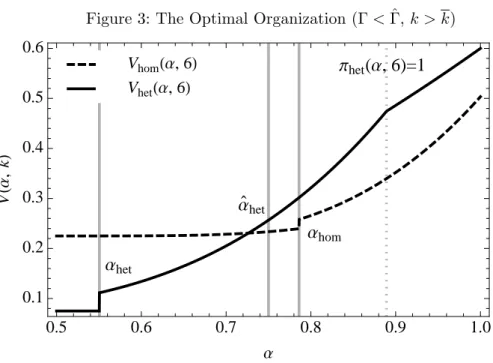
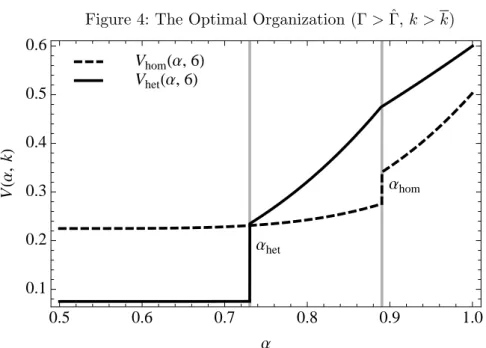
Based on Proposition 2, we can show that there exist two thresholds of k, independent of α, such that if k is below the smaller one of the thresholds, the homogeneous organization is optimal for all α ∈ (1/2, 1], while the heterogenous organization is optimal for all α ∈ (ˆαhet, 1] if k is above the larger one.
Corollary 1. Under Assumptions 1–3, there exist thresholds k and k satisfying 0 < k < k < khet(ˆαhet), such that the optimal organization for the principal is given as follows.
(a) If k < k, then Vhet(α, k) < Vhom(α, k) holds for all α ∈ (1/2, 1).
(b) If k > k, then Vhet(α, k) ≥ Vhom(α, k) holds for all α ∈ (ˆαhet, 1]. The inequality is strict if k ∈ (k, khom(α)).
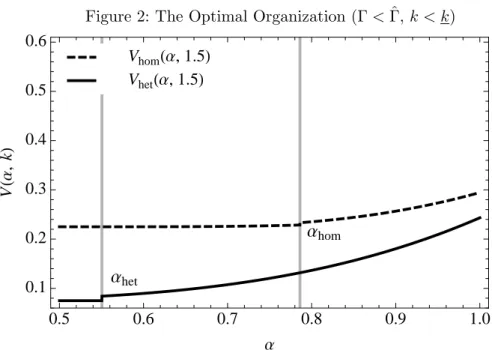
Figure 2 depicts Corollary 1 (a), and Figures 3 and 4 depict Corollary 1 (b). The solid curve represents Vhet(α, k) and the dashed curve Vhom(α, k). The parameter values are the same as those in Figure 1, except k (Figure 2) and BH (Figure 4). In Figure 2, k = 1.5 < k ≈ 2.2, and thus the principal prefers the homogenous organization for all α ∈ (1/2, 1). In Figure 3, k = 6 > k ≈ 5.2 and k = 6 < khom(α) for all α ∈ (ˆαhet, 1]. In Figure 4, BH is changed to BH = 6.6 and hence Γ = 22. Then ˆαhet= αhetholds. Since k = 6 > k ≈ 5.85, the heterogenous organization is strictly preferred to the homogeneous organization for all α ∈ (αhet, 1].
3.5 Complementarities
The analysis of the optimal organization in the previous subsection suggests that the het- erogenous organization is more likely to be optimal as both α and k are sufficiently high. In fact, we can show the following result.
Proposition 3. Suppose Assumptions 1–3 are satisfied.
(a) Vhom(α, k) exhibits increasing differences in (α, k) if α > max{αhet, αγ}. (b) Vhet(α, k) exhibits increasing differences in (α, k).
Figure 2: The Optimal Organization (Γ < ˆΓ, k < k)
0.5 0.6 0.7 0.8 0.9 1.0
0.1 0.2 0.3 0.4 0.5 0.6
Α
VHΑ,kL
VhetHΑ, 1.5L VhomHΑ, 1.5L
Αhom
Αhet
In the figure, we assume ˜c is uniformly distributed over [0, 1], bL= BL= 0.3, bH = 0.9, and BH= 1.35. The cost parameter is set to k = 1.5.
(c) Vhet(α, k) − Vhom(α, k) is increasing in (α, k) if α > αhet and k < kRhet(α).
Proposition 3 (a) and (b) imply that under either organization, decreasing IM’s marginal cost of information acquisition (e.g., investing more in IT, granting IM more discretion over his time use, and so on) improves the performance of the organization more as additional signal is more informative (e.g., more training in human capital, higher knowledge in relevant technology and environments, and so on). These results are consistent with existing empirical evidence (Ennen and Richter, 2010; Brynjolfsson and Milgrom, 2012).
Furthermore, Proposition 3 (c) shows that, as we suggested in the previous subsection, the lower IM’s marginal cost is or/and the more informative the signal is, the more performance improvement a change from homogeneous to heterogenous organization brings about. We are currently unaware of any empirical analysis studying the relationship between preference di- versity in organizations and other organizational practices. Our analysis contributes to the empirical literature on complementarities by offering new testable predictions.
4 Discussions
In this section we discuss our results by modifying some of our settings and assumptions. The formal analysis is relegated to Online Appendix.17 In Subsection 4.1 we argue that if Assumption 1 does not hold, the heterogenous organization no longer enjoys its main advantage that IM is more motivated to gather additional information. In particular, if Assumption 2 fails
17It is available at https://sites.google.com/site/kimiyukimorita/home/online-appendix-itoh-morita.