A uthor(s )
T akahashi, S ayaka; T akahashi, E rina
C itation
IA W A J ournal (2016), 37(1): 16-27
Is s ue D ate
2016-08-23
UR L
http://hdl.handle.net/2433/216362
R ig ht
T his is the accepted version of the following article which has
been published in final form at
http://dx.doi.org/10.1163/22941932-20160118.; T he full-text
file will be made open to the public on 01 J anuary 2018 in
accordance with publisher's 'T erms and C onditions for S
elf-A rchiving'.; T his is not the published version. Please cite only
the published version. この論文は出版社版でありません。
引用の際には出版社版をご確認ご利用ください。
T ype
J ournal A rticle
T extvers ion
author
Timing of vessel formation in twigs and trunks in relation to porosity and leaf flushing
Sayaka Takahashi1 and Erina Takahashi2
1Research Institute for Sustainable Humanosphere, Kyoto University, Uji,
Kyoto 611-0011, Japan
2Faculty of Life and Environmental Science, Shimane University,
Nishikawatsu-cho Matsue-shi Shimane, 690-8504, Japan
Abstract
In order to understand the coordination of leaf phenology and functional xylem anatomy, the timing
of vessel wall lignification in twigs and stems in relation to leaf appearance was studied in nine species
with different porosity patterns. Cylindrical stem cores and twigs were collected from early spring
through late summer from deciduous (Quercus serrata, Liquidambar styraciflua, and Acanthopanax
sciadophylloides), and evergreen (Castanopsis cuspidata; Cinnamomum camphora, Ilex pedunculosa,
Symplocos prunifolia, Quercus glauca and Quercus myrsinifolia) species in a temperate forest. The
first-formed twig vessels lignified at the time of leaf appearance or before in all species. The timing of
stem vessel lignification in relation to leaf appearance in semi-ring-porous deciduous species was
overlapping with that of ring-porous deciduous species and diffuse-porous deciduous species.
Evergreen species showed a great variation in the timing of stem vessel lignification, relative to leaf
flushing. The main conclusions are that 1) Vessel lignification occurs much earlier in twigs than in
trunks of the same trees, with hardly any overlap between the two; 2) Deciduous trees do not differ much
from evergreen species, but there is a weak tendency for evergreen species to have later vessel
differentiation than deciduous species; 3) The timing of vessel formation shows little relation with
porosity patterns and overlaps between diffuse-porous and ring-porous species. This suggests a much
greater intergradation of timing of vessel formation in species of different porosity pattern in evergreen
and deciduous species than recognized in the literature.
Introduction
This study attempts to clarify how variation in vessel porosity affects the timing of vessel formation in
relation to leaf appearance. Temperate broad-leaved trees are evergreen or deciduous and may show
different wood porosities (Wheeler et al. 1989; Hayashi 1991; Itoh 1995). The differences in the size
and distribution of water-conducting cells are related to variations in the phenology of organ
development and the seasonal efficiency of water conduction. Porosity patterns themselves show
gradations and overlap. Many species range from diffuse-porous to semi-ring-porous, or from
ring-porous to semi-ring-porous (Wheeler et al. 1989) and show a considerable plasticity in their xylem
(Scholz et al. 2014).
Previous studies revealed that the timing of vessel formation in relation to leaf appearance in typical
ring-porous deciduous species differs from that in typical diffuse-porous species (Ladefoged 1952;
Suzuki et al. 1996, 2000; Takahashi et al. 2013, 2015). The first-formed vessels, which develop new
rings adjacent to the annual ring border, mature around the time of leaf appearance in stems of
ring-porous species (Zasada & Zahner 1969; Suzuki et al. 1996, 2000; Sass-Klaassen et al. 2011;
González-González et al. 2013; Takahashi et al. 2013; Kudo et al. 2015). In contrast, stem vessels of
diffuse-porous species mature more than two weeks after leaf appearance (Suzuki et al. 1996, 2000;
Čufar et al. 2008; Takahashi et al. 2013).
The wide vessels of the pore-zone in ring-porous deciduous species are known to transport water just
in the one growing season (Greenidge 1955; Chaney & Kozlowski 1977; Ellmore & Ewers 1986;
Utsumi et al. 1999; Umebayashi et al. 2008), while in diffuse-porous deciduous species vessels in
several rings adjacent to the cambium retain their water transport ability for a number of years
(Greenidge 1955; Chaney & Kozlowski 1977; Utsumi et al. 1998; Umebayashi et al. 2008). The time of
stem vessel formation relative to leaf appearance is closely related to water distribution pattern within
annual sapwood rings in ring-porous and diffuse-porous deciduous species (Ladefoged 1952;
Lechowicz 1984; Suzuki et al. 1996; Takahashi et al. 2013).
The above-mentioned studies on seasonal changes in vessel formation in relation to leaf phenology
and water distribution patterns in the sapwood rings lead to the hypothesis that different porosities affect
number of species representing a wide range of porosities, aiming to clarify the coordination between
leaf phenology and functional xylem anatomy. In particular, the seasonal relationship between leaf
appearance and twig and stem vessel formation was studied in nine tree species with different wood
porosity and leaf habits growing together in the same temperate forest stand.
Materials and methods
Study site and sampled trees
The study was conducted in a secondary forest of deciduous and evergreen trees at the Kamigamo
Experimental Forest Station (35° 04′ N, 135° 46′ E, 109–225 m above sea level) of Kyoto University in
Japan. The mean annual temperature over a 30-year period was 14.7°C, with the highest temperature
observed in August (31.8°C) and the lowest in January (-0.9°C). The mean annual precipitation was
1,523 mm (data from 1976 to 2005, Forest Research Station of Graduate School of Agriculture, Kyoto
University 2007).
This study included observations performed on nine tree species with differing leaf habits
(deciduous and evergreen) and different types of vessel porosities, from ring-porous to diffuse-porous
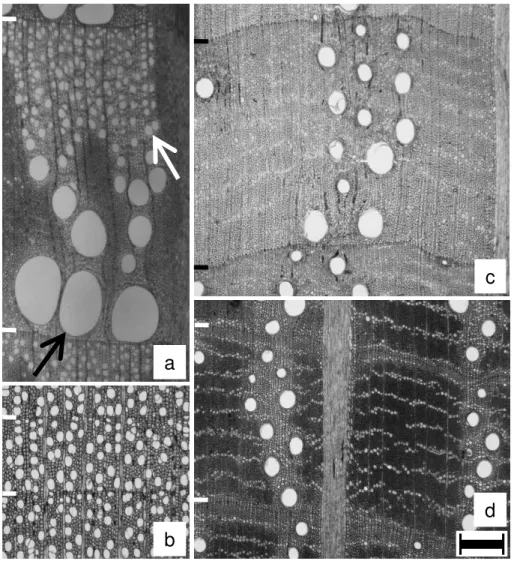
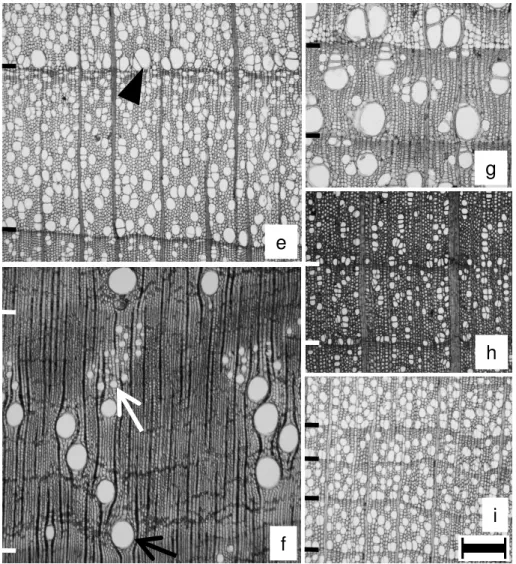
(Table 1; Fig. 1 & 2). Porosity patterns themselves show gradations and overlap. Types of vessel
porosities in this study were classified according to Wheeler et al. (1989), the FFPRI website, and the
InsideWood website. The type of radial-porous was defined as suggested by Gasson (1985) and Noshiro
& Sasaki (2011). Castanopsis cuspidata is characterized as a (semi-)ring-porous to radial-porous
species. Evergreen diffuse-porous species are categorized as diffuse-porous with very weak to more
pronounced semi-ring-porous tendencies. The sampled trees were selected from individuals with a
diameter at breast height ranging from 12 to 56 cm, and a height between 7 and 29 m, with relatively
straight stems. Liquidambar styraciflua and Quercus myrsinifolia individuals were planted trees.
Sampling
Sampling for vessel formation was performed repeatedly during the entire growing season through
collected biweekly between March 14 and June 6 in 2006. Stem samples were collected biweekly
between March 14 and June 20, and monthly between July 4 and August 29, in 2006.
Cylindrical wood core samples with a diameter of 7 mm and a length of 20 mm were collected at
breast height (1.3 ± 0.3 m above the ground) using an increment borer (Mattson, Mora, Sweden) from
each tree (Takahashi et al. 2008).
Twigs with sun-exposed leaves were collected from each tree using a 12-m-long pruner or by
climbing up the trunk and using a 3-m-long pruner. Twigs that had grown within the previous year were
regarded as 1-year-old twigs. In Acanthopanax sciadophylloides, we observed vessel formation in
1-year-old twigs and occasionally in 2- to 4-year-old twigs at 0.5–1.5 cm below the bud base. Stem cores
and twigs were fixed in 3% aqueous glutaraldehyde soon after sampling.
Assessment of vessel formation in cores and twigs
Transverse sections with a thickness of 15–30 μm were cut from each twig or stem sample using a
sliding microtome (Yamato TU-213; Saitama, Japan). The sections were double-stained with 1%
safranin and 1% fast green (Sass 1951) for light microscopic study.
Vessel lignification occurs between cell wall deposition and the disintegration of the end walls
(Imagawa & Ishida 1972; Wakuta et al. 1973; Fukushima et al. 2003; Fromm 2013). Lignification of the
first-formed vessels in the current growth ring, often adjacent to the annual ring border, was determined
by the presence of red color from safranin staining (Sass 1951; Imagawa & Ishida 1972; Takahashi et al.
2008). If lignification was not clear after double staining, a phloroglucinol-hydrochloric acid reaction
was used (Takahashi et al. 2008). The lignification date was defined as the time when the lignification of
almost all (more than 80%) of the first-formed vessels was observed, tangentially using 2–3 mm long
transverse sections.
When enlargement of the first-formed vessels but no lignification of the walls in stems was found by
June 20 or July 4, and lignification of the vessels was observed in August 1 or 29, the date of the
lignification was judged to be two weeks later than June 20 or July 4, respectively. In two trees of
Quercus myrsinifolia, enlargement of the first-formed vessels in the stem was found by August 1, and
Observation of leaf phenology
The leaves of each sampled tree were examined weekly using binoculars (Nikon 8 × 30, 8.8° WF; Tokyo,
Japan) and photographed in situ on the selected trees and sampled twigs. Leaf appearance was defined at
the shoot level, as the date when the lamina separated from the shoot axis (Kikuzawa 1983). We
observed the first flush of leaves in spring weekly between 29 March and 20 June, 2006. The leaf
appearance date was defined as the time when almost all (more than 80% by visual estimate) of flush
leaves appeared.
Results
Timing of twig vessel lignification in relation to leaf appearance
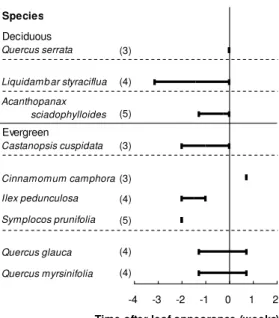
The lignification of the first-formed twig vessels was observed concurrently with leaf appearance in a
ring-porous deciduous Quercus serrata, and 0–3 weeks before leaf appearance in a diffuse-porous
deciduous Liquidambar styraciflua (Fig. 3). Twig vessel lignification occurred 0–1 week before leaf
appearance in Acanthopanax sciadophylloides; 2 weeks before to 1 week after leaf appearance in
evergreen species (Fig. 3). In twigs, overall, the time of the first-formed vessel lignification was close to
the time of leaf appearance and ranged between 3 weeks before and 1 week after leaf appearance (Fig.
3).
Timing of stem vessel lignification in relation to leaf appearance
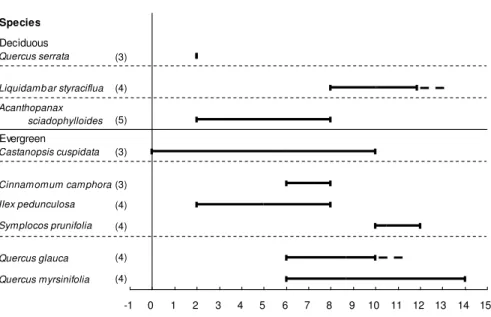
The timing of lignification in the first-formed stem vessels is summarized in Figure 4, and ranges from
nearly simultaneous with leaf flush up to 15 weeks after leaf appearance. There appears to be a strong
overlap between deciduous species, although the total range in timing relative to leaf flush is wider in
evergreen species than in deciduous ones. There is hardly any relationship between type of porosity and
timing of vessel wall lignification of the earlywood and there is a big variation in the timing within some
of the species.
The time of lignification of the first-formed stem vessels in relation to the time of leaf appearance
styraciflua, and evergreen Cinnamomum camphora, Symplocos prunifolia, Quercus glauca and Q.
myrsinifolia (Fig. 4). Acanthopanax sciadophylloides, Castanopsis cuspidata and Ilex pedunculosa
followed a time pattern of vessel lignification overlapping with that of ring-porous and diffuse-porous
deciduous species (Fig. 4).
Timing of stem and twig vessel lignification
The timing of lignification in the first-formed stem vessels relative to twig vessels is summarized in
Figure 5, and ranges between nearly simultaneous with and 14 weeks after lignification in the
first-formed twig vessels. Vessel lignification in twigs occurs earlier than in stems, with hardly any
overlap with timing in stems.
Discussion
Comparison among species with different and intergrading porosities
In this study, we found that the lignification of the first-formed vessels in twigs occurred concurrently
with leaf appearance in both deciduous and evergreen species and in the various types of porosity (Fig.
3). This suggests that twig vessel lignification follows a similar time pattern as in the typical ring-porous
deciduous Quercus serrata and the typical diffuse-porous deciduous Liquidambar styraciflua (Fig. 3).
These results are consistent with previous findings. Twig vessel elements begin to lignify before bud
break (Zasada & Zahner 1969), and cambial cell division at bud bases begins before or simultaneously
with bud break in both ring-porous and diffuse-porous deciduous species (Ladefoged 1952).
Lignification of the first-formed stem vessels occurred shortly after leaf appearance in the typical
ring-porous deciduous Q. serrata and long after leaf appearance in the typical diffuse-porous deciduous
L. styraciflua (Fig. 4). These results are similar to previous findings (Ladefoged 1952; Suzuki et al. 1996,
2000; Takahashi et al. 2013). However, if one considers the timing in other deciduous and evergreen
diffuse-porous, semi-ring-porous, ring-porous or radial-porous species (Fig. 4) the pattern becomes
more complex or even blurred.
Acanthopanax sciadophylloides is categorized as semi-ring-porous (FFPRI website). In this study, A.
rings are diffuse-porous (Fig. 2e). Some of A. sciadophylloides individuals produced leaves and stem
vessels for a short period, similarly to ring-porous deciduous species, while other individuals produced
leaves and stem vessels for a long period, similarly to diffuse-porous deciduous species (Fig. 3–5).
Tyloses are present in old sapwood rings of A. sciadophylloides (Saitoh et al. 1993), so it is possible that
A. sciadophylloides transports water in several annual rings. However, Umebayashi et al. (2008)
categorized A. sciadophylloides as a ring-porous species, given that its wide vessels are known to
transport water mostly during the year in which they are formed, similarly to other ring-porous species.
Thus, it seems that changes in water distribution pattern within annual rings affect the timing of vessel
formation in relation to leaf appearance in the semi-ring-porous deciduous A. sciadophylloides.
Castanopsis cuspidata has (semi-)ring-porous to radial-porous wood (Wheeler et al. 1989;
InsideWood 2004-onwards; FFPRI website). In this study, the first-formed stem vessels lignified not
only long after but also simultaneous with leaf appearance in this species (Fig. 4). Hirano (1998)
reported that secondary wall deposition in stems was completed concurrently with leaf appearance in
Castanopsis sieboldii, a member of the same group. On the other hand, tyloses of C. sieboldii are present
in old sapwood rings (Saitoh et al. 1993), so it is possible that C. sieboldii transport water in several
annual rings. These results suggest that the species categorized as semi-ring-porous, ring-porous or
radial-porous, such as Castanopsis spp., have a broad range of timing of vessel lignification in the stems,
overlapping with the timing in ring-porous and diffuse-porous deciduous species.
Cinnamomum camphora is categorized as semi-ring-porous to diffuse-porous (Wheeler et al. 1989;
FFPRI website), whose earlywood vessels are wider than in other diffuse-porous species (Fig. 1b, 2g–i).
In this study, evergreen Cinnamomum camphora produced leaves and stem vessels for a long period,
similar to diffuse-porous deciduous species (Fig. 4). Pterocarya rhoifolia, which is also categorized as
semi-ring-porous to diffuse-porous (Wheeler et al. 1989; InsideWood 2004-onwards; FFPRI website),
also produces leaves and stem vessels for a long period (Takahashi et al. 2013). These results suggest
that semi-ring-porous to diffuse-porous evergreen species have a time pattern of stem vessel
lignification similar to diffuse-porous deciduous species. Ilex pedunculosa and Symplocos prunifolia are
diffuse-porous (Fig. 2h, i) (Wheeler et al. 1989; FFPRI website). Stem vessel lignification in relation to
(Fig. 4). Especially, stem vessel lignification of a few I. pedunculosa individuals was not different from
ring-porous deciduous species (Fig. 4). Diffuse-porous Fagus sylvatica has been shown to complete
vessel wall deposition in stems 2 weeks after leaf expansion (Čufar et al. 2008). These results suggest
that a few diffuse-porous trees show stem vessel lignification and leaf appearance occurring within a
short time, while the majority take a long time.
Quercus glauca and Q. myrsinifolia are categorized as diffuse-porous to radial-porous (Gasson
1985; Wheeler et al. 1989; FFPRI website; Noshiro & Sasaki 2011). Stem vessel lignification occurred
long after leaf appearance in Q. glauca and Q. myrsinifolia (Fig. 4). Additionally, vessels in several
rings adjacent to the cambium retain their water transport ability for multiple years in radial-porous
evergreen species (Hirose et al. 2005; Umebayashi et al. 2010). This suggests that the time of stem
vessel lignification in radial-porous evergreen plants may be similar to that in diffuse-porous deciduous
species. However, Hirano (1998) also showed that secondary wall deposition in stems was completed
concurrent with leaf appearance in the radial-porous evergreen species Lithocarpus edulis. It is
suggested that some species or trees might need current year’s stem vessels at the time of leaf
appearance.
Our study shows that the timing of stem vessel differentiation in semi-ring-porous deciduous species
overlaps with that of ring-porous deciduous species and diffuse-porous deciduous species. Evergreen
species showed a great variation in the timing of stem vessel lignification, relative to leaf flushing. The
various types of porosity of deciduous and evergreen species clearly intergrade and overlap in their
timing of lignification of the first earlywood vessels. This contradicts the hypothesis that different
porosities affect the timing of vessel formation in relation to leaf appearance, especially in evergreen
species and semi-ring-porous species.
Acknowledgments
We thank the staff of the Kamigamo Experimental Forest Station and of the Field Science Education
and Research Center of Kyoto University for allowing access to the tree specimens and providing
Okada of the Forest Utilization Laboratory, Graduate School of Agriculture, Kyoto University, for
helping us with sample tree selection or sample collection and for their helpful suggestions. We thank
Professor K. Takabe and Associate Professor A. Yoshinaga at the Tree Cell Biology Laboratory,
Graduate School of Agriculture, Kyoto University, for helping us with the phloroglucinol-hydrochloric
acid reaction. We thank Mr. I. Nakane, a staff member at the Kamigamo Experimental Forest Station,
for twig collection from high trees and Mr. Y. Miura for assisting us with sample collection. We also
thank all of the students at the Forest Utilization Laboratory, Graduate School of Agriculture, Kyoto
University, for their assistance at various stages of the study. Our special thanks go to Professor A.
Osawa at the Forest Utilization Laboratory, for his critical reading of the manuscript and his helpful
suggestions. We are very grateful to Professor P. Baas and referees for their constructive comments and
suggestions.
References
Chaney WR & Kozlowski TT. 1977. Patterns of water movement in intact and excised stems of
Fraxinus americana and Acer saccharum seedlings. Ann. Bot. 41: 1093-1100.
Čufar K, Prislan P, De Luis M & Gričar J. 2008. Tree-ring variation, wood formation and phenology of
beech (Fagus sylvatica) from a representative site in Slovenia, SE Central Europe. Trees 22: 749-758.
Ellmore GS & Ewers FW. 1986. Fluid flow in the outermost xylem increment of a ring-porous tree,
Ulmus americana. Amer. J. Bot. 73: 1771-1774.
FFPRI website. http://f030091.ffpri.affrc.go.jp/IDB-E/home.php. Accessed 20 August 2015.
Forest Research Station of Graduate School of Agriculture, Kyoto University. 2007. Meteorological
observations in Kyoto University forests No. 14, 2001-2005 (in Japanese).
Fukushima K, Funada R, Sugiyama J, Takabe K, Umezawa T & Yamamoto H. 2003. Secondary xylem
formation – Introduction to biomass science. Kaiseisha Press (in Japanese).
Gasson P. 1985. Automatic measurement of vessel lumen area and diameter with particular reference to
pedunculate oak and common beech. IAWA Bull. n.s. 6: 219-237.
González-González BD, García-González I & Vázquez-Ruiz RA 2013. Comparative cambial dynamics
and phenology of Quercus robur L. and Q. pyrenaica Willd. in an Atlantic forest of the northwestern
Iberian Peninsula. Trees 27: 1571-1585.
Greenidge KNH. 1955. Studies in the physiology of forest trees. III. The effect of drastic interruption of
conducting tissues on moisture movement. Amer. J. Bot. 42: 582-587.
Hayashi S. 1991. Micrographic atlas of Japanese woods. Wood Research Institute, Kyoto University 23:
1-147 (in Japanese).
Hayashi Y, Furusato K & Nakamura T. 1987. Illustrated trees in color. Hokuryukan, Japan (in
Japanese).
Hirano R. 1998. Phenological wood formation in ring- and diffuse-porous broad-leaved tree species.
Master’s thesis (in Japanese).
Hirose S, Kume A, Takeuchi S, Utsumi Y, Otsuki K & Ogawa S. 2005. Stem water transport of
Imagawa H & Ishida S. 1972. Study on the wood formation in trees: Report II. Development of the
vessel in earlywood of hari-giri, Kalopanax pictus. Res. Bull. Coll. Exp. For. Hokkaido Univ. 29: 55-72
(in Japanese with English summary).
InsideWood. 2004-onwards. Published on the internet (http://insidewood.lib.ncsu.edu/search). Accessed 20 August 2015.
Itoh T. 1995. Anatomical description of Japanese hardwoods I. Reprinted from wood research and
technical notes No. 31: 81-181. Wood Research Institute, Kyoto University, Uji, Kyoto, Japan (in
Japanese).
Itoh T. 1998. Anatomical description of Japanese hardwoods IV. Reprinted from wood research and
technical notes No. 34: 30-166. Wood Research Institute, Kyoto University, Uji, Kyoto, Japan (in
Japanese).
Kikuzawa K. 1983. Leaf survival of woody plants in deciduous broad-leaved forests. 1. Tall trees. Can.
J. Bot. 61: 2133-2139.
Kudo K, Yasue K, Hosoo Y & Funada R. 2015. Relationship between formation of earlywood vessels
and leaf phenology in two ring-porous hardwoods, Quercus serrata and Robinia pseudoacacia, in early
spring. J Wood Sci. (doi 10.1007/s10086-015-1487-6).
Ladefoged K. 1952. The periodicity of wood formation. Dan. Biol. Skr. 7: 1-98.
Lechowicz MJ. 1984. Why do temperate deciduous trees leaf out at different times? Adaptation and
Noshiro S & Sasaki Y. 2011. Identification of Japanese species of evergreen Quercus and Lithocarpus
(Fagaceae). IAWA J. 32: 383-393.
Saitoh T, Ohtani J & Fukazawa K. 1993. The occurrence and morphology of tyloses and gums in the
vessels of Japanese hardwoods. IAWA J. 14: 359-371.
Sass JE. 1951. Botanical microtechnique, Ed. 2: 69-71. The Iowa State College Press, USA.
Sass-Klaassen U, Sabajo CR & den Ouden J. 2011. Vessel formation in relation to leaf phenology in
pedunculate oak and European ash. Dendrochronologia 29: 171-175.
Scholz A, Stein A. Choat B & Jansen S. 2014. How drought and deciduousness shape xylem plasticity in
three Costa Rican woody plant species. IAWA J. 35: 337-355.
Suzuki M, Hirano R & Yoda K. 2000. Phenological analysis of wood formation in temperate deciduous
ring and diffuse porous wood. Chonnam National Univ. Press, Kwangju. Printed in Korea, reprint from
Kim YS (ed.), New horizons in wood anatomy: 132-137.
Suzuki M, Yoda K & Suzuki H. 1996. Phenological comparison of the onset of vessel formation
between ring-porous and diffuse-porous deciduous trees in a Japanese temperate forest. IAWA J. 17:
431-444.
Takahashi S, Okada N & Nobuchi T. 2008. Examination of wood sampling method with an increment
borer: An investigation of seasonal changes in vessel formation. Forest Research, Kyoto 77: 123-128.
Takahashi S, Okada N & Nobuchi T. 2013. Relationship between the timing of vessel formation and leaf
Takahashi S, Okada N & Nobuchi T. 2015. Relationship between vessel porosity and leaf emergence
pattern in ring- and diffuse-porous deciduous trees in a temperate hardwood forest. Botany 93: 31-39.
Umebayashi T, Utsumi Y, Koga S, Inoue S, Fujikawa S, Arakawa K, Matsumura J & Oda K. 2008.
Conducting pathways in north temperate deciduous broadleaved trees. IAWA J. 29: 247-263.
Umebayashi T, Utsumi Y, Koga S, Inoue S, Matsumura J, Oda K, Fujikawa S, Arakawa K & Otsuki K.
2010. Xylem water-conducting patterns of 34 broadleaved evergreen trees in southern Japan. Trees 24:
571-583.
Utsumi Y, Sano Y, Fujikawa S, Funada R & Ohtani J. 1998. Visualization of cavitated vessels in winter
and refilled vessels in spring in diffuse-porous trees by cryo-scanning electron microscopy. Plant
Physiol. 117: 1463-1471.
Utsumi Y, Sano Y, Funada R, Fujikawa S & Ohtani J. 1999. The progression of cavitation in earlywood
vessels of Fraxinus mandshurica var. japonica during freezing and thawing. Plant Physiol. 121:
897-904.
Wakuta R, Saiki H & Harada H. 1973. Enlarging of differentiating vessel element in Firmiana
platanifolia Schott et Endl. Bull. Kyoto Univ. For. 34: 204-216 (in Japanese with English summary).
Wheeler EA, Baas P & Gasson PE. 1989. IAWA list of microscopic features for hardwood identification
with an appendix on non-anatomical information. IAWA Bull. n.s. 10: 219-332.
Zasada JC & Zahner R. 1969. Vessel element development in the earlywood of red oak (Quercus rubra).
Table captions
Table 1. Description of the tree species sampled.
aClasses of porosity were defined based on the FFPRI website, InsideWood (2004-onwards), Gasson
(1985), Wheeler et al. (1989) and Noshiro & Sasaki (2011). Castanopsis cuspidata is characterized as
(semi-)ring-porous to radial-porous species. Evergreen diffuse-porous species are categorized as
diffuse-porous with very weak to more pronounced semi-ring-porous tendencies.
bScientific names are based on Hayashi et al. (1987).
cDiameter at breast height.
Figure captions
Figure 1. Light micrographs of cross sections in deciduous (a,b) and evergreen (c,d) sample trees. – a:
Quercus serrata; black arrow, a wide vessel in the pore zone; white arrow, a narrow vessel in the
non-pore zone. – b: Liquidambar styraciflua. – c: Quercus glauca. – d: Quercus myrsinifolia. – Ring
borders are marked. – Scale bar is 300 μm.
Figure 2. Light microphotographs of cross sections in deciduous (e) and evergreen (f–i) sample trees. –
e: Acanthopanax sciadophylloides; arrowhead, a relatively wide vessel. – f: Castanopsis cuspidata;
black arrow, a relatively wide vessel; white arrow, relatively narrow vessels. – g: Cinnamomum
camphora. – h: Ilex pedunculosa. – i: Symplocos prunifolia. – Ring borders are marked. – Scale bar is
300 μm.
Figure 3. Timing of lignification of the first-formed vessels in twigs relative to the time of leaf
appearance in 2006. Numbers in parentheses indicate the number of trees; bars indicate the time ranges.
Figure 4. Timing of lignification of the first-formed vessels in stems relative to the time of leaf
appearance in 2006. Numbers in parentheses indicate the numbers of trees; - - represents a single tree
that had not yet completed lignification; bars indicate the time ranges.
Figure 5. Timing of lignification of the first-formed vessels in stems compared to twigs in 2006.
Numbers in parentheses indicate the numbers of trees; - - represents a single tree that had not yet
completed lignification; bars indicate the time ranges.
Leaf habit Porositya Speciesb Family Tree No. DBHc Tree height Twigd
(cm) (m)
Deciduous Ring-porous Quercus serrata Thunb. Fagaceae 149 32 14
156 23 8 O
157 36 12 O
158 33 14 O
159 22 13
Diffuse-porous Liquidambar styraciflua L. Hamamelidaceae 182 30 25 O
183 22 22 O
184 33 25
185 40 29
186 44 24 O
187 56 29 O
Semi-ring-porous Acanthopanax sciadophylloides Araliaceae 164 21 7 O
Fr. et Sav. 165 16 7 O
170 22 13
173 21 13 O
177 27 14 O
178 29 17 O
Evergreen ring- (or radial-) Castanopsis cuspidata (Thunb.) Fagaceae 167 56 26 O
porous Schottky 168 39 23 O
169 12 7 O
Diffuse-porous Cinnamomum camphora Sieb. Lauraceae 171 45 19 O
172 29 16 O
176 35 15 O
Ilex pedunculosa Miq. Aquifoliaceae 153 22 9 O
161 24 8 O
162 19 10 O
163 21 11 O
166 24 9
Symplocos prunifolia Sieb. et Zucc. Symplocaceae 150 24 7 O
151 19 9 O
152 21 9 O
154 22 9 O
155 22 8 O
Radial-porous Quercus glauca Thunb. Fagaceae 160 24 11 O
174 29 13 O
175 20 12
180 27 13 O
181 44 17 O
Quercus myrsinifolia Blume Fagaceae 144 22 17 O
145 22 17
146 28 15 O
147 53 20 O
148 30 20 O
b
Scientific names are based on Hayashi et al. (1987). c
Diameter at breast height. d
O: twigs were sampled of this tree. a
Figure 1. Light micrographs of cross sections in deciduous (a,b) and evergreen (c,d)
sample trees. –a: Quercus serrata; black arrow, a wide vessel in the pore zone; white arrow, a narrow vessel in the non-pore zone.–b: Liquidambar styraciflua.–c: Quercus glauca.– d: Quercus myrsinifolia.–Ring borders are marked.– Scale bar is 300μm.
a
d
Figure 2. Light microphotographs of cross sections in deciduous (e) and evergreen (f–
i) sample trees. – e: Acanthopanax sciadophylloides; arrowhead, a relatively wide vessel.–f: Castanopsis cuspidata; black arrow, a relatively wide vessel; white arrow, relatively narrow vessels. – g: Cinnamomum camphora. – h: Ilex pedunculosa.– i: Symplocos pr unifolia. – Ring borders are marked. – Scale bar is 300 μm.
f
h
Figure 3. Timing of lignification of the first-formed vessels in twigs relative to the time of leaf appearance in 2006. Numbers in parentheses indicate the number of trees; bars indicate the time ranges.
-4 -3 -2 -1 0 1 2
(3)
(4)
(5)
(3)
(3)
(4)
(5)
(4)
(4)
Time after leaf appearance (weeks)
Castanopsis cuspidata
Cinnamomum camphora
Ilex pedunculosa
Symplocos prunifolia
Quercus myrsinifolia Acanthopanax sciadophylloides Liquidamb ar styraciflua Quercus serrata
Evergreen
Quercus glauca
-1 0 1 2 3 4 5 6 7 8 9 10 11 12 13 14 15 16
Time after leaf appearance (weeks)
(5)
(6)
(6)
(3)
(3)
(5)
(4)
(5)
(5) Castanopsis cuspidata
Cinnamomum camphora
Ilex pedunculosa
Symplocos prunifolia
Quercus myrsinifolia Acanthopanax sciadophylloides Liquidamb ar styraciflua Quercus serrata
Evergreen
Quercus glauca
Deciduous
-1 0 1 2 3 4 5 6 7 8 9 10 11 12 13 14 15
Lag in weeks between first lignified vessels in stem compared to twig (weeks)
(3)
(4)
(5)
(3)
(3)
(4)
(4)
(4)
(4) Castanopsis cuspidata
Cinnamomum camphora
Ilex pedunculosa
Symplocos prunifolia
Quercus myrsinifolia Acanthopanax sciadophylloides Liquidamb ar styraciflua Quercus serrata
Evergreen
Quercus glauca
Deciduous