sustainability
ISSN 2071-1050www.mdpi.com/journal/sustainability
Review
The Contribution of Wildlife to Sustainable Natural Resource
Utilization in Namibia: A Review
Diana L. van Schalkwyk 1, Kenneth W. McMillin 2, R. Corli Witthuhn 1 and Louw C. Hoffman 1,*
1
University of Stellenbosch, Private Bag X1, Matieland, Stellenbosch, 7602, South Africa; E-Mails: [email protected] (D.L.S.); [email protected] (C.R.W.)
2
Louisiana State University Agricultural Center, 116C Francioni Hall, Baton Rouge, LA 70803, USA; E-Mail: [email protected]
* Author to whom correspondence should be addressed; E-Mail: [email protected]; Tel.: +27-21-808-4747; Fax: +27-21-808-4747.
Received: 21 September 2010; in revised form: 18 October 2010 / Accepted: 12 November 2010 / Published: 15 November 2010
Abstract: Namibia is the driest country in sub-Saharan Africa, but well known for its
richness in species and sustainable natural resource utilization. The Namibian farming sector consists mainly of extensive farming systems. Cattle production contributes 54% of the livestock sector’s production output, followed by sheep and goats (25%), hides and skins (9%), and other forms of agricultural production (12%). Namibia’s freehold farmers have obtained ownership rights over land and livestock since the early 1900s; commercial rights over wildlife and plants were given to freehold farmers in 1967 and to communal farmers in 1996. Natural resource-based production systems then overtook agricultural production systems and exceeded it by a factor of at least two. The shift from practicing conservation to sustainable utilization of natural resources contributed to the rapid growth of wildlife utilization. The wildlife industry in Namibia is currently the only animal production system that is expanding. There are in total at least two million head of different wildlife species. The broader impact of the utilization of wildlife on the economy is estimated to be around N$ 1.3 billion. Tourism, live sales and trophy hunting, cannot sustain further growth. Wildlife farming could offer better opportunities for ensuring long-term sustainability. As the game meat trade in Namibia is not formalized, harvesting wildlife to satisfy the demand for game meat in export markets is still in its infancy.
Sustainable harvesting of wildlife for meat production, however, has the potential to increase earnings to the beneficiaries in the wildlife sector.
Keywords: Namibia; wildlife; sustainable natural-resource based production; biodiversity;
farming; harvesting; game meat; economic benefits; sustainability; meat
1. Introduction
Namibia is well known for its natural resource-based production systems and sustainable use of natural resources. People living in the remote areas of Namibia depend directly on biodiversity for their survival through farming, tourism, hunting, fishing, forestry, manufacturing, trade and education. Biodiversity includes all forms of life, from the smallest microbe, to the largest mammals, trees, and other living organisms. It continuously changes so as to ensure that ecosystems stay in harmony. Species diversity in Namibia is clearly observed along the latitudinal rainfall gradient from the south west to north east of the country [1].
Despite being the driest country in sub-Saharan Africa, the diversity of natural resources in Namibia has enabled many species to adapt to the harsh environment [2]. Namibia is one of the few countries with internationally recognized biodiversity clusters, which include areas that are extremely rich in species and endemism [1].
In Namibia, the preservation of biological diversity and its sustainable utilization are linked through the Namibian National Constitution Act no. 34 of 1998 Article 95 which requires the “maintenance of
ecosystems, essential ecological processes and biological diversity of Namibia and utilization of living natural resources on a sustainable basis” [3]. Namibia’s National Biodiversity Program was
established in September 1994 to support and stimulate national activities relating to natural resource conservation and sustainable use of biological resources [2]. As future developments are inevitable to ensure economic growth, the nature and quality of developments should take into account the value of biodiversity for the country and its inhabitants [1].
2. Livestock Production
The Namibian farming sector comprises mainly of extensive farming systems, with species such as cattle (Bos taurus), sheep (Ovis aries) and boer goats (Capra hircus) [4,5]. The indigenous sanga (Bos
taurus africanus) evolved from different breeds and can be distinguished by region, as some are better
adapted to water scarcity and extreme temperatures [1]. The sector is well developed and has grown in value since 1990 with an average annual nominal growth rate of 10%. On average, cattle production constitutes 54% of the livestock sector’s production output, followed by sheep and goats (25%), hides and skins (9%) and other forms of agricultural production (12%) [6]. The Namibian cattle herd is approximately 2.4 million cattle (Table 1) of which 1.5 million cattle are in communal areas and 0.85 million in commercial areas [7].
karakul) sheep, dairy and pigs contributes only 4% to the output from agricultural production systems.
The total number of goats in Namibia is approximately 2 million (Figure 1), 1.48 million in communal areas and 0.52 million in commercial areas. No formal slaughter market exists for goats, although it is a very popular meat source in rural areas. Most of the goats are sold live to South African agents in Kwazulu-Natal where a lucrative market exists during festive seasons [7].
Figure 1. Livestock numbers in Namibia (2002–2006) (data from [7]).
Table 1. Cattle numbers in Namibia (2002–2006) (data from [7]).
Cattle numbers 2002 2003 2004 2005 2006
Commercial 862,480 947,377 892,347 792,897 748,405
Communal south of the Veterinary Cordon Fence
336,231 343,045 278,845 363,576 350,027
Communal north of the Veterinary Cordon Fence
1,130,842 1,045,672 1,178,508 1,062,857 1,285,528
Total cattle 2,329,553 2,336,094 2,349,700 2,219,330 2,383,960
When both live cattle and meat exports are taken into account, figures from a five year average indicate that a total of approximately 72,000 tons of beef are produced in Namibia annually. The value of sales from the cattle sector increased from N$ 733 million in 2004 to N$ 1,277 million in 2009. Live cattle exports contributed 28,031 tons to exports in 2009, while beef cuts and processed beef products (Figure 2) contributed 20,655 tons [5]. The number of cattle slaughtered at export abattoirs during the previous six years is presented in Figure 3.
Figure 2. Beef, lamb and mutton exported to the European Union, South Africa and other countries (2004–2009) (data from [5]).
Figure 3. Cattle and sheep slaughtered at Namibian export abattoirs (2004–2009)
(data from [5]).
3. Non-Agricultural Resource-Based Production
Natural resource-based production systems in Namibia has overtaken agricultural production systems and exceeds it by a factor of at least two [8]. In 2005, the total gross annual output of Namibian livestock, as well as crops from the commercial as well as communal sectors, amounted to approximately N$ 1,878 million, whilst gross annual output of the non-agricultural natural resource-based sector in commercial areas (Table 2), such as tourism, trophy hunting, wildlife products and indigenous plant products (commercial sector) amounted to approximately N$ 3,200 million.
facilities, trade at game meat outlets and added value to the transport sector. The total value is estimated to be around N$ 1.3 billion when these indirect contributions are included using a multiplier effect of 1.86 [10].
Table 2. Natural resource-based production (N$) in Namibian commercial areas (2005)
(adapted from [8]).
Commodity N$ million
Trophy hunting 316 Live game sales 14.3 Wildlife viewing 2,700
Wood fuel 63
Charcoal 75–100 Plant products 21.6
Total 3,600
4. Wildlife Utilization
The Namibian Government’s Vision 2030 aims to ensure the conservation of natural resources and the sustainable utilization of the country’s wildlife for economic benefits [11]. Approaches to wildlife conservation have changed considerably over recent years; where moving away from practicing conservation towards wise and sustainable use of natural resources has had a major impact [12]. Revenue obtained through natural resource-based production is, however, often taken for granted. Therefore the concept of sustainable harvesting is essential in order to provide for future generations [1].
Namibia has an abundance of wildlife. There are in total at least two million head of different wildlife species (Table 3), a figure roughly similar to the number of domesticated livestock [13]. Wildlife—defined here as all wild animals other than fish and forest dwelling invertebrates—as a resource, is complex, as it comprises all wild animal life, both vertebrates (mammals, birds, reptiles, amphibians) and invertebrates [10]. In the previous two centuries, wildlife numbers in southern Africa were reduced by outbreaks of diseases and over-exploitation by hunters [14]. Although Namibia’s freehold farmers have obtained ownership rights over land and livestock since the early 1900s, commercial rights over wildlife were only given to freehold farmers in 1967 through the South West Africa Wildlife Ordinance [15]. The wildlife industry has been regulated by the Nature Conservation Ordinance No. 4 of 1975 as amended since 1975 [16]. However, minimal community based natural resource management (CBNRM) was put into practice until the implementation of the policies of the Nature Conservation Amendment Act of 1996, resulting in wildlife being utilized and valued by the private sector. This contributed to the rapid growth of wildlife numbers [17].
Table 3. Wildlife numbers in Namibia in 2004 (adapted from [10]).
Species Scientific name Protected areas NVCF* Protected areas SVCF*
Communal land NVCF*
Communal land
SVCF* Private land Total
Springbok Antidorcas marsupialis 33,811# 1,771 37,150 37,270 621,561 731,563 Kudu Tragelaphus strepsiceros 2,063# 1,484 1,545 1,000 345,801 351,893
Gemsbok Oryx gazella 11,450# 3,115 18,670 5,084 350,092 388,411
Red hartebeest Alcelaphus buselaphus 1,468# 115 700 0 122,805 125,088
Eland Tragelaphus oryx 1,704# 524 245 0 34,743 37,216
Plains zebra Equus burchelli 18,098# 0 20 0 7,303 25,421
Mountain zebra Equus zebra hartmannae 8,564# 4,347 2,130 2,175 55,520 72,736
Ostrich Struthio camelus 3,947# 530 2,840 2,020 36,336 45,673
Blue Wildebeest Connochaetes taurinus 4,975# 224 470 0 16,623 22,292
Black faced impala Aepyceros melampus petersi 1,500# 0 0 0 1,870 3,370
Common impala Aepyceros melampus melampus 77# 0 385 0 14,980 15,442
Roan Hippotragus equinus 440# 120 95 0 435 1,090
Sable Hippotragus niger 256# 60 15 0 902 1,233
Lechwe Kobus leche 0 0 250 0 284 534
Tsessebe Damaliscus lunatus 0 15 0 0 162 177
Waterbuck Kobus ellipsiprymnus 0 0 0 0 4,475 4,475
Buffalo Syncerus caffer 1,025# 250 90 0 0 1,365
Giraffe Giraffa camelopardalis 3,683# 229 666 68 5,769 10,415
Warthog Phacochoerus aethiopicus 148# 61 40 0 173,866 174,115
Cheetah Acinonyx jubatus 706# 149 405 270 2,970 4,500
Leopard Panthera pardus 1,970# 430 960 640 4,000 8,000
Lion Panthera leo 574# 23 109 22 0 728
Elephant Loxodonta africana 9,043# 24 735 155 0 9,957
Hippopotamus Hippopotamus amphibious 1,262# 0 300 0 0 1,562
Black rhino Diceros bicornis 816# 43 45 75 134 1,113
White rhino Ceratotherium simum 54# 62 0 0 75 191
* NVCF North of the Veterinary Cordon Fence; * SVCF South of the Veterinary Cordon Fence;
#
Game counts are not representative of the current numbers of wildlife in protected areas.
The black rhino (Diceros bicornis) is a species that is regarded by the IUCN (International Union for Conservation of Nature) as being critically endangered, not only in Namibia, but also in South Africa, Botswana, and Zimbabwe. The mountain zebra (Equus zebra) is also an endangered species in Angola, Namibia and South Africa [21]. It is worth noting the numbers of these endangered species under private land ownership (Table 3). It is a clear indication of the value placed by landowners on these species for consumptive and non-consumptive use.
A veterinary cordon fence (VCF) in northern Namibia (Figure 4) separates areas free of foot and mouth disease from areas where outbreaks of this illness may occur from time to time. No hunting of game for commercial use is allowed in the areas north of the veterinary cordon fence [22].
Figure 4. Foot and mouth disease free zones in Namibia (with new protection zone marked
in green) (adapted from [23]).
under wildlife management; 16.5% is managed by the government as game parks and state protected areas, 6.1% comprise freehold conservancies, 2.1% private protected land and 1.3% community forests and concessions [19].
Figure 5. Areas in Namibia under wildlife management in 2009 (adapted from [19]).
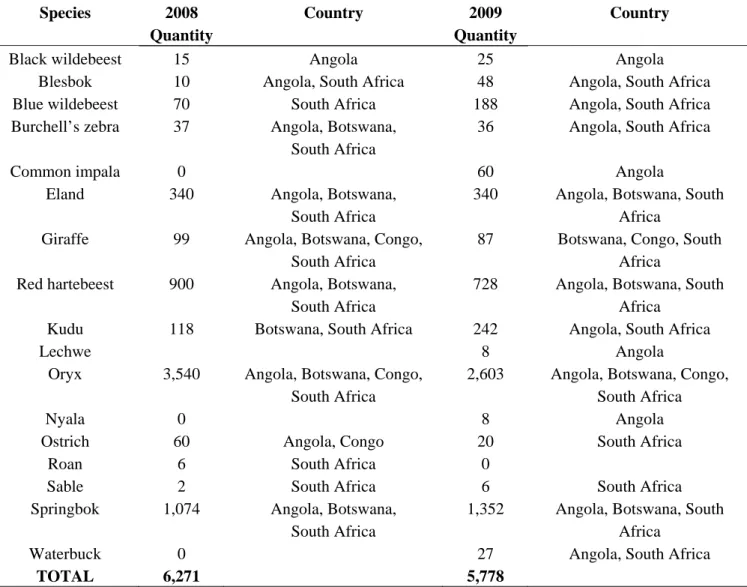
Until recently, live sales were a feasible option for managing wildlife populations, however auction prices reached a peak and are approximately half that obtained for commercial meat sales [8]. The marketing channels for selling live game are: direct sales from wildlife dealers to game ranchers (30% of all animals sold); sales at wildlife auctions (16% of all animals sold); live exports, mainly to South Africa (46% of all sales); and farmer to farmer sales within the country (8% of all animals sold) [17]. A total number of 6,271 and 5,778 game animals were sold live (Table 4) during 2008 and 2009, respectively [27].
Table 4. Wildlife numbers exported live to neighboring countries in 2008 and 2009
(data from [27]).
Species 2008 Country 2009 Country
Quantity Quantity
Black wildebeest 15 Angola 25 Angola
Blesbok 10 Angola, South Africa 48 Angola, South Africa Blue wildebeest 70 South Africa 188 Angola, South Africa Burchell’s zebra 37 Angola, Botswana,
South Africa
36 Angola, South Africa
Common impala 0 60 Angola
Eland 340 Angola, Botswana, South Africa
340 Angola, Botswana, South Africa
Giraffe 99 Angola, Botswana, Congo, South Africa
87 Botswana, Congo, South Africa
Red hartebeest 900 Angola, Botswana, South Africa
728 Angola, Botswana, South Africa
Kudu 118 Botswana, South Africa 242 Angola, South Africa
Lechwe 8 Angola
Oryx 3,540 Angola, Botswana, Congo, South Africa
2,603 Angola, Botswana, Congo, South Africa
Nyala 0 8 Angola
Ostrich 60 Angola, Congo 20 South Africa
Roan 6 South Africa 0
Sable 2 South Africa 6 South Africa
Springbok 1,074 Angola, Botswana, South Africa
1,352 Angola, Botswana, South Africa
Waterbuck 0 27 Angola, South Africa
TOTAL 6,271 5,778
allowed if accompanied by a registered hunting guide [28]. The majority of species hunted by trophy hunters during 2008 and 2009 is depicted in Table 5.
Table 5. Major wildlife species trophy hunted in Namibia (2008 & 2009) (data from [27]).
Species Quantity 2008 Quantity 2009
Oryx 5,845 3,417
Kudu 3,193 1,835
Warthog 4,230 2,517
Springbok 3,704 2,043
Red hartebeest 2,679 1,586
Steenbok 1,229 702
Blesbok 1,204 744
Hartmann’s zebra 1,820 1,064
Blue wildebeest 1,532 895
Eland 1,002 580
Common impala 1,127 670
Black wildebeest 1,163 705
Burchell’s zebra 732 387
Although hunting tourism has long been an important part of Namibian tourism and wildlife policy, this sector remains poorly explored in economic terms [31]. Namibia is one of the most preferred hunting destinations in Africa and trophy hunting earns more foreign currency for Namibia than it does for South Africa. Humavindu and Barnes [28] suggested that trophy hunting is five times more important as a contributor to the national economy in Namibia than to South Africa. Moreover, only Tanzania earns more foreign currency from trophy hunting than Namibia [32]. The number of trophy hunters increased from 181 in 1994 to 775 in 2009 (77%), while the number of common species trophy hunted per year, increased from 4,828 to 18,709 (74%) over the same period [27].
The community-based natural resource management (CBNRM) programs in Namibia are based on the understanding that if resources have sufficient value to local inhabitants, who have exclusive rights of use, benefit and management, then this will create incentives for sustainable utilization [17,33]. This enabled communities in communal areas to establish and register communal conservancies, thereby managing wildlife within these areas, both for wildlife viewing and for hunting tourism [10]. Communities increased their income from all community-based natural resource programs from zero in 1994 to more than N$ 41 million in 2008 [33].
the members of the conservancies which was an important benefit to local households. Additional economic benefits are the value of local management institutions and capacity building which includes the training of those associated with the conservancies [33]. Estimations revealed that for every N$ 1.00 contributed directly to the GDP through wildlife use, an additional N$ 0.86 is contributed indirectly [10].
5. Wildlife Farming
The wildlife industry in Namibia has shown tremendous growth over the past decades and it is currently the only extensive animal production system that is expanding [13,34]. A recent survey concluded that this phenomenon can be attributed to increased rainfall, good farming practices, sustainable harvesting and the creation of additional water sources [35]. Barnes and Jones [34] indicated that, as a result of sustainable wildlife utilization and good wildlife practices, the number of the main wildlife species doubled while livestock numbers decreased by 45% primarily due to severe bush encroachment [36], during the period 1970 to 2000.
Tourism, live sales and trophy hunting alone cannot sustain further growth. Trophy hunting only removes approximately 1% of the national wildlife herd [13]. Predator populations that remove the excess of animals are continuously suppressed, mainly because of livestock farming [24]. Game ranchers also import exotic wildlife species at a high cost, such as blesbok, black wildebeest etc., for tourist viewing. They often refer to the need to control the number of large carnivores by killing them off, or else run the risk of having expensive imported game species preyed upon. This behavior of game ranchers is not likely to change as long as wildlife viewing and wildlife utilization have commercial value [37]. Perceived losses of livestock also influence the removal of these predators [38,39], although game ranchers have more problems with predators than livestock farmers [40]. Possible explanations for this phenomenon could be that game farmers have improved accounting for their wild animals, more so than many livestock farmers, and most predators prefer to prey on wild game species than on domestic livestock species.
and has better resistance to poisonous plants [46] and diseases than livestock [46,47]. These animals also roam large areas without losing weight and have less need for water than cattle [46]. The costs of raising wildlife were found to be lower than costs encountered with livestock farming as some management expenses associated with domestic animals such as dipping, inoculation and herding, are not required for wildlife [48]. This phenomenon was also observed in a study undertaken by the World Bank, which indicated that wildlife utilization can offer better returns than commercial or communal livestock farming [20].
Wildlife populations naturally increase in numbers, typically at a rate of 15–35% per year [13]. Some authors suggest that the abundance of wildlife on freehold land is higher for species such as gemsbok, kudu, hartebeest, impala and eland [10,24,35]. If uncontrolled, particularly on fenced land, wildlife numbers can rapidly exceed the carrying capacity of the land and result in rangeland degradation [49]. Several factors, such as declining income from livestock production, limited farming subsidies and an increase in hunting and ecotourism resulted in some Namibian farmers practicing or considering game ranching as an alternative or additional farming system to cattle ranching [42]. The shift from traditional livestock farming to more natural resource-based wildlife farming is likely to increase with climate change, as well as with the political uncertainty concerning land ownership resulting from new land reform policies promulgated after Namibia’s independence in 1990 [50].
Some experts believe that game ranching for eco-tourism and live sales might reach saturation point, thereby forcing a change in the focus to growing markets for game meat and meat products [51-54]. A study carried out by Berry [47] concluded that when different forms of wildlife utilization, namely trophy hunting, non-trophy recreational hunting, live animal sales and game meat production were evaluated, trophy hunting gave the highest net return, followed by live game sales. However, when an index based on harvesting percentages was developed, the net values of the weighted calculations showed that game meat production was the most profitable, followed by live game sales, non-trophy recreational hunting and trophy hunting. The harvesting percentages used were derived from actual harvesting figures and field operations and considered to be the exploitable surplus. The index value calculated from the harvesting percentages was then multiplied by the net value resulting in the weighted value. Although these findings cannot be generalized, it was observed that a broader based wildlife utilization strategy offered a better return.
6. Meat Production from Wildlife
Game harvesting operations with the purpose of satisfying local and export demand for game meat is still in its infancy in Namibia [13], as the formal game meat trade in Namibia is underdeveloped. This sector has however, significant potential for growth. Game harvesting also has a positive impact on the environment, since it provides a tool to landowners and custodians of land to manage wildlife numbers for ecological carrying capacity, thereby preventing environmental damage [55] in an often rapidly changing climatic area. Meat production potential from various wildlife species has long been recognized [56,57]. The major wildlife species in Namibia under consideration for commercial game meat export are springbok (Antidorcas marsupialis—Zimmerman, 1780), gemsbok (Oryx
1766). The suitability of these species for commercial meat production is not only based on their
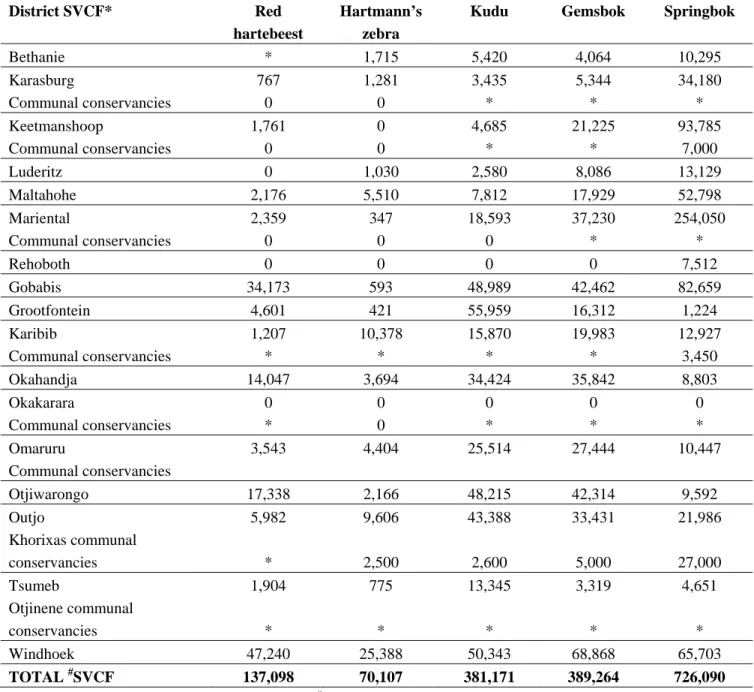
population numbers (Table 6 ), but also on other factors such as their reproductive performance, the fact that they occur in large herds in easily accessible regions, their suitability for commercial harvesting and proximity to de-skinning, de-boning and processing facilities.
Table 6. Population numbers of commercially harvestable wildlife species in the different
districts in Namibia (2007) (adapted from [58]).
District SVCF* Red hartebeest
Hartmann’s zebra
Kudu Gemsbok Springbok
Bethanie * 1,715 5,420 4,064 10,295
Karasburg 767 1,281 3,435 5,344 34,180
Communal conservancies 0 0 * * *
Keetmanshoop 1,761 0 4,685 21,225 93,785
Communal conservancies 0 0 * * 7,000
Luderitz 0 1,030 2,580 8,086 13,129
Maltahohe 2,176 5,510 7,812 17,929 52,798
Mariental 2,359 347 18,593 37,230 254,050
Communal conservancies 0 0 0 * *
Rehoboth 0 0 0 0 7,512
Gobabis 34,173 593 48,989 42,462 82,659
Grootfontein 4,601 421 55,959 16,312 1,224
Karibib 1,207 10,378 15,870 19,983 12,927
Communal conservancies * * * * 3,450
Okahandja 14,047 3,694 34,424 35,842 8,803
Okakarara 0 0 0 0 0
Communal conservancies * 0 * * *
Omaruru 3,543 4,404 25,514 27,444 10,447
Communal conservancies
Otjiwarongo 17,338 2,166 48,215 42,314 9,592
Outjo 5,982 9,606 43,388 33,431 21,986
Khorixas communal
conservancies * 2,500 2,600 5,000 27,000
Tsumeb 1,904 775 13,345 3,319 4,651
Otjinene communal
conservancies * * * * *
Windhoek 47,240 25,388 50,343 68,868 65,703
TOTAL #SVCF 137,098 70,107 381,171 389,264 726,090
* No reliable data available; # SVCF South of the Veterinary Cordon Fence.
surveys will produce more reliable results, but these approaches are both expensive and time consuming [59].
Wildlife may not be harvested from areas subject to official prohibition of harvesting. The reasons for prohibition may be related to conservation, animal health and to animal or plant chemical control [60]. Game meat for export may only be harvested in the OIE (World Organization for Animal Health) recognized foot and mouth disease free zone without vaccination (Figure 4). The Nature Conservation Ordinance No. 4 of 1975 [30] and its associated regulations, regulate the registration of hunting farms, the harvesting of game animals, and the registration of game harvesting teams [61]. The meat from game harvested outside the foot and mouth disease free zone (Figure 4) may not be transported into the disease free area [13]. The primary responsibility for food safety rests with the food business operator as stated in the European Union Regulation (EC) No. 852 Chapter I Article I paragraph 1. According to these regulations it is necessary to ensure food safety throughout the food chain, starting with primary production. Food business operators must therefore, establish, implement and maintain hygiene control procedures based on HACCP (Hazard Analytical Critical Control Points) principles as described in the European Union Regulation (EC) No. 852 Article 5 paragraph 1 [62]. This is applicable to the harvesting of wildlife for meat exports to the European Union and other countries such as South Africa [63].
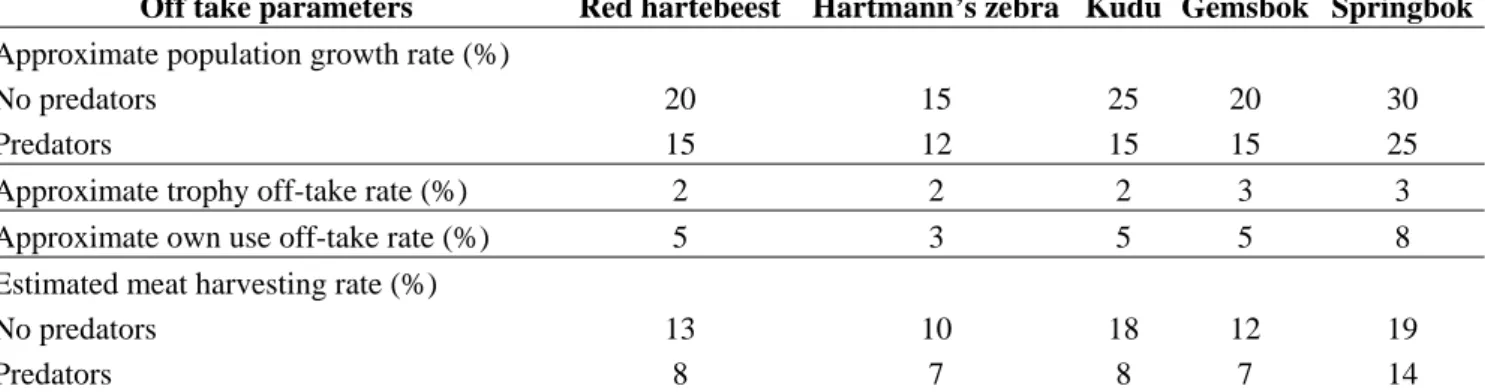
Only 3% of the commercially harvestable species exist north of the veterinary cordon fence, as these species tend to roam in arid to semi-arid areas. South of the veterinary cordon fence springbok make up the largest part of the wildlife population available for commercial harvesting, although the larger antelope exceed springbok in biomass by a factor of about 4.5. When the off-take rates of predators, trophy hunting and personal use are taken into account, a conservative off-take rate varying from 7% for Hartmann’s zebra and gemsbok, 8% for kudu and red hartebeest and 14% for springbok (Table 7) is derived. In terms of income to land owners and conservancies (Table 8), the game meat market has the current potential of generating revenue in excess of N$ 300 million annually [58]. The additional income to harvesting teams, abattoirs, exporters and outlets, could make the game meat industry worth in excess of N$ 500 million per year [13].
Table 7. Off-take parameters for commercially harvestable wildlife species in Namibia
(adapted from [58]).
Off take parameters Red hartebeest Hartmann’s zebra Kudu Gemsbok Springbok
Approximate population growth rate (%)
No predators 20 15 25 20 30
Predators 15 12 15 15 25
Approximate trophy off-take rate (%) 2 2 2 3 3 Approximate own use off-take rate (%) 5 3 5 5 8 Estimated meat harvesting rate (%)
No predators 13 10 18 12 19
Predators 8 7 8 7 14
managed, it can result in an increased population growth. The applied harvesting methodology should adhere to all ethical requirements to ensure that harvesting is not negatively perceived within the consumer market. Game harvesting should be planned and implemented so as to ensure the optimization of the total wildlife production system [13].
Table 8. Potential value (N$) of sustainable game meat harvesting to land owners and
conservancies in Namibia (2008) (adapted from [8]).
Wildlife type Commercial farms *SVCF Communal *NVCF Communal
Conservancies Conservancies
Springbok 44,429,457 2,027,718 1,101,240
Larger game 168,893,039 1,291,425 1,551,083
*SVCF South of the Veterinary Cordon Fence; *NVCF North of the Veterinary Cordon Fence.
7. Game Meat as an Alternative Meat Source
There is a clearly defined demand for meat from species such as springbok, gemsbok and kudu in some countries of the European Union [65]. It is also anticipated that the demand for game meat will increase [66] both locally and internationally [67]. Namibian game meat has to compete with other red meats such as beef and lamb [5], as products from different species are sold in the same markets [68]. Research has shown that consumers are poorly educated regarding the nutritional benefits and cooking methods of game meat [69]. Therefore, the marketing of game meat on a larger and more organized scale could be beneficial and increase profits to both game ranchers and game meat processors [70]. The correct marketing strategy and the availability of game products requiring less cooking time are imperative for the sustainability of game meat in consumer markets [71]. Respondents from a survey conducted at restaurants in South Africa reported that the majority of their respondents (86%) indicated that they would eat game meat [72]. Seventy-six percent of the respondents indicated that they would eat game meat because they like the taste, while reasons for not eating game meat include being afraid that wildlife will become extinct (3%). Two percent of the respondents considered game meat as typical of Africa.
Environmental concerns resulted in consumers showing more interest in free-range and organic products [69]. Game meat can easily be marketed as an organic product as game ranching conforms to the requirements for organic production [73]. These requirements include minimal damage to the environment, prohibition of agro-chemical pesticides and the careful attention to the impact of farming on the environment and the conservation of wildlife [74,75]. In recent years, consumers have an increased awareness of the health status of food they consume [76] and therefore question the origin of food products [77].
meat as less than 500 kJ per 100 g and, viewed with the high protein content of game meat [83], can be regarded as a nutrient-dense food ideal for the discerning consumer. It is however essential that consumers are educated on the health advantages of game meat compared to other red meats [84].
Namibia has a history of small scale attempts to commercially export game meat to the international markets. During the early 1990s Windhoek Wild (Pty) Ltd. exported kudu, gemsbok and springbok meat to Switzerland. This export plant was however closed soon after the Chernobyl accident in Europe which resulted in all game meat sold in European markets being perceived as contaminated with radio-active substances. Exports of game meat recommenced in 2003 when Farmers Meat Market Mariental Abattoir (Pty) Ltd. was approved by the European Union to export springbok meat to the European Union and Norway. This facility exports approximately 70 tons of de-boned springbok meat to the European markets annually. Another facility in the south of Namibia, Brukarros Meat Processors (Pty) Ltd., received approval for the export of de-boned springbok meat to the European Union in 2008 and exported almost 17 tons to various overseas markets during 2009 [5]. Whereas springbok meat is already quite well known in international markets, meat of the larger game species is still unknown in overseas markets [85]. To date, no facility exists to export meat or processed meat products from large game species to overseas markets. In Namibia, game meat is often utilized to produce biltong. This is a traditional form of dried meat consumed in Southern Africa. South Africa is the largest producer and consumer of biltong made from beef or game. The name originates from the Dutch word “bil” meaning buttock and “tong” meaning strip [86]. Other processed products manufactured from Namibian game are salami and smoked game meat; products with a high potential market value in overseas niche markets.
8. Conclusions
The Biodiversity Treaty, of which Namibia is a signatory, which was signed in Brazil in 1992, focuses on promoting the sustainable use of natural resources and the assurance of equitable distribution of the revenue derived from natural resource-based production systems to the beneficiaries. Promoting the direct use of wildlife in Namibia would create economic incentives for investing into wildlife resources on private, communal and state land. Sufficient numbers of commercially harvestable game seem to exist which could render the sustainable harvesting and processing of game meat complimentary to, or as a feasible alternative to, safari hunting and eco-tourism. Sustainable utilization of wildlife for meat production, destined for local distribution and exports, could assist the management of wildlife as a natural resource and economically viable production system. This has the potential to increase earnings to the beneficiaries in the wildlife sector.
References and Notes
1. IECN (Integrated Environmental Consultants Namibia). Biodiversity and Development:
Contributions to Sustainable Development: Biodiversity Management in Namibia—A Decade of Interventions; National Biodiversity Programme, Ministry of Environment and Tourism:
Windhoek, Namibia, 2006.
3. Government of the Republic of Namibia. The Constitution of Namibia; Out of Africa Publishers: Windhoek, Namibia, 1990.
4. Strategic Options for Value Addition in Namibia. Workshop Presentation. Meat Board of Namibia: Otjiwarongo, Namibia, 2006.
5. Namibian Livestock and Meat Statistics; Meat Board of Namibia: Windhoek, Namibia, 2010.
6. Namibian Livestock Sector—Strategic Plan 2007–2011; PWC (PriceWaterhouseCoopers):
Windhoek, Namibia, 2007.
7. Namibian Livestock and Meat Statistics; Meat Board of Namibia: Windhoek, Namibia, 2009.
8. Brown, C. Land Use, Wildlife & Tourism: Big Picture Overview in Namibia; Presented for
Deli-Ostrich (Belgium) Delegation; Namibia Nature Foundation: Windhoek, Namibia, 2008. 9. CBS (Central Bureau of Statistics). Republic of Namibia National Accounts: 1995–2003; National
Planning Commission: Windhoek, Namibia, 2004.
10. Barnes, J.; Nhuleipo, O.; Baker, A.C.; Muteyauli, P.I.; Shigweda, V. Wildlife Resource Accounts
for Namibia, 2004; Ministry of Environment and Tourism: Windhoek, Namibia, 2009.
11. Government of the Republic of Namibia. Namibia Vision 2030; Policy document for long-term national development summary document; NAMPRINT: Windhoek, Namibia, 2004.
12. Jones, B. Wildlife Management and Related Benefits on Communal Land in Namibia. Presented at the Annual General Meeting of the Game Producers’ Association of Namibia; Ministry of Environment and Tourism: Windhoek, Namibia, 1994.
13. Van Schalkwyk, D.L.; Hoffman, L.C. Guidelines for the Harvesting of Game for Meat Export; AgriPublishers: Windhoek, Namibia, 2010.
14. Bond, I.; Child, B.; Harpe, D.D.; Jones, B.; Barnes, J.; Anderson, H. Private land contribution to conservation in southern Africa. In Parks in Transition: Biodiversity, Rural Development and the
Bottom Line; Child, B., Ed.; Earthscan: London, UK, 2004.
15. Barnett, R.; Patterson, C. Sport Hunting in the Southern African Development Community (SADC)
Region: An Overview; TRAFFIC East/Southern Africa: Johannesburg, South Africa, 2006.
16. Laubscher, J.; Jooste, A.; Mbai, S.; Idsardi, E. Market Study for Goat Products and Venison; Report to Meat Board of Namibia: Windhoek, Namibia, 2007.
17. Mendelsohn, J. Farming Systems in Namibia; RAISON (Research and Information Services of Namibia): Windhoek, Namibia, 2006.
18. Krugmann, H. Fundamental Issues and the Threats to Sustainable Development in Namibia; Directorate of Environmental Affairs, Ministry of Environment and Tourism: Windhoek, Namibia, 2001.
19. Brown, C. Areas in Namibia under Wildlife Management; Namibia Nature Foundation: Windhoek, Namibia, 2009.
20. Bojo, J. The economics of wildlife: Case studies from Ghana, Kenya, Namibia and Zimbabwe. In Environmental Policy and Planning, Africa Region; Mohan, P.C., Ed.; World Bank: Washington, DC, USA, 1996; AFTES Working Paper No. 19.
21. Threatened species. Available online: http://www.animalinfo.org (accessed on 7 August 2010). 22. Kamwi, J.A.; Magwedere, K. Export of Namibian Game Meat/Carcasses for Commercial
Purposes; Letter Addressed to Game Meat Products Task Team, Ministry of Agriculture, Water
23. Directorate of Veterinary Services. FMD Disease Free Zones and Fences; Ministry of Agriculture, Water and Forestry: Windhoek, Namibia, 2009.
24. Erb, K.P. Consumptive Wildlife Utilization as a Land-Use Form in Namibia; MBA Thesis; University of Stellenbosch: Stellenbosch, South Africa, 2004.
25. World Travel and Tourism Council. Report on: Namibia—The Impact of Travel and Tourism on Jobs and the Economy 2006. Available online: http://www.wtc.travel (accessed on 21 February 2009).
26. Namibia Tourism Satellite Accounts; NTB (Namibia Tourism Board): Windhoek, Namibia, 2008; pp. 13-15.
27. Uahengo, T. Live Game Sales & Trophy Hunting in Namibia; Ministry of Environment and Tourism: Windhoek, Namibia, 2010.
28. Humavindu, M.N.; Barnes, J.I. Trophy hunting in the Namibian economy: An assessment.
S. Afr. J. Wildl. Res. 2003, 33, 65-70.
29. Mostert, R.; Hoffman, L.C. Effect of gender on the meat quality characteristics and chemical composition of kudu (Tragelaphus strepsiceros), an African antelope species. Food Chem. 2007,
104, 565-570.
30. Nature Conservation Ordinance No. 4 of 1975; Ministry of Environment and Tourism: Windhoek, Namibia, 1975.
31. Samuelsson, E.; Stage, J. The size and distribution of the economic impacts of Namibia hunting tourism. S. Afr. J. Wildl. Res. 2007, 37, 41-52.
32. Agriforum. Trophy Hunting; AgriPublishers: Windhoek, Namibia, 2007; p. 4.
33. Namibia’s Communal Conservancies: A Review of Progress 2008; NACSO: Windhoek, Namibia, 2009.
34. Barnes, J.; Jones, B. Game ranching in Namibia. In Evolution and Innovation in Wildlife
Conservation: From Parks and Game Ranches to Transfrontier Conservation Areas; Suich, H.,
Child, B., Eds.; Earthscan: London, UK, 2009; pp. 113-126.
35. Lindsey, P.A. An Analysis of Game Meat Production in Namibia: Linkages with Food Security; Draft Report; TRAFFIC: South Africa, 2010, (in press).
36. Joubert, D. Bush Encroachment—Prevention Is Better Than Cure; Workshop Report; Conservation Association of Namibia: Windhoek, Namibia, 2006.
37. Schumann, M. Predator Conflict Resolution in Namibian Conservancies; M. Tech. Dissertation; Nelson Mandela Metropolitan University: Port Elizabeth, South Africa, 2006.
38. Marker, L.; Dickman, A.J.; Mills, M.G.L.; Macdonald, D.W. Aspects of the management of cheetahs (Acinonyx jubatus) trapped on Namibian farmlands. Biol. Conserv. 2003, 114, 401-412. 39. Montag, J. Compensation and predator conservation: Limitation of compensation. Carniv.
Damage Prev. News 2003, 6, 2-6.
40. Marker, L.; Mills, M.G.L.; Macdonald, D.W. Factors influencing perceptions and tolerance towards cheetahs (Acinonyx jubatus) on Namibian farmlands. Conserv. Biol. 2003, 17, 1491-1499.
42. Saltz, D.; Ward, D.; Kapofi, I.; Karamata, J. Population estimation and harvesting potential for game in arid Namibia. S. Afr. J. Wildl. Res. 2004, 34, 153-161.
43. Du Toit, J.T. Feeding-height stratification among African browsing ruminants. Afr. J. Ecol. 1990,
28, 55-62.
44. Hopcraft, D. Empowering of landowners: From failed preservation to conservation that works. In Sustainable Utilization—Conservation in Practice; Ebedes, H., Reilly, W., van Hoven, W., Penzhorn, B., Eds.; Wildlife Decision Support Services: Pretoria, South Africa, 2002; pp. 34-37. 45. Hopcraft, D.; Arman, P. Preliminary Records on Comparative Productivity of Wild and Domestic
Animals, Appendix II; National Report on the Human Environment in Kenya: Nairobi, Kenya,
1971.
46. Dasmann, R.F. African Game Ranching; Pergamon and Macmillan: Oxford, UK, 1964.
47. Berry, M.P.S. A comparison of different wildlife production enterprises in the Northern Cape Province, South Africa. S. Afr. J. Wildl. Res. 1986, 16, 124-128.
48. Skinner, J.D.; Davies, R.A.G.; Conroy, A.M.; Dott, H.M. Productivity of springbok (Antidorcas
marsupialis) and Merino sheep (Ovis aries) during a Karoo drought. Trans. Roy. Soc. S. Afr. 1986, 46, 149-164.
49. Davies, R.J. Optimizing stocking mix and financial resources for game production. S. Afr. J.
Wildl. Res. 1994, 24, 101-104.
50. Van der Merwe, P.; Saayman, M.; Krugell, W. Factors that determine the price of game. Koedoe
2004, 47, 105-113.
51. Hoffman, L.C. The yield and carcass chemical composition of impala (Apeyceros melampus), a southern African antelope species. J. Sci. Food Agr. 2000, 80, 752-756.
52. Hoffman, L.C.; Kritzinger, B.; Ferreira, A.V. The effects of region and gender on the fatty acid, amino acid, mineral, myoglobin and collagen contents of impala (Apeyceros melampus) meat.
Meat Sci. 2005, 69, 551-558.
53. Higginbottom, K.; King, N. The Live Trade in Free-Ranging Wildlife within South Africa and the
Implications for Australia; Rural Industries Research and Development Corporation: Barton,
Australia, 2006; RIRDC Publication No. 06/046.
54. Du Toit, J.G. Role of the Private Sector in the Wildlife Industry; Wildlife Ranching SA/Du Toit Wilddienste: Tswane, South Africa, 2007.
55. Conroy, A. The philosophy of game ranching in South Africa. In Sustainable Utilization—
Conservation in Practice; Ebedes, H., Reilly, W., van Hoven, W., Penzhorn, B., Eds; Wildlife
Decision Support Services: Pretoria, South Africa, 2002; pp. 20-22.
56. Ledger, H.P.; Sachs, R.; Smith, N.S. Wildlife and food production. World Rev. Anim. Prod. 1967,
3, 13-36.
57. Skinner, J.D. Selected species of ungulates for game farming in southern Africa. Acta Zool. Fenn.
1984, 172, 219-200.
58. Brown, C. Potential for Venison—National Wildlife Population Estimates per District. Presented at the Game Meat Working Group; Ministry of Environment and Tourism: Windhoek, Namibia, 2007. 59. Caughley, G.; Sinclair, A.R.E. Wildlife Ecology and Management; Blackwell Science:
60. Recommended International Code of Hygienic Practice for Game (CAC/RCP 29-1983, Rev.1,
1993); Codex Alimentarius: Rome, Italy, 2003.
61. Namakela, U.; Müseler, D. Review of Environmental and Veterinary Regulations Governing the
Harvesting, Processing and Export of Namibian Game Meat; Report prepared for the Game Meat
Working Group, Ministry of Environment and Tourism: Windhoek, Namibia, 2007.
62. Commission Regulation (EC) No. 852/2004 on the Hygiene of Foodstuffs; European Commission: Brussels, Belgium, 2004.
63. Meat Safety Act No. 40 of 2000; Government of the Republic of South Africa: Pretoria, South Africa, 2000.
64. Hoffman, L.C. Can South African Produce Game Meat according to European Union Standards? The Springbok and Impala Story. In Proceedings of the 11th International Meat Symposium on
Consistency of Quality, Centurion, South Africa, 29–30 January 2003.
65. Olivier, E.; van Zyl, A. Commercial Game Industry Affected by New Meat Hygiene Regulations; South African Game and Hunt: Pretoria, South Africa, 2002.
66. Carruthers, J. “Wilding the farm or farming the wild”? The evolution of scientific game ranching in South Africa from the 1960s to the present. Trans. Roy. Soc. S. Afr. 2008, 63, 160-181.
67. Jansen van Rensburg, D.M. Venison as Health Food. In Proceedings of the 5th International
Wildlife Ranching Symposium, Pretoria, South Africa, 20–23 March 2001; South African Game:
Pretoria, South Africa, 2001.
68. Cattaneo, P.; Pellegrini, C. Tecnologia di produzione della bresaola equina. Ingegneria Chimica e
Alimentare 1995, 11, 9-15.
69. Crafford, K.; Hoffman, L.C.; Muller, M.; Schutte, de W. Consumer Expectations, Perceptions and Purchasing of South African Game Meat: Current Consumption and Marketing Trends. In
Proceedings of the Consistency of Quality: 11th International Meat Symposium, Centurion, South
Africa, 29–30 January 2003; ARC, ANPI: Irene, South Africa, 2003; pp. 167-187.
70. Hoffman, L.C. The effect of different culling methodologies on the physical meat quality attributes of various game species. In Sustainable Utilization—Conservation in Practice; Ebedes, H., Reilly, W., van Hoven, W., Penzhorn, B., Eds; Wildlife Decision Support Services: Pretoria, South Africa, 2001; pp. 78-86.
71. Radder, L.; le Roux, R. Factors affecting food choice in relation to venison: A South African example. Meat Sci. 2005, 71, 583-589.
72. Hoffman, L.C.; Crafford, K.; Muller, N.; Schutte, de W. Perceptions and consumption of game meat by a group of tourists visiting South Africa. S. Afr. J. Wildl. Res. 2003, 33, 125-130.
73. Hoffman, L.C.; Bigalke, R.C. Utilising Wild Ungulates from Southern Africa for Meat Production: Potential Research Requirements for the New Millennium. In Proceedings of the 37th
Congress of the Wildlife Management Association of South Africa, George, South Africa, 20–21
September 1999; Southern African Wildlife Management Association (SAWMA): Pretoria, South Africa, 1999; pp. 17-18.
74. Madge, D.G. Organic Agriculture; Agmedia: East Melbourne, Australia, 1995.
76. Hoffman, L.C.; Wiklund, E. Game and venison—Meat for the modern consumer. Meat Sci. 2006,
74, 197-208.
77. De Montzey, S. Traceability and certification in the French pig meat production chain 2001. In
Proceedings of 2nd International Virtual Conference on Pork Quality, Concordia, Brazil,
5 Novembr–6 December 2001; Available online: http://www.conferencia.uncnet.br/pork (accessed on 10 May 2010).
78. Schönfeldt, H.C. Nutritional Content of Venison. In Symposium: Venison Industry—Research
Requirements and Possibilities; Agricultural Research Council: Pretoria, South Africa, 1993.
79. Crawford, M.A.; Gale, M.M.; Woodford, M.H.; Casped, N.M. Comparative studies on fatty acid composition of wild and domestic meats. Int. J. Biochem. 1970, 1, 295-305.
80. Hoffman, L.C. The yield and nutritional value of meat from African ungulates, camelidae, rodents, ratites and reptiles. Meat Sci. 2008, 80, 94-100.
81. Wood, J.D.; Richardson, R.I.; Nute, G.R.; Fisher, A.V.; Campo, M.M.; Kasapidou, E.; Sheard, P.R.; Enser, M. Effects of fatty acids on meat quality: A review. Meat Sci. 2003, 66, 21-32.
82. Aidoo, K.E.; Haworth, R.J.P. Nutritional and chemical composition of farmed venison. J. Hum.
Nutr. Diet. 1995, 8, 441-446.
83. Smit, K. Meat Quality Characteristics of Blesbok (Damaliscus dorcas phillipsi) and Red Hartebeest (Alcelaphus buselaphus caama) Meat; MSc Thesis; Department of Consumer Science, University of Stellenbosch: Stellenbosch, South Africa, 2004.
84. Radder, L. Restaurants and venison marketing: A South African experience. Food Serv. Technol.
2002, 2, 109-114.
85. Marketing of Namibian Game Meat; Ministry of Environment and Tourism: Windhoek, Namibia, 2008.
86. Sattar, A.; Diz, M., Franklin, D.L. Competitiveness of the Food Processing Cluster in Namibia; Small and Medium Enterprise Competitiveness Enhancement Program, U.S. Agency for International Development: Washington, DC, USA, 2003.
![Table 1. Cattle numbers in Namibia (2002–2006) (data from [7]).](https://thumb-ap.123doks.com/thumbv2/123deta/6868808.246100/3.892.73.825.646.807/table-cattle-numbers-in-namibia-data-from.webp)
![Figure 2. Beef, lamb and mutton exported to the European Union, South Africa and other countries (2004–2009) (data from [5])](https://thumb-ap.123doks.com/thumbv2/123deta/6868808.246100/4.892.214.684.183.462/figure-mutton-exported-european-union-south-africa-countries.webp)

![Table 3. Wildlife numbers in Namibia in 2004 (adapted from [10]).](https://thumb-ap.123doks.com/thumbv2/123deta/6868808.246100/6.1263.59.1199.146.813/table-wildlife-numbers-namibia-adapted.webp)

![Figure 5. Areas in Namibia under wildlife management in 2009 (adapted from [19]).](https://thumb-ap.123doks.com/thumbv2/123deta/6868808.246100/8.892.77.821.239.949/figure-areas-namibia-wildlife-management-adapted.webp)
![Table 5. Major wildlife species trophy hunted in Namibia (2008 & 2009) (data from [27])](https://thumb-ap.123doks.com/thumbv2/123deta/6868808.246100/10.892.223.678.220.579/table-major-wildlife-species-trophy-hunted-namibia-data.webp)