Development of serious game which use full body interaction and accumulated
motion
Hajime MISUMI
Kanagawa Institute of Technology
Wataru FUJIMURA Kanagawa Institute of Technology
Takayuki KOSAKA Kanagawa Institute of Technology Motofumi HATTORI
Kanagawa Institute of Technology
Akihiko SHIRAI∗ Kanagawa Institute of Technology
Abstract
This article reports a new method and tools for exaggerated real- time character animation control method for full-body gesture in- teraction systems. Game Action Motion Interaction Controller (GAMIC) is a motion interaction design tool that can be used by motion interaction designer with KINECT, WiiRemote, it com- prises a generic evaluation function with thresholds and does not require any additional programmings.
1 CartooNect
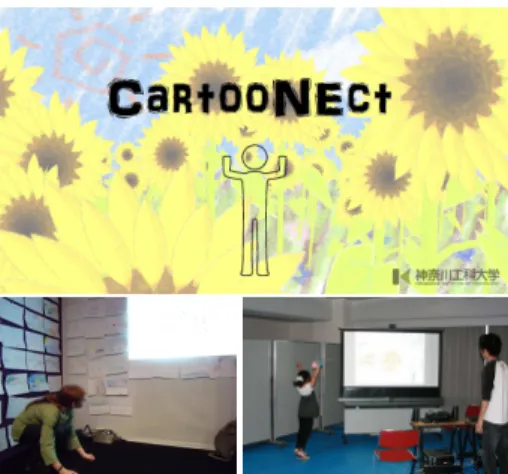
CartooNect is a serious game system that used KINECT by the mo- tion of whole body interactions. In our plan of experiment, children or adult draw a picture by hand drawing on paper that background and properties. When a player stand in front of the system, the player’s whole body is displayed to player in a real time with the drawn picture as a background and they can move free to play as an actor in virtual world. The player can walk around in radioactive pollution field freely. When the player emulates a motion of avatar that stands up and crouches down, sunflowers are bloom on the pol- luted field. This project told a message to show and share Japanese disaster in a casual way. Especially, it could tell a function of agri- culture in radioactive pollution using full body interaction serious game.
Figure 1: players action of CartooNect
2 Motivation: intuitive animation control
method and tool for KINECT generation
Real-time animation in-game avatars driven by full-body gesture in- teraction systems using real-time motion capture data are extremely
∗e-mail: [email protected]
appealing. Further, it is becoming more popular since researchers and developers can easily access consumer-priced depth sensors in Microsoft KINECT and OpenNI frameworks.
However, a system that can realize suitable real-time animations for each player actions is required. This article describes a new method and a tool for exaggerated but sophisticated interactive an- imation control systems for real-time animation playback timings. Our method can improve best player experiences without program- ming by offline/online GUI’s for current video games and interac- tive systems.
Figure 2: A scene of motion design in a game project
3 GAMIC: Game Action Motion Interaction
Controller
Game Action Motion Interaction Controller (GAMIC) is a tool that can link the timings between KINECT recognition and avatar ani- mation playback by GUI, WiiRemote, and actual motions. GAMIC requires linking between physical players action and real-time avatar animation playback timings for the development of game systems that assume full-body gesture interactions using KINECT. GAMIC defines a recognition timing of KINECT for animation playback timing by GUI. MID stores two target gestures-for the start and end (T1, T2)-using WiiRemote in front of KINECT on the GAMIC GUI.
This recognition can be expressed as an evaluation function of the current posture and its threshold is a target frame. The evaluation function expresses a similarity between the current player’s kine- matics and target postures from KINECT inputs, and it can be ob- tained as a summation of the inner products of target and current bones.
If a current posture V fits a target posture T, the evaluation function f(T, V ) outputs 1. Its threshold P1 can control the recognition difficulty by f(S, V ) as a starting target frame S.
The trigger frame (TF) is an intermediate posture, and it exists be- tween SF(T1) and EF(T2) as a result of the continuity of human motions. TF is an indescribable and dynamic posture but it can be expressed by an evaluation function f(E, V ) with its threshold P2.
Figure 3: Screenshot of GAMIC
TF must be set correctly it can generate togetherness if the posterior half-animation is synchronous with the recognition.
GAMIC can control the recognition sensitivity, timing, and anima- tion impressions simultaneously by adjusting P2.
Figure 4: Evaluation function
4 Conclusion
By using GAMIC, we realized a higher quality of animation-timing implementations with resource effective tools by non-programming methods. This process requires some personnel (MIA, Program- mers, Actors) to create the core of the interaction sense from past projects.
It will be also integrated with physics and/or machine-learning- based posture estimations and animation blending to create effec- tive interaction experiments in the near future. Template matching
and physics- and learning- based approaches can improve player gesture recognitions and dynamic animation however, these tech- niques also require human decisions and large trial-and-error peri- ods for improvement.
In contrast, GAMIC has the advantage that intuitive player ac- tions can be explored for real-time animations by MID instead of machine-learning methods. Hence, assignment and linkage be- tween player actions and predefined animations can be improved, especially for special actions that are otherwise impossible by phys- ical motions.
Figure 5: Depth images from KINECT and target motions by mo- tion interaction designer (MID)
5 References
BLEIWEISS, A., ESHAR, D., KUTLIROFF, G., LERNER, A., OSHRAT, Y., AND YANAI, Y. 2010. Enhanced interactive gam- ing by blending full-body tracking and gesture animation. In ACM SIGGRAPH ASIA 2010 Sketches, ACM, New York, NY, USA, SA
’ 10, 34:1.34:2.
ISHIGAKI, S., WHITE, T., ZORDAN, V. B., AND LIU, C. K. 2009. Performance-based control interface for character animation. ACM Trans. Graph. 28 (July), 61:1.61:8.
Microsoft kinect. http://www.xbox.com/en-US/kinect.
NATURAL MOTION. Euphoria.
http://www.naturalmotion.com/euphoria.
OPENNI. OpenNI (Natural Interaction). http://openni.org/. REIL, T., AND MASSEY, C. A bipedal case study - facilitating controller evolution in morpho-functional-machines. Morphofunc- tional machines: the new species : designing embodied intelli- gence.
SHIRATORI, T., AND HODGINS, J. K. 2008. Accelerometer- based user interfaces for the control of a physically simulated char- acter. ACM Trans. Graph. 27 (December), 123:1.123:9.