Fictivity and Frames in Mimetic State Expressions
*Kimi Akita
1. Introduction
This paper proposes a frame-semantic account of “fictive” state expressions using mimetic (or ideophonic) words in Japanese. In Japanese, many reduplicative mimetics, whose assumed primary function is the depiction of sound and manner (see (1a) and (2a)), can be used as part of state ex- pressions, as in (1b) and (2b) (Tamori 1984; Akita 2009; Suzuki 2012; among others).1 Note that, in Japanese mimetics, the voicing of obstruents is sound-symbolically linked with a set of semantic dimensions, such as heaviness, largeness, and coarseness (Hamano 1998: 172).
(1) a. Ai-ga eda-o {bokiboki/ pokipoki} -to ot-ta. (−state) A-NOM branch-ACC MIM MIM -QUOT break-PST
‘Ai broke the branch with a cracking sound.’
b. Kono eda-wa {bokiboki/ ??pokipoki} -da. (+state) this branch-TOP MIM MIM -COP
‘This branch is completely broken.’
(2) a. Ai-ga poteti-o {zakuzaku/ sakusaku} -to tabe-ta. (−state) A-NOM potato.chip-ACC MIM MIM -QUOT eat-PST
‘Ai ate potato chips with a crunching noise.’
b. Kono poteti-wa {??zakuzaku/ sakusaku} -da. (+state)
this potato.chip-TOP MIM MIM -COP
‘These potato chips are crunchy.’
As these examples illustrate, some state expressions are only available to mimetics with a voiced obstruent (e.g., bokiboki-da ‘be completely broken’ in (1b)), whereas others are limited to mimetics with a voiceless obstruent (e.g., sakusaku-da ‘be crunchy’ in (2b)). In this paper, I argue that the
* This study was partly supported by Grant-in-Aid for Young Scientists (B) (no. 24720179) and Grant-in-Aid for Scientific Research (C) (no. 25370425). I thank Seizi Iwata and Takeshi Usuki for their helpful comments on an earlier version of this paper. The usual disclaimer applies.
1 Mimetics with total reduplication in Tokyo Japanese exhibit correspondences between syntactic cate- gories and accentuation patterns. While adverbial mimetics that are optionally marked by the quotative particle (e.g., (1a), (2a)) and verbal mimetics (e.g., sakusaku-su- [MIM-do] ‘feel crunchy’) have an initial accent (realized as a pitch fall), nominal(-adjectival) mimetics that are followed by a copula (e.g., (1b), (2b)) or a genitive marker (e.g., bokiboki-no eda [MIM-GEN branch] ‘completely broken branch’) are un- accented (Kageyama 2007).
Akita, Kimi. 2014. Fictivity and frames in mimetic state expressions. Gengo‐bunka kyoo‐
doo‐purozyekuto 2013: Sizen‐gengo‐e‐no riron‐teki‐apurooti [Joint project on language & culture 2013: Theoretical approaches to natural language], 1‐10. Osaka: Osaka University.
pattern in (1) and (2) is partly predictable from the event types of the mimetics involved, whose analysis requires the notions of fictivity (Talmy 1996) and frames (Fillmore 1982).
This paper is organized as follows. Section 2 introduces two types of fictive state expressions in Japanese mimetics. Section 3 presents distributional data of the two types of fictive state expres- sions and the voicing of initial obstruents of mimetics. Section 4 discusses the possible reason for the skewed distribution, focusing on the frame-semantic content of mimetics in each type of fictive ex- pression. Section 5 concludes.
2. Fictive State Expressions in Japanese Mimetics
Two types of “fictive” state expressions abound in Japanese mimetics (Mikami 2006; Yu 2012; Akita 2013; Toratani 2013a; Usuki and Akita 2013). Fictive state expressions represent state metonymically by referring to a non-actual event that is associated with the state (see Kunihiro 1985; Matsumoto 1996; Talmy 1996; Nakamoto et al. 2004). The first type of fictive metonymy is called
“vestigial metonymy” (VM). In VM, the state of an object is represented by referring to a hypotheti- cal sound or manner that is conceived as having led to the state. For example, the demolished state of the machine represented by the mimetic barabara ‘in pieces’ in (3b) is conceptualized as a result of the scattering or pattering motion of its parts. This dynamic event is what this mimetic expresses in its “basic” use illustrated in (3a).
(3) a. Gake-no ue-kara koisi-ga barabara oti-te-ki-ta. (basic) cliff-GEN top-from pebble-NOM MIM fall-CONJ-come-PST
‘Pebbles came pattered down from the top of the cliff.’
b. Kono kikai-wa ittan barabara-ni kaitai-si-te yusoo-si,
this machine-TOP once MIM-COP demolition-do-CONJ transportation-do kumitate-naos-u. (VM)
assembly-do.again-NPST
‘[We] transport this machine by temporarily demolishing [it] completely, and then
reassemble [it].’ (Mikami 2006: 206-207)
The second type of fictive metonymy is termed “conditional metonymy” (CM). In CM, the state of an object is represented by depicting the sound or manner that may take place if we act on it. For example, the solid state of the frozen laundry represented by katikati ‘frozen solid’ in (4b) is expressed as something that may emit the clinking sound, which is illustrated in (4a), if one hits it.
(4) a. … koori-ga katikati-to nar-u oto-ga suzusi-i. (basic) ice-NOM MIM-QUOT sound-NPST sound-NOM cool-NPST
‘… [I] find the clinking sound of ice cubes cool.’ b. … sentakumono-ga katikati-ni koot-te-simat-ta. (CM)
laundry-NOM MIM-COP freeze-CONJ-end.up-PST
‘… the laundry has frozen solid.’ (Mikami 2006: 211-212)
The two types of fictive metonymy are thus clearly defined and distinguishable from each other in terms of the causal relation between the fictive sound/manner and the state represented.2 On the one hand, the referent sound in VM (e.g., the pattering sound of machine parts) is caused by and accompanies the event (e.g., the demolition of the machine) that also causes the state (e.g., complete separation). The referent manner in VM (e.g., the scattering of machine parts) also accompanies the causing event (e.g., the demolition of the machine). On the other hand, in CM, the state (e.g., the solid state of the frozen laundry) exists first, and it serves as the cause of the sound or manner (e.g., a clinking sound). In the next section, the same lines of analysis are extended to all conventional redu- plicative mimetics to see the whole picture of the distributions of VM and CM.
3. Data: Fictivity and Voicing
As we saw in Section 1, some mimetic state expressions prefer initial voicing, but others do not. Here, I show that the distributions of voiced and voiceless initials in these expressions are in part correlated with the types of metonymy involved in them. Let us start with our first examples. Based on the definitions in Section 2, the state expressions in (5a) and (5b) are analyzed as instances of VM and CM, respectively. Specifically, the hypothetical cracking sound and folding manner mimicked by bokiboki in (5a) are caused by or accompany the branch breaking event, which also causes the completely broken state of the branch. In contrast, the crunching sound imitated by sa- kusaku in (5b) is caused by masticating the potato chips that are already in the crunchy state.
(5) a. Kono eda-wa {bokiboki/ ??pokipoki} -da. (= 1b) (VM) this branch-TOP MIM MIM -COP
‘This branch is completely broken.’
2 Some mimetics illustrate “factive” types of metonymy. For example, gorogoro in (ib) represents Ai’s laziness that is typically accompanied by her rolling/lying activity, which is the basic meaning of the mi- metic illustrated in (ia).
(i) a. Ai-ga beddo-de gorogoro korogat-te i-ta. (basic) A-NOM bed-in MIM roll-CONJ be-PST
‘Ai was rolling repeatedly on the bed.’
b. Ai-ga beddo-de gorogoro kuturoi-de i-ta. (factive metonymy) A-NOM bed-in MIM relax-CONJ be-PST
‘Ai was relaxing idly on the bed.’
Obviously, the manner and the activity involved in factive cases are coextensional. This temporal/causal characteristic allows us to distinguish factive metonymy from both types of fictive metonymy and, ac- cordingly, to posit a separate frame-semantic account for it (cf. Section 4).
b. Kono poteti-wa {??zakuzaku/ sakusaku} -da. (= 2b) (CM)
this potato.chip-TOP MIM MIM -COP
‘These potato chips are crunchy.’
Interestingly, both the voiced-VM and voiceless-CM correspondences are found more widely. A few additional examples are given for each.
(6) VM:
a. Ai-no nooto-wa {biribiri/ *piripiri} -dat-ta. A-GEN notebook-TOP MIM MIM -COP-PST
‘Ai’s notebook was ripped up.’ (< ‘ripping’)
b. Ai-ga Ken-o {bokoboko/ *pokopoko} -ni nagut-ta. A-NOM K-ACC MIM MIM -COP beat-PST
‘Ai beat Ken completely.’ (< ‘beating’)
c. Ai-ga senbee-o {baribari/ *paripari} -ni wat-ta. A-NOM rice.cracker-ACC MIM MIM -COP break-PST
‘Ai broke the rice cracker into pieces.’ (< ‘crunching’)
(7) CM:
a. Kono beekon-wa {??garigari/ karikari} -da. this bacon-TOP MIM MIM -COP
‘This bacon is crunchy.’ (< ‘crunching’)
b. Ai-ga huusen-o {*banban/ panpan} -ni hukuram-ase-ta. Ai-NOM balloon-ACC MIM MIM -COP swell-CAUS-PST
‘Ai swelled the balloon to bursting.’ (< ‘popping’)
c. Ai-ga senbee-o {??baribari/ paripari} -ni yai-ta. A-NOM rice.cracker-ACC MIM MIM -COP roast-PST
‘Ai made crispy rice crackers.’ (< ‘crisping’)
Below are exhaustive lists of obstruent-initial reduplicative mimetics to which fictive metonymy is clearly available (42 [10.17%] of 413 relevant entries in Kakehi et al. 1996). Their basic dynamic meanings are given in parentheses.
(8) a. C1 = voiced:
VM: barabara ‘in pieces’ (< ‘pattering, scattering’), baribari ‘torn up’ (< ‘crunch- ing’), bekobeko ‘dented’ (< ‘a thin metal surface caving in’), biribiri ‘ripped
up’ (< ‘ripping’), bokiboki ‘completely broken’ (< ‘cracking’), bokoboko
‘beaten up’ (< ‘beating’), boroboro ‘tattered’ (< ‘crumbling’), bosabosa ‘di- sheveled’ (< ‘getting disheveled’), bukubuku ‘flabby’ (< ‘bubbling up’), bu- tubutu ‘having many spots’ (< ‘many spots coming out’), gunyagunya ‘squishy’ (< ‘twisting’), guruguru ‘coiled up’ (< ‘coiling, moving around’), gusyagusya
‘crushed’ (< ‘crushing’), gusyogusyo ‘sopping wet’ (< ‘getting sopping wet’), gutyagutya ‘messy’ (< ‘squashing’)
CM: zyarizyari ‘gritty’ (< ‘crunching’), gasagasa ‘dry and rough’ (< ‘rustling’), gatagata ‘rickety’ (< ‘rattling’), gisigisi ‘unsmooth (of hair)’ (< ‘squeaking’), guragura ‘wobbly’ (< ‘wobbling’), zarazara ‘rough and gritty’ (< ‘rattling’) b. C1 = voiceless:
VM: kusyakusya ‘rumpled’ (< ‘crumpling’), kutakuta ‘exhausted’ (< ‘collapsing from fatigue’), pukupuku ‘chubby’ (< ‘swelling’), pinpin ‘tightly stretched’ (<
‘stretching tightly’)
CM: karikari ‘crunchy’ (< ‘crunching’), kasakasa ‘dry’ (< ‘rustling’), katikati ‘hard’ (< ‘clinking’), korikori ‘crunchy’ (< ‘crunching’), korokoro ‘chubby’ (< ‘roll- ing’), kotikoti ‘dry and hard’ (< ‘clinking’), parapara ‘dry (of rice)’ (< ‘pat- tering’), paripari ‘crispy’ (< ‘crisping’), pasapasa ‘dried out’ (< ‘crumbling’), perapera ‘thin (of paper)’ (< ‘flipping’), sakusaku ‘crunchy’ (< ‘crunching’), sarasara ‘dry and smooth’ (< ‘rustling’), sikosiko ‘firm and chewy’ (<
‘crunching’), syakisyaki ‘crisp’ (< ‘crisping’), taputapu ‘flabby’ (< ‘sloshing’), turuturu ‘slippery’ (< ‘slipping’), panpan ‘swollen to bursting’ (< ‘popping’)
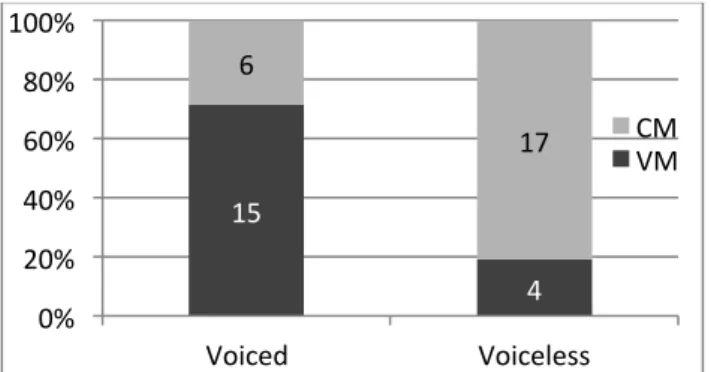
Figure 1 plots the distributional results. As is obvious, mimetics with voiced initials prefer VM, whereas those with voiceless initials prefer CM (Fisher’s exact test: p < .01). (For mimetics with sonorant and vowel initials, I found only one item that can readily be used in a fictive-metonymical expression: uneune ‘sinuous’ (< ‘meandering’) [VM].)
Figure 1. Initial voicing and fictivity in mimetic state expressions 15
4 6
17
0% 20% 40% 60% 80% 100%
Voiced Voiceless
CM VM
The obtained asymmetry seems too sharp to ignore. In the next section, I propose a sound-symbolic account in favor of Frame Semantics that is potentially extensible beyond the dis- cussion of mimetic fictivity.
4. A Frame-Semantic Account
The associations between voiced initials and VM and between voiceless initials and CM be- come straightforward when we take a closer look at the mechanisms underlying the two types of fictive metonymy. The main idea is that VM and CM involve two different types of background events (or “frames”). More precisely, the sound or manner a VM expression refers to (e.g., the cracking sound) is caused by or belongs to a change-of-state or change-of-location event (e.g., the breaking of a branch) that leads to the referent state (e.g., the completely broken state of a branch). The sound or manner a CM expression refers to (e.g., the clinking sound) is caused by an impact event (e.g., tapping) that involves an object (e.g., frozen laundry) in the referent state (e.g., the solid state). Change events and impact events both typically involve a volitional action upon an object, but they consist of different sets of semantic components and relations (Yu 2012; Akita 2013; Usuki and Akita 2013). I illustrate the details of VM and CM by drawing on the semantic descriptions of rele- vant event frames in Berkeley FrameNet.
First, change of state and change of location at least partly correspond to the Cause_to_fragment and Cause_motion frames in FrameNet, respectively. The two frames consist of a number of semantic components called “frame elements” (FEs) (see Fillmore and Baker 2010), whose relationships are here roughly indicated by boxing the relevant FEs by subevents (or
“subframes”). Causal relationships between subframes are indicated by solid arrows and metonymi- cal links by broken arrows. Note that the diagrams only depict relevant parts of the frames.
(9) a. Cause_to_fragment (e.g., the frame evoked by bokiboki ‘cracking’): The Transitive_action frame:
[FE1a] AGENT (e.g., a person)
[FE1b] WHOLE_PATIENT (e.g., a hard stick) [FE1c] INSTRUMENT (e.g., hands)
[FE1d] MANNER (e.g., folding intensely) [FE1e] PURPOSE (e.g., disposal)
[FE1n] …
The Sound-emission frame: [FE2a] SOUND (e.g., crack-crack) [FE2n] …
The Result frame:
[FE3a] PIECES (e.g., fragments) [FE3b] RESULT (e.g., broken) [FE3c] DEGREE (e.g., complete) [FE3n] …
VM VM
b. Cause_motion (e.g., the frame evoked by barabara ‘pattering, scattering’):
The two diagrams clearly show that in VM the resultant state is expressed by referring to the (sali- ent) sound and/or manner belonging to subframes that do not causally follow the result subframe, as the term “vestigial” alludes.
Next, the impact event is registered as “the Impact frame” in FrameNet. The following dia- gram shows how the sound (or manner) depicted in CM is located in the frame. Unlike the above two cases of VM, the state in CM is expressed by referring to the sound (or manner) that causally follows it. (Consider guragura ‘wobbly’ (< ‘wobbling’) for a case in which impact causes manner.) This regressive arrow is again what the term “conditional” alludes to.
(10) Impact (e.g., the frame evoked by katikati ‘clinking’):
Now that we have seen that the two types of fictive metonymy involve two different types of The Transitive_action frame:
[FE1a] AGENT (e.g., a person) [FE1b] AREA (e.g., the air) [FE1c] THEME (e.g., grains) [FE1d] MEANS (e.g., tossing) [FE1e] INITIAL_STATE (e.g., a lump) [FE1n] …
The Sound-emission frame: [FE3a] SOUND (e.g., patter) [FE3n] …
The Motion frame:
[FE2a] THEME (e.g., gains) [FE2b] MANNER (e.g., scattering) [FE2c] GOAL (e.g., the ground) [FE2n] …
The Transitive_action frame: [FE1a] IMPACTEE (e.g., a hard object) [FE1b] IMPACTOR (e.g., a person) [FE1c] MANNER (e.g., tapping)
[FE1d] PERIOD_OF_ITERATION (e.g., short) [FE1e] INSTRUMENT (e.g., a hard object) [FE1f] STATE_OF_IMPACTEE (e.g., hard) [FE1n] …
The Sound-emission frame: [FE2a] SOUND (e.g., clink-clink) [FE2n] …
The Result frame:
[FE4a] THEME (e.g., gains) [FE4b] RESULT (e.g., scattered) [FE4n] …
VM
VM
CM
event frames, we are ready to discuss their asymmetrical distribution in terms of initial voicing ob- tained in the previous section. The asymmetry can be ascribed to the sound-symbolic value of the voicing of obstruents in Japanese mimetics. As cited above from Hamano (1998), voiced initials are associated with heavy, large, and coarse referents, whereas voiceless initials are associated with light, small, and fine referents. In the context of dynamic events, these sound-symbolic values can reason- ably be translated as different degrees of intensity or affectedness: voiced initials are linked with in- tense actions that significantly affect the object involved, whereas voiceless initials are linked with light actions that do not seriously affect the object. In general, VM involves a greater degree of in- tensity and affectedness than CM, as it involves change of state or location. The impact involved in CM is not as intense, as its purpose is simply to see the state of the object. In short, it is the high in- tensity and affectedness associated with voiced initials that prefer the change event in VM, and it is the low intensity and affectedness associated with voiceless initials that prefer the impact event in CM (see Oseki 2013 for a similar discussion on the correlation between the voicing contrast and transitivity). It should be noted that the asymmetry in question is a mere tendency, which is a reflec- tion of the non-absolute nature of sound symbolism in general (Diffloth 1994).
5. Conclusion
In this paper, I have argued that the two types of fictive state expressions in Japanese mimetics have distinct frame-semantic contents and that they give rise to a divergence in preference for mi- metics with initial voiced and voiceless obstruents. This study has at least two general implications. First, the present frame-semantic account demonstrates the significant contribution of the fi- ne-grained semantics of mimetics to the availability of fictive state expressions. This conclusion is consistent with the recent move toward the detailed description of mimetic semantics (Akita 2012; Toratani 2013b; Usuki and Akita 2013) and sound-emission constructions (Iwata 2006; Tamura 2006). Second, the present study suggested the “grammatical” relevance of sound symbolism. This direction of research has clearly been neglected (cf. Fujimori 2005; Oseki 2013). Additional atten- tion may reveal previously unnoticed roles of sound symbolism, a traditionally “exceptional” phe- nomenon.
References
Akita, Kimi. 2009. A Grammar of Sound-Symbolic Words in Japanese: Theoretical Approaches to Iconic and Lexical Properties of Mimetics. Ph.D. dissertation, Kobe University.
---. 2012. Toward a frame-semantic definition of sound-symbolic words: A collocational analysis of Japanese mimetics. Cognitive Linguistics 23, 1: 67-90.
---. 2013. Constraints on the semantic extension of onomatopoeia. The Public Journal of Semiotics 5, 1: 21-37.
Berkeley FrameNet. International Computer Science Institute. https://framenet.icsi.berkeley.edu/ fndrupal/
Diffloth, Gérard. 1994. i: big, a: small. In Leanne Hinton, Johanna Nichols, and John J. Ohala, eds., Sound Symbolism, 107-114. Cambridge: Cambridge University Press.
Fillmore, Charles J. 1982. Frame semantics. In the Linguistic Society of Korea, ed., Linguistics in the Morning Calm, 111-137. Seoul: Hanshin.
---, and Collin Baker. 2010. A frames approach to semantic analysis. In Bernd Heine and Heiko Narrog, eds., The Oxford Handbook of Linguistic Analysis, 313-340. Oxford: Oxford Univer- sity Press.
Fujimori, Atsushi. 2005. Japanese morphemic vowels and telicity: Mono-syllabic verb cases. Pro- ceedings of the 2005 Annual Conference of the Canadian Linguistic Association. http://westernlinguistics.ca/Publications/CLA-ACL/Fujimori.pdf
Hamano, Shoko. 1998. The Sound-Symbolic System of Japanese. Stanford, CA: CSLI Publications. Iwata, Seizi. 2006. Where there’s a sound, there’s motion: Two types of path PPs that appear after
verbs of sound emission. Paper presented at the Fourth International Conference on Construc- tion Grammar, University of Tokyo, 3 September 2006.
Kakehi, Hisao, Ikuhiro Tamori, and Lawrence Schourup. 1996. Dictionary of Iconic Expressions in Japanese. Berlin/New York: Mouton de Gruyter.
Kunihiro, Tetsuya. 1985. Ninti-to gengo-hyoogen [Cognition and linguistic expressions]. Journal of the Linguistic Society of Japan 88: 1-19.
Matsumoto, Yo. 1996. Subjective-change expressions in Japanese and their cognitive and linguistic bases. In Gilles Fauconnier and Eve E. Sweetser, eds., Spaces, Worlds, and Grammar, 124-156. Chicago: The University of Chicago Press.
Mikami, Kyoko. 2006. Nihongo-no giongo/gitaigo-ni okeru imi-no kakutyoo: Konseki-teki-ninti/ yoki-teki-ninti-no kanten-kara [Semantic extension in Japanese mimetics: From the perspec- tive of vestigial and prospective cognition]. Studies on Japanese Language and Literature 57: 199-217.
Nakamoto, Koichiro, Katsunori Kotani, and Hitoshi Isahara. 2004. Yoki-teki-ninti-to keiyoo-hyoogen: Huan-ni motozuku zyookyoo-haaku [Prospective Cognition and interpreta- tion of adjectives]. Proceedings of the 4th Annual Meeting of the Japanese Cognitive Linguis- tics Association, 34-44.
Oseki, Mai. 2013. Nihongo-onomatope-ni okeru onsyootyoo-to bunpoo-gensyoo [Sound symbolism and grammatical phenomena in Japanese mimetics]. M.A. thesis, Hokkaido University. Suzuki, Ayaka. 2012. Nihongo-onomatope-zyutugo-no keisiki-ni tuite: Suru/siteiru/da-no sen-
taku-kizyun-o tyuusin-ni [Mimetic predicates in Japanese: Focusing on the criteria for select-
ing the predicative forms, -suru, -shiteiru, and -da]. Journal of Japanese Grammar 12, 2: 162-178.
Talmy, Leonard. 1996. Fictive motion in language and ‘ception.’ In Paul Bloom, Mary A. Peterson, Lynn Nadel, and Merrill F. Garrett, eds., Language and Space, 211-276. Cambridge, MA: The MIT Press.
Tamori, Ikuhiro. 1984. Japanese onomatopoeias: Manner adverbials vs. resultative adverbials. Jimbun Ronshu: Journal of Cultural Science 20, 2: 163-178. Kobe University of Commerce. Tamura, Yuki-Shige. 2006. Characteristics of English sound-emission path construction: A proto-
type cross-linguistic account. In Masa-aki Yamanashi, ed., Studies in Cognitive Linguistics, No. 5, 209-240. Tokyo: Hituzi Syobo.
Toratani, Kiyoko. 2013a. Hukusi-onomatope-no tokusyusei: Tagisei/zisyoosei-kara-no koosatu [Pe- culiarities of adverbial mimetics: From the perspective of polysemy and eventivity]. In Kazuko Shinohara and Ryoko Uno, eds., Onomatope-kenkyuu-no syatei: Tikazuku oto-to imi [Sound symbolism and mimetics: Rethinking the relationship between sound and meaning in language], 101-115. Tokyo: Hituzi Syobo.
---. 2013b. Logical structures of mimetic adverbs in Japanese: A preliminary analysis. Paper pre- sented at Role and Reference Grammar Conference 2013. Universität Freiburg, 3 August 2013.
Usuki, Takeshi, and Kimi Akita. 2013. Fiction in an encyclopedia: A Generative Lexicon approach to fictive mimetic resultatives in Japanese. In Fukuoka Linguistic Circle, ed., Gengogaku-kara-no tyooboo 2013: Hukuoka-gengo-gakkai 40-syuunen-kinen-ronbunsyuu [A view from linguistics 2013: Papers on the 40th anniversary of Fukuoka Linguistic Circle], 308-321. Kyushu: Kyushu University Press.
Yu, Wei-Lun. 2012. Hureemu-no kanten-kara miru nihongo-no giongo: Imi-to imi-kakutyoo-o tyuusin-ni [Japanese onomatopoeic words in terms of frames: Focusing on their meanings and semantic extension]. Proceedings of the 2012 International Conference on Japanese Lan- guage Education, 237-251. Taipei: Soochow University.